


Insurance bills have a nasty habit of creeping up quietly. You sign up for a policy, set up auto-pay, and completely forget about it. Then, a few years later, you glance at your bank statement and realize you are paying double.
You wonder what went wrong, but the truth is, the system is designed to penalize people who put their finances on autopilot. Between inflation, skyrocketing vehicle repair costs, and surging extreme weather events, coverage costs are breaking records. The 2026 market is undeniably brutal. According to current data, the national average cost of full-coverage car insurance recently hit $2,273 a year, or around $189 a month. Meanwhile, the national average for homeowners insurance sits at $2,543 annually.
But you don’t have to accept these steep price hikes lying down. If you want to know how to lower insurance premiums, you need a proactive game plan. Getting a fair rate isn’t about buying cheap, useless coverage and leaving yourself totally exposed to financial ruin. It is about optimizing what you already have, knowing the rules, and making the big carriers actually fight for your cash.
1. How to Lower Insurance Premiums by Shopping Around
Let’s get one thing straight right out of the gate: loyalty does not pay in the insurance game. Companies actually punish you for sticking around. They know you hate dealing with paperwork, so they intentionally inch your prices up at renewal time, assuming you won’t bother to leave. To beat this “loyalty penalty,” you must get at least three quotes every single time your policy renews. Prices swing wildly depending on where you live and the risk models of different carriers.
For example, drivers in Vermont pay an incredibly low average of $1,451 a year for full coverage car insurance. On the flip side, folks in Maryland get slammed with $4,193 annually for the exact same level of protection. The easiest way to spot a rip-off is to have an independent broker pull quotes from a dozen companies at once. Brokers do all the heavy lifting for free, giving you a clear picture of the market. Even if you love your current provider, having a cheaper quote in hand gives you the ultimate leverage to negotiate a price match before you sign your renewal documents.
|
Shopping Strategy |
Action Step |
Why It Works |
|
Annual Review |
Check market rates 30 days before renewal. |
Catches sneaky price creep before you are locked in. |
|
Use a Broker |
Let an independent agent do the legwork. |
Uncovers cheaper, regional insurers you have never heard of. |
|
Match Limits |
Compare identical coverage levels side-by-side. |
Proves you are not sacrificing safety for a cheap monthly rate. |
2. Hike Your Deductibles Deliberately
Your deductible is the cash you agree to pay out of pocket before your insurance actually kicks in to cover the rest. Insurers absolutely love high deductibles because it forces you to shoulder the upfront financial risk. It actively stops you from filing tiny, annoying claims that cost them money to process. In return, they happily slash your monthly bill. When you want to figure out how to lower insurance premiums quickly, adjusting this one number is often the fastest route.
Bumping your car insurance deductible from $250 up to $1,000 drops your collision and comprehensive costs fast. Over just three claim-free years, you will easily save enough in premiums to cover that higher deductible anyway. The exact same logic applies to your home. Moving a homeowners deductible from $1,000 to $2,500 can shave hundreds off your annual rate. The only catch? You actually need that cash sitting in a dedicated savings account. Do not raise your deductible if you cannot comfortably afford to write a check for that amount on a random Tuesday when disaster strikes.
|
Deductible Shift |
The Upside |
The Downside |
|
$250 to $500 |
Decent premium drop (10 to 15 percent). |
Very manageable out-of-pocket cost for most people. |
|
$500 to $1,000 |
Strong premium drop (20 to 30 percent). |
You absolutely need a solid emergency fund in place. |
|
$1,000 and up |
Maximum monthly premium savings. |
Hurts your wallet hard if you actually crash or have a fire. |
3. Bundle Your Policies Together
Insurance carriers are inherently greedy businesses. They want all of your business, and they do not want their competitors getting a dime. To secure your loyalty, they dangle massive multi-policy discounts, usually referred to as bundling. Buy your homeowners (or renters) coverage and your auto coverage from the exact same company, and they will almost always give you a steep break on the total combined price. This is one of the most reliable strategies in the industry.
Considering the average homeowner pays a staggering $2,543 a year right now, and folks in states like Florida pay a crushing $7,136 annually, grabbing a bundling discount is critical. Shaving 15 to 25 percent off that bill changes your monthly budget dramatically. Bundling also makes your life incredibly easy. You get one app, one bill, one renewal date, and one single agent to call if a bad storm crushes your garage and your car at the exact same time. However, never blindly trust the bundle. Always compare the bundled quote against the cost of buying separate policies from two deeply discounted standalone providers to ensure the math actually works in your favor.
|
Bundling Mix |
Average Savings |
Who Needs It |
|
Auto and Home |
15 to 25 percent |
Homeowners with one or more cars in the driveway. |
|
Auto and Renters |
5 to 10 percent |
Apartment renters wanting cheap liability and property protection. |
|
Multiple Cars |
10 to 20 percent |
Families parking two or more vehicles at the exact same address. |
4. Cut the Dead Weight From Your Policy
Most people carry way too much dead weight on their insurance profiles. Your life changes constantly, but your policy stays exactly the same unless you aggressively update it. Did your teenager move out for college? Did you install a heavy-duty smart security system? Are you still paying for comprehensive coverage on a 15-year-old rusty car that barely runs? You have to audit your coverage annually.
Look closely at your older vehicles. A standard industry rule states that if your vehicle is worth less than 10 times the annual premium for collision coverage, you need to drop that coverage immediately. You are quite literally throwing money away. Furthermore, you need to ruthlessly hunt down overlapping coverages. Stop paying your auto insurer $50 a year for roadside assistance if you already have a AAA membership or a premium travel credit card that offers the exact same service for free. Finding how to lower insurance premiums is often just a matter of cutting duplicate services.
|
Coverage to Cut |
When to Axe It |
The Smarter Alternative |
|
Collision on Old Cars |
The car’s total market value dips under $3,000. |
Put that premium cash directly into a “new car” savings fund. |
|
Rental Reimbursement |
You own a reliable spare vehicle at home. |
Just drive your second car if the main one breaks down. |
|
Roadside Assistance |
Your premium credit card already offers it. |
Use your credit card perks instead of paying the insurer twice. |
5. Let Them Track Your Driving Habits
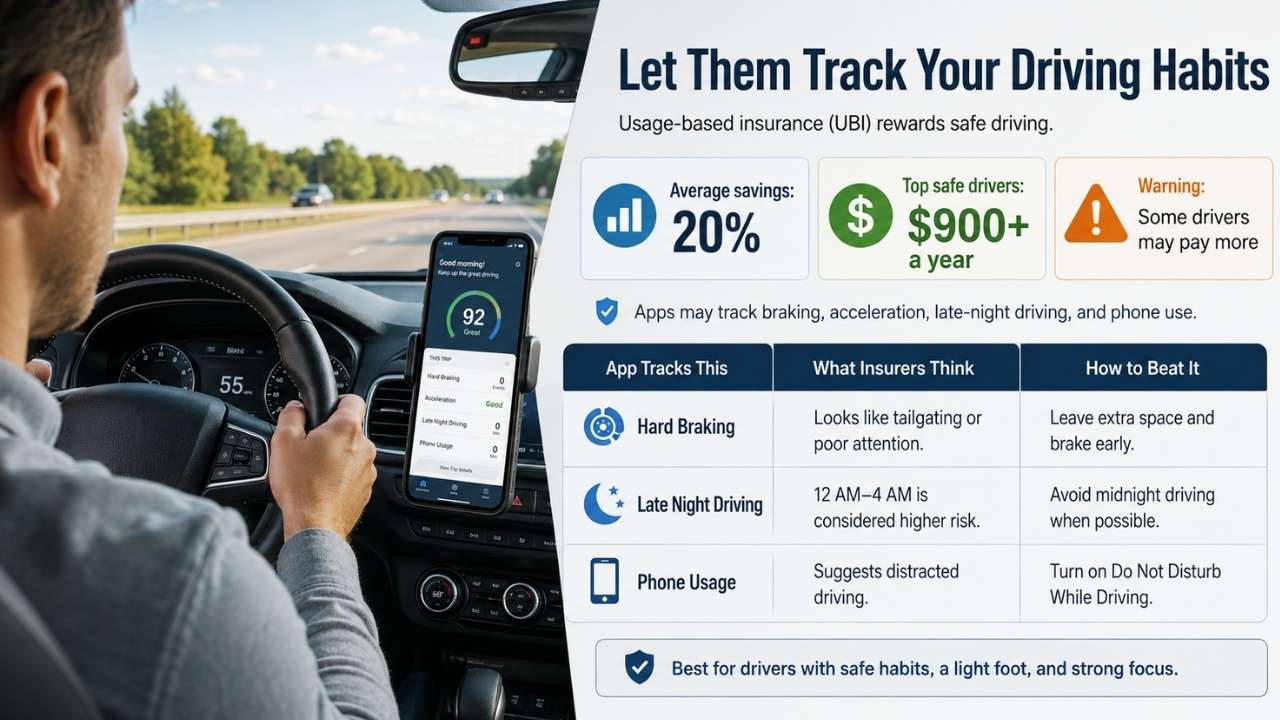
If you actually drive the speed limit and obey traffic laws, you should absolutely make your insurer track you. Most major auto carriers now actively push usage-based insurance (UBI) or telematics programs. You simply download their tracking app to your smartphone or plug a tiny device into your car, and it silently monitors your daily driving habits for a few months. Data from 2026 shows that drivers who successfully complete these programs save an average of 20 percent on their rates, with some top-tier safe drivers saving over $900 a year.
These apps track hard braking, rapid acceleration, phone usage, and whether you drive late at night. If you mathematically prove you are a safe, low-risk driver, you score massive discounts. But a quick warning: telematics is a double-edged sword. Over 40 percent of people who try these programs eventually see their rates increase because they drive far worse than they thought they did. They speed, they tailgate, and they look at their phones at red lights. Only opt-in if you have a genuinely light foot and stellar focus behind the wheel.
|
App Tracks This |
What Insurers Think |
How to Beat It |
|
Hard Braking |
You constantly tailgate or do not pay attention. |
Leave extra space between cars and brake incredibly early. |
|
Late Night Driving |
Midnight to 4 AM means drunk drivers and tired eyes. |
Stay completely off the roads after midnight whenever possible. |
|
Phone Usage |
You illegally text and drive, causing massive accidents. |
Turn on the “Do Not Disturb While Driving” setting on your phone. |
6. Fix Your Credit Score Fast
This strategy constantly surprises people, but it is deeply impactful. In almost every single state across the country, insurance companies legally use your credit score to price your monthly premiums. The actuarial math is very simple to them: people with great credit scores file significantly fewer insurance claims. Therefore, if your credit tanks due to missed payments or high debt, your home and auto insurance bills will spike aggressively.
You must treat your credit score like a defensive financial shield. Pay your bills on time every month, aggressively kill your credit card debt, and keep your utilization low. If you recently paid off a massive student loan or a chunk of medical debt and your score jumped 50 points, pick up the phone right now. Call your insurance agent and explicitly ask them to re-run your credit profile. This simple move can help you lock in a significantly lower pricing tier right in the middle of your policy term.
|
Credit Action |
Score Impact |
Premium Impact |
|
Paying down debt |
Lowers utilization and boosts your score fast. |
Unlocks significantly cheaper rate tiers across the board. |
|
Missing a payment |
Tanks your score and leaves a negative mark. |
Triggers high-risk penalty pricing that lasts for years. |
|
Disputing errors |
Restores an accurate and fair credit score. |
Erases unfair rate hikes caused by reporting mistakes. |
7. Hunt Down Hidden Industry Discounts
Insurance agents are business people, and they rarely volunteer discounts out of the goodness of their hearts. Volunteering discounts cuts directly into their agency’s profit margins. You have to hunt these savings down and ask for them by name. Many carriers offer dozens of highly specific discounts that sit quietly off the radar unless a customer explicitly requests them.
Did you recently transition to a fully remote work-from-home job? Call your auto insurer today and drastically update your annual mileage. Dropping your commute from 15,000 miles a year down to just 4,000 miles instantly reduces your crash risk, which forces them to lower your bill. Look aggressively for affinity groups, too. Your college alumni association, your specific trade union, or your professional fraternity might have a 10 percent discount deal heavily negotiated with a major national carrier. If you have a teenager on your policy, force them to keep a B average to maintain the lucrative “good student” discount.
|
Hidden Discount |
How to Get It |
Average Savings |
|
Low Mileage |
Drive fewer than 7,500 total miles a year. |
5 to 15 percent |
|
Affinity Groups |
Flash your alumni, union, or professional membership card. |
5 to 10 percent |
|
Good Student |
Maintain a 3.0 GPA on every single report card. |
10 to 15 percent (applied to the teen’s expensive rate) |
8. Lock in Health and Life Rates Early
Age and physical condition literally dictate everything when it comes to life and health coverage. The absolute best way to keep these specific premiums cheap is to buy your coverage when you are young, fit, and perfectly healthy. A robust term life policy purchased in your late 20s stays dirt-cheap for decades, locking in a low rate before age-related health issues start creeping in. Delaying this purchase costs you exponentially more every passing year.
Insurers mercilessly penalize bad lifestyle habits. Smokers routinely pay double the normal rate for life insurance. However, this is not a permanent life sentence. If you officially quit smoking for 12 solid months, tell your provider immediately—they will usually cut your premium in half. You should also play their modern tracking games. Wear their branded fitness trackers, hit the gym regularly, and take the wellness discounts they offer. Many health providers now slash rates by up to 20 percent if you prove you are actively exercising.
|
Healthy Habit |
The Immediate Payoff |
The Long Game |
|
Quitting Smoking |
Instantly slices life insurance premiums by up to 50 percent. |
Results in vastly better physical health and a much fatter wallet. |
|
Buying in your 20s |
Locks in the absolute mathematical floor price. |
Guarantees cheap, predictable coverage that lasts until retirement. |
|
Using Fitness Apps |
Unlocks interactive wellness discounts up to 20 percent. |
Literally getting paid cash by your insurer to stay in great shape. |
9. Fortify Your Property Against Disaster
Homeowners insurance inherently hinges on physical location and physical risk. If your house is incredibly easy to rob or highly prone to massive wind and hail damage, you pay a severe premium. Change your physical risk profile, and you force the insurer to change your bill. Recent market data shows how vital this is: states like Louisiana and Colorado have seen massive premium spikes in recent years due to relentless severe weather.
Fight back against these localized rate hikes by aggressively hardening your property. Installing basic deadbolts and smoke detectors is just the baseline. A centrally monitored burglar and fire alarm gets you real, noticeable discounts. Upgrading to an impact-resistant roof can save you up to 20 percent in hail-prone regions. Furthermore, installing a smart water shut-off valve stops catastrophic pipe bursts the second they happen, drastically lowering your risk of filing a massive, six-figure water damage claim. Keep all the receipts for these upgrades and email them directly to your agent.
|
Home Upgrade |
Why Insurers Care Deeply |
Discount Size |
|
Monitored Alarm |
Fast police and fire response limits the total damage. |
5 to 10 percent |
|
Smart Water Shut-Off |
Stops catastrophic interior pipe bursts instantly. |
3 to 5 percent |
|
Impact-Resistant Roof |
Survives massive hail storms without needing replacement. |
10 to 20 percent |
10. Pay for the Small Stuff Out of Pocket
Insurance explicitly exists for major life catastrophes, not minor daily inconveniences. Maintaining a perfectly clean claims history is your absolute golden ticket to securing low rates. If you file a tiny, annoying claim, it instantly sticks to your CLUE (Comprehensive Loss Underwriting Exchange) report for up to seven full years. It acts like a giant red flag to every carrier in the country, actively jacking up your rates for the foreseeable future.
If a neighborhood kid hits a baseball that shatters your living room window and it costs exactly $600 to fix, but your deductible is $500, absolutely do not call your insurance company. You will get a tiny $100 check in the mail, but they will likely hike your rate by $200 a year for the next three to five years. You lose the long-term math completely. Pay cash for the small stuff, keep your record clean, and keep your insurance powder dry for when a giant oak tree actually crushes your roof.
|
The Damage Scenario |
Your Deductible |
The Smart Financial Move |
|
$800 bumper scrape |
$500 |
Pay cash entirely. Do not take a massive rate hike for a $300 check. |
|
$1,500 stolen bicycle |
$1,000 |
Pay cash. It is way too close to the deductible to risk your home rate. |
|
$25,000 kitchen fire |
$1,000 |
File the claim immediately. This is exactly what you pay them for. |
Final Thoughts
Figuring out how to lower insurance premiums does not require a complex finance degree or insider industry knowledge. It just takes a little bit of hustle and a few hours of focused attention once a year. The latest 2026 market data proves that rates are only moving in one direction right now: aggressively upward. Do not let laziness quietly drain your hard-earned bank account month after month.
Shop the market constantly, strip out useless duplicate coverages, raise those deductibles intelligently, and fiercely guard your credit score. Block off a single hour this coming weekend, make a few strategic phone calls, and stop overpaying for coverage. Take control of your policies today, and keep your money in your own wallet.
Frequently Asked Questions (FAQs) About How to Lower Insurance Premiums
Can a tiny gap in coverage raise my rates?
Absolutely. If you cancel your auto insurance even one single day before your brand-new policy officially starts, algorithms flag you as a high-risk customer. Always overlap your old and new policies by a full day.
Does my job title actually change my car insurance?
Yes, it does. Actuaries have decades of data proving that teachers, registered nurses, and pilots statistically crash less than other professions. If you recently got a big promotion or switched to a safer career, tell your agent to unlock a hidden discount.
Will checking my own quotes wreck my credit score?
No, not at all. When an insurance company pulls your credit profile to generate a quote, it registers as a “soft pull.” It does not touch your actual score. You can pull 50 quotes today and your credit will not flinch.
Does a red car cost more to insure?
This is a total industry myth. Insurers do not care about the paint color on your vehicle. They care deeply about the engine size, historical crash test ratings, and local theft data. Buy the red car without fear.
Does cleaning out my garage lower my rate?
It actually can. Parking your vehicle securely inside a locked garage cuts the risk of theft, vandalism, and expensive hail damage. If you finally cleared out those old cardboard boxes and started parking inside, call your agent to update your garage status.