


Starting a new job means sitting through human resources presentations and filling out a mountain of paperwork. Somewhere in that massive stack is your benefits package, and right in the middle is your retirement savings plan.
If you landed a job at a tech startup or a corporate marketing firm, you will probably see a 401k on the page. But if you took a nursing job at a non-profit hospital or a teaching gig at a public school, you will likely see a 403b instead. At first glance, both names just look like random numbers and letters thrown together. Actually, they simply refer to the specific sections of the IRS tax code that created them.
Both accounts let you stash away part of your paycheck so it can grow tax-free until you retire. But the mechanics behind them vary. Understanding a 403b vs 401k helps you make smart choices about your financial future. This is especially true if you plan to switch careers down the road or consolidate old accounts. Let’s break down exactly how these plans operate, where they overlap, and where they part ways based on the latest 2026 rules.
What Exactly Is a 403b Plan?
A 403b plan, sometimes called a tax-sheltered annuity plan, is a retirement savings vehicle designed exclusively for specific public sector and nonprofit employees. You simply cannot get a 403b at a regular, for-profit company. The government created these plans specifically for public school teachers, university professors, ministers, and workers at tax-exempt charities and hospitals. Historically, 403b plans only allowed you to invest in annuities. An annuity is basically an insurance contract that pays out a fixed income stream later in life. Today, thanks to updates in the tax code, they also let you invest in mutual funds, though many older legacy plans still lean heavily on annuity products.
Because non-profits and schools often run on incredibly tight budgets, the government designed 403b plans to carry lower administrative costs. Non-profit employers do not always have to follow the strict federal reporting rules that corporations do. They can skip a lot of red tape provided they keep their involvement to a minimum and do not offer an employer match. This lower barrier to entry allows smaller charities and public institutions to offer real retirement benefits to their workforce without going bankrupt from administrative fees.
|
Feature |
403b Plan Details |
|
Who Gets It |
Public school teachers, non-profit workers, clergy, hospital staff |
|
Alternative Name |
Tax-Sheltered Annuity plan |
|
Historical Focus |
Annuity contracts |
|
Modern Investments |
Annuities and mutual funds |
|
Primary Benefit for Employers |
Lower administrative burden for tax-exempt organizations |
Breaking Down the 401k Plan
The 401k is the undisputed heavyweight champion of the corporate world. Congress created the 401k way back in 1978. Originally, companies used it as a small perk alongside traditional pensions. Fast forward to today, and the 401k has almost entirely replaced the pension system in the private sector. Private, for-profit businesses offer 401k plans to their employees. When you enroll, you agree to have a percentage of your paycheck deposited directly into an investment account. You get to choose how to invest that money, usually picking from a menu of mutual funds, index funds, and target-date retirement funds.
Because for-profit companies run these plans, they fall under strict federal laws designed to protect employees from mismanagement. These laws ensure companies do not mishandle your money or unfairly benefit highly paid executives over regular workers. The 401k gives the everyday worker incredible power to build their own wealth over a career, relying heavily on the long-term growth of the stock market. Because the employer usually bears the cost of running the plan, employees get access to institutional-class investments that they might not easily find on their own.
|
Feature |
401k Plan Details |
|
Who Gets It |
Employees at private, for-profit companies |
|
Origin Year |
1978 |
|
Typical Investments |
Mutual funds, index funds, target-date funds, sometimes company stock |
|
Primary Focus |
Equity market growth |
|
Primary Benefit |
Wide variety of investment options and robust employee protections |
403b vs 401k: Comparing the Core Mechanics
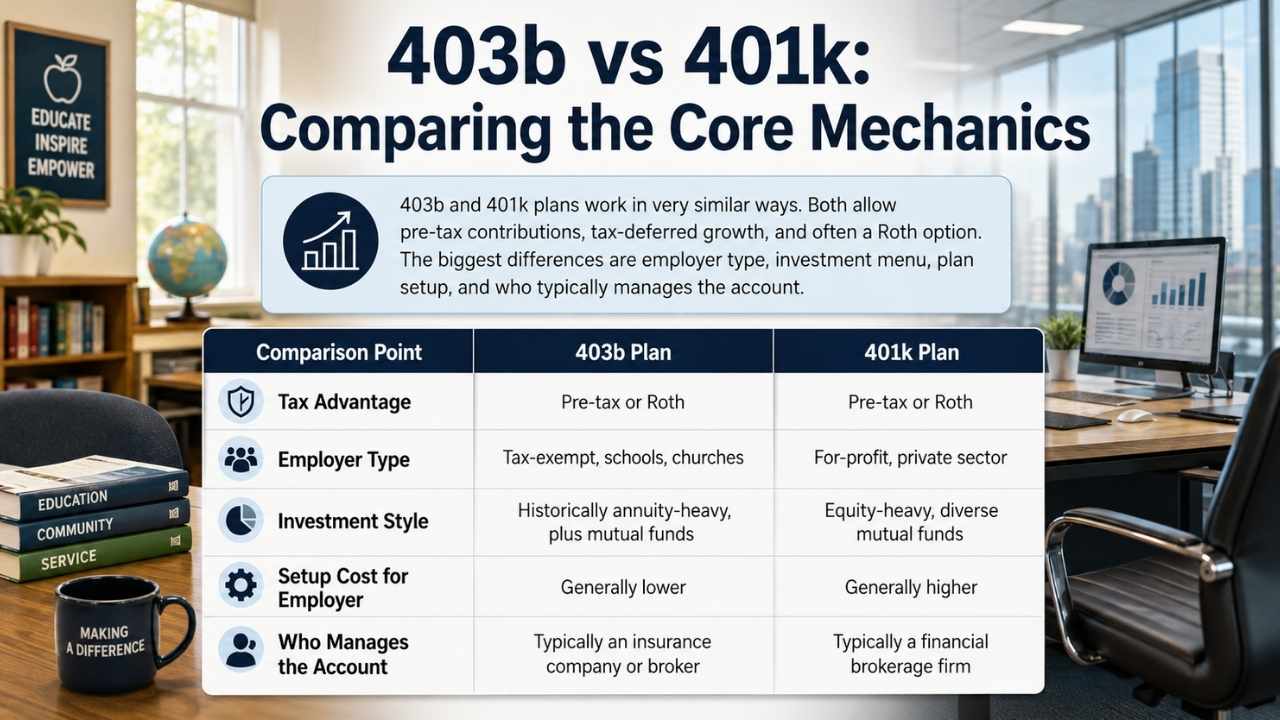
When you put a 403b vs. a 401k side by side, you will realize they share the exact same genetic code. Both let you make pre-tax contributions. This means the money leaves your paycheck before the government taxes it, instantly lowering your taxable income for the year. Both plans let your money grow tax-deferred. That means you will not pay capital gains taxes on your profits year over year as your account balances rise. You pay taxes only when you withdraw the money in retirement. Both plans also offer a “Roth” option nowadays.
If you choose a Roth 401k or Roth 403b, you pay taxes upfront based on your current tax bracket, but your withdrawals in retirement are completely tax-free. The real divide comes down to eligibility, the exact investment menus offered by your plan provider, and a few quirky rules that specifically favor veteran non-profit workers. While the core engine works the same way, the dashboard you look at will look totally different depending on whether an insurance broker or a giant financial brokerage firm runs your specific plan. Let’s dig deeper into the differences that actually impact your paycheck and your eventual retirement date.
|
Comparison Point |
403b Plan |
401k Plan |
|
Tax Advantage |
Pre-tax or Roth |
Pre-tax or Roth |
|
Employer Type |
Tax-exempt, schools, churches |
For-profit, private sector |
|
Investment Style |
Historically annuity-heavy, plus mutual funds |
Equity-heavy, diverse mutual funds |
|
Setup Cost for Employer |
Generally lower |
Generally higher |
|
Who Manages the Account |
Typically an insurance company or broker |
Typically a financial brokerage firm |
2026 Contribution Limits: How Much Can You Save?
The IRS caps how much money you can put into your retirement accounts every single year. For most people, the limits look identical across both plan types. The base contribution limit for both a 401k and a 403b sits at $24,500 for the year 2026. If you hit age 50, the IRS lets you play catch-up to build your nest egg faster. The standard catch-up contribution is $8,000 in 2026, meaning someone 50 or older can contribute up to $32,500 total. But recent legislation completely changed the game for older workers.
Thanks to the SECURE 2.0 Act, employees ages 60 through 63 qualify for a “super catch-up” contribution. If you fall into this specific age bracket, you can contribute an extra $11,250 on top of the base limit. That means a 61-year-old could realistically funnel up to $35,750 into their 401k or 403b in 2026. The combined employee plus employer limit caps out at a massive $72,000 for 2026 before any catch-up amounts. These massive limits give workers an incredible opportunity to turbocharge their wealth right before they ride off into the sunset.
|
Contribution Type |
403b Plan Limit (2026) |
401k Plan Limit (2026) |
|
Standard Employee Limit |
$24,500 |
$24,500 |
|
Age 50+ Catch-up |
$8,000 |
$8,000 |
|
Ages 60-63 Super Catch-up |
$11,250 |
$11,250 |
|
Overall Combined Limit (Employee + Employer) |
$72,000 |
$72,000 |
|
Total Age 60-63 Max |
$35,750 |
$35,750 |
Hidden 403b Perks and New Roth Mandates
When comparing a 403b vs 401k, you have to look closely at the fine print to find some hidden advantages and new traps. The 403b has a hidden superpower: the 15-year rule. If you work for the same eligible organization for 15 years, you might qualify for an extra catch-up allowance. This rule lets you contribute an extra $3,000 per year, up to a lifetime maximum of $15,000. You can even combine this with the age 50+ catch-up if you qualify for both. The 401k offers absolutely nothing like this.
On the other hand, you need to watch out for a new rule if you earn a high salary. Starting in 2026, if you earned more than $150,000 from your employer in the prior calendar year, any age-based catch-up contributions you make must go into a Roth account. You can no longer use catch-up money to lower your pre-tax income if you cross that salary threshold. This means high earners will have to pay taxes upfront on that extra $8,000 or $11,250 they put away. Congress did this to collect more tax revenue now, rather than waiting for you to retire.
|
Special Rules |
403b Plan |
401k Plan |
|
Special Service Catch-up |
Up to $3,000/year (15-year rule) |
Not available |
|
Max Lifetime Service Catch-up |
$15,000 |
Not applicable |
|
Combine with 50+ Catch-up? |
Yes |
Not applicable |
|
Roth Mandate for High Earners |
Yes, if over $150,000 prior year |
Yes, if over $150,000 prior year |
|
When Mandate Starts |
2026 |
2026 |
The Investment Menus: Annuities vs. Mutual Funds
Your financial returns ultimately depend on exactly what you invest your money in. Here, the two plans differ significantly due to their long histories. Because insurance companies originally managed 403b plans, you will find a lot of annuities in these accounts. An annuity guarantees you a specific payout, making it a very safe, conservative choice. The huge downside? Annuities often come with steep fees and far lower long-term growth potential compared to the stock market. Over a 30-year career, missing out on compound market growth can easily cost you hundreds of thousands of dollars.
A 401k typically offers a much broader, more aggressive lineup. You can buy mutual funds, bond funds, index funds tracking the S&P 500, and sometimes even individual company stock. If you want maximum growth over decades, the broader stock exposure in a 401k usually provides a much stronger vehicle to build wealth. If you have a 403b, dig into your fee schedule right away. Modern 403b plans now offer low-cost mutual funds through a 403(b)(7) custodial account, but you have to actively select them. Don’t just set it and forget it if your employer defaults you into an expensive annuity product.
|
Investment Feature |
403b Plan |
401k Plan |
|
Primary Offerings |
Annuities, mutual funds |
Mutual funds, index funds, target-date funds |
|
Risk Profile |
Often conservative |
Ranges from conservative to aggressive |
|
Fee Structure |
Sometimes high (legacy annuities) |
Varies, usually highly competitive |
|
Growth Potential |
Can be limited by annuity caps |
High, tied directly to stock market |
|
Company Stock |
No |
Sometimes offered by the employer |
Employer Matches and Vesting Schedules Explained
A major deciding factor for job seekers is the employer match. Free money is the absolute best kind of money, and capturing the match should always be your first financial priority. In the corporate world, 401k matches act as a heavy recruiting tool to lure in top talent. A company might offer to match 100 percent of your contributions up to 5 percent of your salary. However, they protect their investment with a vesting schedule. Vesting means you must stay at the company for a certain amount of time before that matched money actually belongs to you.
If you leave a job with a 4-year vesting schedule after just two years, you forfeit a large portion of the matched money right back to the company. Non-profits handle things differently. Because operating budgets run so tight, fewer non-profits offer a robust 403b match. If they do, the percentage might be lower than a corporate counterpart. However, non-profits generally offer much faster vesting schedules. Sometimes, the money vests immediately. If you get a match on day one, it belongs to you on day one, even if you decide to quit on day two.
|
Match & Vesting |
403b Plan |
401k Plan |
|
Match Frequency |
Less common, depends heavily on budget |
Very common, used for recruiting |
|
Vesting Speed |
Often immediate or very fast |
Usually 3 to 6 years (cliff or graded) |
|
Match Limits |
Subject to overall IRS limits ($72,000 total in 2026) |
Subject to overall IRS limits ($72,000 total in 2026) |
|
Who Keeps Unvested Money? |
Employee (usually right away) |
Employer (if employee leaves early) |
|
Vesting Strategy |
Rewards short-term tenure |
Rewards long-term loyalty |
Administrative Costs, Fees, and ERISA Protections
You cannot talk about workplace retirement accounts without mentioning ERISA. That stands for the Employee Retirement Income Security Act of 1974. ERISA forces employers to follow massive, highly complex compliance rules. They have to prove they aren’t charging you hidden fees, and they must run annual non-discrimination tests. These tests ensure the highly paid bosses do not get better plan benefits than the everyday rank-and-file workers. All private 401k plans must comply strictly with ERISA. This compliance costs companies thousands of dollars a year, which is exactly why 401ks cost more to run from the business side.
A 403b, on the other hand, can legally bypass ERISA entirely in many cases. If a non-profit does not contribute any money to the plan and keeps employee participation strictly voluntary, the Department of Labor gives them a safe harbor exemption. This massively lowers the cost of running the 403b, helping cash-strapped charities and schools offer a retirement plan without going broke paying lawyers and accountants. The trade-off? Employees lose some of the massive federal oversight and strict fiduciary protections that ERISA guarantees.
|
Compliance Factor |
403b Plan |
401k Plan |
|
ERISA Compliance |
Optional (Depends on employer match and involvement) |
Mandatory |
|
Non-Discrimination Testing |
No (If non-ERISA) |
Yes (Annually) |
|
Administrative Costs |
Very low (If non-ERISA) |
Moderate to High |
|
Employee Protections |
Limited (If non-ERISA) |
High (Strict federal oversight) |
|
Employer Fiduciary Duty |
Lower (If non-ERISA) |
Extremely High |
Withdrawals, Penalties, and Required Minimum Distributions
The rules for getting your hard-earned money out are practically identical for both plans. The IRS really wants you to save this money for retirement, so they build a massive fence around it. You cannot just pull money out of either account without paying a penalty until you reach age 59.5. If you cash out early, you will pay ordinary income tax on the amount, plus a brutal 10 percent early withdrawal penalty. Eventually, the government forces you to take the money out so they can finally tax it. We call these Required Minimum Distributions.
Under current rules shaped by the SECURE 2.0 Act, you must start pulling money out of your pre-tax 401k or pre-tax 403b when you hit age 73. That age threshold pushes all the way up to 75 in the year 2033. However, if you hold a Roth 401k or Roth 403b account, you get a massive break. Thanks to SECURE 2.0, Roth accounts inside workplace plans are completely exempt from Required Minimum Distributions during your lifetime. You can leave that money growing tax-free forever and pass it straight down to your heirs.
|
Withdrawal Rule |
403b Plan |
401k Plan |
|
Standard Penalty-Free Age |
59.5 |
59.5 |
|
Early Withdrawal Penalty |
10% + standard income tax |
10% + standard income tax |
|
Current RMD Age |
73 (pushes to 75 in 2033) |
73 (pushes to 75 in 2033) |
|
Roth Account RMDs |
Exempt during lifetime |
Exempt during lifetime |
|
Penalty Exemptions |
Hardships, first home purchase, medical |
Hardships, first home purchase, medical |
What Happens When You Change Jobs?
People change careers more than ever today. If you transition from a non-profit gig to a corporate job, you will inevitably have to handle a 403b vs 401k rollover. You absolutely do not want to leave a trail of old, forgotten retirement accounts behind you. You can easily roll a 403b into your new 401k, or vice versa, without paying a single dime in taxes. The key is to do a direct rollover, where the money moves straight from the old brokerage to the new one. Never let them cut a check directly to you, or you might accidentally trigger a massive, completely avoidable tax bill.
Alternatively, you can roll either account into an Individual Retirement Account. Rolling over into an IRA usually gives you total, uncompromised control over your investments. You gain access to thousands of individual stocks and exchange-traded funds, and generally pay far lower fees than leaving the money parked in a former employer’s rigid plan. Just make sure you do not accidentally mix pre-tax and Roth money during the transfer process.
|
Rollover Options |
Old 403b Plan |
Old 401k Plan |
|
Roll to New Employer Plan? |
Yes, if the new plan allows it |
Yes, if the new plan allows it |
|
Roll to a Traditional IRA? |
Yes, tax-free |
Yes, tax-free |
|
Roll to a Roth IRA? |
Yes, but you pay taxes on the conversion |
Yes, but you pay taxes on the conversion |
|
Leave it Alone? |
Yes, if the balance is high enough |
Yes, if the balance is high enough |
|
Tax Consequence of Direct Roll |
None |
None |
Final Thoughts
Choosing a winner in the epic 403b vs 401k debate usually boils down to where you work. You do not get to pick between the two; your employer chooses for you based on their legal tax status. If you land in the corporate world with a 401k, you benefit from incredibly strong federal protections under ERISA, highly aggressive investment options, and lucrative employer matches used to keep you around. If you dedicate your entire career to public service, education, or charity, your 403b offers a solid, low-maintenance way to build massive wealth over time.
You also get an incredible 15-year catch-up rule that corporate workers can only dream of. The most critical step is not worrying obsessively about which acronym sits on your pay stub. The absolute best thing you can do is enroll as early as humanly possible, capture every single dime of your employer match, actively check your fund fees, and let compound interest do the heavy lifting over the decades. Your future self will thank you for taking action today.
Frequently Asked Questions (FAQs) About 403b vs 401k
Can I have both a 403b and a 401k at the exact same time?
Yes, you absolutely can. If you work a corporate day job and teach at a community college at night, you might have access to both accounts. However, your total contribution limit applies across both plans. You cannot put $24,500 into the 401k and another $24,500 into the 403b in the same year. The IRS looks at your total elective deferrals as a single, combined cap.
What happens to my 403b if I quit my non-profit job for a giant corporate job?
You have three main options on the table. You can leave the money in the old 403b if your former employer allows it. You can roll it over directly into your new company’s 401k to keep everything organized in one place. Or, you can roll it over into a private Traditional IRA, which often gives you the widest variety of investment choices and the absolute lowest fees.
Does contributing to a 403b reduce my state pension payouts down the road?
No, it does not. If you work in the public sector as a teacher or government worker, a 403b is entirely separate from your state pension system. Your 403b acts as pure supplemental income. Funding it will not decrease the complex formula used to calculate your traditional pension benefits when you retire.
Why does my 403b only seem to offer really expensive annuities?
This happens because 403b plans originally started purely as tax-sheltered annuities back in the day. If you have an older, legacy plan, your employer might still only contract with a single insurance company. Talk to your human resources department immediately to see if they offer a 403(b)(7) custodial account option, which is the specific IRS code that lets you buy much cheaper mutual funds instead.
Are there hardship withdrawals for a 403b exactly like there are for a 401k?
Yes, absolutely. Both plans let you pull money out early without the painful 10 percent penalty in extreme, highly qualified cases. The SECURE 2.0 Act actually expanded these exceptions to include terrible situations like personal and family emergencies, domestic abuse, terminal illness, and federally-declared natural disasters.
Do high earners have special rules for catch-up contributions moving forward?
Yes, thanks to the massive SECURE 2.0 Act. Starting in 2026, if you earned more than $150,000 from your employer in the prior calendar year, any catch-up contributions you make must be made as after-tax Roth contributions. You can no longer use catch-up contributions to lower your pre-tax income if you cross that high-wage threshold.