


When you quit a job, your brain is usually buzzing with a million things. You are turning in your laptop, saying goodbye to your favorite coworkers, and getting ready for the next big adventure. Amidst all that chaos, your old retirement account usually gets left behind in the dust.
You probably aren’t the only one who has forgotten about an old workplace plan. Believe it or not, Americans have left behind a massive 31.9 million orphaned retirement accounts as of recent industry estimates, leaving roughly $2.1 trillion sitting in absolute limbo.
Leaving your cash in a former employer’s plan might feel harmless today. But over a decade or two? High administrative fees and lousy default investments can rob you of hundreds of thousands of dollars in compound growth. The average forgotten account holds just over $66,000. If you leave that money unattended, you are giving up total control over your financial future.
If you want to grab control of your wealth, figuring out how to roll over a 401k is your very first step. I have watched plenty of incredibly smart people accidentally trigger massive tax bills just by clicking the wrong button on a withdrawal form. This guide walks you through exactly how to move your money safely. We will cover the tax traps you absolutely must dodge, the mechanics of getting your money out, and the new federal rules that could actually force your money out of your old plan if you don’t act fast.
4 Choices for Your Old 401(k): Which Path Makes Sense?
When you walk out the office door for the last time, your retirement account does not magically follow you to your next gig. The money stays stuck right where it is until you explicitly tell the plan administrator what to do with it. You generally have four distinct choices, and picking the right one depends heavily on your current financial situation, your tax bracket, and how much control you want over your investments. Some people prefer the hands-off approach, while others want to aggressively manage every single dollar.
If you have a decent chunk of change in the account, federal law lets you keep your money exactly where it is. Some folks take this route because they love the ultra-low-cost institutional funds their old company offered. But here is the catch. You aren’t an active employee anymore. Because you no longer work there, the company stops covering your account maintenance fees. Suddenly, you will see recordkeeping fees quietly draining your balance every single quarter. On top of that, you can’t add a single dime of new money to the account, which makes tracking your long-term growth a total headache. Moving it into your new employer’s plan is incredibly convenient. You get one login, one monthly statement, and a unified investment strategy. I almost always suggest this route to high earners who use the “Backdoor Roth IRA” strategy because keeping your pre-tax cash inside a workplace plan shields you from the IRS’s nasty pro-rata tax rule.
Rolling your balance into an Individual Retirement Account (IRA) is the absolute gold standard if you want total freedom. You open an IRA at a powerhouse discount brokerage—think Fidelity, Vanguard, or Charles Schwab—and instantly unlock the entire stock market. Instead of picking from a sad menu of 15 mutual funds, an IRA lets you buy practically any stock, ETF, index fund, or bond out there. Best of all, major brokerages charge exactly zero account maintenance fees. Finally, there is the nuclear option: cashing it out. Cashing out means taking a distribution check and depositing it straight into your personal checking account. Unless you are literally facing eviction, never do this. If you are under age 59 and a half, the IRS slaps you with a brutal 10 percent early withdrawal penalty. The entire amount gets added to your taxable income for the year, triggering heavy federal and state taxes. A $20,000 cash-out easily shrinks to $13,000 by the time it hits your bank account.
|
Option |
Investment Freedom |
Account Fees |
Tax Impact |
Best For… |
|
Leave It Alone |
Limited to old plan lineup |
Often increase after you leave |
None |
People who love their old plan’s exclusive funds. |
|
New Workplace Plan |
Limited to new plan lineup |
Varies by new company |
None |
High earners needing to preserve Backdoor Roth capability. |
|
Roll to IRA |
Virtually unlimited (stocks, ETFs) |
Zero at major brokers |
None (if matched properly) |
Savers who want total control and zero maintenance fees. |
|
Cash Out |
Not applicable |
Not applicable |
10% penalty plus full income tax |
Absolute financial emergencies only. |
Direct vs. Indirect Rollovers: Dodging the 20% Tax Trap
When folks ask me for advice on moving their cash, the actual mechanics of the transfer usually trip them up. The IRS gives you two ways to handle the move: a direct rollover or an indirect rollover. Choosing the wrong one is an incredibly common, wildly expensive mistake that ruins tax returns every single year. You have to specify exactly which method you want when you call your old plan provider, or they might default to the option that gets you penalized.
In a direct rollover, the money never touches your personal bank account. Your old plan provider either wires the funds or cuts a check made out directly to your new financial institution for your benefit. For example, the check might read: “Charles Schwab, FBO Jane Doe.” Because you never personally cash the check, the IRS views this as a seamless institutional transfer. You pay zero taxes, nothing gets withheld, and you don’t have to stress about ticking clocks. This is the stress-free way to handle your money, and it guarantees the IRS stays completely out of your hair during the transition.
In an indirect rollover, you ask your old provider to cut a check written directly in your name. You might think it is easier to just deposit this in your checking account and immediately transfer it to your new IRA. Here is exactly why that ruins your finances. By law, your old plan administrator must withhold 20 percent of your pre-tax balance and send it to the IRS for federal taxes. If you had $100,000, they only hand you an $80,000 check. The IRS gives you exactly 60 calendar days to deposit the full $100,000 into a new retirement account. Since they only gave you $80,000, you must front the missing $20,000 out of your own personal savings to complete the rollover. Sure, you get that 20 percent back when you file your taxes next year, but if you don’t have the cash lying around, the IRS treats that missing $20,000 as an early cash distribution. You will owe regular income taxes on it, plus a 10 percent penalty. Always demand a direct rollover.
|
Feature |
Direct Rollover |
Indirect Rollover |
|
Check Payee |
New custodian (For Benefit Of you) |
You personally |
|
Tax Withholding |
Zero (0%) |
20% mandatory federal withholding |
|
Time Limit |
Handled institutionally; no strict deadline |
Exactly 60 calendar days |
|
Penalty Risk |
Virtually zero |
Extremely high if funds are delayed or short |
|
Verdict |
Highly Recommended |
Avoid at all costs |
Matching Tax Buckets: Traditional vs. Roth
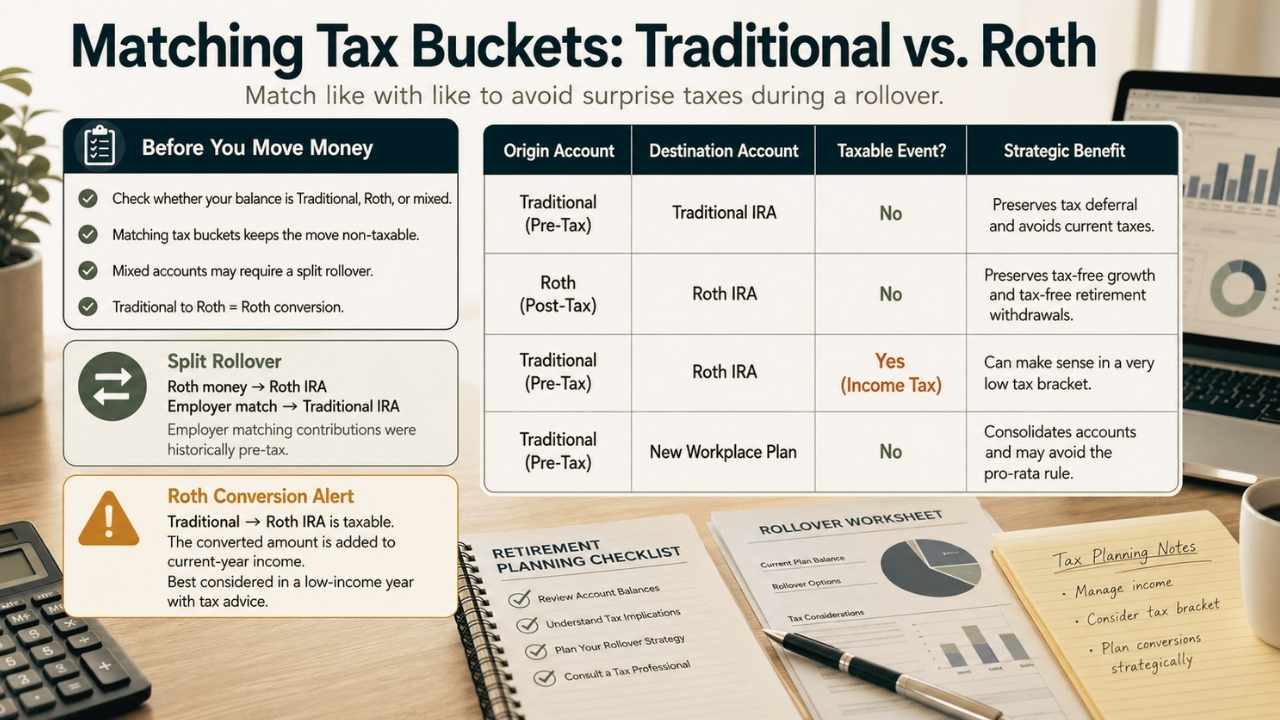
Before you hit any transfer buttons, pull up your latest account statement and look closely at your tax status. You probably hold pre-tax (traditional) money, post-tax (Roth) money, or a mix of both. Matching your tax buckets perfectly ensures you don’t owe the IRS a single penny during the move. Mixing them up carelessly is a fast track to a surprise tax bill in April. You need to know exactly what kind of money you are holding before you open your destination accounts.
If you transfer money between identical tax environments, it isn’t a taxable event. Traditional accounts are pre-tax, meaning you haven’t paid taxes on that income yet. Moving a traditional account to a traditional IRA means the money moves tax-free and continues to grow tax-deferred until you retire. Roth accounts are funded with after-tax money, so rolling a Roth account to a Roth IRA is completely tax-free, and it grows tax-free forever. Keep an eye on your employer match. Even if you only contributed your own money to a Roth account, your employer’s matching contributions historically had to be made on a pre-tax basis. If you have a mixed account, you need to execute a “split rollover.” You will send the Roth money to a Roth IRA and the employer match to a traditional IRA.
You can actually choose to move your pre-tax balance directly into a Roth IRA. The IRS totally allows this, but they classify it as a Roth conversion. If you do this, the entire converted balance gets added to your gross taxable income for the current year. If you convert $50,000, you will owe ordinary income tax on that $50,000 when tax season rolls around. Why do this voluntarily? If you took a gap year, went back to school, or simply have an unusually low income this year, converting the cash while you sit in a low tax bracket lets you lock in tax-free growth for the rest of your life. It is a brilliant strategy if you plan it with a tax professional, but an awful surprise if you do it by accident.
|
Origin Account |
Destination Account |
Is it a Taxable Event? |
Strategic Benefit |
|
Traditional (Pre-Tax) |
Traditional IRA |
No |
Preserves simple tax deferral and avoids current year taxes. |
|
Roth (Post-Tax) |
Roth IRA |
No |
Preserves tax-free growth and tax-free withdrawals in retirement. |
|
Traditional (Pre-Tax) |
Roth IRA |
Yes (Income Tax) |
Great if you are currently in a very low tax bracket. |
|
Traditional (Pre-Tax) |
New Workplace Plan |
No |
Consolidates accounts without triggering the pro-rata tax rule. |
How to Roll Over a 401k: The 5-Step Execution Plan
Moving an old retirement account sounds incredibly intimidating, but it is really just a standardized banking process. Once you understand the sequence, knowing exactly how to roll over a 401k becomes incredibly simple. You just need to follow a few precise steps to make sure the cash gets from point A to point B without any IRS interference. I always tell folks to tackle this on a Tuesday morning when customer service lines are fully staffed.
Step one is opening your receiving account. Decide where the money is going. If you want an IRA, log into a reputable brokerage firm like Vanguard, Schwab, or Fidelity and open an account. Make sure you open the correct type of IRA to match your incoming funds. By the way, rollovers do not count toward your normal annual contribution limits. For example, the IRS limit for IRA contributions in 2026 is $7,500, or $8,600 if you are age 50 or older. You can roll over a massive $500,000 account and still make your full $7,500 personal contribution for the year. Step two is getting your transfer instructions. Your new brokerage will provide deposit instructions. You need the exact payee name, your new account number, and the physical mailing address for check deposits.
Step three is calling your old plan administrator. Log into your former employer’s portal. Many modern platforms let you handle the entire direct transfer online. If they use a legacy system, call their customer service desk. Tell the representative explicitly that you need to initiate a direct trustee-to-trustee rollover. Step four is tracking the transfer. Electronic wire transfers clear in a few business days. If they issue a paper check, it might go directly to your new broker, or it might come straight to your mailbox. If it comes to your house, don’t panic. As long as the check is made payable to the new financial institution, open your brokerage app and use mobile check deposit. Step five is the most critical: invest the funds. When your rollover clears, the money lands in your new account as uninvested cash. You must log in, search for the mutual funds or ETFs you want, and manually execute a buy order. Leave it in cash, and inflation will eat your retirement alive.
|
Step |
Action Required |
Pro-Tip for Success |
|
1. Account Setup |
Open an IRA or verify your new workplace plan accepts transfers. |
Double-check that tax types (Pre-tax or Roth) match perfectly. |
|
2. Get Instructions |
Secure the exact check payee name and physical mailing address. |
Write down your new account number to give to your old provider. |
|
3. Initiate Transfer |
Call your old provider to request a direct rollover. |
Specifically say “Direct Trustee-to-Trustee Transfer” on the phone. |
|
4. Track the Funds |
Monitor your mail or new account dashboard. |
If a check comes to your house, use mobile deposit immediately. |
|
5. Invest the Cash |
Buy index funds, target-date funds, or ETFs. |
Do not let your retirement savings sit in a basic cash sweep account. |
SECURE 2.0 and the $7,000 Automatic Force-Out Rule
If you are putting off moving your old account because you think you can just leave it there forever, federal law might actually make the decision for you. The SECURE 2.0 Act completely changed the rules for small, abandoned retirement balances. Employers are now legally allowed to kick former employees out of the company plan if their balance is too small. Companies do this because keeping ex-employees on the books costs them money in administrative fees, so they clean house regularly.
Recently, the involuntary automatic rollover limit was bumped up from $5,000 to $7,000. Here is exactly how it plays out based on your vested balance. If you have under $1,000 in the account, your old employer can legally close it, liquidate the investments, and mail a check directly to your last known address. This immediately triggers taxes and penalties if you don’t deposit it into a new IRA within 60 days. If your balance is between $1,000 and $7,000, they can’t cash you out, but they can force an automatic transfer. They will shove your money into a default Safe Harbor IRA chosen by the employer.
You absolutely do not want your money in a default Safe Harbor IRA. These forced accounts usually charge ridiculous administrative fees and park your money in ultra-conservative cash investments that barely beat inflation. Your wealth essentially stagnates while fees slowly bleed it dry. If your balance is over $7,000, you are totally safe from forced removal. The employer needs your explicit consent to move the funds. Regardless of your balance, proactively moving your money is the only way to guarantee you retain full control over what you pay in fees and what your money is invested in.
|
Vested Account Balance |
What the Employer Can Legally Do |
Your Required Action |
|
$1 to $999 |
Automatically cash out the account and mail you a check. |
Complete a 60-day indirect rollover to save it from penalties. |
|
$1,000 to $7,000 |
Force-transfer funds to a default Safe Harbor IRA. |
Find the default IRA and initiate a transfer to a broker you actually want. |
|
Over $7,000 |
Nothing. They must hold your account indefinitely. |
Take your time, but a proactive transfer is still highly recommended. |
Complex Edge Cases: Loans, Company Stock, and the Rule of 55
While the standard transfer process is super straightforward for most people, a few edge cases require highly careful planning. If you fall into one of these specific scenarios, blindly moving your money could cost you tens of thousands of dollars in lost tax advantages or trigger immediate penalties. Check these conditions before hitting the transfer button online.
Did you borrow money from your retirement account for a down payment on a house or to crush credit card debt? Quitting your job triggers a nasty repayment clause on that outstanding 401k loan. Under current tax law, you have until the federal tax filing deadline for that tax year to pay back the remaining loan balance into an IRA. If you cannot afford to pay it back in cash, the unpaid balance defaults. The IRS treats defaulted loans as early distributions, slapping you with standard income taxes and a 10 percent penalty right off the bat.
Does your account hold shares of your former company’s stock? If those shares skyrocketed in value during your tenure, rolling them into an IRA might be a horrible idea. Using a tax strategy called Net Unrealized Appreciation (NUA), you can move the company stock into a standard taxable brokerage account instead. You only pay ordinary income tax on the original cost basis. When you sell the stock later, the growth gets taxed at long-term capital gains rates, which are way lower than the ordinary income rates you would pay pulling money out of an IRA. Finally, be aware of the Rule of 55. Usually, you cannot touch workplace plan money without a penalty until age 59 and a half. But if you leave your job during or after the calendar year you turn 55, this rule lets you take penalty-free distributions directly from that specific employer’s plan. If you move that money into an IRA, you instantly lose that privilege.
|
Scenario |
The Core Rule |
Recommended Action |
|
Active Loan |
Unpaid balances default and become taxable distributions. |
Repay the balance to an IRA before tax day to dodge penalties. |
|
Holding Company Stock |
IRAs tax withdrawals as ordinary income. NUA uses lower capital gains rates. |
Consult a tax professional about executing an NUA strategy first. |
|
Quitting at Age 55+ |
Allows penalty-free withdrawals from that specific workplace plan. |
Leave the funds in the plan if you need cash before age 59 and a half. |
Final Thoughts
Figuring out how to roll over a 401k is hands down one of the most profitable, high-impact moves you can make during a career change. Spending a few hours consolidating your accounts keeps your hard-earned wealth out of the hands of fee-hungry administrators. It stops your cash from becoming just another statistic in the massive pile of forgotten accounts across the country.
Remember the golden rules: demand a direct transfer to sidestep the 20 percent tax trap, match your tax buckets carefully, and the second the money hits your new account, invest it immediately in the market. Taking aggressive ownership of your old retirement accounts today guarantees your money will be ready and waiting for you the day you decide you never want to work again.
Frequently Asked Questions (FAQs) About 401(k) Rollovers
Do I need my spouse’s signature to roll over my account?
Most of the time, yes. Under the Employee Retirement Income Security Act (ERISA), your spouse has legal rights to your retirement account as a beneficiary. Many plan administrators demand a notarized spousal consent form before releasing the funds, especially if you want to name someone other than your spouse as the primary beneficiary on the new IRA.
Can I roll over just the after-tax portion of my 401(k)?
Yes! If you made non-Roth, after-tax contributions to your plan, you can do a split rollover. Send the pre-tax earnings to a Traditional IRA and roll the original after-tax contributions straight into a Roth IRA without paying conversion taxes. Financial nerds call this the “Mega Backdoor Roth” strategy.
Does a rollover count against my annual IRA contribution limits?
Nope. Rollovers don’t count against your yearly caps. For example, for the 2026 tax year, you can contribute up to $7,500 (or $8,600 if you’re age 50 or older). You can roll over a massive $500,000 workplace account and still make your full $7,500 personal contribution for the year.
Can I roll my old account into a Solo 401(k)?
Absolutely. If you ditched the corporate grind to start freelancing or launch a small business, open a Solo 401(k). As long as you have no full-time, non-owner employees, you can roll your old employer plan straight into it, giving you massive contribution limits and total control over your investments.