

You want to break into tech or pivot to a new career. But you definitely do not want to take out a massive student loan to do it. If you spend any time looking for entry-level tech jobs, you will run into Google’s professional training programs. The pitch sounds amazing. Skip the expensive four-year degree. Spend a few months studying online. Get your resume directly in front of major global employers.
But the tech job market is brutal right now. Companies are picky. You need to know what hiring managers actually care about before you spend your time and money. So, people constantly ask: are Google Career Certificates worth it in 2026?
Yes, they are. But you have to play the game right. Finishing a Coursera track won’t magically drop a $90,000 job in your lap. To win today, you need a strategy. You need to know which certificates matter, which ones are overcrowded, and what you must do after you get that digital badge. Let’s look at the real costs, the actual job outcomes, the brand new AI learning tracks, and how these programs hold up against today’s hiring standards.
The 2026 Job Market Reality
When you try to figure out if Google Career Certificates are worth it, you must look at the hard numbers. Millions of people have taken these courses. Google built them so absolute beginners could learn fast and get hired.
Employers do respect the training. A recent 2026 NACE Job Outlook survey shows that 70% of employers now prefer skills-based hiring over strict degree requirements. Better yet, 75% of Google Career Certificate graduates actually report a positive career bump—like a new job, a promotion, or a raise—within six months of finishing.
But here is the catch. Because so many people have these credentials now, the certificate alone just gets you to the starting line. It is a baseline requirement. Hiring managers want proof that you can do the work. If you just watch the videos and skip the hands-on labs, you will bomb your technical interviews.
|
The 2026 Reality |
What You Need to Know |
|
Experience Needed |
Zero. No college degree or tech background required. |
|
How You Learn |
Watch videos, take quizzes, and do hands-on labs on Coursera. |
|
Success Rate |
75% of grads see a career benefit within six months. |
|
College Credit |
You can get up to 16 college credits for certain tracks. |
|
What Employers Want |
They like the cert, but they demand a custom portfolio to hire you. |
Which Core Certificates Actually Get You Hired?
Not all Google certificates yield the same results. The job market decides their value. Some fields desperately need fresh talent. Others are flooded with beginners. Here is a look at the core tracks and how they perform in the real world right now.
The Heavy Hitters: Cybersecurity and IT Support
The Cybersecurity Professional Certificate is the undisputed heavyweight champion right now. Companies desperately need security analysts. The Bureau of Labor Statistics (BLS) projects a massive 28.5% job growth for this field through 2034. You learn network security, threat detection, Linux basics, and SIEM tools. It is not overly saturated, and starting salaries range from $55,000 to $85,000.
The IT Support Certificate is the classic path. If you just want to grab a help desk job quickly, do this one. You learn troubleshooting, networking, and operating systems. It offers a steady entry point into tech. Expect average starting salaries around $60,000.
The Data Path: Data Analytics vs. Business Intelligence
The Data Analytics Certificate is incredibly popular. Over two million people have enrolled. You learn how to clean and visualize data using SQL, Tableau, and R. But because millions have taken it, the entry-level market is heavily saturated.
To stand out, smart analysts stack this with the Business Intelligence Certificate. This intermediate track teaches advanced dashboarding. If you have both, you prove to employers that you can process data and actually present useful insights to the boss.
The Crowded Markets: UX Design and Digital Marketing
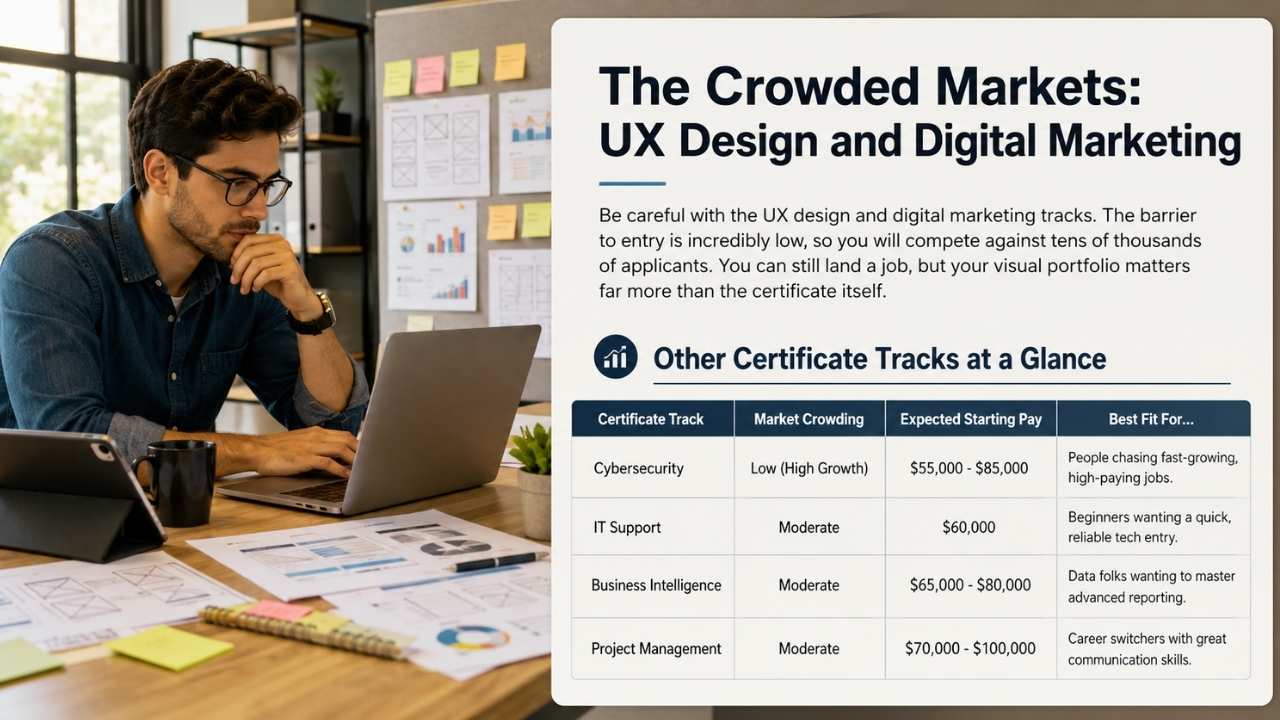
Be careful with the UX design and digital marketing tracks. The barrier to entry here is incredibly low. You will compete against tens of thousands of applicants. You can absolutely still land a job, but your visual portfolio matters way more than the certificate itself.
|
Certificate Track |
Market Crowding |
Expected Starting Pay |
Best Fit For… |
|
Cybersecurity |
Low (High Growth) |
$55,000 – $85,000 |
People chasing fast-growing, high-paying jobs. |
|
IT Support |
Moderate |
$60,000 |
Beginners wanting a quick, reliable tech entry. |
|
Business Intel |
Moderate |
$65,000 – $80,000 |
Data folks wanting to master advanced reporting. |
|
Project Mgmt |
Moderate |
$70,000 – $100,000 |
Career switchers with great communication skills. |
The Game Changers: New Google AI Tracks
Artificial intelligence changed everything this past year. Google noticed. Instead of just offering basic tech courses, they dropped dedicated AI tracks that map directly to modern jobs. If you want to future-proof your resume, check out the Google AI Essentials and the Google AI Professional Certificate tracks. The professional program teaches you actual generative AI skills.
Also, don’t sleep on the IT Automation with Python certificate. It teaches you how to write scripts to automate boring, repetitive tasks. This pairs perfectly with AI prompting skills. If you stack an AI track on top of a core certificate, you immediately look like a modern, tech-savvy candidate.
|
New AI Tracks |
Level |
What You Actually Learn |
|
AI Essentials |
Beginner |
Basic AI literacy and prompting for everyday work. |
|
Prompting Essentials |
Beginner |
Deep dive into writing great prompts to speed up tasks. |
|
AI Professional |
Intermediate |
Hardcore generative AI skills for tech careers. |
|
IT Automation (Python) |
Intermediate |
Writing scripts to make computers do the boring work. |
The Financial Breakdown: A Low-Risk Bet
Let’s talk about the money. Google does not hit you with a massive flat fee. They host these courses on Coursera. Coursera charges a $49 monthly subscription.
Most of the core certificates take about 150 to 200 hours to finish. If you study 10 hours a week, you finish in three to six months. That means your total out-of-pocket cost is roughly $150 to $300. You can also grab Coursera Plus for $399 a year for unlimited access.
Compare that to a traditional four-year computer science degree. Those easily cost over $80,000. Even a coding bootcamp usually charges $10,000 to $20,000. From a financial standpoint, making Google Career Certificates worth it is easy. The risk is incredibly low.
|
Education Type |
Typical Cost |
Time to Finish |
Debt Risk |
|
Google Certificate |
$150 – $300 ($49/mo) |
3 – 6 Months |
None. You can even find free access options. |
|
Tech Bootcamp |
$10,000 – $20,000 |
3 – 9 Months |
High. Often requires taking out big loans. |
|
Traditional Degree |
$40,000 – $100,000+ |
4 Years |
Very High. |
How the Employer Consortium Actually Works
Google talks a lot about their employer consortium. They built a network of over 150 major companies—places like Deloitte, T-Mobile, American Express, and Walmart. These companies promised to look at certificate holders for entry-level jobs. Does it work? Yes, but you have to use it right.
When you graduate, you get access to CareerCircle and a private job platform. You can upload your resume directly to these employers. Do not skip this step! Most students ignore it. Submitting your resume here bypasses the brutal, automated filters on public job boards like Indeed. It puts your name in front of human recruiters who already like the Google program.
|
Consortium Perks |
Why You Should Care |
|
150+ Employers |
Real jobs across tech, finance, and retail. |
|
Direct Resume Upload |
Skip the public job board filters and reach humans. |
|
Smaller Applicant Pool |
You only compete with other program graduates here. |
|
Free Career Coaching |
Get 1-on-1 interview practice via CareerCircle. |
4 Steps to Guarantee You Stand Out
You cannot stop working the second you get your digital badge. Employers want to see hustle. If you want to make your Google Career Certificates worth it, follow the exact four steps successful graduates use to get hired.
- Build a Real Portfolio: Do not just submit the guided Coursera capstone project. Every single graduate has that exact same project. Find a unique dataset, write a custom script, or analyze a real security log. Put it on a personal website or GitHub.
- Stack Your Credentials: Employers love specialists. If you take the Data Analytics course, immediately follow it up with Business Intelligence. If you finish IT Support, tackle the IT Automation with Python track.
- Apply at Volume: Do not apply to five jobs and sit by the phone. Treat the job hunt as a numbers game. Apply to dozens of roles every week. Tweak your resume keywords to match each job description.
- Network with the Consortium: Upload your resume to the Google employer platform on day one. Then, find recruiters from those 150 companies on LinkedIn. Send them a quick, polite message mentioning your new certification.
|
Post-Graduation Steps |
Why You Must Do This |
Time It Takes |
|
Build Custom Projects |
Proves you can solve real problems without a teacher. |
2-4 Weeks |
|
Stack Certificates |
Shows deep expertise (e.g., Data Analytics + BI). |
1-3 Months |
|
Volume Applying |
Beats the applicant tracking systems and rejection odds. |
Ongoing |
|
Active Networking |
Gets you in front of employers who already trust Google. |
1-2 Hours/Week |
Final Thoughts
The tech industry moves crazy fast. A few years ago, you practically begged for an interview if you didn’t have a computer science degree. Today, companies care about skills. They want to know what you can build, fix, and analyze today. So, are google career certificates worth it? Absolutely. For less than $300, you get world-class training, hands-on labs, and a direct line to 150 top-tier employers. It is the lowest-risk educational bet you can make in 2026.
Just remember that the certificate only gets you in the room. Your personal drive, your custom projects, and your networking hustle keep you there. Pick a track that fits your goals, put your head down, and get to work.
Frequently Asked Questions (FAQs) About Google Career Certificates Worth it
Can I get college credit for a Google Certificate?
Yes. The American Council on Education (ACE) recommends them for up to 16 college credits. Schools like Northeastern University and Purdue Global accept these credits. This saves you thousands in tuition if you ever decide to get a bachelor’s degree.
Can I speedrun a Google Certificate in one month?
Technically, yes. The courses are entirely self-paced. If you treat it like a full-time job and grind for 30 to 40 hours a week, you can finish fast. You only end up paying a single $49 monthly payment.
Are these certificates good for senior tech workers?
No. These are for entry-level roles and career switchers. If you already have an IT degree or three years of experience, you will find the material way too basic. Go get advanced credentials like AWS, Azure, or CompTIA instead.
Do I lose my course access if I cancel Coursera?
Yes. Coursera cuts your access to graded assignments and premium videos the second you stop paying. Download all your notes, templates, and project files to your computer before you hit cancel.