


Picture this. You finally carve out an hour of deep focus. Your coffee is perfectly hot, your browser tabs are actually organized, and you stand ready to crush that massive project you have been dodging all week.
Then, a coworker drops a direct message asking for a super quick favor. Two minutes later, your boss swings by your desk to see if you have bandwidth for a brand-new initiative. Before your morning coffee even gets cold, your entire day is completely wrecked. You smiled and agreed to everything because saying yes feels incredibly safe. It makes you look like an amazing team player.
We have all been there at some point in our careers. However, constantly saying yes is a one-way ticket to burnout, missed deadlines, and a mountain of quiet resentment. Figuring out how to say no at work is the most critical survival skill you can master in today’s chaotic office environment. Let’s fix your boundaries, protect your time, and do it without ruining your professional reputation.
The Massive Cost of Always Saying Yes
Every time you say yes to a random request, you silently say no to something else. Usually, that something else is your actual job, your evening plans, or your absolute sanity. We waste an absurd amount of time at work dealing with distractions and unnecessary tasks that drain our energy. The latest 2026 workplace burnout statistics reveal that 66 percent of employees in the United States experienced some form of burnout. A staggering 77 percent of workers report experiencing heavy work-related stress, which ruins their overall focus.
Employees experiencing burnout are nearly three times more likely to actively look for a new job. When you fail to guard your time, you contribute to a global crisis where low employee well-being creates an estimated $322 billion in lost productivity and turnover. The main causes of this stress include looming deadlines and managing staff, but a massive chunk comes from dealing with unexpected issues as they pop up. If you refuse to gatekeep your time, your coworkers will gladly fill it for you.
You take on too much, the quality of your work crashes, you miss important deadlines, and you make stupid mistakes. Ironically, the very people you tried to impress by saying yes end up annoyed by your sloppy performance. Guarding your time is not lazy. It is absolutely how you survive the modern corporate grind.
|
The Bad Habit |
What It Actually Does to Your Career |
How Pushing Back Saves You |
|
Diluted Focus |
You spend your day context-switching and get absolutely nothing finished. |
Keeps you locked onto the specific tasks that actually get you promoted. |
|
Burnout City |
You completely wreck your sleep and mental health trying to do it all. |
Preserves your energy so you do not crash and burn by Thursday afternoon. |
|
Zero Respect |
People treat you like a permanent dumping ground for their busywork. |
Shows people you respect your own time, forcing them to respect it too. |
|
Opportunity Loss |
You lose hours of peak productivity doing minor administrative tasks. |
Frees you up to handle high-level strategy and high-impact deliverables. |
Why We Are Terrified to Push Back
Let’s be completely honest with ourselves. We absolutely hate conflict. We desperately want our peers to like us and our bosses to reward our hard work. We panic that turning down a task makes us look difficult, uncooperative, or completely incompetent. You might worry about missing a promotion, getting a terrible performance review, or angering the wrong executive.
But reality rarely matches our late-night anxiety and overthinking. Most of your colleagues just want their immediate problem solved quickly. If you cannot fix it for them, they will not hold a massive grudge. They will simply go ask someone else for help. You have to actively reframe how you view rejection inside the office. Understand that people respect clear, honest communication way more than they respect broken promises.
Once you accept this basic fact, figuring out how to say no at work gets a whole lot easier. You are not rejecting the person asking you for help. You are simply declining the specific task they brought to your desk. Pushing back shows you take your core responsibilities seriously. It proves you understand exactly what your job requires.
|
The Fear in Your Head |
The Reality of the Situation |
What You Should Tell Yourself |
|
They will think I am lazy. |
They will see you are slammed with high-priority work. |
Pushing back proves I take my current deadlines incredibly seriously. |
|
I will get fired immediately. |
Missing huge deadlines gets you fired. Setting boundaries does not. |
Protecting company time is exactly what I am paid to do every day. |
|
They will absolutely hate me. |
Real professional respect requires honesty, not blind agreement. |
I would rather say no right now than let them down on Friday. |
|
I will miss out on chances. |
You miss out on real opportunities when bogged down by junk. |
Focusing on my main goals makes me a prime candidate for promotion. |
Smart Strategies for How to Say No at Work
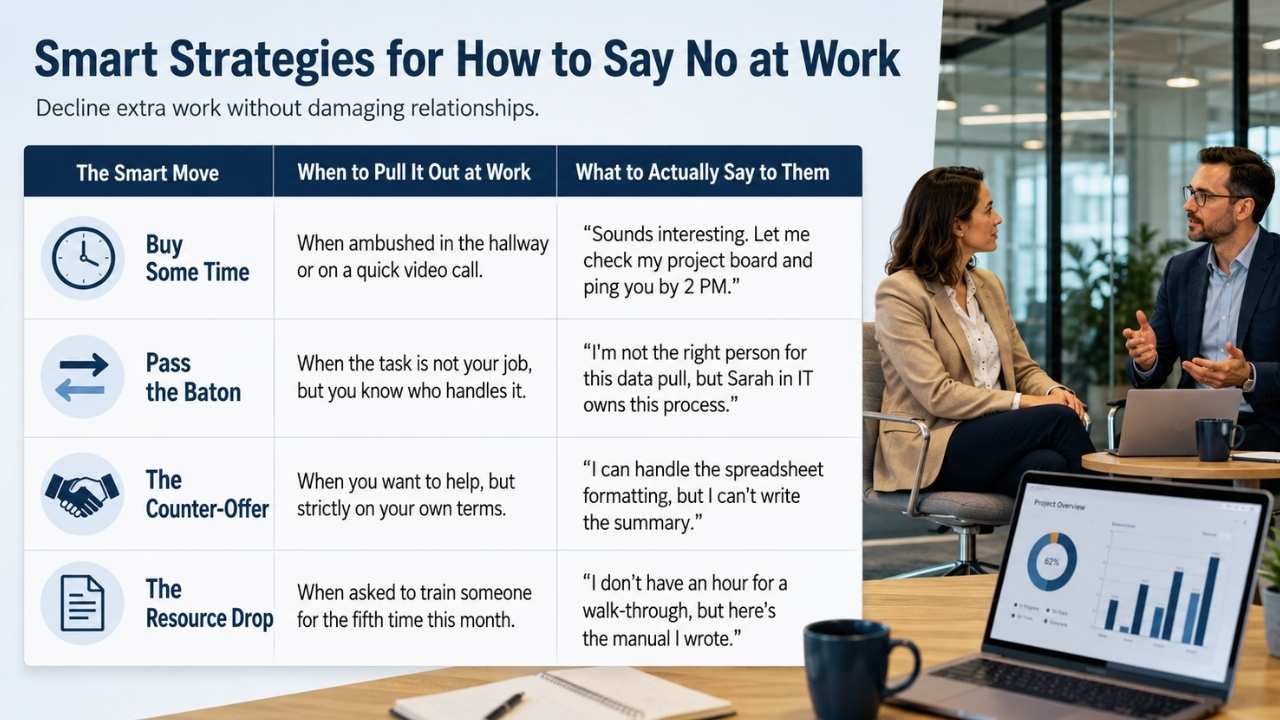
You do not need to shout a hard refusal and storm off. That just makes things incredibly weird and spikes everyone’s defenses. Instead, use smart tactics that decline the extra work while keeping the vibe completely collaborative. The best trick in the entire book is simply buying yourself more time. Never answer a surprise request on the spot. When someone ambushes you, your brain panics and defaults to yes.
By saying you need to check your calendar and get back to them in an hour, you break the pressure. You give yourself room to breathe, check your real workload, and draft a polite refusal. Another secret weapon is using the word because. People are significantly more likely to accept a refusal if you just give them a logical reason. We are wired to look for logical justification in every interaction.
You can also deploy the counter-offer technique. A flat refusal shuts down communication entirely. Offering an alternative keeps the relationship healthy. Tell them you cannot do exactly what they want right now, but offer a smaller way you can assist them later. This shows you still care about their ultimate success without sacrificing your own schedule.
|
The Smart Move |
When to Pull It Out at Work |
What to Actually Say to Them |
|
Buy Some Time |
When ambushed in the hallway or on a quick video call. |
Sounds interesting. Let me check my project board and ping you by 2 PM. |
|
Pass the Baton |
When the task is not your job, but you know who handles it. |
I am not the right guy for this data pull, but Sarah in IT owns this process. |
|
The Counter-Offer |
When you want to help, but strictly on your own terms. |
I can handle the spreadsheet formatting, but I cannot write the summary. |
|
The Resource Drop |
When asked to train someone for the fifth time this month. |
I do not have an hour for a walk-through, but here is the manual I wrote. |
Managing Up and Saying No to Your Boss
Pushing back on a peer is one thing. Telling the person who controls your paycheck that you are too busy terrifies most normal people. When you deal with a manager, you have to frame the conversation entirely around business priorities, not your personal feelings. Bosses care about output, return on investment, and hitting team goals. If they drop a massive new task on your desk, ask them what needs to fall off your plate to make room for it. Make it a simple math problem about the available hours in a typical workday.
Never just say that you do not have time. Instead, physically show them your current hand. Put the ball right back in their court and ask them to do their actual job. Their job is managing priorities. Show them your calendar, list your active deliverables, and explain the trade-offs of taking on this new assignment.
This approach transforms a tense confrontation into a strategic planning session. You maintain your professional image while effectively blocking the extra work. Knowing how to say no at work to your boss is the ultimate test of your boundary-setting skills.
|
What the Boss Wants |
The Hidden Trap for You |
How to Push Back Like a Total Pro |
|
Urgent New Project |
You already have a completely full plate of critical work. |
I can take this on, but because of that, the Q3 report gets delayed. Which is the priority? |
|
Weekend Work |
A non-emergency task bleeding into your Saturday. |
I am offline this weekend with family, but I will make this my first task on Monday. |
|
Doing Two Jobs |
Asking you to take on a massive new role with no pay bump. |
I would love to own this. Let’s schedule a chat to align my title and comp with this new scope. |
|
Unrealistic Deadline |
They want a month of work done in three short days. |
I can deliver a rough outline by Friday, or the full polished version by the 15th. Your call. |
Setting Hard Boundaries with Coworkers and Clients
People will treat you exactly how you allow them to treat you. Coworkers ask for constant favors because you are the absolute path of least resistance. It is way easier to ask you than to figure it out themselves. If you always proofread their work or remind them of upcoming deadlines, you are actively training them to be lazy. You have to stop doing their jobs for them.
Clients are a completely different beast altogether. They absolutely love scope creep. They will ask for just one more quick edit until your profit margins completely vanish into thin air. You have to detach your emotions and stick strictly to the original contract. If you need to figure out how to say no at work to a highly demanding client, point directly to the agreed-upon paperwork.
Remind them of the project charter. Every time they ask for an addition, cheerfully let them know you can draft a new statement of work with updated pricing. Usually, the request suddenly becomes far less urgent when it comes with an extra invoice. Protect your bandwidth with total ruthlessness.
|
Who You Are Dealing With |
What They Do to Cross the Line |
How to Shut It Down Quickly |
|
Lazy Coworkers |
Dropping by unannounced to completely derail your focus. |
Wear big headphones. Say you are in deep focus mode. Ask them to send an email. |
|
External Clients |
Adding new features or revisions way outside the contract. |
Love that idea. Let me draft a new statement of work and pricing for that extra phase. |
|
Direct Reports |
Bringing you their problems and expecting you to solve them. |
What three solutions have you tried? Let’s brainstorm, but you need to own the fix. |
|
Chatty Colleagues |
Trapping you in endless conversations when you are busy. |
I would love to catch up, but I am on a super tight deadline. Let’s grab coffee later. |
Escaping the Remote Work Productivity Trap
Working from home completely wiped out the physical line between the office and your living room. It is incredibly hard to disconnect when your corporate office is also your kitchen table. Recent data shows that reduced stress is actually the most commonly reported benefit of remote work, and roughly 36 percent of remote workers experience far less burnout.
However, if you do not aggressively manage your digital boundaries, your coworkers will assume you are available around the clock. You have to protect your offline time fiercely, or you will find yourself answering emails at ten o’clock on a Tuesday just to keep up with the perceived demand. Turn off your notifications the minute your shift ends. Remove your work email from your personal cell phone.
Make it physically difficult to check in on work after hours. Communicate your exact working hours clearly in your email signature and your internal messaging apps. When people know you disappear at five o’clock sharp, they stop expecting instant replies at dinner time. Taking control of your digital availability is non-negotiable for long-term survival.
Read Also: How to Transition from Military to Civilian Careers?
|
The Remote Work Nightmare |
Why It Keeps Happening Daily |
How to Fix It Right Now |
|
Late Night Emails |
Teams working across wildly different time zones. |
Do not reply until morning. Put your working hours right in your email signature. |
|
Endless Slack Pings |
The toxic expectation that you are always at your keyboard. |
Use Do Not Disturb aggressively. Set a status saying you are doing deep work until 2 PM. |
|
Camera Fatigue |
Being forced onto video for a meeting that is clearly an email. |
Decline the video option. Say you are staying off-camera to beat severe screen fatigue. |
|
Weekend Check-ins |
The lingering fear that you are missing out on important updates. |
Delete the work apps from your phone on Friday afternoon and reinstall them Monday morning. |
Handling Guilt Trips and Workplace Anger
Sometimes, you will do absolutely everything perfectly. You will use highly polite phrasing, offer a great alternative, and keep a friendly smile on your face. And the person will still get incredibly mad at you. They might be completely stressed out about their own tight deadlines and just used to you caving to their heavy demands. Hold your ground firmly. Do not apologize profusely for having normal limits.
If you backpedal the second someone gets frustrated, you teach them that a little pushback is all it takes to break you completely. Stay calm, repeat your clear reasoning without over-explaining your life story, and politely exit the awkward conversation. Realize that their anger is a reflection of their poor planning, not a reflection of your work ethic. You cannot manage their emotions for them.
Learning how to say no at work means getting extremely comfortable with a little bit of temporary disappointment. Keep treating them with standard, cheerful professional courtesy. They will eventually get over it, and they will respect your time moving forward.
|
Their Negative Reaction |
Why They Are Actually Doing It |
How You Need to Handle It |
|
The Heavy Guilt Trip |
Trying to manipulate your empathy to get free help. |
Stick to the facts. I wish I could, but because of the launch, I am maxed out. |
|
Getting Visibly Angry |
Panicking about failing their own project and taking it out on you. |
Keep it cool. I know this is urgent for you. Let’s ask the director for extra freelance help. |
|
The Silent Treatment |
Passive-aggressive punishment for daring to push back on them. |
Ignore it completely. Keep treating them with standard, cheerful professional courtesy. |
|
Going Over Your Head |
Complaining to your boss that you refuse to be a team player. |
Keep a paper trail. Show your boss your packed schedule and explain why you declined the task. |
Final Thoughts
Guarding your time is not selfish in the slightest. It is the only way you survive a long career without losing your mind completely. If you constantly absorb everyone else’s stress, do their delayed tasks, and fix their sloppy mistakes, your own career goes absolutely nowhere. Mastering how to say no at work takes serious practice.
It feels totally awful the first few times you do it. Your heart races, your palms sweat, and the guilt hits you extremely hard. Push through it. The long-term payoff is a beautifully balanced workload, dramatically lower stress, and coworkers who actually respect your time. Start small this week.
Decline one ridiculous meeting that has no agenda. Push back on one crazy deadline by offering a smart counter-proposal. Watch how incredibly fast your daily grind improves when you finally take total control of your own calendar.
Frequently Asked Questions (FAQs) About How to Say no at Work
What if I am the new guy on the team? Can I still say no?
Yes, but tread extremely carefully. You desperately want to prove your worth, but taking on too much guarantees you will screw up your core job. Frame your pushback entirely around wanting to do your primary training perfectly. Try saying you want to fully master your main role before you grab side projects. Ask if you can circle back to their request next month.
You absolutely do not need to go to every single trivia night or corporate happy hour. Pick one high-value event a quarter to show your face and actively network. For the rest of them, say you have important family commitments tonight. Tell them to have a drink for you. It works like a charm every single time.
What if someone corners me in front of the whole team?
Never give a firm answer in front of an audience. It instantly turns into a public power struggle and puts you on the spot. Smile and immediately buy yourself some time. Say that sounds like a very cool initiative. Tell them to shoot you the details in an email so you can check your heavy calendar.
How do I push back on the chief executive officer?
Directly refusing senior leadership is incredibly risky. Instead of a hard refusal, show them the direct trade-offs. Tell them you are happy to jump on their request. Make sure they know this delays the massive product rollout by two weeks. Ask if you have their green light to officially pause that major project. Let them make the hard choice.