


We all know the drill. January 1st rolls around, and you swear you will change your life this time. You buy the expensive running shoes, download a premium productivity app, and dump every single piece of junk food in the trash. For about two weeks, you feel completely unstoppable.
Then, a highly stressful week at work hits. You spend all day managing your team and putting out fires. You miss one workout, then two. Suddenly, you are right back where you started, feeling a familiar wave of guilt and frustration.
I have been there, and I can tell you this: failing to maintain a new routine is not a personal character flaw. It is a system failure. Society constantly pushes the narrative that we just need more discipline and hustle. But if you truly want to build habits that stick, you have to stop fighting your brain’s natural biological wiring.
You need to leverage behavioral science. Habits dictate a massive portion of our daily lives, and rewiring them requires a specific, strategic approach rather than just relying on sheer motivation. This guide breaks down exactly how to wire new, positive behaviors into your daily routine so they become as automatic as checking your phone in the morning.
The Neuroscience of Your Daily Routine
To actually change your behavior, you first need to understand how your brain processes your daily actions. Your brain is a relentless efficiency machine that constantly looks for ways to save effort and conserve energy. It achieves this by turning your repeated actions into automatic routines. Cognitive scientists call this process “chunking,” and it all happens deep inside a primitive region called the basal ganglia.
When a new behavior fully solidifies into a habit, the conscious decision-making center of your brain—the prefrontal cortex—essentially powers down to save bandwidth. You go completely on autopilot. Recent 2026 studies reveal that over 66 percent of our daily behaviors are triggered strictly by habit rather than active choice. Once a routine is in motion, an incredible 87.6 percent of those behaviors happen entirely automatically.
Furthermore, a June 2026 breakthrough study discovered that a brain chemical called acetylcholine plays a massive role in helping us break old routines. When we face sudden changes or unexpected outcomes, a surge of acetylcholine actually helps our brain snap out of rigid autopilot, allowing us to pivot and form new choices.
Read Also: How to Build a Three-Fund Portfolio for Long-Term Growth
|
Brain Component |
Primary Function |
Daily Impact on Behavior |
|
Basal Ganglia |
Stores automatic routines and pattern recognition |
Takes over completely when a habit becomes established |
|
Prefrontal Cortex |
Handles conscious decisions and complex planning |
Drains energy rapidly when fighting old, ingrained routines |
|
Dopamine |
Acts as a chemical reward and reinforcer |
Creates the powerful cravings that drive you to repeat actions |
|
Acetylcholine |
Promotes behavioral flexibility and unlearning |
Surges during setbacks to help you break rigid, outdated choices |
The Habit Loop in Action
Behavioral psychology breaks this automation down into a specific, repetitive loop: cue, routine, and reward. Every single habit you have follows this exact cycle. The cue triggers your brain to act, the routine is the physical or mental action you take, and the reward delivers a hit of satisfaction. Over time, your brain associates the cue directly with the reward, creating a massive craving that drives the behavior before you even consciously think about it.
How Neuroplasticity Changes the Game?
Repetition physically changes the structure of your brain through neuroplasticity. When you repeat an action, the neural connections encoding it get thicker and stronger. Your brain builds a literal superhighway for that specific behavior. This is why breaking a bad habit feels physically uncomfortable; you are forcing your brain to abandon a well-paved highway and hack its way through a dense jungle instead.
Why Relying on Willpower Will Break You
Willpower is a finite, exhaustible resource that acts exactly like a muscle. If you spend your entire morning making high-stakes decisions, managing your team, and resisting the donuts in the breakroom, your willpower reserves will be completely empty by the time you drive home. We call this decision fatigue. This is exactly why trying to force yourself to hit the gym after a grueling nine-hour workday rarely works for anyone.
You are actively fighting biological exhaustion, and by the evening, your brain just does not have the energy to override your basal ganglia’s intense desire to crash on the couch. Current statistics expose just how useless willpower really is when used alone. A staggering 88 percent of all New Year’s resolutions fail miserably. Nearly a quarter of goal-setters drop their ambitions entirely within the first seven days, and 43 percent quit before February even starts.
Ultimately, only 9 percent of people actually complete their resolutions. These massive failure rates have absolutely nothing to do with laziness or a lack of character. They happen because people rely on raw, unbridled motivation rather than designing intelligent systems that remove the burden of choice from their day.
|
Strategy Focus |
Reliance on Willpower |
Long-Term Success Rate |
|
Pure Motivation |
Extremely High |
Very Low (Under 10 percent success rate) |
|
Environment Design |
Low |
High (Makes good choices the default path) |
|
Implementation Intentions |
Low |
Very High (Bypasses daily decision fatigue completely) |
The Trap of Decision Fatigue
Every time you make a choice, from what to eat for breakfast to how to handle a client dispute, you burn a small amount of cognitive energy. By the time evening rolls around, your prefrontal cortex is exhausted. This forces your brain to seek the easiest possible path, which always leads right back to your oldest, most deeply ingrained habits.
Why Systems Beat Goals?
Goals tell you where you want to go, but systems actually get you there. When you rely on a system—like packing your gym bag the night before or automating your savings—you do not need to make a choice in the moment. The decision is already made. To build habits that stick, you must completely remove the need to “choose” to do the right thing on a daily basis.
Proven Frameworks to Build Habits That Stick
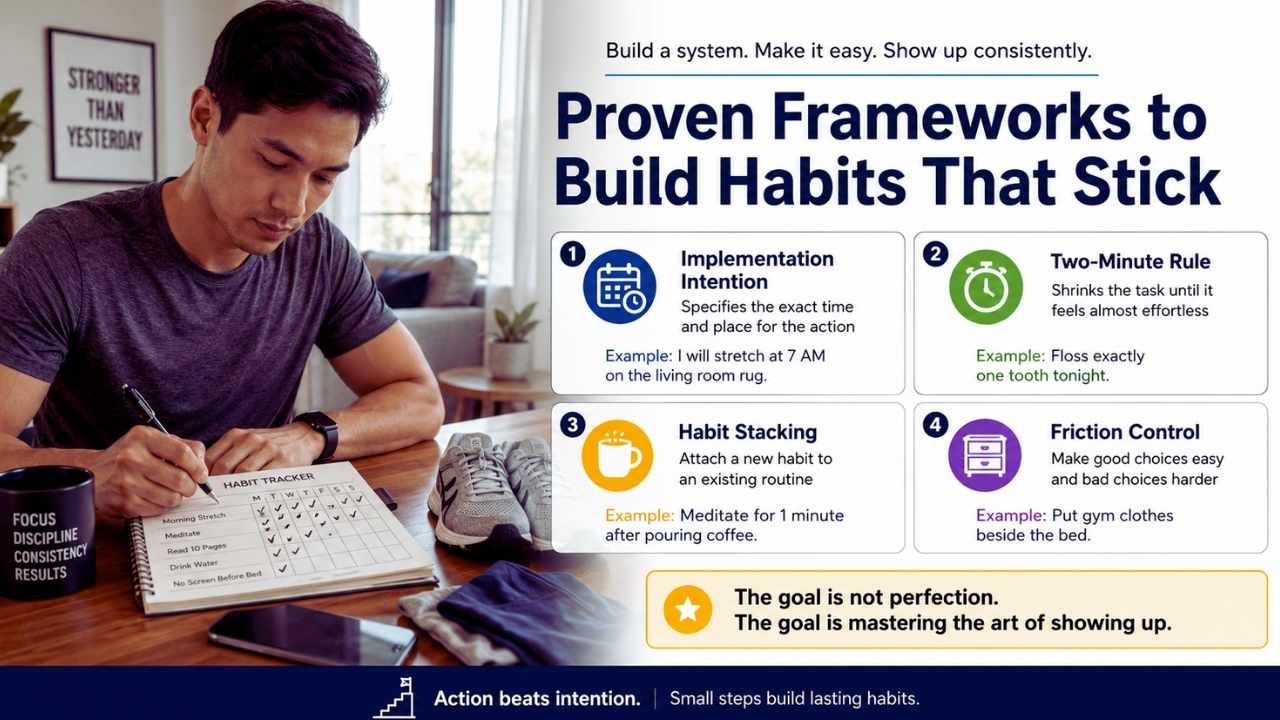
You simply cannot tell yourself you will do better tomorrow and expect anything to change. You need an actionable, concrete system designed specifically to bypass your brain’s natural resistance to new things. A major 2026 insight from the World Economic Forum highlighted that gradual behavior change improves long-term retention by over 30 percent.
People who write down specific “if-then” plans—known as implementation intentions—succeed at a massive 91 percent rate, compared to just 35 percent for people who only rely on motivation. You also need to scale your actions down until they feel ridiculously easy. If you want to start flossing, commit to flossing exactly one tooth tonight. If you want to run, just put your shoes on. The goal right now is not the physical result; the goal is mastering the art of showing up.
You can also use habit stacking, which means pairing a new action with a deeply established routine, like meditating for one minute right after pouring your morning coffee. Finally, ruthlessly eliminate friction for good choices and maximize friction for bad ones. Put the TV remote batteries in another room, or leave your gym clothes right next to your bed.
|
Framework Tactic |
How It Works Mechanically |
Real-World Example |
|
Implementation Intention |
Specifies exact time and location for the action |
“I will stretch at 7 AM on the living room rug.” |
|
Two-Minute Rule |
Shrinks the new task down to require zero motivation |
Flossing exactly one tooth every single night. |
|
Habit Stacking |
Pairs a new action tightly with an existing routine |
Doing five squats immediately after brushing your teeth. |
|
Friction Control |
Alters the physical environment to guide behavior |
Putting junk food on the highest, hardest-to-reach shelf. |
Master the Implementation Intention
Vague goals die fast. Your brain cannot process broad instructions like “I want to exercise more.” It needs highly specific directives. Use this exact formula: I will [BEHAVIOR] at [TIME] in [LOCATION]. Instead of saying you will read more, write down that you will read for exactly 15 minutes at 8:00 PM sitting in the living room chair.
The Magic of the Two-Minute Rule
Human behavior depends heavily on how easy an action is to perform. High-effort tasks require incredibly high motivation. Since motivation naturally fluctuates, difficult new routines almost always fail. Scale your habit down so it takes less than two minutes. The volume comes later; right now, you are just building the neural pathway.
Strategic Environmental Design
If you want to run in the morning, lay out your shoes, clothes, and water bottle the night before. You remove the friction of finding gear in the dark. If you want to stop mindlessly scrolling on your phone, charge it in the kitchen overnight instead of on your nightstand. The sheer annoyance of having to get out of bed to retrieve it forces your brain completely out of autopilot mode.
The Reality of Consistency and Tracking
A massive roadblock we face when trying to establish permanent changes is the toxic mindset of perfectionism. I see people abandon their goals entirely just because they missed a single Tuesday workout or ate one bad meal. Let us clear up a massive societal misconception right now: it absolutely does not take 21 days to form a habit. According to a 2024 meta-analysis and reinforced by 2026 behavioral research, the actual median time to build a habit sits between 59 and 66 days.
Depending on the complexity of the task, the real timeline ranges anywhere from 18 to 254 days. Interestingly, morning routines form significantly faster than evening ones because our environmental cues are more consistent and our willpower reserves are full early in the day. The best thing you can do is adopt the “Never Miss Twice” rule. Missing one single day has zero measurable impact on your long-term progress.
The permanent damage only occurs when one missed day snowballs into a streak. Using a physical wall calendar or a digital tracker to cross off successful days creates a powerful visual chain, giving your brain a quick dopamine hit every single time you mark your progress.
|
Tracking Method |
Best Used For |
Psychological Benefit |
|
Wall Calendar (Chain Method) |
Daily repetitive tasks like writing or daily exercise |
Provides strong visual momentum and instant dopamine release |
|
Habit Tracker Mobile Apps |
Managing multiple routines simultaneously |
Offers easy personal data analysis and automated reminders |
|
Accountability Partner |
High-resistance, deeply difficult tasks |
Adds positive social pressure and mutual emotional support |
Debunking the Fake Timeline Myths
Expecting to change your life in 21 days sets you up for inevitable disappointment. Drinking a glass of water every morning might take three weeks to become a habit, but doing fifty pushups before breakfast could take eight entire months. Respect the process. The habit tracking app market, which hit $1.7 billion recently, thrives entirely on helping people visualize this long-term consistency.
The “Never Miss Twice” Principle
When you inevitably mess up—and you will—do not panic. Missing a day does not delete your progress. The only rule you need to follow is to never miss twice in a row. If you skip a scheduled workout, you make absolutely certain you execute the habit the very next day. This stops the slide back into old behaviors dead in its tracks.
Think Like a Pro: The Identity Shift
Ultimately, the people who successfully build lasting behaviors do not just change their daily actions; they fundamentally change how they view themselves. Most people set outcome-based goals, like wanting to lose twenty pounds or wanting to write a book. The fatal flaw here is focusing entirely on a distant, future destination. Once you finally reach it, your core motivation vanishes instantly, and the old, comfortable routines creep right back in to take over.
You need to aggressively shift to identity-based goals. Instead of trying to read a book, your goal is to become a reader. Instead of trying to run a race, your goal is to become a runner. When your daily actions perfectly align with your internal identity, you finally stop fighting yourself. A true runner does not have to psych themselves up to go for a jog; running is simply what they do. True behavior change is identity change.
Every single time you perform your small, daily action, you are actively casting a vote for the exact type of person you wish to become. I apply this exact mindset to my own leadership style and professional drive, knowing that greatness requires invisible, relentless devotion to the process.
|
Focus Area |
Core Mindset Focus |
Example Internal Dialogue |
|
Outcome-Based |
Fixated completely on the final result |
“I need to hit 10,000 steps today so I can lose weight.” |
|
Process-Based |
Fixated on executing the daily system |
“I will walk for twenty minutes right after dinner tonight.” |
|
Identity-Based |
Fixated on developing a new self-image |
“I am the exact type of person who prioritizes daily movement.” |
Outcome vs. Identity Goals
Outcome goals fixate on what you want to get. Identity goals fixate on who you want to be. I always look at Sachin Tendulkar when I think about this level of dedication. He has been a lifelong inspiration to me, and his mastery on the pitch was not just born of raw, natural talent. It was built on an invisible, relentless devotion to daily practice. He did not rely on being “in the mood” to train. He had a system that demanded consistency, and he fully embodied the identity of a master craftsman.
Casting Votes for Your Future Self
You do not have to be perfect to change your identity. If you exercise three days out of the week, the majority of your votes for that week are cast for the identity of an athlete. Over time, the evidence piles up, and your brain starts to believe the new story you are telling it.
Final Thoughts
You do not rise to the level of your goals; you fall to the level of your systems. If you truly want to transform your daily life, stop aiming for massive, sweeping overnight overhauls. Start paying incredibly close attention to the small, seemingly insignificant actions you take on autopilot every single day.
To permanently build habits that stick, you have to respect the science. Start impossibly small. Tie your new behaviors tightly to existing routines. Ruthlessly design your physical environment to make good choices effortless. Give yourself some grace when you inevitably stumble, but enforce the “Never Miss Twice” rule without exception. Change takes immense patience, but with the right science-backed systems wired into your day, your daily routines will inevitably compound into massive, undeniable success.
Frequently Asked Questions (FAQs) About Build Habits That Stick
Can I build multiple habits at the exact same time?
Behavioral scientists strongly advise against this. Your brain has limited bandwidth. Trying to overhaul your diet, exercise routine, and sleep schedule all at once leads to total burnout. Focus intensely on one specific habit until it reaches automaticity, then move to the next.
What is an “extinction burst” and why does it cause relapse?
An extinction burst is a sudden, aggressive spike in the intensity of a bad habit right after you attempt to quit it. Your brain panics because it misses its usual dopamine hit. Knowing that cravings actively spike around days 3 to 5 helps you ride out the storm without relapsing.
How does stress impact habit formation?
Stress actively suppresses your prefrontal cortex and hands control straight over to the basal ganglia. Under high stress, you will always revert to your most deeply ingrained habits.