


Most people aren’t lazy. They’re distracted. You sit down to finish one important task. Then an email pops up. A message lands. A meeting reminder flashes. You check one thing. Then another. Ten minutes later, your main task is still open, but your focus is gone.
That’s how work feels now. Deep work explained in simple words means doing hard, valuable work with full focus and no distractions. It’s the kind of work that helps you think clearly, solve problems, write better, learn faster, and create something useful. Deep work isn’t about working longer hours. It’s not about acting busy. It’s about giving your best attention to the task that matters most.
That matters more than ever. Recent workplace research shows that many knowledge workers now deal with constant pings, ad hoc meetings, after-hours messages, and too little uninterrupted focus time. Workers may spend more time communicating than creating. Many also feel their workday has become chaotic and fragmented.
That explains why so many people feel tired but not truly productive. Deep work gives you a way out. It helps you stop reacting all day and start doing work that actually moves things forward.
Deep Work Explained: What It Really Means
Deep work is focused work on a task that needs serious thinking. Cal Newport, who popularized the term, describes deep work as distraction-free concentration on a mentally demanding task. Put simply, it means choosing one hard thing and staying with it long enough to make real progress.
Writing a strong article is deep work. Building a strategy is deep work. Studying a complex topic is deep work. Debugging code is deep work. Planning a content cluster is deep work. Replying to routine emails is usually not deep work. Moving cards around a project board is not deep work. Checking updates every few minutes is not deep work.
The difference is simple. Deep work creates value. Shallow work keeps things moving. You need both. But you shouldn’t let shallow work eat your best hours.
|
Key Idea |
What It Means |
Real Example |
Why It Matters |
|
Deep work |
Focused work on a demanding task |
Writing, coding, research, strategy |
Creates valuable output |
|
Shallow work |
Easy work that can be done while distracted |
Email, admin, routine updates |
Keeps daily work moving |
|
Focus block |
Protected time for one task |
60 minutes of writing |
Reduces switching |
|
Cognitive demand |
Work that needs real thinking |
Editing, analysis, planning |
Builds skill |
|
Distraction-free work |
No switching during the session |
Phone away, tabs closed |
Improves quality |
|
Output clarity |
Knowing what you’ll finish |
Draft 800 words |
Prevents drifting |
Deep Work Is Not Just Working Hard
You can work hard and still stay scattered. A full day of emails, meetings, dashboards, calls, and quick replies can feel intense. But that doesn’t always mean you made meaningful progress.
Deep work has a target. You know what you’re trying to finish. You remove distractions. You stay with the task. You produce something that matters. That is why one focused hour can often beat several scattered hours.
Deep Work vs Shallow Work
Shallow work isn’t bad. Every job has it. You need to answer emails. You need to send updates. You need to attend some meetings. You need to check data, organize files, and handle small tasks. The problem starts when shallow work takes over your best mental energy.
If you do email first, chat second, meetings third, and creative work last, you may never reach your best thinking. Deep work should come before the day becomes noisy. A better approach is to protect deep work during your sharpest hours and batch shallow work into smaller windows.
Why Deep Work Matters More Today
Work has become noisy. Messages arrive all day. Meetings appear with little warning. Apps fight for attention. Many people no longer get a clean stretch of time to think.
Workplace research from Microsoft shows that employees using digital tools face heavy interruption patterns. Microsoft’s 2025 findings point to frequent notifications, ad hoc meetings, and blurred workday boundaries. Its 2023 research also found that many people don’t get enough uninterrupted focus time.
This is not just annoying. It changes the quality of work. When your attention keeps breaking, your work gets slower. You lose the thread. You make more mistakes. You spend more time restarting than creating. You may still look busy. But the real work gets pushed aside. Deep work matters because it protects your attention before the day gets swallowed by noise.
|
Modern Work Problem |
What Happens |
Real Impact |
Better Response |
|
Constant notifications |
Attention breaks often |
Hard tasks take longer |
Turn off non-urgent alerts |
|
Ad hoc meetings |
The day becomes unpredictable |
Focus blocks disappear |
Use meeting rules |
|
After-hours messages |
Work has no clean ending |
Recovery gets weaker |
Set response boundaries |
|
Too much communication |
Creation time shrinks |
Output quality drops |
Batch replies |
|
App switching |
The brain keeps resetting |
Mental fatigue rises |
Use one tool at a time |
|
Information overload |
People search instead of create |
Decisions slow down |
Keep clear notes |
The Workday Has No Clean Edges
Many people now check messages before breakfast. They reply between meetings. They squeeze real work into tiny gaps. Then they return at night because the day never gave them enough quiet time.
That’s a bad trade. Your best work should not always happen after everyone else stops interrupting you. Deep work protects your important work earlier. It gives the day a stronger shape. Instead of waiting for silence, you create it.
Focus Is Now a Career Skill
Fast replies are common. Deep thinking is rarer. People who can focus well can write better, solve harder problems, learn faster, and make smarter decisions. That makes deep work a real career advantage.
In a distracted workplace, focus stands out. A person who can produce one clear strategy document, one strong report, one useful product idea, or one polished article has more value than someone who only reacts quickly all day.
What Research Says About Distraction and Task Switching
Your brain doesn’t jump between hard tasks as smoothly as you think. When you stop writing to check a message, your attention doesn’t return instantly. You have to rebuild the thread. You need to remember where you were, what you were thinking, and what came next.
That takes energy. Research on interrupted work has found that people may work faster after interruptions, but they often feel more stress, frustration, time pressure, and effort. That means the task may still get done, but it feels harder than it needed to.
Task switching also has a cost. The brain needs time to reorient itself. Even small switches can add up across a full workday. Heavy media multitasking can make focus even harder. Research has found that heavy media multitaskers are more vulnerable to irrelevant information and may perform worse on some attention and task-switching tests. The lesson is clear. Your brain works better when it gets fewer unnecessary switches.
|
Research Insight |
What It Means in Daily Work |
Common Sign |
Better Habit |
|
Interruptions raise stress |
You may work faster but feel worse |
More pressure, less calm |
Reduce avoidable pings |
|
Task switching costs energy |
The brain must reset |
You lose your place |
Batch similar tasks |
|
Multitasking weakens focus |
Irrelevant things become harder to ignore |
You chase every alert |
Close extra tabs |
|
Context matters |
Returning to a task takes effort |
Restarting feels slow |
Keep notes before stopping |
|
Recovery matters |
The brain needs breaks |
Focus drops late in the day |
Take real pauses |
|
Attention improves with practice |
Focus is trainable |
Sessions get easier |
Start with short blocks |
“Just Checking” Is the Trap
“Just checking” sounds harmless. You check one email. Then you see a second one. Then a chat message pulls you in. Then you remember another task. Suddenly, your main task feels far away.
The check may take one minute. The restart takes much longer. A better rule is simple: don’t check during deep work. If something pops into your mind, write it down. Then return to the task.
Multitasking Feels Productive, But Often Isn’t
Most people aren’t doing many hard things at once. They’re switching fast. That can feel productive because you’re active. But activity isn’t the same as progress.
Deep work helps you stop bouncing between tasks and start finishing the right ones. The goal isn’t to become a better multitasker. The goal is to need less multitasking.
Benefits of Deep Work
Deep work gives your best energy to your best work. It improves quality. It reduces mental clutter. It helps you learn faster. It makes progress visible. It also gives your day more control. When you finish a deep work block, you usually have something real to show for it.
That feeling matters. A completed draft, a solved problem, a clear plan, or a finished section gives you proof that the day moved forward. Deep work also protects your confidence. You stop ending every day with the same thought: “I was busy, but what did I actually finish?” Instead, you can point to real output.
|
Benefit |
Why It Matters |
Real-Life Example |
Long-Term Value |
|
Better output |
Full attention improves quality |
Cleaner article draft |
Stronger reputation |
|
Faster learning |
Focus helps hard ideas stick |
Learning SEO or coding |
Skill growth |
|
Less mental noise |
Fewer switches reduce stress |
Calmer workday |
Better energy |
|
More creativity |
Ideas need quiet space |
Stronger campaign concept |
Better original work |
|
Better decisions |
Deep thinking reveals trade-offs |
Clearer strategy |
Fewer poor choices |
|
Career growth |
Valuable skills compound |
Better work portfolio |
Higher professional value |
|
More control |
You choose what matters |
Protected focus blocks |
Less reactive work life |
Deep Work Improves Quality
Good work needs space. A strong article, SEO plan, design, business model, or technical solution can’t grow from constant interruption. These tasks need time for ideas to connect.
When you stay with one task, you notice details. You find weak points. You improve structure. You make better choices. That is why deep work improves quality. It gives your thinking enough room to work.
Deep Work Builds Skill
Skill grows when you stretch your mind. If you only do easy tasks, you may stay busy but stop improving. Deep work pushes you into the harder zone where growth happens.
That applies to writing, editing, research, coding, design, marketing, leadership, and learning. The more often you practice focused work, the easier it becomes to enter that state again.
Deep Work Makes the Day Feel Cleaner
A scattered day feels heavy because you keep restarting. Deep work removes some of that friction. You choose a task. You block time. You remove distractions. You finish a clear piece of work.
That feels different from simply surviving the inbox. It gives the day a backbone.
How to Practice Deep Work Step by Step?
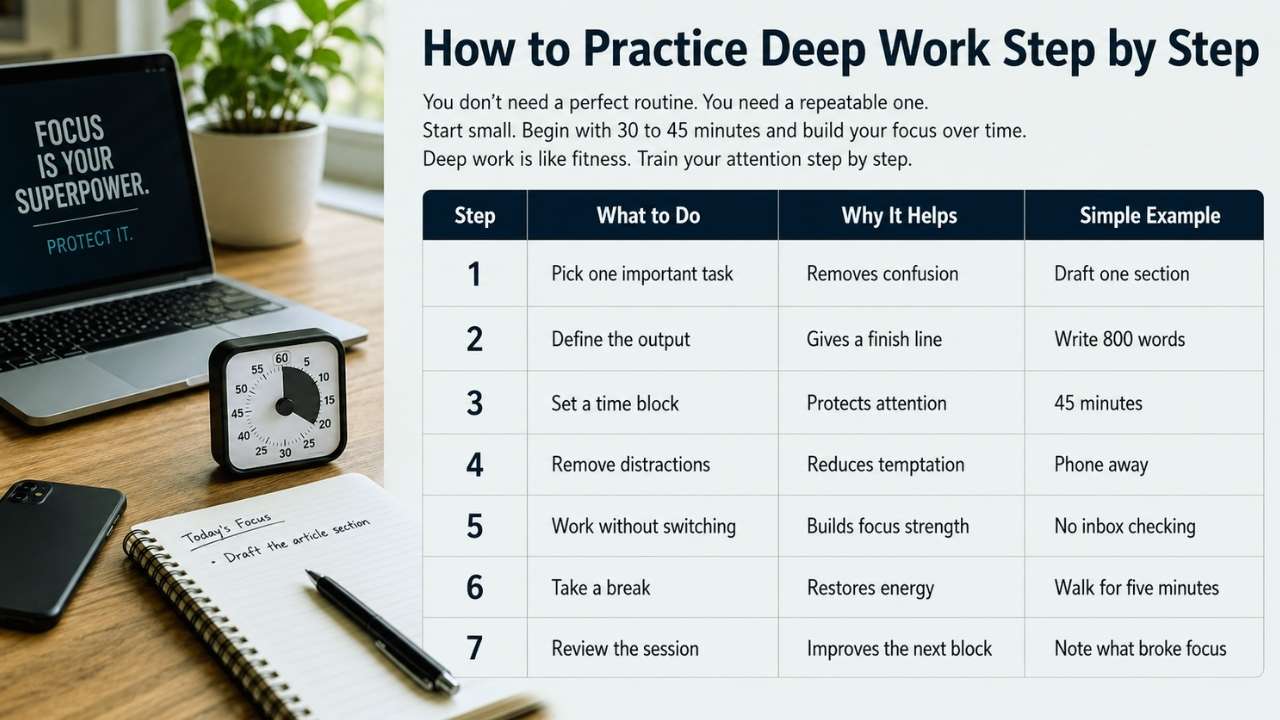
You don’t need a perfect routine. You need a repeatable one. Start small. If you’re used to checking your phone every few minutes, don’t begin with a four-hour focus block. Start with 30 to 45 minutes.
The point is not to become a machine. The point is to train your attention. Deep work is like fitness. You don’t start with the heaviest weight. You start where you are, repeat the habit, and build capacity over time. Each session should have one clear task, one time limit, and one visible result.
|
Step |
What to Do |
Why It Helps |
Simple Example |
|
1 |
Pick one important task |
Removes confusion |
Draft one section |
|
2 |
Define the output |
Gives a finish line |
Write 800 words |
|
3 |
Set a time block |
Protects attention |
45 minutes |
|
4 |
Remove distractions |
Reduces temptation |
Phone away |
|
5 |
Work without switching |
Builds focus strength |
No inbox checking |
|
6 |
Take a break |
Restores energy |
Walk for five minutes |
|
7 |
Review the session |
Improves the next block |
Note what broke focus |
Step 1: Choose One High-Value Task
Pick a task that needs real thinking.
Ask yourself:
- Will this task create value?
- Does it need concentration?
- Will distraction hurt the quality?
- Will finishing it make the day feel successful?
If yes, it deserves deep work. Do not waste your best focus on tiny tasks. Save it for work that has real weight.
Step 2: Define a Clear Output
Vague tasks create weak sessions.
Don’t write: “Work on article.”
Write: “Draft the first 800 words.”
Don’t write: “Improve SEO.”
Write: “Review the top 10 pages and list content gaps.”
Don’t write: “Plan content.”
Write: “Create a 12-topic cluster map.”
A clear output gives your brain a target.
Step 3: Set the Rules Before You Start
Before the session begins, decide how long you’ll work, what you’ll finish, which tabs can stay open, where your phone will be, and what you’ll do if another task comes to mind.
Keep the answer simple. Write distractions on paper. Don’t follow them. This one habit can save the whole session.
Step 4: End With a Closing Ritual
Don’t end a deep work block by falling into email or social media. Close the session cleanly. Save your work. Write the next step. Note what distracted you. Take a real break. Return later with a clear starting point.
A clean ending makes the next session easier. It also teaches your brain that deep work has a beginning and an end.
Deep Work Schedule Examples
Deep work won’t look the same for everyone. A writer may need a long morning block. A manager may need two short sessions. A student may work better at night. A parent may need flexible windows.
The best schedule is the one you can actually repeat. A perfect schedule that collapses after two days is not useful. A simple 45-minute daily block that you can keep for months is powerful.
The trick is to protect your best energy, not just your leftover time. If your morning is sharp, use it. If your home is quieter at night, use that. If your workday is full of meetings, protect one smaller focus block before the day turns reactive.
Read Also: How to Build a Three-Fund Portfolio for Long-Term Growth
|
Schedule Type |
Best For |
How It Works |
Practical Tip |
|
Morning deep work |
Writers, students, strategists |
Use the first 60 to 90 minutes for hard work |
Avoid email first |
|
Time blocking |
Busy professionals |
Put focus blocks on the calendar |
Treat it like a meeting |
|
Batching |
Managers and editors |
Group email, calls, and admin |
Reply in windows |
|
Weekly focus day |
Founders and creators |
Keep one day mostly meeting-free |
Plan it in advance |
|
Split sessions |
Parents and freelancers |
Use two shorter blocks |
Protect small windows |
|
Team focus hours |
Companies and teams |
Shared no-meeting time |
Make it visible |
Morning Deep Work
Morning works well because the mind is often fresher before the day gets noisy. A simple routine works best. Keep your phone away. Open only the file you need. Work for 60 minutes. Avoid email before the session. Review what you finished.
This protects your best energy. Even if you can’t control the full day, you can often control the first hour.
Time Blocking
Time blocking gives every part of the day a job. For example, you might write from 8:30 to 10:00, check email from 10:00 to 10:30, research from 10:30 to 11:30, reply to the team before lunch, and edit in the afternoon.
This removes the constant question: “What should I do now?” You already know. Time blocking also makes overload visible. If your calendar has no room for deep work, the problem is no longer hidden.
Weekly Deep Work Day
Some work needs a bigger space. A weekly deep work day works well for strategy, research, writing, planning, product thinking, course creation, and long-form editing.
It works best when you batch meetings on other days. A focus day should not become a secret admin day. Protect it for work that needs real thought.
How Much Deep Work Should You Do?
Most people can’t do deep work for eight hours. That’s normal. Deep work is demanding. Beginners may manage 30 to 60 minutes. Experienced workers may handle two to four hours across the day. Don’t judge your focus by someone else’s routine.
The real question is not, “How many hours can I force myself to focus?” The better question is, “How much high-quality focus can I repeat without burning out?” That shift matters. Deep work should stretch you, not destroy you. If a session leaves you sharper and more satisfied, the rhythm is probably right. If it leaves you drained every day, the block may be too long or poorly timed.
|
Level |
Realistic Daily Target |
Best Format |
What to Watch |
|
Beginner |
30 to 60 minutes |
One short block |
Avoid phone checking |
|
Intermediate |
1 to 2 hours |
One or two blocks |
Protect breaks |
|
Advanced |
2 to 4 hours |
Two strong sessions |
Watch fatigue |
|
Busy manager |
30 to 90 minutes |
Priority focus block |
Reduce meetings |
|
Creative worker |
2 to 3 hours |
Morning creation block |
Keep output clear |
|
Student |
45 to 120 minutes |
Study blocks |
Use active recall |
|
Freelancer |
1 to 3 hours |
Client or creation blocks |
Batch admin work |
Quality Beats Duration
A clean 45-minute block beats a distracted three-hour session. Track output, not just time.
Ask what you finished, whether the work was better than usual, how often you switched, and what you should change next time. That turns focus into a skill.
Don’t Push Deep Work Into Exhaustion
Deep work needs energy. If you are hungry, sleep-deprived, stressed, or overloaded, focus will suffer. You may still sit at the desk, but the quality will drop.
Sometimes the smartest productivity move is a real break. Rest is not the enemy of deep work. It supports it.
How to Reduce Distractions Before Deep Work
You can’t rely on willpower alone. Willpower gets tired. Your environment should make focus easier.
That means removing common triggers before you start. The phone is the biggest one for many people. Even if you don’t pick it up, its presence can pull part of your attention. Email is another trap because it creates false urgency. Open tabs also split your thinking.
Deep work works better when the setup is clean. You don’t need a perfect office. You need fewer avoidable interruptions.
|
Distraction |
Why It Hurts |
Fix |
Better Rule |
|
Phone |
Easy dopamine loop |
Keep it in another room |
No phone during focus |
|
|
Creates false urgency |
Check at set times |
Reply in batches |
|
Chat apps |
Trains instant response |
Use focus status |
Pause notifications |
|
Open tabs |
Splits attention |
Use one-window work |
Only task tabs stay |
|
Noise |
Breaks thought flow |
Use headphones or quiet space |
Control what you can |
|
Meetings |
Fragment the day |
Batch or shorten them |
No agenda, no meeting |
|
Clutter |
Adds visual noise |
Clear the desk |
Start clean |
|
Random ideas |
Pulls you away |
Keep a scratchpad |
Write, don’t follow |
Use a Focus Setup Checklist
Before every deep work session, check your setup. Phone away. Notifications off. One task selected. One file open. Timer set. Water nearby. Clear next action.
This takes two minutes. It can save the whole session. The checklist works because it removes decisions. Once the setup is done, you only have one job: start.
Protect Your Browser
The browser is useful. It’s also a trap. Use one clean window for deep work. Close unrelated tabs. Keep only what the task needs.
If you keep drifting, use a website blocker during focus blocks. You can also create a separate browser profile for deep work with no social bookmarks, no shopping tabs, and no news shortcuts.
Set Communication Rules
Deep work becomes easier when people know when you’re available. Use a simple message: “I’m offline for a focus block from 9:00 to 10:30. I’ll reply after that.”
That isn’t rude. It’s clear. People usually respect boundaries when they understand them.
Deep Work for Different Roles
Deep work isn’t only for writers, programmers, or researchers. Almost every knowledge worker has tasks that need full attention. The task changes by role, but the principle stays the same. Protect the work that creates the most value.
A writer needs focus to shape ideas. An SEO specialist needs focus to read the SERP and spot patterns. A manager needs focus to make good decisions. A student needs focus to understand hard material. Deep work is not one habit for one profession. It is a way to protect serious thinking.
|
Role |
Deep Work Example |
Useful Output |
Common Distraction |
|
Writer |
Drafting long-form content |
Finished article section |
Research rabbit holes |
|
Editor |
Structural editing |
Stronger copy |
Constant revisions |
|
SEO specialist |
Search intent analysis |
Content gap map |
Too many tools |
|
Developer |
Debugging or building |
Working solution |
Chat interruptions |
|
Designer |
Concept development |
Strong visual direction |
Feedback overload |
|
Founder |
Strategy planning |
Clear decision document |
Urgent operations |
|
Student |
Studying hard material |
Better understanding |
Phone checking |
|
Manager |
Team planning |
Better priorities |
Meeting overload |
Deep Work for Writers and Editors
Writing is thinking. A strong article needs structure, facts, flow, examples, and judgment. That can’t happen well if you check messages every few minutes. Writers can use deep work for outlining, drafting, rewriting, fact-checking, headline testing, and search intent review.
Editors can use deep work to improve structure, remove weak sections, tighten flow, and sharpen the reader’s experience. The best writing often appears after the first messy pass. Deep work gives you enough time to reach that better version.
Deep Work for SEO Professionals
SEO can become shallow fast. Tools, dashboards, rankings, and reports can fill the day. But serious SEO work needs thinking.
Deep SEO work includes SERP review, search intent mapping, content gap research, internal linking strategy, technical audit review, and topic cluster planning. The tool gives data. Deep work turns that data into decisions. That is where the value sits.
Deep Work for Managers
Managers often struggle with deep work because their calendars are packed. But managers still need focus for hiring decisions, team planning, performance reviews, process design, strategy documents, and problem diagnosis.
A manager with no focus time becomes reactive. A manager with protected thinking time makes better decisions. Leadership needs space to think. Without that space, every decision becomes rushed.
Deep Work and AI Tools
AI can support deep work. It can also become another distraction. Used well, AI helps with research notes, outlines, summaries, editing, and planning. Used poorly, it creates more tabs, more options, and more average work. The key is to use AI with a clear job.
Don’t open an AI tool just because you feel stuck. First, define what you want from it. Do you need a summary? A structure? A list of missing angles? A clarity check?
AI works best when it supports your thinking, not when it replaces your attention. As AI makes average output easier to produce, deep human judgment becomes more valuable.
|
AI Use Case |
Good Use |
Risk |
Better Practice |
|
Research support |
Summarize notes |
Accepting weak facts |
Verify key claims |
|
Outline help |
Shape structure |
Generic headings |
Add human angle |
|
Editing |
Improve clarity |
Losing voice |
Keep your style |
|
Planning |
Compare options |
Overthinking |
Limit outputs |
|
Admin |
Summarize meetings |
Missing context |
Review manually |
|
Content ideas |
Find angles |
Repetitive suggestions |
Add experience |
|
Fact checking |
Spot gaps |
False confidence |
Use trusted sources |
Use AI Before or After the Focus Block
A cleaner workflow looks like this. Use AI to prepare notes or outline options. Start a deep work block. Think, write, edit, or solve the problem yourself. Use AI again to check gaps. Verify important claims.
This keeps you in control. AI can prepare the field. Deep work still does the thinking.
AI Doesn’t Replace Judgment
AI can speed up parts of work. But it can’t replace your judgment. You still decide what matters. You still check facts. You still shape the final message. You still bring context, taste, and responsibility.
That’s why deep work still matters in an AI-heavy workplace. The more tools we have, the more valuable clear thinking becomes.
Common Deep Work Mistakes
Most people don’t fail at deep work because they’re lazy. They fail because the setup is weak. They start without a clear task. They keep the phone nearby. They check email first. They work too long without a break. Then they wonder why focus feels impossible.
Deep work does not depend on motivation alone not depend. It depends on design. You need a better task, a better environment, a better time block, and a better ending. When the system improves, focus gets easier.
|
Mistake |
What Happens |
Better Move |
Why It Works |
|
No clear task |
You drift |
Define one output |
Gives direction |
|
Phone nearby |
You check it |
Put it away |
Removes temptation |
|
Email first |
You become reactive |
Create first |
Protects fresh energy |
|
Long sessions too soon |
You burn out |
Start with 45 minutes |
Builds capacity |
|
No break |
Focus drops |
Take recovery seriously |
Restores attention |
|
Too many tools |
You manage tools, not work |
Simplify |
Reduces noise |
|
No review |
You repeat mistakes |
Track what worked |
Improves next session |
|
No boundary |
Others interrupt |
Share focus time |
Sets expectations |
Mistake 1: Waiting to Feel Focused
You may not feel focused at first. That’s normal. Focus often shows up after you begin. Give your brain 10 minutes to settle.
If you quit every time the start feels messy, you’ll never reach the deeper part of the session.
Mistake 2: Treating Everything as Urgent
Urgent doesn’t always mean important. A message can feel urgent and still be low-value. A quiet task can feel less urgent but matter far more.
Deep work protects important work from loud work. That single shift can change your whole day.
Mistake 3: Copying Extreme Routines
You don’t need to copy someone who works deeply for four hours every morning. Start with your real life. Build from there.
A repeatable 45-minute block beats an ambitious plan you quit after two days. Consistency wins.
A 7-Day Deep Work Plan for Beginners
Use this plan to build the habit without making it complicated. The goal isn’t perfection. The goal is practice. A week is enough to notice your biggest distraction patterns. You’ll see when your energy is best, what pulls you away, and which tasks deserve focus.
This plan starts small because small habits stick better. By the end of the week, you should know your best focus window and your biggest focus leak. That is enough to build a stronger routine.
|
Day |
Focus Goal |
Action |
What to Notice |
|
Day 1 |
Notice distractions |
Track what pulls you away |
Main interruption source |
|
Day 2 |
Start small |
Do one 30-minute focus block |
How hard it feels |
|
Day 3 |
Remove phone |
Keep it away during work |
Phone urge frequency |
|
Day 4 |
Delay email |
Check email after deep work |
Morning focus quality |
|
Day 5 |
Extend the block |
Try 45 minutes |
Energy level |
|
Day 6 |
Review output |
Compare focused vs scattered work |
Work quality |
|
Day 7 |
Plan next week |
Put deep work on your calendar |
Best repeatable time |
Day 1: Track the Noise
Write down every time you switch tasks. You may be surprised by how often it happens. Do not judge yourself. Just observe. Awareness comes before change.
Day 2: Complete One Small Block
Pick one useful task. Set a timer for 30 minutes. Work only on that task. Don’t aim for perfect focus. Aim for no switching. If your mind wanders, bring it back. That’s the practice.
Day 7: Make It Repeatable
At the end of the week, choose your best focus time and protect it. Deep work becomes powerful when it becomes routine. Don’t build a routine around wishful thinking. Build it around the time that actually worked.
How Teams Can Support Deep Work?
Deep work is easier when teams respect focus. If every message needs an instant reply, nobody gets real thinking time. If meetings appear without warning, people can’t plan their best work. Teams need shared rules.
This is especially important for remote and hybrid teams. Digital tools make collaboration easier, but they also make interruption easier. A team can look connected while everyone’s attention is broken.
Good teams don’t just ask people to focus. They design work so focus is possible. That means fewer weak meetings, clearer response times, better written updates, and shared focus blocks.
|
Team Habit |
Why It Helps |
Example Rule |
Result |
|
Core meeting hours |
Protects focus windows |
Meetings only from 11 to 3 |
Better planning |
|
Async updates |
Reduces meeting load |
Written updates before calls |
Fewer calls |
|
Clear response times |
Lowers reply pressure |
Non-urgent replies within 24 hours |
Less anxiety |
|
Focus blocks |
Normalizes deep work |
No-meeting mornings |
Stronger output |
|
Better agendas |
Cuts weak meetings |
No agenda, no meeting |
Less wasted time |
|
Meeting notes |
Helps absent workers catch up |
Share summary after calls |
Better alignment |
|
Quiet channels |
Reduces random pings |
Use urgent tags only when needed |
Less noise |
Managers Must Model Focus
A team won’t protect focus if leaders reward instant replies all day. Managers should block focus time, cancel weak meetings, use async updates, avoid non-urgent after-hours pings, and praise finished work instead of constant availability.
Culture changes when attention gets treated as a real resource. If leaders want deep work, they must stop turning every small issue into an interruption.
Deep Work Should Be Visible
Deep work works better when people know it exists. Put focus blocks on calendars. Share response expectations. Agree on meeting windows. Use status messages honestly.
This removes confusion. People don’t have to guess whether you are ignoring them. They know you are working on something important and will reply later.
Deep Work Checklist
Use this checklist before every serious work block. A checklist may sound simple, but it works because focus often fails before the work starts. The phone stays nearby. Too many tabs stay open. The task is unclear. Notifications stay on. Then the session collapses.
A checklist prevents that. It turns deep work into a repeatable setup instead of a mood you hope for. You can keep this checklist on paper, in your notes app, or beside your desk. The goal is not to make work complicated. The goal is to remove the small leaks before they drain your attention.
|
Checklist Item |
Why It Matters |
Done |
|
I chose one important task |
Prevents drifting |
|
|
I defined the exact output |
Creates a finish line |
|
|
I set a clear time limit |
Protects the block |
|
|
I closed unrelated tabs |
Reduces temptation |
|
|
I moved my phone away |
Removes the biggest pull |
|
|
I turned off notifications |
Prevents interruption |
|
|
I told my team if needed |
Sets expectations |
|
|
I kept a scratchpad nearby |
Captures random thoughts |
|
|
I reviewed the session after finishing |
Improves next time |
Simple Deep Work Formula
Use this formula:
One task + fixed time + no switching + clear output = deep work.
That’s the core habit. You can build more rules later. But you don’t need a complex system to begin. Start with one block. Repeat it. Improve it.
Final Thoughts
Deep work isn’t about becoming unreachable. It’s about becoming intentional. The world will keep asking for your attention. Messages will keep arriving. Meetings will keep appearing. Feeds will keep refreshing. That noise won’t disappear on its own.
You need a system. Start small. Pick one important task. Block 45 minutes. Move your phone away. Close extra tabs. Work until the timer ends. Then review what happened. That simple habit can change how your day feels. Deep work explained at its core means this: protect your best attention for the work that matters most.
You don’t need a perfect routine. You need a repeatable one. Build that, and focus stops feeling like luck. It becomes a skill.
Frequently Asked Questions (FAQs) About Deep Work Explained
Is Deep Work the Same as Flow?
No flow is a mental state where work feels smooth and absorbing. Deep work is the practice that creates the conditions for focused, demanding work. Deep work can lead to flow, but it may also feel hard. Both count.
Can Deep Work Help With Burnout?
It can help if burnout comes from scattered attention and constant switching. But deep work isn’t a cure for exhaustion, poor management, or chronic stress. You also need rest, boundaries, and realistic workloads. Deep work should make the day cleaner, not heavier.
Can People With ADHD Practice Deep Work?
Some can, but the method may need adjustment. Shorter sessions, timers, visual checklists, body doubling, and lower-distraction environments may help. For medical or mental health concerns, speak with a qualified professional.
Does Deep Work Mean Ignoring Your Team?
No deep work works best with clear communication. Tell people when you’re offline and when you’ll respond. You’re not avoiding work. You’re protecting the work that needs focus.
Can Deep Work Work in a Noisy Home?
Yes, but you may need shorter blocks. Try headphones, a fixed work corner, early morning sessions, or timed focus sprints. You don’t need perfect silence. You need fewer avoidable interruptions.
Should I Listen to Music During Deep Work?
It depends on the task. For writing, reading, and analysis, lyrics can distract. Instrumental music, white noise, or silence often works better. Test it. Keep what improves output. Remove what slows you down.