


Look, I completely understand the hesitation. Nobody likes paying for insurance. You are already dropping a massive chunk of your hard-earned paycheck on rent, a security deposit, parking fees, and utilities. Tacking on yet another monthly bill just feels like a slap in the face. So, you look at your shrinking budget and ask yourself: do you need renters insurance, or is it just another way for property managers to squeeze extra money out of you?
Here is the brutal truth that most people ignore until it is too late. Recent data shows that only about 57 percent of renters actually have an active policy. That means over 40 percent of people renting right now are walking a financial tightrope without a safety net. Even crazier? A huge chunk of the people who do have it only bought it because their lease legally forced them to show proof before handing over the keys.
Most folks think their landlord’s hazard policy automatically protects them if a sudden fire breaks out or someone kicks in the front door while they are at work. It totally does not. If the guy in the apartment upstairs leaves his bathtub running and water ruins your laptop, your new couch, and your entire closet, your landlord pays exactly nothing to replace your stuff. You foot that massive bill entirely on your own. But here is the surprisingly good news: covering your back is ridiculously cheap. Let us look at what this coverage actually does, what it costs right now, and why skipping it is a massive financial gamble you should not take.
What Exactly Does Renters Insurance Cover?
When friends ask me, do you need renters insurance, they usually assume I am just telling them to buy a policy to protect a stolen television or a nice watch. But standard coverage is actually a three-headed financial bodyguard that does so much more than replace electronics. First, it protects your personal property. Imagine physically flipping your apartment upside down and shaking it.
Everything that falls out is your stuff: clothes, furniture, tech, kitchen gear, and bikes. If a fire, theft, or windstorm ruins it, your policy cuts you a check. Second, it covers personal liability, which is the real unsung hero here. If your dog nips someone in the hallway, or a buddy trips over a rug in your living room and snaps his wrist, they can easily sue you.
Your liability coverage steps in to pay their expensive medical bills and your legal defense. Third, it provides loss of use, which insurance folks call additional living expenses. If a kitchen fire makes your place completely unlivable, you cannot just sleep on the street. Loss of use pays for your hotel, takeout meals, and extra commuting costs while a construction crew repairs your apartment.
|
Coverage Type |
What It Actually Does |
Standard Limit Ranges |
Real-World Example |
|
Personal Property |
Replaces your stolen or destroyed belongings. |
$15,000 to $100,000 |
A burglar steals your MacBook and your expensive mountain bike. |
|
Personal Liability |
Pays legal fees and damages if you get sued. |
$100,000 to $500,000 |
Your dog bites a neighbor, and they need stitches and emergency care. |
|
Medical Payments |
Covers minor injuries to guests on your property. |
$1,000 to $5,000 |
A friend cuts their hand badly on a broken glass in your kitchen. |
|
Loss of Use |
Pays for a hotel if your unit is unlivable. |
30 percent to 50 percent of property limit |
A burst pipe floods your unit, forcing you into a hotel for two weeks. |
The Hidden Catch: Actual Cash Value vs. Replacement Cost
Before you blindly pull the trigger on a policy online, you absolutely need to understand exactly how insurers pay out their claims. This is where uninformed people get burned badly. Insurance companies use two completely different methods to value your ruined stuff: Actual Cash Value (ACV) and Replacement Cost Value (RCV).
Actual Cash Value pays you what your items were worth at the exact second they were destroyed. They heavily factor in depreciation over time. Say you bought a beautiful $2,000 couch four years ago. If a fire ruins it, an ACV policy will not give you two grand. It might hand you $1,200 because the couch is old and heavily used. If a new one costs $2,000 today, you pay that $800 difference straight out of your own pocket. ACV policies are cheaper upfront but super risky if disaster strikes.
Replacement Cost Value, on the other hand, pays exactly what you need to buy a brand-new, identical item today. If that old couch burns up, an RCV policy cuts you a check for what a new one costs at the store right now. It costs a few extra bucks a month, but it saves you from hunting for cheap, used furniture on Facebook Marketplace after a traumatic fire.
|
Feature |
Actual Cash Value (ACV) |
Replacement Cost Value (RCV) |
|
Payout Method |
Pays depreciated value (what it is worth today). |
Pays what it costs to buy a brand-new equivalent right now. |
|
Out-of-Pocket Risk |
High. You usually have to make up the cash difference yourself. |
Low. You get enough cash to replace the item entirely without stress. |
|
Monthly Premium |
Cheaper upfront cost. |
Slightly higher monthly cost. |
|
Best For |
Renters on an extremely tight, uncompromising monthly budget. |
Renters with high-value electronics, furniture, or large households. |
The Real Cost in 2026: Cheaper Than You Think
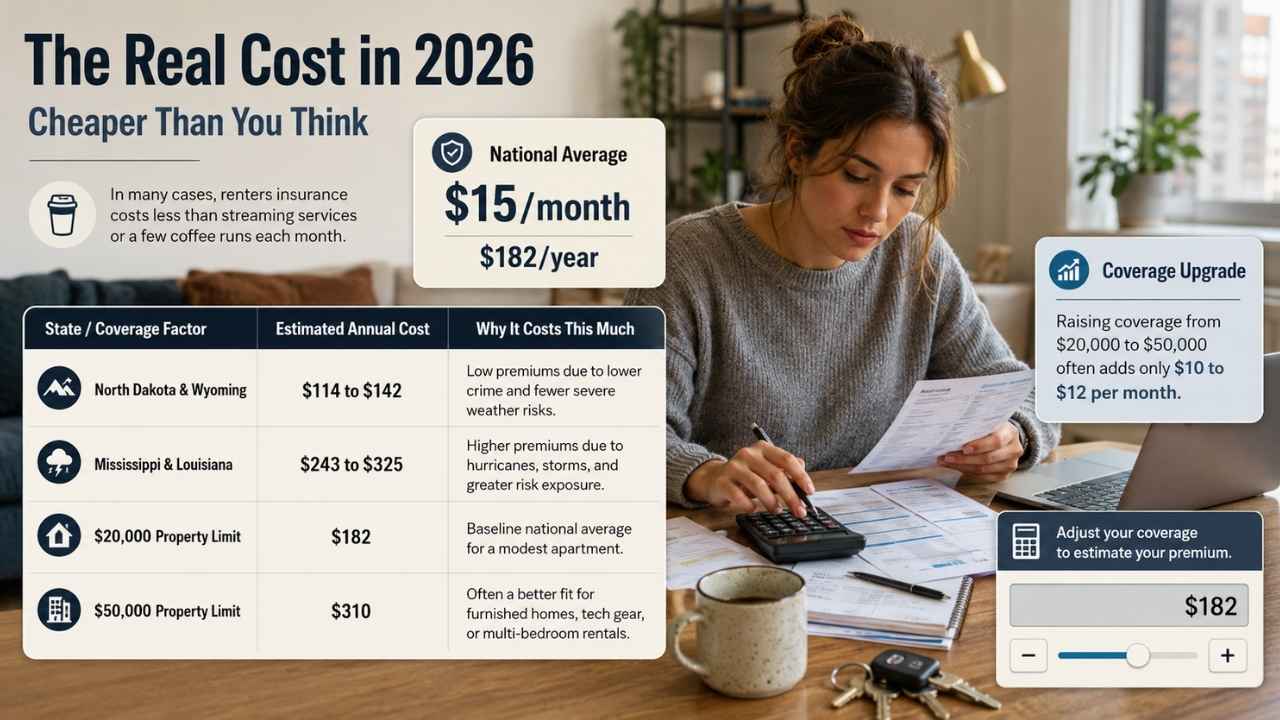
Let us talk specifically about money. The absolute biggest excuse people throw out for skipping this coverage is the monthly cost. But if you are asking do you need renters insurance strictly based on the price tag, prepare to be completely surprised. In 2026, the national average cost sits at roughly $15 a month, which works out to about $182 for an entire year.
You probably drop way more cash on streaming services or a few weekend coffee runs than you would on twelve months of coverage. Where you live heavily dictates your exact rate. If you rent in a coastal state prone to hurricanes or a city with high property crime, you pay more. For example, renters in Louisiana and Mississippi pay the highest rates in the country, averaging between $243 and $325 a year.
But if you live in Wyoming or North Dakota, you might pay as little as $114 to $142 annually. The amount of coverage you choose also bumps the price up or down slightly. Raising your personal property coverage from $20,000 to $50,000 usually only costs an extra $10 to $12 a month, making it an incredible financial bargain.
|
State / Coverage Factor |
Estimated Annual Cost |
Why It Costs This Much |
|
North Dakota & Wyoming |
$114 to $142 |
Lowest average premiums due to minimal severe weather risks and low crime. |
|
Mississippi & Louisiana |
$243 to $325 |
Highest average premiums due to extreme hurricane, flood, and storm exposure. |
|
$20,000 Property Limit |
$182 |
National average for baseline coverage tailored for a minimal apartment. |
|
$50,000 Property Limit |
$310 |
Better suited for furnished multi-bedroom units or higher-end gaming and tech setups. |
Use this interactive calculator below to see exactly how tweaking your personal limits changes your estimated monthly premium in real-time:
Landlord Insurance vs. Your Stuff (The Big Mix-Up)
We need to completely kill the most dangerous myth in renting right now. Your landlord absolutely has an insurance policy on the physical building you live in. But their policy protects their bank account and their physical assets, not yours. If a massive grease fire starts next door and burns the whole apartment building down, the landlord’s hazard insurance pays to rebuild the walls, the roof, and the plumbing.
It even pays them handsomely for the lost rental income while the building sits empty. What it will definitely not pay for is your burnt sneakers, your melted flat-screen television, or your ruined memory foam mattress.
Unless you hire a very expensive lawyer and definitively prove the landlord was explicitly negligent, you are entirely on your own for your losses. The landlord’s policy is strictly structural. When considering if do you need renters insurance, this exact nightmare scenario is why the answer is a screaming yes every single time.
Read Also: Sunk Cost Fallacy in Personal Finance: How to Avoid It
|
Scenario |
Landlord’s Insurance Pays For |
Your Renters Insurance Pays For |
|
Apartment Fire |
Rebuilding the walls, floors, and the physical structure. |
Replacing your furniture, clothes, shoes, and electronics. |
|
Burst Pipe Flood |
Fixing the broken plumbing and replacing the wet drywall. |
Replacing your ruined rugs, damaged laptops, and soaked bedding. |
|
Break-In/Burglary |
Fixing the broken front door or repairing a shattered window. |
Replacing your stolen jewelry, cash, and expensive gaming consoles. |
|
Visitor Injury |
Nothing (unless injured directly by severe structural neglect). |
The resulting medical bills if a guest tripped over your belongings inside your unit. |
Weird Stuff Your Policy Actually Covers
Most of us get the basic concept: fire burns your stuff, the insurance company buys you new stuff. But standard policies actually pack some incredibly awesome hidden perks that most renters completely miss out on. First, your coverage actively travels with you. If you fly to Europe for vacation and someone snatches your suitcase right out of a rental car, your renters insurance covers the theft.
\If a thief grabs your laptop from your table at a local coffee shop while you order a drink, you are fully covered. It usually extends up to 10 percent of your total property limit away from home. Second, it covers spoiled food. If a massive summer storm knocks out the local power grid for three days and your fridge turns into a warm science experiment, you can file a quick claim to restock all your expensive groceries.
Finally, it handles bizarre liability claims, like accidentally shattering a parked car’s windshield with a rogue golf ball. Your renters liability coverage will step up and pay for the costly glass damage without breaking a sweat.
|
Scenario / Item |
Is It Covered? |
Important Caveat |
|
Off-Premises Theft |
Yes. |
Covers items stolen from your car or while traveling, usually strictly capped at a percentage of your total limit. |
|
Spoiled Food |
Yes. |
Reimburses you for food lost during a prolonged power outage, but the outage must be caused by a covered peril like a storm. |
|
Earthquakes & Floods |
No. |
You must buy separate, standalone policies for these specific, large-scale natural disasters. |
|
Dog Bites |
Yes. |
Pays medical and legal bills, but many major insurers explicitly ban aggressive breeds like Pitbulls or Rottweilers. |
How to Hack Your Rate and Score a Discount?
If you have finally decided to buy a policy, you might as well get the absolute cheapest rate possible. Insurers offer a bunch of great discounts, but they rarely brag about them openly. You have to ask your agent directly. The absolute easiest way to slash your monthly premium is by bundling your coverage. If you already pay for car insurance, call that exact same company and ask to add a renters policy to your account.
Most companies offer a 10 percent to 25 percent multi-policy discount right off the top. Sometimes, the overall savings on your auto insurance completely wipe out the new cost of the renters policy, making it practically free. Next, take a hard look around your apartment complex. Does your building have gated access, security cameras, or a front desk concierge?
Do you personally have a heavy-duty deadbolt, a modern smoke detector, or a fire sprinkler inside? Insurers happily hand out discounts for modern safety features because they drastically lower the chance of theft or severe, out-of-control fires. Finally, consider tweaking your deductible to save even more cash over the long haul.
|
Discount Strategy |
How It Works |
Estimated Savings |
|
Bundling (Multi-Policy) |
Buying renters insurance directly from your existing auto insurer. |
10 percent to 25 percent off your total combined insurance bill. |
|
Raising the Deductible |
Changing your upfront deductible from $500 to a higher $1,000 threshold. |
Saves you roughly $15 to $20 a year on premium costs. |
|
Safety Features |
Having strong deadbolts, modern burglar alarms, or indoor fire sprinklers. |
5 percent to 15 percent off your total renters premium. |
|
Claims-Free History |
Going 3 to 5 full years without filing any minor or major insurance claims. |
Up to 20 percent off your rate with select major carriers. |
Final Thoughts
Let us bring this entire conversation back down to reality. Ultimately, do you need renters insurance? If you have thirty grand in hard cash sitting in a checking account right now to completely replace your furniture, your entire wardrobe, and your tech gear, then you are probably fine. If you can easily pay for a hotel for a solid month while your building burns down without breaking a sweat, then no, you do not technically need it.
But if you are like the rest of us, operating on a tight monthly budget and desperately trying to build up your savings, going without it is like driving on the highway without wearing a seatbelt. For roughly $15 a month, you completely protect yourself from total financial ruin and endless legal headaches. Stop assuming your landlord has your back when things go completely wrong.
They do not. Protect your hard-earned stuff, protect your personal liability, and just buy the policy. It is quite literally one of the only financial safety nets available today that genuinely costs less than your weekend pizza habit.
Frequently Asked Questions (FAQs) About Do You Need Renters Insurance
Does renters insurance cover bed bugs?
Nope, almost never. Insurers consider pests—bed bugs, mice, roaches—a maintenance issue, not a sudden disaster. You and your landlord get to fight over who pays the exterminator.
What happens if my roommate steals my stuff?
If you and your roommate share a policy, you’re out of luck. Insurance doesn’t cover theft by people named on the policy. If you have separate policies, you can file a claim, but you’ll need a police report. (Pro tip: Always buy your own separate policy).
Are my expensive engagement rings fully covered?
Yes, but with strict caps. Standard policies limit payouts on luxury items like jewelry, firearms, and high-end electronics. If someone steals a $10,000 engagement ring, a standard policy might only hand you $1,500. You need to buy an “endorsement” or a “rider” to fully cover expensive jewelry.
Does my policy cover damage I do to the apartment?
Yes, under the liability section. If you fall asleep boiling pasta and start a fire that ruins the kitchen cabinets, your liability coverage pays the landlord for the repairs.