


Your LinkedIn profile is basically a digital resume. But here’s the problem: your experience section only tells your side of the story. Anyone can type out a list of impressive achievements. You can easily claim you’re a visionary leader or a marketing expert. The real magic happens when someone else publicly backs up those exact claims. That’s where LinkedIn recommendations come into play.
They act as permanent letters of reference. They validate your work ethic, technical skills, and character. When recruiters or potential clients browse your page, a glowing recommendation provides instant social proof. But let’s be real. Getting a generic pat on the back doesn’t help you anymore. Hiring managers scan right past empty praise. To stand out today, you need specific, impactful testimonials that prove your niche expertise. Back in May 2026, while I was overseeing a massive multi-lingual content rollout across German, Spanish, French, and Hindi markets for our platform at Editorialge, I had to review dozens of digital profiles to bring on specialized talent.
I didn’t have time to guess who was actually good at their job. I looked straight at their recommendations. The professionals who had specific, metric-driven praise stood out instantly. Just as Sachin Tendulkar didn’t become a cricket legend simply by claiming he was good—his technique was validated by coaches, peers, and millions of fans—you need others to validate your professional skills. Let’s break down a practical strategy to get linkedin recommendations that elevate your personal brand and unlock serious career opportunities.
Why You Must Focus on LinkedIn Recommendations in 2026
If you think recommendations are just a polite gesture, you’re missing out on massive profile traffic. A solid recommendation is a powerful endorsement that signals trust to both humans and search algorithms. Over 1.3 billion members use the platform globally across 200 countries today. With the massive influx of AI-generated applications, human trust is at a premium.
Nearly 66 percent of recruiters admit it’s harder than ever to find qualified talent. When recruiters use the platform’s backend tools, they filter candidates by specific skills. Profiles packed with optimized content, including recommendations that naturally use industry keywords, simply rank better. Hiring managers want skills-first validation. They want proof you can actually run digital marketing campaigns, manage content pipelines, or code an application. We naturally trust the opinions of others.
A recruiter feels much safer reaching out if your past managers publicly champion your daily work. It lowers the risk of hiring a stranger. You go from being a risky unknown to a vetted professional. Plus, detailed recommendations keep people reading your page longer. High dwell time tells the algorithm your profile provides value, which passively boosts your overall reach. You must proactively manage this section if you want to compete.
|
Benefit Area |
Impact on Your Career |
Real-World Value |
|
Recruiter Trust |
Validates your specific skills |
Reduces hiring risk and shortens interviews |
|
Search Visibility |
Boosts overall profile completeness |
Increases appearances in targeted searches |
|
Social Proof |
Provides third-party verification |
Backs up the claims on your digital resume |
|
Engagement |
Keeps viewers reading your page longer |
Strengthens your personal brand authority |
The Anatomy of a High-Converting Endorsement
Before you start asking people for favors, you must understand what a winning recommendation actually looks like. A weak review is vague, short, and packed with empty corporate jargon. A strong one is specific, story-driven, and hyper-focused on hard results. Hiring managers spot low-effort, AI-generated fluff from a mile away. You want your colleagues to write something authentic, punchy, and grounded in reality. A highly effective recommendation follows a simple four-part narrative.
First, it needs a strong hook defining exactly how you worked together. Second, it must include the context, such as the specific project, campaign, or crisis you tackled together. Third, the writer must highlight the unique core strength you brought to the table. Finally, it must state the tangible business result that happened directly because of your work. Look at the difference between a weak and strong example. A weak review says you’re a great project manager who shows up on time.
A strong review says you streamlined a multi-lingual content production pipeline, kept the project two weeks ahead of schedule, and optimized the SEO workflow to secure a 20 percent bump in organic traffic. Or perhaps it highlights how you meticulously audited organizational data tables, catching that a specific corporate entity was entirely replaced by another brand before publication. The second option proves your worth with actual business metrics. This is exactly what you should aim for when you get linkedin recommendations from your network.
|
Review Element |
Weak Example |
Strong Example |
|
Focus |
Vague traits (nice, helpful) |
Tangible business outcomes |
|
Tone |
Robotic or generic |
Authentic and conversational |
|
Evidence |
None provided |
Specific examples and data |
|
Length |
One brief, throwaway sentence |
A focused, punchy paragraph |
A Step-by-Step Strategy to Get LinkedIn Recommendations
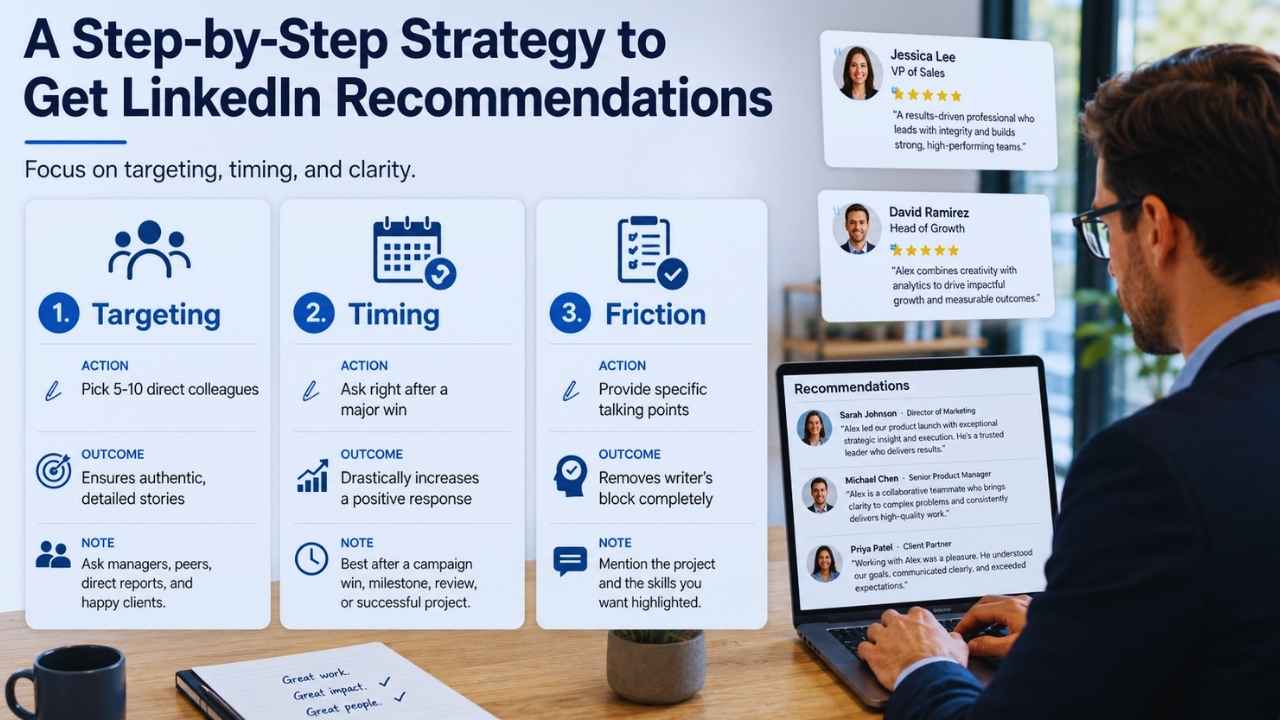
Getting great testimonials takes a deliberate approach. You can’t just blast automated requests to everyone in your network and cross your fingers. You need a targeted strategy built on timing, personalization, and clarity. Start by mapping out your target list. Identify the right people who can offer a diverse mix of professional perspectives. Reach out to former managers, direct reports, peers, and happy clients. Make a tight list of five to ten people who actually know your day-to-day work habits. Asking an executive you met for five minutes will only result in a generic blurb.
Stick to colleagues who’ve seen you in the trenches. Next, time your request perfectly. Timing dictates your success rate. Don’t wait until you’re desperately hunting for a new job to ask. The absolute best time to request a review is when your value is top-of-mind. Great triggers include wrapping up a successful digital campaign, passing your annual review, hitting a major revenue milestone, or right before a favorite colleague leaves the company.
Finally, make the request frictionless. People are incredibly busy. If you send a blank request, they have to try to remember what you did two years ago. They’ll procrastinate and eventually forget. Remind them of a specific project you crushed together. Tell them exactly which skills you want them to highlight.
|
Action Step |
What You Need to Do |
Expected Outcome |
|
Targeting |
Pick 5-10 direct colleagues |
Ensures authentic, detailed stories |
|
Timing |
Ask right after a major win |
Drastically increases a positive response |
|
Friction |
Provide specific talking points |
Removes writer’s block completely |
Proven Outreach Templates That Guarantee a Response
To secure high-quality responses, personalize your outreach messages. Never use the platform’s default, automated text. It looks lazy, and it rarely gets a meaningful response. You have to craft a message that sounds like it came from a human being. Use these proven templates as a starting point. Tweak the details to match your specific voice, industry, and relationship. For a former manager, try this. Say you’re updating your profile to reflect recent growth in technical SEO and content strategy.
Mention how much you loved working under their leadership on the latest platform expansion. Ask if they’d be open to writing a brief recommendation highlighting your team coordination skills during that launch. Offer to send over a few bullet points to make it easier for them. For a peer or colleague, keep it collaborative. Tell them it’s been awesome collaborating on optimizing the latest landing pages. Ask if they want to trade recommendations.
Offer to write one highlighting their data analysis skills in exchange for a few thoughts on your project management contributions. For a happy client, be polite and value-driven. Mention how much you enjoyed helping them scale their digital publication efforts. Ask if they feel comfortable writing a quick recommendation focused on the organic traffic growth you achieved together. This customized approach is the best way to get linkedin recommendations that truly reflect your value.
|
Audience Type |
Core Message Tone |
Strategic Focus of the Request |
|
Managers |
Respectful and professional |
Quantifiable wins and leadership traits |
|
Peers |
Collaborative and casual |
A mutual, honest exchange of testimonials |
|
Clients |
Value-driven and polite |
Business impact, ROI, and service delivery |
How the 2026 LinkedIn Search Algorithm Views Your Profile
Think about your profile holistically. When recruiters search for candidates in 2026, the backend algorithms evaluate your entire profile to determine relevance. The system looks for keyword density, profile completeness, and the strength of endorsements in specific skills. If your headline says you’re a digital marketing expert, but all your recommendations talk about your graphic design skills from eight years ago, the algorithm gets confused. Your endorsements must align directly with your current career trajectory.
When you ask people for reviews, tell them to include keywords relevant to your current target roles. If you want to move into a leadership role, ask them to mention your strategic planning or team-building skills. These semantic keywords help the algorithm understand your expertise. The platform now processes over 20 million job applications daily, and recruiters are relying heavily on AI sorting tools to filter through the noise. Standing out requires strict keyword alignment.
Treat your profile like a targeted landing page. Every single section needs to point toward the job you want next. Encourage your connections to write stories that feature the specific software, languages, or methodologies you use daily. This simple alignment strategy boosts your visibility and ensures you rank higher when headhunters search for those exact terms.
|
Optimization Factor |
How to Apply It |
Impact on Your Profile |
|
Profile Alignment |
Match reviews with your headline |
Proves focused niche expertise |
|
Semantic Keywords |
Ask writers to use industry terms |
Ranks higher in recruiter searches |
|
Recent Activity |
Secure one new review annually |
Shows your skills are sharp and current |
The Art of Giving to Receive: Writing for Others
Building a highly credible professional brand takes consistent effort. If you want to systematically grow your endorsements without looking desperate, bake this process right into your standard work routine. The easiest, most ethical way to get a recommendation is to simply give one first. The psychological law of reciprocity is incredibly powerful. Take fifteen minutes every Friday to write a thoughtful, unsolicited testimonial for a colleague, vendor, or client who genuinely deserves it.
Don’t ask for anything in return right away. Just write it and submit it. Usually, they feel thrilled by the unexpected praise and naturally feel compelled to return the favor. Even if they don’t write one back, you actively build massive goodwill within your network. Aim to request or write new testimonials every six to twelve months. This keeps your profile fresh and proves you’re currently performing at a high level.
Giving authentic praise also puts your name and face on their profile, which serves as a subtle networking strategy. It shows that you’re a collaborative team player who recognizes and celebrates the hard work of others. Make this a permanent part of your digital networking strategy, and you’ll see your own endorsements grow organically over time.
|
Giving Strategy |
Action Item |
Long-Term Benefit |
|
Reciprocity |
Write one unsolicited review weekly |
Builds organic praise without asking |
|
Consistency |
Update your profile every six months |
Shows current, active value |
|
Targeting |
Focus on recent, relevant peers |
Maintains high-quality proof |
Handling Unwanted or Outdated Reviews
You have complete control over what appears on your public page. If someone sends you a testimonial packed with typos, or focuses on skills you no longer want to advertise, you aren’t forced to accept it. You can easily click the revision request button. This sends the text back to the author with a private message. You can gently thank them and ask them to tweak a specific sentence to mention the content framework migration you completed together. Most professionals are happy to make a quick edit.
Also, don’t be afraid to hide old recommendations. If your career path shifts from accounting to digital marketing, an old testimonial praising your tax preparation skills distracts from your new SEO expertise. Keep your display focused strictly on quality and relevance over sheer quantity. Five highly relevant, recent stories easily beat twenty outdated blurbs.
Regularly auditing your profile ensures that your public image matches your current professional goals. Don’t let outdated praise drag down your new brand. As you figure out how to get linkedin recommendations consistently, you must also master the art of pruning the ones that no longer serve your career trajectory. Keep your profile sharp, focused, and completely relevant.
|
Management Tool |
When to Use It |
Result for Your Profile |
|
Visibility Toggle |
When past reviews no longer fit |
Keeps your profile highly targeted |
|
Revision Request |
To fix typos or clarify achievements |
Ensures polished, professional text |
|
Strategic Sorting |
To feature the best reviews first |
Grabs recruiter attention instantly |
Final Thoughts
Your professional reputation is your single most valuable career asset. While tweaking your headline, writing a strong summary, and updating your skills section are necessary tasks, nothing matches the raw credibility of a genuine, third-party endorsement. Taking the time to strategically get linkedin recommendations transforms your profile from a static, boring work history log into a dynamic, high-converting landing page.
Remember to focus on identifying the right colleagues, timing your outreach around recent victories, and making the writing process as frictionless as possible for them. Start small so you don’t feel overwhelmed. Reach out to just one close peer this week. You’ll quickly see how a single piece of authentic, public feedback dramatically boosts your visibility, validates your hard work, and opens doors to your next big career move. Consistency is the key to building a robust personal brand. Build these habits today, and your network will continue to reward you with opportunities for years to come.
Frequently Asked Questions (FAQs) About Get Linkedin Recommendations
Can you edit a recommendation someone wrote for you?
You cannot directly edit the text yourself. However, you can ask for a revision before accepting it onto your profile. This sends a private message back to the author, allowing you to politely request specific changes, add metrics, or fix typos.
How many recommendations do I actually need to stand out?
There is no absolute magic number, but aiming for 5 to 10 high-quality, detailed reviews is a great benchmark. Having 3 recent, highly specific stories from the last 12 months is far more powerful than having 15 generic ones from a decade ago. Focus entirely on recent relevance.
Does getting recommendations help with search engine optimization (SEO)?
Yes, indirectly. When your network includes industry-specific semantic keywords in their reviews (like “technical SEO,” “content strategy,” or “digital marketing”), it reinforces your profile’s relevance. When recruiters search those terms, profiles with higher keyword density rank higher.
Is it acceptable to trade recommendations with my coworkers?
Absolutely. Trading is a highly standard networking practice, provided you actually worked together and the feedback is honest. Avoid trading generic, empty praise with friends who have never actually seen you work. Recruiters easily spot fake fluff.
Should I ask external clients for reviews if I am a full-time employee?
Yes, client reviews are pure gold. They prove you handle external relationships well, communicate effectively, and deliver on your promises. Just double-check your employer’s internal social media and privacy policies to ensure client testimonials are allowed.