
On the cold morning of February 24, 2022, the world watched in disbelief as tanks rolled across borders and missiles hit major cities. People everywhere started asking one big question: why Russia invaded Ukraine. While it felt like a sudden explosion of violence, the fuse had been burning for a very long time.
This is not just a story about two countries fighting; it is about history, broken promises, and the way the map of Europe is drawn. To understand the situation, we have to look at the mess of the past and the fears of the present. Many people talk about this conflict using complicated words, but the basic facts are easier to grasp than they seem.
This guide will walk you through everything from the fall of the Soviet Union to the current state of things in 2026. We will look at the goals, the mistakes, and the human cost without the confusing jargon. By diving into the roots of the crisis, we can see how old grievances turned into a modern war.
|
Key Fact |
Detail |
|
Primary Invasion Date |
February 24, 2022 |
|
Strategic Motivation |
Security buffers and historical reunification |
|
Main Figures |
Vladimir Putin and Volodymyr Zelenskyy |
|
Geographical Focus |
Donbas, Crimea, and the road to Kyiv |
|
Global Impact |
Record high energy prices and food insecurity |
You cannot understand why Russia invaded Ukraine without looking at how these two nations grew up together. For centuries, their stories were so mixed that it is hard to tell where one ends and the other begins. Many Russians, including their leaders, see Ukraine not as a separate country, but as a long-lost brother. This idea of a shared identity is at the heart of the current tragedy. It is more than just a border dispute; it is a battle over who gets to tell the story of their ancestors.
For Moscow, Ukraine is the cradle of their civilization, and losing it feels like losing a piece of their own soul. However, for Ukrainians, that same history is one of struggle and a constant fight to be seen as their own people. This friction has existed for hundreds of years, moving between periods of close cooperation and violent suppression.
From Kyivan Rus to the Soviet Union
Go back over a thousand years, and you find a federation called Kyivan Rus. Both Moscow and Kyiv claim this as their cultural birthplace. It is like two people arguing over who gets to keep the family photo album. For a long time, Ukraine was part of the Russian Empire. Later, it became a major piece of the Soviet Union.
During the Soviet years, the border between Russia and Ukraine was just a line on a map with no real guards. People moved, married, and worked across that line every day. However, it was not always a happy family. In the 1930s, the Soviet government caused a massive famine in Ukraine called the Holodomor. Millions died. This event planted a seed of desire for independence that never went away.
The 1991 Independence and the Budapest Memorandum
When Ukraine became independent, it suddenly had the third-largest nuclear arsenal on the planet. It was a terrifying amount of power for a brand-new nation to manage. In 1994, Ukraine made a deal called the Budapest Memorandum to ensure its future safety. They gave up their nukes and sent them to Russia. In return, Russia, the US, and the UK promised to never threaten Ukraine and to respect its borders.
For about twenty years, this deal mostly held up without major issues. Russia and Ukraine traded together and even shared a naval base in Crimea. But as Ukraine started looking toward Europe for better jobs and more freedom, Russia started to worry. Moscow felt like its neighbor was walking away from the family, and they were not ready to let go of their influence.
|
Historical Milestone |
Significance |
Lasting Impact |
|
Kyivan Rus Era |
Shared religious and cultural roots |
Both claim original heritage |
|
The Holodomor |
Man-made famine in the 1930s |
Deep distrust of Moscow’s rule |
|
1991 Referendum |
92% of Ukrainians vote for independence |
Final collapse of the Soviet Union |
|
1994 Memorandum |
Ukraine gives up 1,900 nuclear warheads |
Security promises broken in 2014 |
The 2014 Turning Point: The Maidan Revolution
If 1991 was the divorce, 2014 was the moment things got violent and messy. This was a massive shift that explains exactly why Russia invaded Ukraine later on. It all started with a trade deal that many young Ukrainians saw as their ticket to a better life. Ukraine’s president at the time, Viktor Yanukovych, was supposed to sign an agreement with the European Union.
At the very last second, he backed out because Russia offered him a better (and more threatening) deal involving billions in loans. This felt like a betrayal to the people who wanted to move away from the corruption of the past. The protests that followed were not just about trade; they were about the very soul of the country.
Why the Euromaidan Protests Started?
People in Kyiv were furious and took to the streets in massive numbers. They felt their future was being stolen by a leader who cared more about Moscow than his own citizens. Thousands of people went to the central square, the Maidan, to protest through the freezing winter. They wanted a country that looked more like Poland or Germany and less like a Russian puppet state.
The protests lasted all winter and became a symbol of national pride. Things turned bloody when the police started shooting at the crowds, killing dozens of protesters. Eventually, President Yanukovych fled to Russia after realize he had lost control. A new government was formed that was very pro-Western and ready to break ties with the old ways.
The Annexation of Crimea
Russia called this change in government a coup backed by the United States and refused to recognize it. Almost immediately, Russian soldiers without patches on their uniforms—nicknamed little green men—showed up in Crimea. Within weeks, Russia had taken over the peninsula and held a vote to make it part of Russia.
Crimea is vital because it houses Russia’s Black Sea Fleet, and Moscow was afraid a pro-Western Ukraine would kick them out. Putin argued he was protecting~the Russian-speaking people there, but most of the world saw it as an illegal land grab. This was the first time since World War II that a European country had forcibly taken land from a neighbor.
The War in Donbas: Donetsk and Luhansk
Right after Crimea, fighting broke out in eastern Ukraine, a place called the Donbas. Russian-backed groups took over government buildings and declared themselves independent from Kyiv. Ukraine sent its army to take the cities back, but the conflict soon turned into a stalemate. This became a long, grinding war that lasted eight years before the 2022 invasion even started.
It created a deep scar in the country and gave Russia a permanent foothold inside Ukraine’s borders. Thousands of people died in the trenches while the world mostly looked the other way. This ongoing war provided the perfect excuse for Russia to eventually launch its full-scale attack, claiming they needed to finish what they started.
|
2014 Event |
Key Action |
Resulting Tension |
|
Euromaidan |
Protesters oust Viktor Yanukovych |
Ukraine shifts toward the West |
|
Crimea Annexation |
Stealth invasion by Russian forces |
Ongoing international sanctions |
|
Donbas Uprising |
Formation of DPR and LPR |
14,000 deaths before 2022 |
|
Minsk Accords |
Failed ceasefire agreements |
Distrust between Kyiv and Moscow |
Understanding the NATO Expansion Debate
You cannot talk about this war without talking about NATO and how it makes Russia feel. This is the North Atlantic Treaty Organization, a group of countries that promised to protect each other no matter what. If you mess with one member, you mess with all of them, including the United States. After the Cold War ended, many countries that used to be under Russia’s thumb joined NATO for safety.
They were terrified that Russia would one day try to take them back, and they wanted a security guarantee. To these countries, NATO is a life jacket; to Russia, it looks like a shark circling their waters. This disagreement is one of the biggest reasons why Russia invaded Ukraine.
Russia’s Perspective on “Red Lines”
Moscow absolutely hates the idea of NATO moving closer to its borders. They see the alliance as a club designed specifically to hold Russia down and eventually destroy it. Putin has often said that Western leaders promised not to expand NATO back in the 1990s. While historians argue about whether that promise was ever written down, the feeling of betrayal in Russia is very real.
They call Ukraine joining NATO a red line that can never be crossed. To them, having NATO missiles in Ukraine would be like Russia putting missiles in Mexico. It is an existential threat that they feel they must stop by any means necessary, including war.
The Western and Ukrainian View on Sovereignty
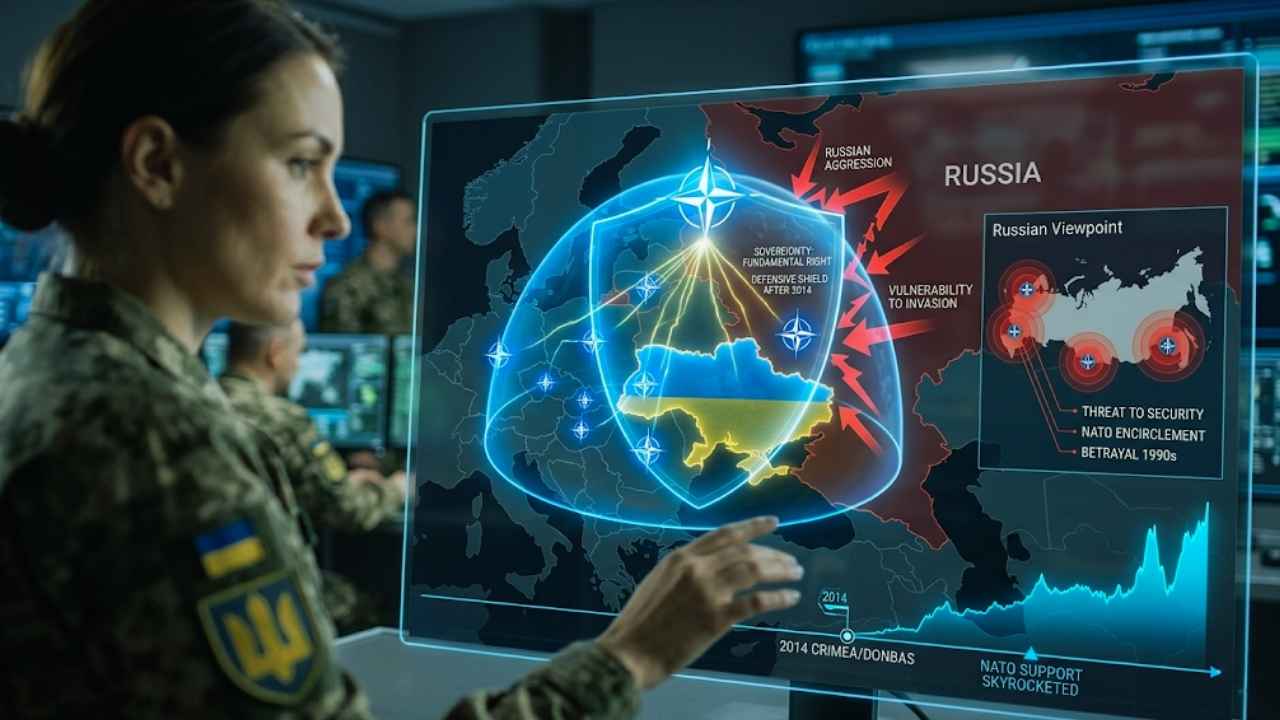
Ukraine’s side of the story is quite simple: We are an independent country, and we can join whatever club we want. They argue that as a sovereign nation, no other country should have a veto over their future. They point out that Russia’s own aggression is what makes them want to join NATO in the first place.
Before 2014, most Ukrainians were not that interested in joining the alliance. But after Russia took Crimea and started the war in the Donbas, support for NATO skyrocketed. They see it as the only shield strong enough to protect them from a neighbor that does not respect their right to exist. To them, neutrality is just an invitation for another invasion.
|
NATO Position |
Russian Viewpoint |
Ukrainian Viewpoint |
|
Membership |
A tool for Western encirclement |
A fundamental right of a free nation |
|
Deployment |
Threat to Moscow’s security |
Necessary defense against aggression |
|
The 1990s |
Betrayal and broken promises |
A move toward a democratic Europe |
|
Future Role |
Must stop at current borders |
Must include Ukraine for lasting peace |
The Lead-up to the 2022 Full-Scale Invasion
By late 2021, the world started seeing very scary pictures taken by satellites over the Russian border. Thousands of Russian tanks, trucks, and tents were moving into position from the north, south, and east. It was not just a few soldiers; it was a massive war machine being built in plain sight.
Russia claimed it was just a drill or a training exercise, but the evidence said otherwise. They were moving blood supplies and setting up field hospitals, things you only do if you expect real casualties. The tension was so thick you could almost feel it through the news reports.
Military Buildup on the Borders
Western intelligence agencies, especially in the US and the UK, started shouting that an invasion was coming. Many people, including some in Ukraine, did not want to believe it. It seemed too crazy for a modern country to launch a full-scale war in Europe in the 21st century.
But the buildup kept growing until over 150,000 troops surrounded Ukraine. Russia was testing the world’s reaction, waiting to see if anyone would stand in their way. They even moved troops into Belarus, which gave them a direct path to the Ukrainian capital, Kyiv. The stage was set for a massive conflict that would change the world forever.
Failed Diplomacy and the Minsk Agreements
There were frantic meetings in Paris, Berlin, and Moscow as leaders tried to stop the war before it started. Politicians like Emmanuel Macron and Olaf Scholz spent hours talking to Putin, trying to find a middle ground. Russia demanded that NATO promise to never let Ukraine join and that all Western troops leave Eastern Europe.
These were demands that NATO simply could not meet without giving up its core values. Meanwhile, the old Minsk Agreements, which were supposed to end the fighting in the Donbas, had completely fallen apart. Both sides blamed each other for the failure, and the window for a peaceful solution slammed shut.
|
Pre-Invasion Timeline |
Event |
Consequence |
|
November 2021 |
100,000 Russian troops at border |
Global alarm and falling stocks |
|
December 2021 |
Russia issues security demands |
NATO rejects the “no expansion” rule |
|
January 2022 |
Cyberattacks hit Ukraine |
Essential services temporarily disabled |
|
February 2022 |
Russia recognizes Donbas rebels |
Legal “excuse” created for invasion |
Putin’s Stated Goals vs. Reality
When the invasion finally began, Putin gave a long, angry speech that lasted almost an hour. He did not call it a war; he called it a Special Military Operation. He used specific words to justify his actions, but many of those words did not match what was actually happening on the ground.
He claimed he was going in to fix a problem that the West had created. However, as the bombs started falling on apartment buildings and schools, it became clear that the goals were much broader than just a small military action. The world was seeing a full-scale attempt to remove a government and take over a nation.
What is “Denazification” and “Demilitarization”?
Putin said he wanted to denazify Ukraine, which was a very strange and offensive claim to most of the world. Ukraine’s president, Volodymyr Zelenskyy, is Jewish and had family members who died in the Holocaust. There is no evidence that the Ukrainian government is run by Nazis or follows Nazi ideology.
Most experts believe this was just a buzzword used to trigger the emotions of the Russian people, who take great pride in their history. Demilitarization simply meant destroying Ukraine’s ability to defend itself. By taking away their weapons, Russia hoped to make Ukraine a weak neighbor that could never say no to Moscow again.
Defending the Russian-Speaking Population
Another reason given for the invasion was to stop a genocide against Russian speakers in the Donbas. Again, international monitors who had been in the region for years found no evidence of any such thing. While there were certainly tensions and some discrimination, it was nowhere near the mass killing that Russia claimed.
By using these extreme words, Russia tried to make its invasion look like a heroic rescue mission. They wanted to convince their own people that they were the “good guys” coming to save their brothers. In reality, the invasion ended up killing many of the very Russian speakers Putin claimed he was there to protect.
|
Terminology Used |
Russian Claim |
Independent Observation |
|
Denazification |
Removing a “Nazi” regime |
Zelenskyy is Jewish; no Nazi govt |
|
Demilitarization |
Disarming a hostile neighbor |
Attempt to leave Ukraine defenseless |
|
Genocide |
Protecting Donbas from mass murder |
No evidence found by the UN or OSCE |
|
Special Operation |
A limited military action |
A full-scale, unprovoked war |
The Strategic and Economic Motives
Money and power are always part of the equation when it comes to war. Beyond the speeches and the history, there are cold, hard reasons why Russia invaded Ukraine that involve natural resources and geography. Ukraine is a very wealthy land if you look at what is under the soil and how the land is shaped.
It has some of the richest farmland in the world and massive deposits of minerals and gas. Controlling this wealth would give any country a huge advantage in the global market. For Russia, taking control of these assets was a way to boost their own economy while hurting a rival.
Energy Resources and Pipelines
Ukraine has been the main highway for Russian gas going to Europe for decades. Russia has to pay billions of dollars in fees to move their gas through Ukrainian pipes. If Russia controls Ukraine, they control the highway and save billions of dollars. Also, there are huge natural gas deposits under the Black Sea near Crimea and in the Donbas region.
If Ukraine were to develop these resources, they could become a major competitor to Russia’s own gas industry. Russia likely wanted to make sure that never happened by taking control of the land first. It was a move to protect their own monopoly on energy.
Geography and the Buffer Zone Strategy
Geography is a silent driver of many wars. Russia is a massive country, but its heart—Moscow and St. Petersburg—is located on a very flat plain. Historically, invaders like Napoleon and Hitler used this flat land to march their armies into Russia. Ukraine is the biggest part of that plain.
In the minds of Russian military leaders, holding Ukraine means having a thousand miles of space between their capital and an enemy army. It is an old-fashioned way of thinking about defense, but it still drives their decisions today. They want a ~buffer zone~ that they can control to feel safe in their own homes.
|
Resource/Asset |
Strategic Importance |
Economic Value |
|
Natural Gas |
Leverage over Europe |
Hundreds of billions in revenue |
|
Neon Gas |
Essential for making computer chips |
Ukraine produces 70% of global supply |
|
Black Soil |
High-yield grain production |
“Breadbasket” status for global trade |
|
Warm Water Ports |
Year-round naval and trade access |
Essential for power projection |
The Global Impact of the Conflict
This war did not stay inside the borders of Ukraine; it hit every corner of the planet. Within weeks of the first bomb, people in Egypt were paying more for bread, and people in the US were paying more for gas. The ripples from this conflict touched almost every person on earth in some way. It showed just how connected we all are in the modern world. When one major producer of food and energy goes to war, everyone feels the pain. The conflict has forced countries to rethink where they get their fuel and how they protect their own borders.
- The Great Energy Shift: When the West put sanctions on Russian oil and gas, prices went through the roof. Europe had to scramble to find new ways to heat homes and run factories. This has actually speeded up the move toward green energy in many places.
- The Hunger Crisis: Ukraine grows a huge amount of the world’s wheat and corn. With the ports blocked and fields turned into battlegrounds, food prices climbed, hurting the world’s poorest people in Africa and the Middle East the most.
- A New Refugee Crisis: Over 8 million people left Ukraine, and millions more were moved inside the country. It was a human wave that tested the kindness and the budgets of countries like Poland and Germany.
- Global Alliances: The war pushed Russia closer to China and Iran, while it made NATO stronger and more unified than it had been in thirty years. The world is being divided into new teams.
|
Global Sector |
Primary Change |
Long-term Result |
|
Energy |
End of cheap Russian gas in EU |
Faster transition to solar and wind |
|
Food Security |
Wheat prices hit record highs |
Focus on local farming in Africa |
|
Geopolitics |
Finland and Sweden join NATO |
Russia becomes more isolated from West |
|
Technology |
Rapid development of drone warfare |
New rules for modern military combat |
The Situation in 2026: Where Do We Stand?
As we look at the world in mid-2026, the question of why Russia invaded Ukraine has shifted toward how will it ever end? The war has become a slow, painful grind. The front lines have not moved much in the last year, but the fighting is still very intense every single day. Both sides are using advanced technology, including AI-powered drones and long-range missiles, to strike deep behind the lines. The war has become a test of who can keep their economy and their people going the longest. It is a war of attrition where every inch of land costs hundreds of lives.
The international mood is changing as the conflict drags on. While support for Ukraine remains, many countries are starting to feel the weight of the cost. There is renewed pressure for some kind of peace talk or ceasefire, even if it is just temporary. The Russian economy has proven more resilient than many expected, but the cost in human lives is now in the hundreds of thousands on both sides. Cities that were once beautiful centers of culture are now piles of rubble, and the map of the region is being redrawn by trenches and minefields that will take decades to clear.
|
2026 Status Report |
Current Reality |
Future Outlook |
|
Military Fronts |
Trench warfare in the East and South |
High risk of a permanent “frozen” war |
|
Humanitarian |
Rebuilding starts in Western Ukraine |
Long-term trauma for a generation |
|
Economic |
Russia relies on “War Economy” |
High risk of bankruptcy for both sides |
|
Political |
Zelenskyy remains the face of resistance |
Potential for leadership shifts in 2027 |
Final Thoughts
The story of why Russia invaded Ukraine is a tragedy of missed opportunities and historical ghosts. It is a reminder that the past is never really dead; it is just waiting to be used as an excuse for the present. At its heart, the conflict is about a nation trying to choose its own path while its larger neighbor refuses to let go of the old ways. Russia wanted a buffer and a puppet; Ukraine wanted a future and a choice. This clash has broken the peace in Europe and forced the world to wake up to a new, more dangerous reality.
Understanding this conflict is important because it is not just about one piece of land or one group of people. It is about the rules we all live by. It is about whether a country’s borders are truly theirs and whether the world can still solve problems with words instead of bombs. As we look at the situation today, the search for a lasting peace remains the most important task for the world. We must learn from this tragedy so that it never happens again, for the sake of the people in Ukraine and for the safety of everyone on this planet.
Frequently Asked Questions (FAQs) About Why Russia Invaded Ukraine
Did Ukraine have a chance to join NATO before the war?
Ukraine was promised they would join one day back in 2008, but they were never given a clear timeline or a plan. This left them in a “gray zone” — not protected by NATO, but enough of a threat to make Russia angry.
How do ordinary Russians feel about the invasion?
It is hard to know for sure because protesting is illegal in Russia. Some people fully support the war because of what they see on state TV, while others are quietly against it but afraid to speak up. Thousands have left the country to avoid being drafted.
What is the “Breadbasket of Europe”?
This is a nickname for Ukraine because of its incredibly fertile soil. They produce a huge percentage of the world’s sunflower oil, wheat, and corn. When the war started, it caused a global food emergency.
Why hasn’t the UN stopped the war?
Russia is a permanent member of the UN Security Council, which means they have “veto power.” They can block any official UN action against themselves, which has made the organization feel very weak during this crisis.
What are “Sanctions” and do they work?
Sanctions are like a global “time-out.” Other countries stop buying things from Russia or selling them technology. While they haven’t stopped the war yet, they have made it much harder and more expensive for Russia to build new weapons and grow its economy.
Are there any secret reasons for the invasion?
Some people believe that Putin was afraid that a successful, democratic Ukraine would make Russians want a different kind of government at home. By destroying the Ukrainian model, he protects his own power in Moscow.