


The dream of working in high-end tech used to feel locked behind a university gate. For a long time, if you didn’t have a computer science degree, you were basically invisible to recruiters at big firms. But things have changed fast.
I have seen people go from being baristas, teachers, and sales reps to leading data teams at major companies. You don’t need to spend four years and a small fortune on a degree that might be outdated by the time you graduate. Today, we are going to look at exactly how to become a data scientist without a CS degree by focusing on what actually matters to hiring managers in 2026. This isn’t about shortcuts; it is about taking the right path that builds real skills and a solid portfolio.
The Reality: Can You Break Into Data Science Without a Tech Background?
The short answer is yes, and it is actually becoming more common every day. In the current job market, companies are drowning in data but starving for people who can make sense of it. They have realized that a computer science degree doesn’t always equal someone who can solve a business problem.
I have talked to many hiring managers who say they prefer candidates who have practical, hands-on experience over someone who just studied theory for years. The barrier to entry has shifted from “where did you go to school” to “what can you show me right now.” This is great news for you if you are willing to put in the work to learn the tools and techniques used in the industry today.
The data science field is massive, and it needs people from all walks of life. If you come from a non-tech background, you bring a unique perspective that a typical coder might lack. You understand how people think, how businesses operate, or how a specific industry works. This domain knowledge is your secret weapon.
When you combine your existing expertise with data skills, you become a double threat. You aren’t just a person who runs scripts; you are a problem solver who knows how to use data to drive real change. That is exactly how to become a data scientist without a CS degree and stay competitive in the long run.
The 2026 Data Science Job Market and Alternative Pathways
By 2026, the job market has matured significantly. We are seeing a huge demand for “Applied Data Scientists” who can work alongside AI agents and automated systems. Traditional degrees often struggle to keep up with how fast these tools change.
This is why alternative pathways like self-teaching, specialized certifications, and intensive projects are so effective. Companies are now using AI-driven hiring tools that scan your GitHub and portfolio projects before they even look at your education section. If your projects show you can handle real-world messiness, you are in.
Why Employers Value Domain Expertise Over Degrees?
Think about a hospital trying to predict patient readmission rates. Who would you rather have leading that project: a computer scientist who has never stepped foot in a clinic, or a former nurse who learned Python? The nurse understands the variables, the edge cases, and the human element behind the numbers. This is why domain expertise is so highly valued. Your previous career isn’t “lost time.” It is the foundation that makes your data analysis more relevant and actionable for a business.
|
Feature |
Traditional CS Degree |
Non-Degree Pathway (2026) |
|
Time to Job-Ready |
4 Years |
6 to 12 Months |
|
Financial Cost |
$40k – $120k |
$0 – $15k |
|
Curriculum |
Broad and Theoretical |
Highly Specific and Practical |
|
Networking |
Campus-based |
Global Digital Communities |
|
Industry Relevance |
Slower to update |
Updated in real-time |
Step-by-Step Roadmap to Become a Data Scientist
If you want to know how to become a data scientist without a CS degree, you need a plan that won’t leave you feeling lost. The most common mistake is trying to learn everything at once. You don’t need to be a world-class coder and a PhD-level mathematician on day one. You need to build a stack of skills that build on each other.
This roadmap focuses on the core pillars: math, programming, data handling, and machine learning. By following a structured sequence, you ensure that you don’t have gaps in your knowledge that will come back to haunt you during a technical interview.
Step 1: Master the Foundational Math and Statistics
You don’t need to be a math wizard, but you do need to understand the logic behind the algorithms. Statistics is the most important part here. You need to know about probability, distributions, and hypothesis testing. Why? Because data science is essentially about making educated guesses based on evidence.
If you don’t understand things like p-values or confidence intervals, you might report “insights” that are actually just random noise. Linear algebra and calculus are also helpful, but you only need to understand how they work under the hood of machine learning models.
Step 2: Learn the Core Programming Languages (Python and SQL)
Python is the undisputed language of data science. It is easy to read, has a massive community, and is packed with libraries that do the heavy lifting for you. You should focus on writing clean, readable code and learning how to use libraries like NumPy and Pandas. However, SQL is often the unsung hero.
Almost every company stores its data in databases that require SQL to access. If you can’t write a query to get the data you need, you can’t analyze it. Mastery of SQL will often get you your first job as a data analyst, which is a perfect stepping stone.
Step 3: Understand Data Manipulation and Visualization
Real-world data is usually a disaster. It is full of missing values, typos, and weird formats. Data manipulation is the art of taking that mess and turning it into something useful. This is where you will spend about 80% of your time as a data scientist. Once the data is clean, you need to tell a story with it.
Visualization tools like Tableau, Power BI, or Python libraries like Seaborn help you explain your findings to people who don’t care about code. If you can make a chart that makes a manager say “Aha!”, you have done your job.
Step 4: Dive into Machine Learning and Artificial Intelligence
This is the “cool” part that everyone wants to jump into immediately. Machine learning is about building models that learn patterns from data to make predictions. You should start with the basics like linear and logistic regression before moving to more complex things like random forests or neural networks.
In 2026, you also need to be familiar with how to use Large Language Models (LLMs) and how to integrate AI into your workflow. Understanding the ethics of AI and how to prevent bias in your models is just as important as the code itself.
|
Stage |
Focus Area |
Essential Tools/Concepts |
|
Foundation |
Math & Stats |
Probability, Hypothesis Testing |
|
Technical |
Programming |
Python (Pandas), SQL |
|
Workflow |
Data Wrangling |
Data Cleaning, Feature Engineering |
|
Storytelling |
Visualization |
Tableau, Matplotlib, Power BI |
|
Advanced |
Machine Learning |
Scikit-learn, XGBoost, AI APIs |
Alternative Education Pathways to Traditional Degrees
Since you aren’t going the traditional route, you have to be smart about where you spend your time and money. There are so many resources out there that it can feel like a firehose of information. The key is to find a medium that matches how you learn best.
Some people love the structure of a bootcamp, while others prefer to piece together free resources. Whatever you choose, make sure it offers hands-on practice. Reading about data science is useless if you aren’t actually typing code and breaking things on your own computer.
The beauty of 2026 is that the industry has fully embraced online learning. You can now get certificates that are backed by companies like Google, IBM, and Microsoft. These carry real weight because they are designed to teach you the exact tools those companies use every day.
If you are looking for how to become a data scientist without a CS degree, these pathways are your best friend. They allow you to learn at your own pace while building a portfolio of work that you can show off to potential employers.
Online Courses and Massive Open Online Courses
Platforms like Coursera, edX, and DataCamp are perfect for getting started. You can take a single course for $50 or even for free if you don’t need the certificate. I recommend looking for “Specializations” or “Professional Certificates.”
These are curated tracks that take you from beginner to job-ready in a specific niche. The key here is to not just watch the videos. You have to do the assignments, even the ones that aren’t graded. That is where the actual learning happens.
Intensive Data Science Bootcamps
If you need a push and have some savings, a bootcamp can be a game-changer. These are usually three to six months of high-intensity learning. You will be surrounded by other people doing the same thing, which is great for networking and staying motivated.
Many bootcamps also have “job guarantees” or career services that help you polish your resume and get interviews. Just do your homework before picking one; look for reviews from recent grads in 2025 and 2026 to see if the curriculum is still up to date.
Recognized Professional Certifications
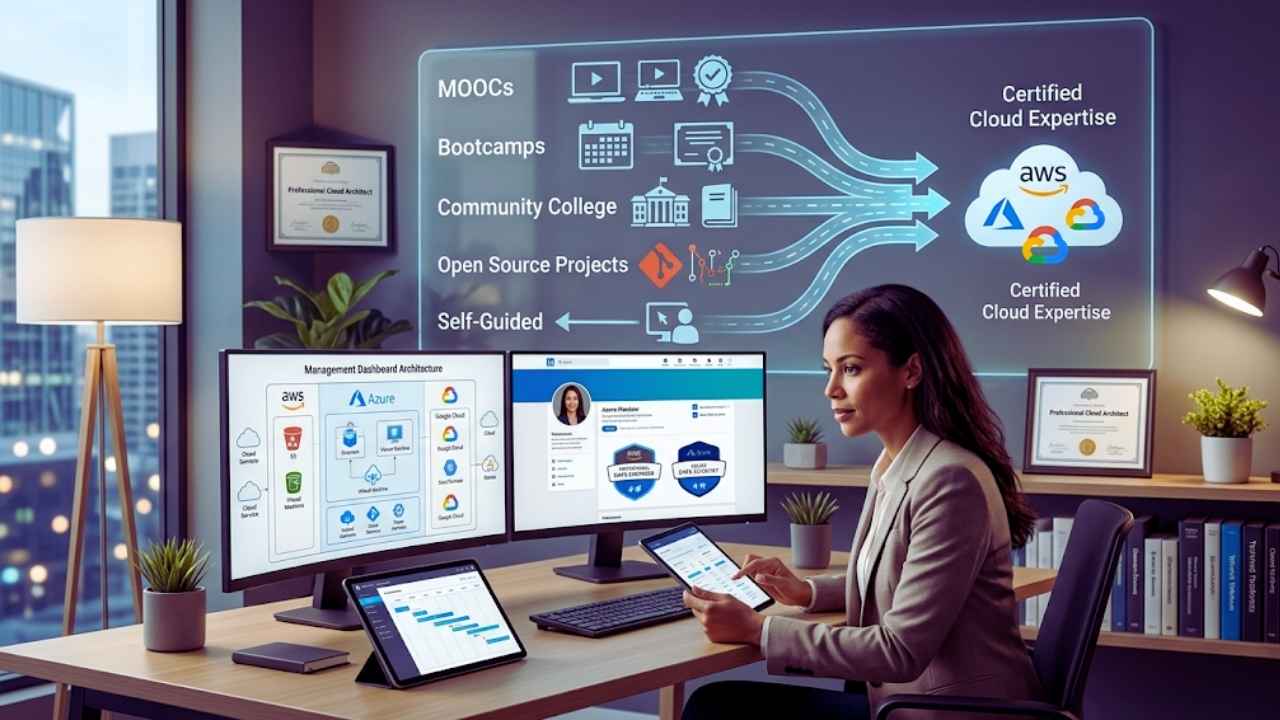
Certifications from cloud providers like AWS, Azure, and Google Cloud are incredibly valuable right now. Most companies have moved their data to the cloud, so if you can prove you know how to manage data in those environments, you are ahead of the pack.
These exams are tough and technical, which is why they are respected. Earning a “Professional Data Engineer” or “Azure Data Scientist” badge is a clear signal to a recruiter that you know your stuff, regardless of what your degree says.
|
Pathway |
Best For |
Typical Cost |
|
Self-Guided MOOCs |
Disciplined self-starters |
$0 – $500 |
|
Professional Certs |
Proving cloud/tool expertise |
$100 – $300 per exam |
|
Bootcamps |
Rapid career switchers |
$7k – $15k |
|
Community College |
Those wanting some structure |
$1k – $5k |
|
Open Source Projects |
Learning by doing with others |
$0 |
Building a Standout Data Science Portfolio
Your portfolio is the single most important part of your application. When someone asks how to become a data scientist without a CS degree, the answer always involves a GitHub link. A portfolio isn’t just a list of code; it is a showcase of your thinking process. I want to see how you handled a weird dataset, what questions you asked, and how you reached your conclusions. A good project that solves a real-world problem is worth more than a hundred certificates.
Building a portfolio also gives you something to talk about during interviews. Instead of giving vague answers, you can say, “In my project where I analyzed New York City taxi data, I found that weather patterns had a 20% impact on tip amounts.”
This shows you are practical and results-oriented. It also proves that you can handle the end-to-end process of a data project, from data collection to final presentation. That kind of experience is exactly what hiring managers are looking for in 2026.
Moving Beyond Beginner Datasets
If I see one more project using the “Titanic” dataset, I might lose my mind. Every beginner uses it. To stand out, you need to find unique data. Go to Kaggle, but look for the weird, unpolished datasets. Or better yet, create your own. Scrape data from a hobby website, use a public API from the government, or track your own personal data for three months. A project that is unique to you shows passion and curiosity, two traits that are highly valued in data science.
Establishing a Strong GitHub and Kaggle Presence
GitHub is where you show the world that you can write clean, professional code. You don’t need a hundred repositories; three to five high-quality ones are better. Each should have a “README” file that explains what the project is, how to run it, and what you learned.
Kaggle is also great for showing off your skills in a competitive environment. Even if you don’t win, a “Kaggle Expert” badge shows you have the persistence to tackle hard problems. It also lets you see how other professionals solve the same problems you are working on.
|
Project Type |
Data Source |
Goal |
|
Explanatory |
Public Health Records |
Find trends in disease outbreaks |
|
Predictive |
Real Estate APIs |
Predict home prices in your city |
|
Operational |
Personal Finance |
Automate your monthly spending report |
|
Creative |
Spotify API |
Analyze your music taste over time |
|
Social |
Twitter/X Archive |
Perform sentiment analysis on a trending topic |
Getting your first job is often the hardest step. You might feel like an imposter because you don’t have that CS degree, but you have to push through that. The tech industry is full of people who taught themselves. The key is to be strategic about where you apply.
Don’t just spray and pray your resume to every “Junior Data Scientist” posting. Look for roles where your previous background gives you an edge. If you worked in retail, look at data roles in supply chain or consumer behavior.
Interviews in 2026 are more about problem-solving than memorizing algorithms. You will likely face a technical screen, a take-home project, and a final “culture fit” interview. Be ready to explain your projects in detail. Talk about the mistakes you made and how you fixed them.
Showing that you can learn from failure is often more impressive than a perfect project. Networking is also huge. Reach out to people on LinkedIn, attend local meetups, and contribute to open-source projects. Sometimes, a referral is the only way to get your resume seen by a human.
Translating Your Past Experience into Data Speak
Your resume needs to be a bridge between your old career and your new one. If you were a teacher, don’t just say you taught kids. Say you “analyzed student performance data to tailor curriculum, resulting in a 10% increase in test scores.”
Use data-centric language to describe your past achievements. This shows that you have always had an analytical mindset, even if you weren’t using Python yet. It makes the transition feel natural to a recruiter rather than a sudden 180-degree turn.
Networking and Tailoring Your Resume
Every resume you send out should be slightly different. Look at the job description and pick out the keywords they use. If they mention “A/B testing” and “SQL,” make sure those are front and center on your resume. Networking isn’t just about asking for jobs; it is about building relationships.
Follow data scientists you admire, comment on their work, and ask thoughtful questions. When a job opens up at their company, they are much more likely to help you if they already know who you are and have seen your work online.
|
Interview Level |
Focus |
How to Prepare |
|
Initial Screen |
General fit and communication |
Practice your “elevator pitch” |
|
Technical Quiz |
SQL and Python basics |
Use sites like LeetCode or HackerRank |
|
Take-Home Project |
End-to-end data skills |
Focus on clean code and clear explanations |
|
Behavioral |
Soft skills and teamwork |
Use the STAR method for stories |
|
Case Study |
Business logic and strategy |
Read about real-world data science problems |
Final Thoughts
The path to a new career is never a straight line, especially when you are doing something as bold as this. There will be days when the code doesn’t work and the math feels impossible. But remember that every expert was once a beginner who didn’t quit. If you focus on building a solid foundation and showing off your work, you will find your way.
This guide on how to become a data scientist without a CS degree is just the starting point. The real work happens in the hours you spend at your keyboard, figuring things out one line of code at a time. Keep going, keep curious, and don’t let a lack of a degree hold you back from the career you want.
Frequently Asked Questions (FAQs) About Become Data Scientist no CS Degree
1. How long does it really take to become a data scientist without a degree?
If you are starting from scratch and can put in 15-20 hours a week, expect it to take about 9 to 12 months. Some people do it faster in a bootcamp, but for most, a year is a realistic timeframe to become truly job-ready.
2. Is Python or R better for data science in 2026?
Python has largely won the battle for general data science. It is more versatile and better for AI and production environments. R is still great for deep statistical research, but if you want to be hirable in the widest range of roles, stick with Python.
3. Can I get a data science job if I am over 40?
Absolutely. In fact, older candidates often have better domain expertise and “soft skills” like communication and leadership. Your age is an asset because you have more life and business experience to bring to your data analysis.
4. Do I need a high-end computer to learn data science?
Not necessarily. Most of the heavy lifting can be done in the cloud using tools like Google Colab or Kaggle Notebooks for free. Any decent laptop that can run a web browser and a code editor will get you through your first year of learning.
5. Should I learn Excel before learning Python?
If you already know Excel, great. If not, don’t spend too much time on it. Python can do everything Excel can do and much more. Most modern data teams prefer Python or SQL for anything more complex than a basic spreadsheet.
6. How important is a LinkedIn profile for getting hired?
It is vital. Think of it as your digital storefront. Keep it updated with your latest projects, share interesting articles, and connect with people in the industry. Many recruiters search for candidates directly on LinkedIn before ever posting a job.