


We all have the exact same 24 hours in a day. Yet, some people manage to build massive companies, stay fit, and leave work by 5 p.m., while the rest of us drown in unread emails and endless to-do lists. The difference is not raw intelligence or working harder than everyone else. The difference comes down to using proven time management frameworks to filter out the noise and focus on what truly matters. Right now, the modern workplace operates like a giant distraction factory.
Between constant Slack notifications, back-to-back video calls, and the lingering temptation to scroll through social media, our attention is constantly fractured. If you do not have a solid system in place to protect your time, someone else will happily steal it from you. You will spend your entire day reacting to other people’s emergencies instead of making actual progress on your own meaningful goals.
This comprehensive guide will break down exactly how you can reclaim your day from the chaos. We are going to explore eight highly effective methods to manage your heavy workload, stop procrastinating on hard tasks, and leave the office feeling genuinely accomplished. Whether you are a creative dealing with scattered thoughts or a busy manager buried in useless meetings, there is a strategy here that fits your exact work style.
The Reality of Workplace Productivity
Most professionals severely overestimate how much focused work they actually complete on a given day. Recent workplace data shows that the average office employee is truly productive for barely three hours out of a standard eight-hour workday. The rest of the time vanishes into unnecessary meetings, shifting between open browser tabs, chatting with coworkers, and answering non-urgent messages.
Relying entirely on your memory or a scattered collection of sticky notes simply does not cut it anymore in today’s fast-paced environment. Without a structured approach, you automatically default to answering the loudest demand rather than the most important one. Implementing clear time management frameworks shifts you from a reactive panic mode to a proactive execution mode.
When a new project lands on your desk, your system tells you exactly where it fits. This cuts down decision fatigue drastically. You stop wasting valuable mental energy figuring out what to do next and simply follow the plan you already created. A good system acts as an invisible shield, keeping low-value tasks away from your peak energy hours.
|
Productivity Reality |
Direct Consequence |
System Solution |
|
3 hours of actual deep work |
Extremely slow project progress |
Block specific hours for focused tasks |
|
Constant digital notifications |
Fractured attention and mistakes |
Batch process emails twice a day |
|
No formal daily planning |
High daily stress and burnout |
Assign every task a specific priority level |
|
Treating everything as urgent |
Exhaustion with no real results |
Filter requests through a framework |
Why We Need a System Now?
The modern workday has completely blurred the lines between urgent and important. Because we can be reached instantly at any hour, every single request feels like an emergency that requires immediate action. We urgently need robust frameworks to rebuild the boundaries that technology has torn down. A proper framework gives you permission to ignore things. It helps you say no to pointless meetings without feeling guilty, because you have a visual representation of your actual capacity.
1. The Eisenhower Matrix
Named after former U.S. President Dwight D. Eisenhower, this decision-making tool helps you figure out what actually needs your attention right now versus what can wait. The matrix forces you to separate your tasks based on two very specific criteria: urgency and importance. It brutally exposes the busywork you subconsciously use to procrastinate on hard projects.
If you constantly feel like you are putting out fires but making absolutely zero forward progress in your career, this is exactly where you need to start. You draw a square and divide it into four smaller boxes. Take your massive, overwhelming to-do list and place every single item into one of the four quadrants. Quadrant one gets your immediate attention today because these are real crises.
Quadrant two goes directly onto your calendar for later this week because this is your deep, strategic work. Quadrant three tasks go to someone else, or you push back on them because they are just other people’s noisy interruptions. Quadrant four tasks get crossed off entirely because they are complete time-wasters. You will quickly realize that most of the things stressing you out belong in the third quadrant.
|
Quadrant |
Action Required |
Typical Examples |
|
Urgent & Important |
Do it immediately today |
Major crisis, strict client deadline |
|
Important, Not Urgent |
Schedule it on your calendar |
Strategic planning, deep creative work |
|
Urgent, Not Important |
Delegate it to someone else |
Answering most emails, sudden interruptions |
|
Not Urgent & Not Important |
Delete it from your list completely |
Mindless scrolling, organizing desk drawers |
Protecting Your Best Time
This method is absolutely perfect for managers, executives, and anyone whose inbox is full of random requests from other people. It cures the terrible habit of treating every single notification like a life-or-death emergency. By using this matrix daily, you actively protect your quadrant two time. That is the space where the real career-advancing work actually happens.
2. The Pomodoro Technique
Francesco Cirillo invented this wildly popular method in the late 1980s using a simple tomato-shaped kitchen timer he found in his house. The core idea is to break your heavy workday into short, intensely focused sprints followed by brief periods of mandatory rest. Human brains cannot maintain deep concentration for four hours straight without degrading in performance. We need specific intervals to recharge.
The Pomodoro Technique provides a built-in rhythm that prevents mental burnout while keeping digital distractions securely locked away. You pick one specific task and set a timer for exactly 25 minutes. During this strict window, you cannot check your phone, fetch a coffee, or switch browser tabs for any reason. If a random thought pops into your head, you quickly write it down on a piece of scratch paper and immediately return to the task at hand.
When the timer rings, you must stop working immediately, even if you are mid-sentence. Take a five-minute break to walk around, stretch, or stare out the window to rest your eyes. This simple boundary turns a massive, intimidating project into a series of small, highly manageable games.
|
Pomodoro Step |
Action to Take |
Level of Focus Required |
|
1. Preparation |
Pick one single task to complete |
High |
|
2. Sprint |
Set timer for 25 minutes and work |
Absolute maximum focus |
|
3. Short Rest |
Take a 5-minute physical break |
Rest and detach |
|
4. Long Rest |
After 4 full cycles, rest 30 mins |
Complete mental recovery |
Building Unbreakable Focus
If you have a notoriously short attention span or struggle with heavy procrastination, this is your holy grail. Committing to just 25 minutes of work feels incredibly easy compared to staring down a massive project. Writers, software developers, and college students use this method constantly to crush deadlines. It forces you to just start the work, and starting is almost always the hardest part of any job.
3. Time Blocking
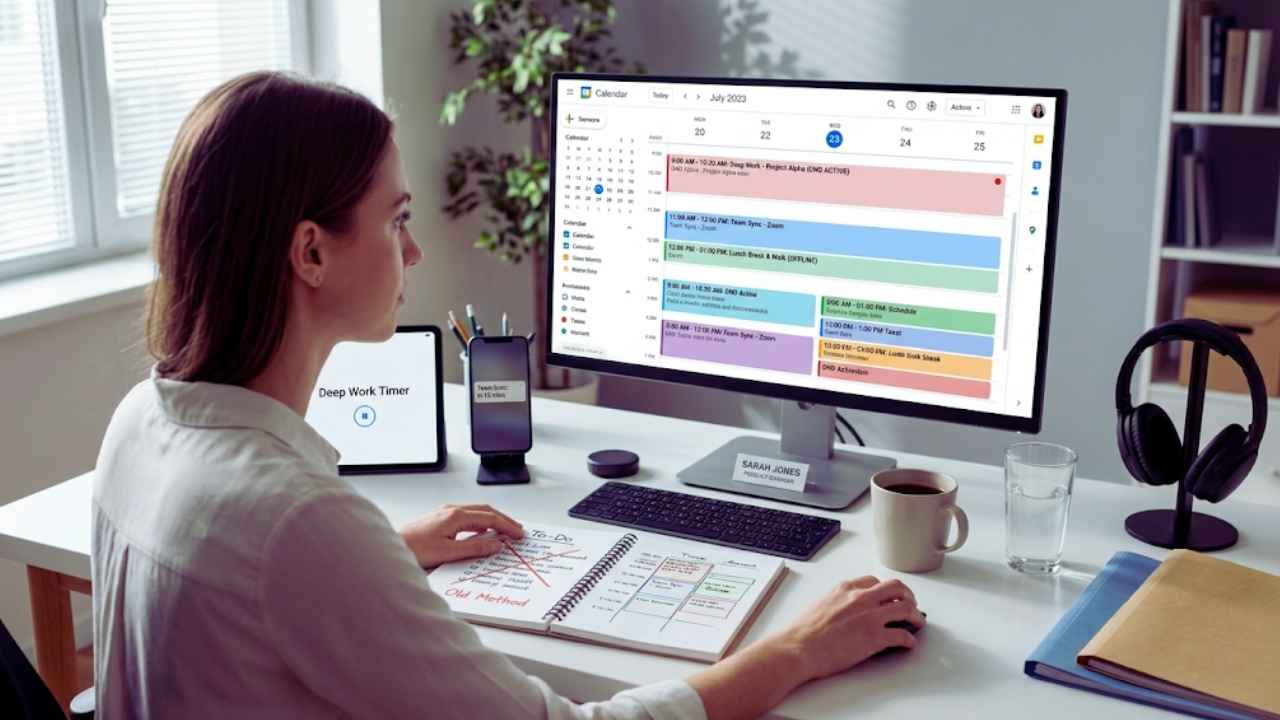
Time blocking means you stop working from an open-ended list and start working directly from your daily calendar. You plan out every single hour of your day in advance, assigning specific tasks to specific time slots from morning until evening. When you give every single minute a clear job, your time abruptly stops vanishing into thin air.
You take total control of your schedule instead of letting your chaotic inbox run your entire life. You open your digital calendar and start by blocking out your personal necessities first, like lunch breaks, a quick walk, and a solid end-of-day cutoff time so you actually go home. Then, you block out your mandatory meetings. Finally, you take your most important tasks and drop them into the remaining empty slots.
Treat these solo work blocks with the exact same respect you would give a meeting with your company’s CEO. If a coworker tries to schedule a quick sync over your deep work block, decline the invitation and firmly offer a different time. By claiming the space first, you dictate how your day unfolds.
|
Scheduled Time Block |
Assigned Activity |
Distraction Status |
|
09:00 AM – 10:30 AM |
Deep work on main project |
Do Not Disturb mode active |
|
10:30 AM – 11:00 AM |
Process emails and messages |
Batch processing |
|
11:00 AM – 12:00 PM |
Team sync and collaboration |
Open communication |
|
12:00 PM – 01:00 PM |
Lunch break and outdoor walk |
Completely offline |
Taking Back Your Calendar
Professionals juggling multiple complex projects at once absolutely thrive on time blocking. If your days are normally chopped to pieces by random, poorly planned meetings, time blocking lets you claim your best focused hours before anyone else can steal them. It provides a highly visual roadmap of your actual capacity, making it much easier to say no to extra work when your calendar is visibly full.
4. The Getting Things Done (GTD) Method
Productivity expert David Allen created the GTD method based on one incredibly simple truth: your brain is a terrible office. Our minds are biologically designed to generate brilliant ideas, not to store them like a filing cabinet. When you try to remember every single email you need to send and every bill you need to pay, you create a massive amount of background anxiety that drains your energy.
GTD gets absolutely everything out of your head and into a trusted external system. You start by capturing every single thought, task, and random idea into a notebook or a digital app without filtering anything. Next, you clarify what each item actually means. If a task takes less than two minutes to complete, you do it right then and there. Then, you organize the remaining actionable items into specific project lists or context lists.
Crucially, you must perform a comprehensive weekly review to clean up your messy lists and plan the days ahead. Finally, you look at your beautifully organized lists and simply start executing the work with a completely clear mind.
|
The 5 GTD Steps |
Main Objective |
Final Result |
|
1. Capture |
Write absolutely everything down |
A clear, calm mind |
|
2. Clarify |
Decide the exact next physical action |
Clear intent and direction |
|
3. Organize |
Put the action in the correct context list |
Clear logical structure |
|
4. Reflect |
Review all lists completely every week |
Clear focus for the future |
|
5. Engage |
Do the actual work without hesitation |
Clear, measurable progress |
Curing the Overwhelmed Mind
If you regularly wake up at 2 a.m. in a total panic because you forgot to email an important client, GTD will completely change your life. It is the perfect framework for complex corporate roles that involve managing hundreds of tiny moving parts across different departments. It requires some heavy upfront discipline to set up initially, but once it is running smoothly, it completely eliminates the daily stress of forgetting important details.
5. Eat the Frog
Famous author Mark Twain supposedly once said that if your job is to eat a live frog, you should do it first thing in the morning. That way, nothing worse can possibly happen to you for the rest of the day. In modern productivity terms, the frog represents your biggest, ugliest, and most important task. It is the exact thing you are actively dreading and actively avoiding by doing smaller, easier things.
By eating the frog immediately, you guarantee that every single day is a massive win. Before you leave the office today, identify tomorrow’s specific frog. Write it clearly on a physical sticky note and place it right on your computer keyboard so you cannot miss it. Tomorrow morning, do not check your email, do not check your messages, and do not look at the daily news.
Sit down, open your computer, and tackle that single difficult task immediately. Do not stop working on it until the frog is completely eaten. Even if the entire rest of your day completely falls apart and gets swallowed by unexpected emergencies, you still accomplished your most critical goal.
|
Task Difficulty Level |
Best Time to Execute |
Personal Energy Level |
|
The Frog (Hardest Task) |
First thing in the morning |
Highest willpower and focus |
|
Medium Complexity Tasks |
Midday before lunch |
Moderate energy |
|
Simple Admin / Emails |
Late afternoon |
Lowest cognitive energy |
Destroying Morning Procrastination
This specific strategy is the ultimate cure for chronic procrastination. If you routinely spend your fresh mornings doing “fake work” like aggressively organizing digital folders or tweaking spreadsheet colors just to avoid the real work, you need to eat the frog. It perfectly utilizes your peak morning willpower and creates a massive wave of positive momentum that carries you straight through the dreaded afternoon slump.
6. The Pareto Principle (80/20 Rule)
Vilfredo Pareto was an Italian economist who noticed a fascinating trend: 80 percent of the land in Italy was owned by just 20 percent of the population. This intense imbalance appears absolutely everywhere in life and business. In your daily work, roughly 80 percent of your positive results come from just 20 percent of your total efforts. The Pareto Principle forces you to ruthlessly identify those few high-impact activities and actively ignore the rest of the useless noise.
You have to look closely at your long task list and ask yourself a very hard question. Which two out of these ten items will actually get me promoted or double my company’s revenue? Most of what we do at work every day is just administrative padding that makes us feel busy.
Once you identify your true top 20 percent tasks, you must protect the time you spend on them aggressively. The remaining 80 percent of your tasks should be automated using software, delegated to someone else, or given the absolute minimum amount of acceptable effort required to not get fired.
|
Business Effort (The 20%) |
Business Result (The 80%) |
Action to Take |
|
Key client relationship calls |
Generates the majority of sales |
Double your time spent here |
|
Core product software coding |
Ensures main feature stability |
Protect this time fiercely |
|
High-level strategic planning |
Dictates year-long direction |
Schedule weekly without fail |
|
Formatting internal memos |
Zero impact on bottom line |
Do it poorly or automate it |
Maximizing Your Leverage
Entrepreneurs, business owners, and senior corporate leaders absolutely must live by this specific rule. When you are the boss, no one tells you what to prioritize on a daily basis. You can incredibly easily waste 60 hours a week on low-impact busywork while your company slowly fails. The 80/20 rule forces you to step back, look closely at the big picture, and focus your limited energy entirely on maximum leverage activities.
7. Kanban Boards
Originally developed on the fast-paced Toyota manufacturing floor in Japan, Kanban is a highly visual time management system. Instead of staring blankly at a massive, depressing text list of things you need to do, you move physical or digital cards across a segmented board.
It provides an instant, at-a-glance understanding of exactly where your work stands, what specific items are stuck, and what needs to happen next to keep things moving. You create three simple columns on a white board or use a digital app like Trello. Label the columns: To Do, Doing, and Done. Write every single task on a separate card in the To Do column.
When you actually start working on something, physically pull that card into the Doing column. When you finish it, move it to Done. The absolute most important rule of the entire Kanban system is limiting your work in progress. You are strictly not allowed to have more than three cards in the Doing column at once. You must finish something before starting something new.
|
Board Column |
Primary Purpose |
Strict System Rule |
|
To Do |
Holds the backlog of all future tasks |
Uncapped amount allowed |
|
Doing |
Represents active, ongoing work |
Limit to only 2-3 items max |
|
Done |
Houses fully completed work |
Review weekly and archive |
Visualizing Your Bottlenecks
If standard text lists make your eyes glaze over with boredom, Kanban is the perfect antidote. It is also the absolute ultimate framework for seamless team collaboration. Everyone on your staff can see exactly who is working on what piece of the project, completely eliminating those highly annoying status update meetings. The physical and visual satisfaction of dragging a heavy task card into the Done column provides a fantastic dopamine hit that keeps you highly motivated all week long.
8. Timeboxing
Timeboxing is the highly aggressive cousin of time blocking. While time blocking gently tells you when you will work on something, timeboxing strictly dictates exactly how long you are allowed to spend on it before you must stop. It assigns a hard, non-negotiable deadline to every single task on your list.
When the digital timer hits zero, the task is officially over, regardless of whether it is completely polished or perfect. Let us say you need to draft a slide deck for a presentation. With regular time blocking, you reserve two hours to work on it. With timeboxing, you give yourself exactly two hours to finish it completely.
You set a timer, and you work as furiously as humanly possible. If the font formatting is not perfectly aligned when the timer rings, too bad. You save the file, close the presentation program, and immediately move to the next item on your strict schedule. It is a brutal but highly effective way to work.
|
Key Aspect |
Traditional Time Blocking |
Strict Timeboxing |
|
Primary Focus |
Scheduling the start time |
Enforcing the strict end time |
|
Main Goal |
Protect time from others |
Limit time spent by yourself |
|
Best Used For |
Deep, thoughtful work |
Beating severe perfectionism |
|
Execution Style |
Flexible and flowing |
Rigid and deadline-driven |
Curing the Perfectionism Disease
Parkinson’s Law clearly states that work will naturally expand to fill the time allotted for its completion. If you give yourself an entire week to write a simple internal report, it will somehow take you a week. If you give yourself two strict hours, you will get it done in two hours. Timeboxing completely cures the disease of perfectionism. It aggressively forces you to accept “good enough” and prevents tiny, low-value tasks from secretly eating your entire work week.
How to Choose Your Next Framework?
Reading through a list of detailed time management frameworks can feel a bit like drinking from a firehose. You absolutely do not need to use all eight of these methods at the same time. In fact, trying to implement more than two at once will almost guarantee total failure and burnout.
The real secret to sustainable daily productivity is picking a system that naturally fits your existing daily habits and the specific demands of your current job role. Start by looking very closely at where you usually fail. If you constantly start exciting new projects without ever finishing your old ones, you need to build a visual Kanban board immediately. If you end the day feeling incredibly busy but accomplishing absolutely nothing of value, start mapping your tasks on the Eisenhower Matrix right now.
Give your chosen framework at least two solid weeks of daily, consistent use before giving up on it. It takes real time for your brain to rewrite bad habits. Do not be afraid to mix and match. Many top performers use GTD to safely capture their ideas and Timeboxing to aggressively execute them.
|
Your Biggest Weakness |
Best Framework to Try First |
Expected Result |
|
Chronic Procrastination |
Eat the Frog, Pomodoro |
Immediate action and momentum |
|
Overwhelmed by external requests |
The Eisenhower Matrix |
Clear boundaries and focus |
|
Forgetting important details |
Getting Things Done (GTD) |
Zero dropped tasks and calm |
|
Severe Perfectionism |
Strict Timeboxing |
Faster delivery of projects |
Final Thoughts
True productivity is never about squeezing every last ounce of energy out of your body until you inevitably collapse from burnout. It is entirely about working with clear, deliberate intention. When you finally adopt one of these proven time management frameworks, you forcefully stop letting other people dictate your daily schedule. You build a massive, protective wall around your limited focus and energy.
You finally get to decide what is truly important for your own career and life. Start small tomorrow morning when you wake up. Pick just one method from this list, stick strictly to its rules for the entire day, and watch closely how quickly your daily stress levels drop. The right system gives you your precious time back, and time is the only resource on earth you can never buy more of.
Frequently Asked Questions (FAQs) About Time Management at Work
What is the absolute most effective time management framework?
There is no single magic bullet that works for every human being. The most effective system depends entirely on your specific job role and your natural personality. The Pomodoro Technique is wildly effective for independent creators who need deep, uninterrupted focus, while the Eisenhower Matrix is the absolute gold standard for corporate managers who need to delegate aggressively. Choose the one that fixes your biggest daily bottleneck.
How long does it actually take to build a time management habit?
Forget the old self-help myth about 21 days. Modern behavioral psychology shows it typically takes anywhere between four to eight weeks for a completely new routine to feel truly automatic in a chaotic workplace setting. You will inevitably have bad days where you fail and fall back into old, comfortable habits. Just forgive yourself, reset your system the very next morning, and keep moving forward.
Can I effectively combine different time management methods?
Yes, and you absolutely should try it once you learn the basics. The most highly productive people on earth build custom hybrid systems. A very common and powerful combination is using the Getting Things Done method to organize all incoming chaotic requests, and then using strict Timeboxing to actually execute the daily work on the calendar. The rules are highly flexible. Keep what works for your brain and ruthlessly discard what does not.
How is AI currently changing time management?
Artificial intelligence is currently radically shifting how we track and plan our daily schedules. Modern software tools use AI to automatically categorize incoming tasks, accurately predict how long future projects will take based on your past performance, and even automatically block off protective focus time on your calendar. This massively reduces the manual administrative burden of managing your schedule, letting you focus purely on executing the actual work.