

You hear the buzzword everywhere. It dominates tech blogs, clutters your social media feeds, and sneaks into everyday workplace conversations. Yet, if someone put you on the spot and asked what is artificial intelligence, you might draw a blank. We have spent decades watching movies where robots either save the universe or completely destroy it.
That Hollywood drama makes the actual tech feel intimidating and out of reach. The truth is much simpler and far more practical. It already powers the apps on your phone and the software you use at work. I want to cut through the heavy academic jargon and explain exactly how this tech operates in plain English. We will explore its different forms, how it impacts global business, and why understanding it gives you a serious edge in your career.
At a basic level, artificial intelligence is a field of computer science dedicated to building smart systems that perform tasks normally requiring human thought. Think about how you pick up a new skill, analyze a complicated problem, or translate a foreign language. The technology aims to mimic those cognitive functions using code and massive datasets. When your GPS dynamically reroutes you around a traffic jam, you are watching it happen in real-time.
It relies on a combination of advanced math and pattern recognition. The end goal is to create software that operates independently without a human holding its hand every step of the way. Traditional software is rigid and only does exactly what a programmer types. Smart systems learn from their environment, adapt to new inputs, and improve over time. You do not need a computer science degree to understand it. You just need to look at the basic building blocks.
How Does Artificial Intelligence Work?
To really figure out what is artificial intelligence, we have to open the hood and look at the engine. A smart system is not a single piece of software you just install on a laptop. It is a massive, interconnected ecosystem of hardware and code that allows a machine to act smart. The setup starts by feeding millions of data points into a network. The computer analyzes that data, finds hidden patterns, and uses those patterns to make accurate predictions. Let us break down the specific components that make this entire process happen.
The Role of Data and Algorithms
Data acts as the absolute lifeblood of any smart system. Without a massive pile of information to learn from, the computer sits there uselessly. This data takes many forms, including text from articles, digital photographs, audio files, and raw financial statistics. The better and more diverse the data you feed it, the smarter the system gets. Algorithms are the engines that chew through this data. Think of an algorithm as a highly detailed recipe a computer follows to solve a problem. In standard programming, a human writes the recipe. In these advanced systems, algorithms allow the computer to write its own rules by studying the data.
Machine Learning Explained
Machine learning stands as the most common method the tech industry uses today. Instead of giving a computer strict instructions, engineers give it a goal, a dataset, and algorithms that let it figure out the best way to hit that goal. If you want to teach a program to recognize a cat, you do not write a list of cat features. You show the model tens of thousands of photos labeled cat and not a cat. It eventually figures out the visual patterns on its own through trial and error. It adjusts its internal math every time it guesses wrong until it gets it right.
Deep Learning and Neural Networks
Deep learning takes that basic concept and cranks the complexity way up. It relies entirely on artificial neural networks, which are layers of algorithms designed to loosely mimic a human brain. A network has an input layer for data, hidden processing layers in the middle, and an output layer for the final answer. Each hidden layer looks at a specific piece of the puzzle and passes its findings to the next layer. Because so many layers process information at once, these systems learn incredibly complex concepts. This tech powers the facial recognition on your phone.
Natural Language Processing
Natural Language Processing is how computers actually understand and generate human language. Human speech is incredibly messy. We use local slang, sarcasm, and context clues that change the meaning of our words entirely. This tech combines linguistics with deep learning to make sense of the mess. It breaks sentences into smaller chunks to analyze the mathematical relationships between words. This is exactly how customer service chatbots understand your complaints and how your phone translates voice to text so smoothly.
|
Component |
Function |
Everyday Example |
|
Data |
The raw information fed into the system. |
Reading thousands of scanned books. |
|
Algorithms |
The mathematical rules used to process information. |
The core code of a search engine. |
|
Machine Learning |
Training systems to learn without strict programming. |
E-commerce product recommendations. |
|
Deep Learning |
Using neural networks for complex pattern recognition. |
Autonomous vehicle object detection. |
The Core Types of Artificial Intelligence (By Capability)
Not all smart systems pack the same punch. When tech professionals explain what is artificial intelligence, they usually group the tech based on how capable it is compared to a human brain. Some tools are highly specialized for boring office tasks, while others only exist in science fiction right now. Researchers divide the evolution of this technology into three distinct capability stages. We need to look at what they are and where the tech industry currently stands today.
Artificial Narrow Intelligence
Artificial Narrow Intelligence usually goes by the name weak AI. Do not let that name trick you, because it handles massive global workloads every single day. Narrow systems are strictly designed to do one specific task exceptionally well and nothing else. They operate inside a very tight box and cannot think logically beyond their programming. Every piece of smart tech you use today falls into this category. A generative text tool can write a blog post in seconds, but it has zero self-awareness and cannot balance your checkbook.
Artificial General Intelligence
Artificial General Intelligence is the next big milestone. A system reaching this level would have the ability to learn, understand, and apply knowledge across many completely different fields just like you do. If you taught a general system how to play a strategy game, it could take those problem-solving skills and apply them to fixing a global supply chain issue. It could seamlessly transfer abstract thought from one topic to another. This remains the ultimate goal for major tech labs, but we are definitely not there yet.
Artificial Superintelligence
Artificial Superintelligence marks the theoretical stage where machines become significantly smarter than the brightest human minds in every conceivable way. This covers advanced mathematics, scientific discovery, creative arts, and complex social skills. Once a machine hits the general intelligence level, it could theoretically upgrade its own code faster than human engineers ever could. This triggers an intelligence explosion where the machine gets infinitely smarter in a matter of days. This is why researchers focus so heavily on safety protocols right now.
|
Capability Stage |
Technical Definition |
Current Status |
|
Narrow Intelligence |
Performs a single specific task highly effectively. |
Exists everywhere today. |
|
General Intelligence |
Matches human cognitive abilities across multiple domains. |
Purely theoretical right now. |
|
Superintelligence |
Surpasses human intelligence entirely in all disciplines. |
Exists only in science fiction. |
Categorizing AI by Functionality
Another great way to classify this tech is by looking at how it actually functions in the real world. Researchers closely examine how a system uses memory to make critical decisions. This functional classification shows the practical evolution of the software over the last few decades. It tracks the movement from basic reaction systems to advanced machines that might one day understand complex human emotions. We broke this down into four distinct functional categories below so you can see the clear progression.
Reactive Machines
Reactive machines represent the absolute oldest form of intelligent systems ever built. They do not have any memory storage to rely on for their daily decision-making. They cannot look back at past experiences or previous mistakes to figure out what they should do next. They simply look at the world right now and react perfectly to it based on their initial programming. IBM built a famous supercomputer named Deep Blue that beat a world chess champion by simply calculating the best possible immediate move on the board.
Limited Memory Systems
Limited memory systems can successfully look into the past, but only for a very short window of time. They smoothly take pre-programmed knowledge and mix it with recent historical data to make much better choices. Nearly all the advanced applications we use today fall directly into this functional bucket. Self-driving cars rely on limited memory to navigate city streets without crashing. They observe recent dynamic data, like the exact speed of the car braking ahead of them, to change lanes safely.
Theory of Mind
Theory of Mind is a well-known psychology term borrowed by computer scientists. It means understanding that other people have their own unique thoughts, feelings, and beliefs that drive their actions. In the tech world, a system with this capability would read your emotions and adjust its behavior based on how you feel. We absolutely do not have this technology yet. Your smartphone might know you are yelling based on microphone volume, but it does not actually understand the human concept of frustration.
Self-Awareness
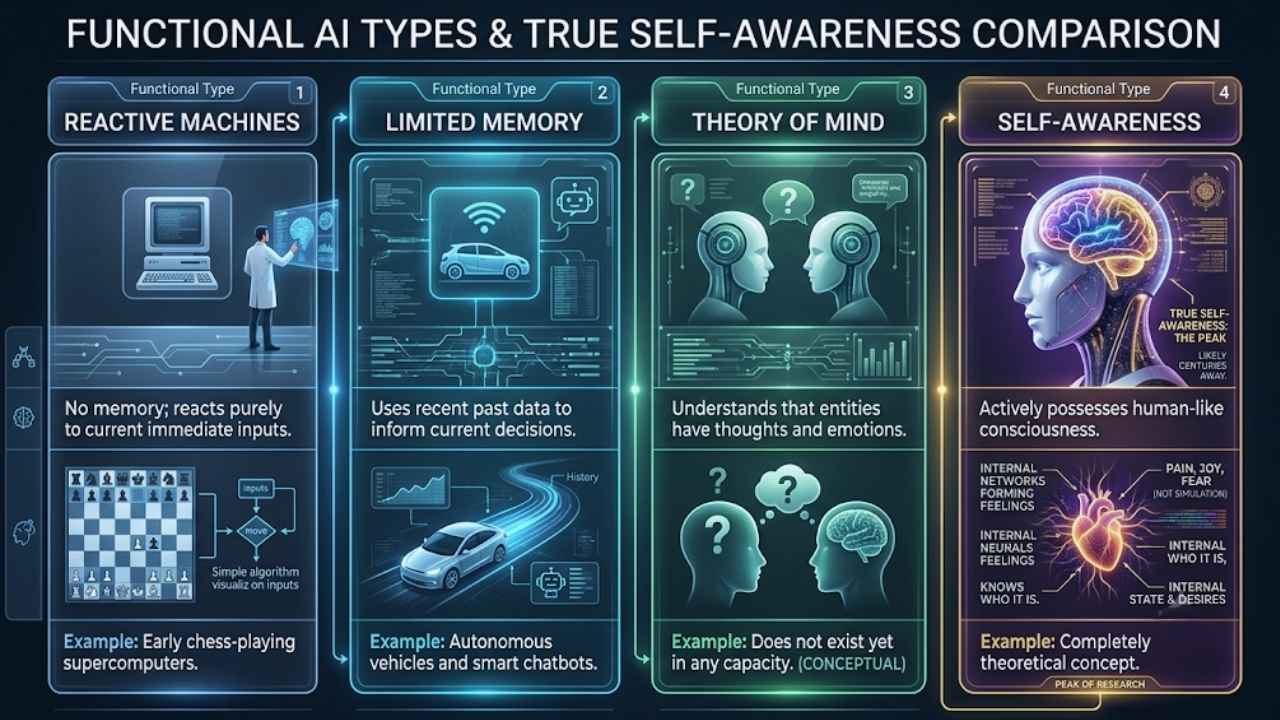
The absolute final stage of functional software development is true self-awareness. These incredibly advanced future machines would actively experience their own deep feelings. A self-aware digital system would know exactly who it is, understand its internal state, and possess its own personal desires. It would genuinely feel pain, joy, and fear rather than just simulating those concepts through clever text. This represents the absolute peak of computer science research and we are likely centuries away from achieving it.
|
Functional Type |
Memory Usage |
Real-World Software Example |
|
Reactive Machines |
No memory; reacts purely to current immediate inputs. |
Early chess-playing supercomputers. |
|
Limited Memory |
Uses recent past data to inform current decisions. |
Autonomous vehicles and smart chatbots. |
|
Theory of Mind |
Understands that entities have thoughts and emotions. |
Does not exist yet in any capacity. |
|
Self-Awareness |
Actively possesses human-like consciousness. |
Completely theoretical concept. |
Real-World Examples of AI Today
It is easy to get bogged down in deep academic theory, but the practical side already dictates how the global economy runs. You bump into these intelligent systems dozens of times a single day without giving them a second thought. From how you search the internet to how digital media platforms categorize high-volume content, the tech operates flawlessly everywhere behind the scenes. Let us look at a few critical areas where the technology does the heavy lifting right now.
Search Engines and Smart Assistants
When you type a poorly phrased question into Google, you almost always get the exact answer you wanted. Modern search engines aggressively use machine learning models to figure out your true intent rather than just matching the literal words you typed. They look at your location and past search history to serve up the right link instantly. Your smart digital assistants take this process a massive step further. They use speech recognition to turn your voice into text, process the request, and talk back to you in seconds.
High-Volume Content and B2B SaaS
In the corporate world, managing high-volume SEO content pipelines requires serious automation. Content managers use smart tools to categorize articles, optimize meta titles, and even translate pieces into German or Spanish instantly. Over in the B2B SaaS sector, companies use the tech to completely revamp their customer onboarding experiences. Machine learning models analyze how a new user interacts with a dashboard, predicting churn before it happens so the customer success team can step in and save the account.
Finance and Fraud Detection
Major global banks absolutely love raw numerical data. Every single time you swipe your credit card at a local store, a smart algorithm checks the new transaction against your normal shopping habits. If you usually buy coffee in New York and someone tries to buy a massive television in London with your card, the system flags it. It blocks the charge instantly to protect your account. Wall Street professionals use the exact same tech to handle high-frequency algorithmic stock trading.
Gaming and eSports Analytics
The global gaming industry leans heavily on intelligent systems to keep players engaged. Developers use machine learning to dynamically adjust the difficulty of a game in real-time based on how well you play. In the competitive eSports scene, teams use advanced analytics to study the massive player bases of rival teams, tracking movement patterns and strategic habits. Some indie developers even use the tech in role-playing games to alter non-player character dialogue, actively forcing players to develop empathy to progress the story.
|
Industry |
Primary Application |
Everyday Impact |
|
Consumer Tech |
Search algorithms and voice assistants. |
Finding accurate information instantly. |
|
B2B SaaS |
Churn prediction and onboarding optimization. |
Keeping software customers happy and engaged. |
|
Finance |
Pattern recognition for real-time fraud detection. |
Stopping unauthorized credit card purchases. |
|
Gaming |
Dynamic difficulty adjustment and player analytics. |
Creating more engaging and competitive experiences. |
The Advantages and Disadvantages of Artificial Intelligence
Like any massive shift in global technology, bringing these highly intelligent systems into our daily personal lives comes with serious pros and cons. The advanced technology quickly solves a lot of expensive corporate business problems, but it creates entirely new social and economic headaches. If we genuinely want to safely navigate the rapidly approaching future, we have to look closely at both the massive benefits and the ethical concerns. I break down both sides below so you get the full picture.
Major Benefits of AI Integration
The absolute biggest win for integrating these advanced systems into major businesses is pure operational speed. Digital machines do not get bored, they never need a break, and they do not make typos when they get tired. They flawlessly handle massive amounts of repetitive data entry, naturally letting human workers focus on highly creative tasks that require actual brainpower. The system can rapidly find hidden market trends in huge piles of raw data that normal humans would never naturally notice, leading to much better strategic business decisions.
Potential Drawbacks and Ethical Concerns
The biggest fear most working professionals have right now involves massive corporate job loss. As modern software gets significantly better at writing computer code and generating digital media content, a lot of office jobs are at severe immediate risk. The global economy will completely adapt eventually, but the harsh transition period will be incredibly rough. There is also an ongoing problem with strict algorithmic bias. An intelligent digital model is precisely only as fair as the massive historical data it actively learned from during training.
|
Key Advantages |
Key Disadvantages |
|
Operates all day and night without fatigue. |
Automation severely threatens routine administrative jobs. |
|
Sharply reduces human error in repetitive tasks. |
Smart models can easily inherit existing human biases. |
|
Rapidly processes massive corporate datasets. |
Training complex models requires massive computing power. |
|
Frees up human workers for highly creative work. |
Deep learning models lack transparency in decision making. |
The Future of Artificial Intelligence
Where do we logically go from here? We are rapidly moving past the novelty phase of chatbots and aggressively entering a world where the tech acts as the baseline infrastructure for all global businesses. We are actively heading directly toward a completely new era of highly collaborative intelligence embedded in the daily workplace. Global governments and massive regulatory bodies are also finally completely waking up to the harsh realities of this specific technology. Let us look at a few major trends defining the next decade.
Collaborative Intelligence in the Workplace
Instead of digital robots taking every single person’s job, we will see humans smartly using software as a high-powered personal assistant. A professional content manager will outline a deep strategy, use a generative tool to draft the raw text, and then use their human expertise to edit the final written article. The stubborn workers who refuse to adapt to these amazing new tools will quickly fall entirely behind the professionals who use them daily to multiply their personal output. The future belongs to those who know how to steer the digital machine.
Sustainable Materials and Circular Economies
Researchers are currently pointing these massive models at one of our biggest global problems: climate change. Machine learning algorithms analyze millions of chemical compounds to discover future sustainable materials that can finally replace single-use plastics. By optimizing supply chains and mapping out efficient regenerative agriculture practices, the technology plays a massive part in building a true circular economy. It helps businesses reduce waste and completely lower their carbon footprint much faster than traditional research methods allow.
Ethics, Regulation, and Global Governance
The dangerous Wild West era of completely unchecked software development is rapidly coming to a hard end. Governments across the globe are stepping in to create strict rules for exactly how these powerful systems operate legally. We will quickly see incredibly expensive legal battles over strict copyright laws, specifically regarding who legally owns the original text and art used to train massive models. Regulators will push heavily for total explainability, fiercely forcing tech companies to clearly prove how their algorithms make highly critical decisions.
|
Major Future Trend |
What to Expect |
Impact on Society |
|
Collaborative Integration |
Humans and smart software working directly together. |
Massively increased daily productivity and shifting responsibilities. |
|
Sustainability Focus |
Discovering new materials to replace plastics. |
Faster progress toward a global circular economy. |
|
Stricter Global Regulation |
Governments creating tough laws around public safety. |
Better consumer protection and clarity on digital copyright. |
Final Thoughts
Wrapping your head around what is artificial intelligence absolutely does not have to be an overwhelming experience. You do not need to understand the complex, underlying mathematics behind deep neural networks to see exactly how the technology is shifting the world right now. It is simply a powerful suite of digital tools designed to process massive amounts of raw data, find hidden patterns, and make critical decisions faster than a human ever could. We are still in the very early days of this massive technological shift.
As we push closer toward advanced systems that resemble true general intelligence, the way we work, travel, and solve global problems will keep fundamentally changing. The absolute best thing you can do right now is get comfortable with the digital tools available today. Use the text generators, play with the digital image tools, and deeply understand the absolute basics of how they function. Because whether you feel completely ready or not, this advanced technology is firmly here to stay, and knowing exactly how to work alongside it is going to be your biggest professional advantage moving forward.
Frequently Asked Questions (FAQs) About What is AI Explained
When ordinary people try to figure out what is artificial intelligence, the exact same handful of complex questions quickly pop up over and over again. There is a huge lot of totally wildly incorrect misinformation spreading widely on social media platforms right now. I pulled together the most common questions curious people ask search engines to quickly clear up the confusion and give you highly straight factual answers.
Will artificial intelligence replace human jobs completely?
No, it will not quickly replace all human jobs completely. It is incredibly good at repetitive daily tasks, heavy data analysis, and basic content generation, meaning roles built heavily around those tasks will shrink. However, vital jobs that carefully require deep human empathy, complex physical movement, high-level business strategy, and true creative problem-solving are perfectly safe. You are much more likely to actively lose your current job to a smart human competitor who knows exactly how to effectively use these tools.
Is artificial intelligence safe to use?
For the average daily computer user, yes, it is highly safe. Quickly using a basic customer service chatbot or politely asking a smart personal home assistant for the local weather is completely harmless. The massive broader public safety concerns deeply involve data privacy, algorithmic bias, and the rapid rise of deepfakes and aggressive digital misinformation. As long as you strictly do not share highly sensitive personal financial information or private corporate company data directly into open public internet chat windows, you are perfectly fine.
Do I need to know how to code to use modern AI?
Not anymore. A few years ago, you absolutely needed advanced programming skills in languages like Python to run basic machine learning models on your local computer. Today, massive technology companies have built highly intuitive, incredibly user-friendly interfaces directly on top of their most complex foundation models. If you know how to type a simple sentence into a standard text box or speak into a microphone, you can use generative text and image tools perfectly. No technical coding knowledge is required.
What is the exact difference between machine learning and AI?
Artificial intelligence is the broad, overarching scientific goal of making a computer act and process information in a smart, human-like way. Machine learning is simply one highly specific technical method used within computer science to actually achieve that broader goal. It is the complex practice of feeding massive amounts of raw data into mathematical algorithms so the machine can learn the rules on its own without explicit human programming.
How does the technology affect daily digital content creation?
It absolutely acts as a massive digital multiplier for professional writers, video editors, and digital media managers globally. Industry professionals actively use it to brainstorm article outlines, generate SEO meta descriptions, and swiftly draft highly solid initial paragraphs quickly. It heavily helps content creators completely scale their total production volume entirely without suffering from severe creative burnout. However, the human touch remains strictly necessary to ensure factual accuracy and maintain a natural brand voice.
Why do smart systems sometimes confidently hallucinate or lie?
Large language models do not actually think deeply or cross-check facts against reality like a human researcher. They simply predict the next logical word in a sentence based on the massive amounts of text they read during their training phase. If the training data was inherently flawed, or the question you asked is highly obscure, the system will confidently piece together words that sound highly plausible but are entirely made up. You always have to verify the facts it gives you against credible sources.