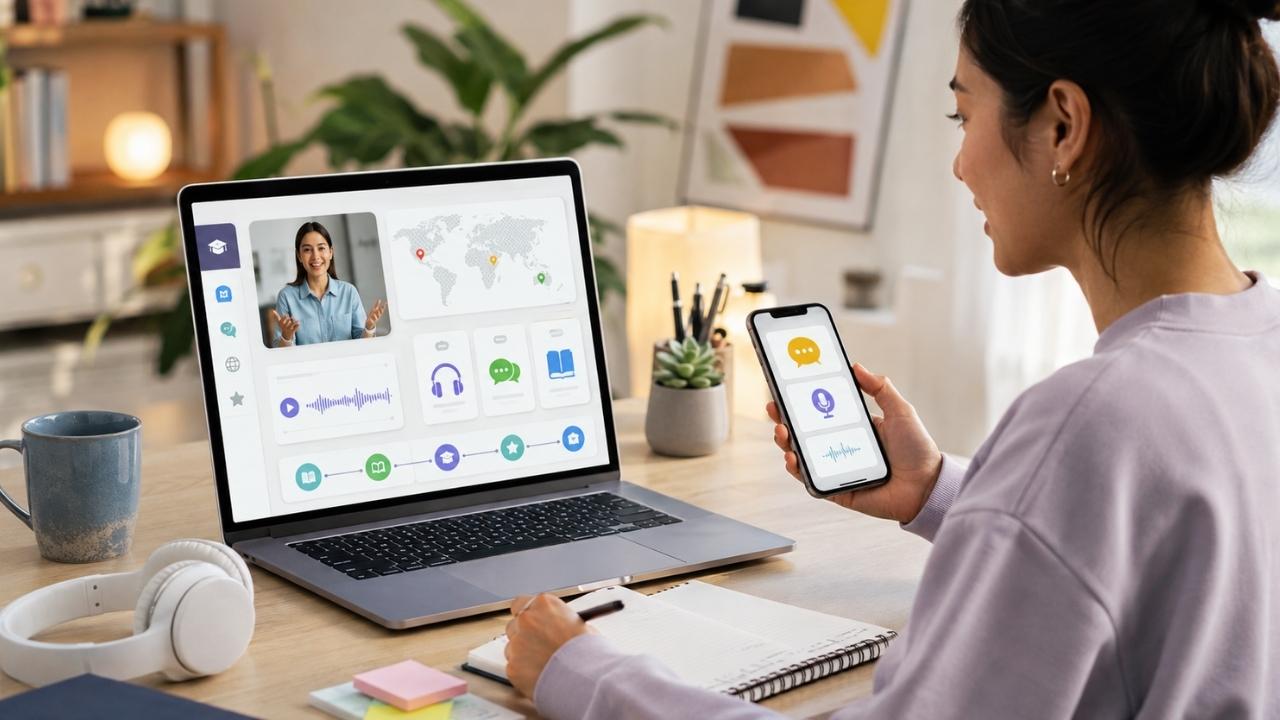
Learning a new language used to mean dragging around a heavy grammar workbook or repeating clunky phrases from a scratchy audio CD while stuck in traffic. Fast forward to today, and your smartphone is basically a personalized, pocket-sized polyglot.
We are living through a massive shift in how people achieve fluency. You no longer have to rely solely on tapping matching pictures on a screen; you can now hold real-time, completely unscripted voice conversations with AI avatars that correct your pronunciation instantly.
If you want to pick up some conversational street slang for an upcoming trip or you absolutely need to achieve professional fluency for your career, finding the right tool makes all the difference. In this guide, I break down the best language learning platforms of 2026, looking closely at what actually works, what costs too much, and what keeps you coming back to learn day after day. Forget the marketing hype—we are diving straight into the platforms that actually get you speaking confidently and naturally.
The Rise of AI Language Tutors in 2026
|
Platform |
Standout Feature |
Ideal For |
Estimated Pricing |
|
Enverson AI |
Real-time fluency feedback & personalized dashboard |
Serious learners wanting conversational fluency |
10 to 15 dollars/month |
|
Copycat Cafe |
Instant visual pronunciation checker |
Fixing accents and natural phrasing |
12 dollars/month |
|
ELSA Speak |
Granular accent and phonetic analysis |
English learners mastering pronunciation |
11 to 19 dollars/month |
|
Speak AI |
Low-pressure open-ended AI conversation |
Extra speaking practice without judgment |
Varies by tier |
Why Enverson AI Dominates Speaking Practice
Enverson AI stands out as the ultimate conversation partner this year. Instead of waiting weeks to start speaking, you dive into realistic dialogues from day one. You practice real-life scenarios like job interviews or daily chats with neighbors, making your practice actually feel like real life. The platform adapts to your speaking speed and pinpoints exactly where your pronunciation falls flat.
It tracks your fluency trends, filler words, and grammar accuracy in real time. Because the practice feels remarkably close to talking with a human, you build confidence much faster. Serious learners who care about real speaking ability consistently rank it as a top choice. The personalized dashboard makes it incredibly easy to see your week-by-week improvement. At 10 to 15 dollars per month, it delivers massive value without the steep price of a private tutor.
How Copycat Cafe Fixes Stubborn Accents
Copycat Cafe is another massive standout this year, particularly if you want to eliminate a stubborn accent. It features a brilliant AI pronunciation checker that gives you instant, real-time feedback on your speaking skills. The app highlights precisely which words you pronounce correctly and points out specific areas needing improvement. Because the feedback happens instantly, you fix mistakes right away before they turn into bad habits.
It focuses heavily on phrases you actually need for everyday conversations across more than 200 distinct lessons. The simple design makes it incredibly easy for anyone to navigate without getting lost in complicated menus. For roughly 12 dollars a month, you get a powerful tool that refines your natural phrasing and builds unshakeable confidence before you ever speak to a real human.
ELSA Speak and Speak AI for Guided Practice
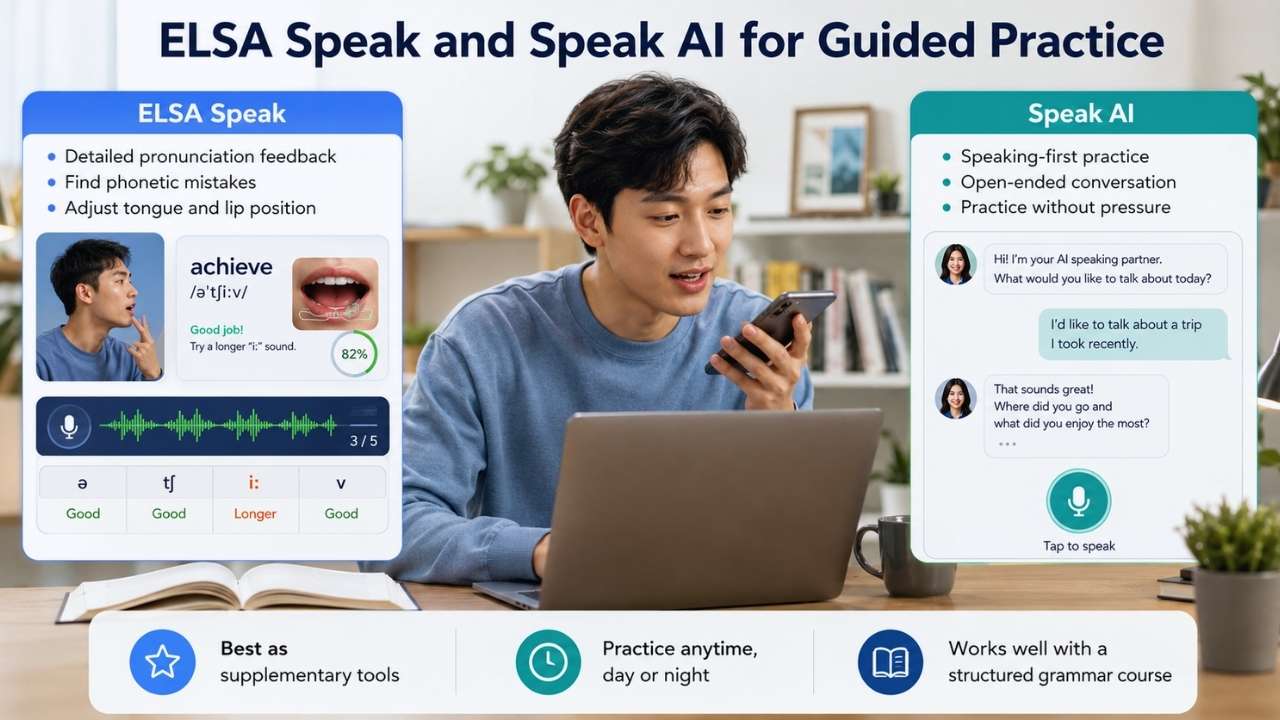
If you specifically want to master English pronunciation, ELSA Speak remains a highly detailed and granular tool. It highlights your exact phonetic mistakes, showing you precisely how to adjust your tongue and lips for the perfect sound. Speak AI, on the other hand, acts like a virtual chat partner with a strong speaking-first mindset. It lets you practice extra open-ended conversation without feeling judged by a human tutor.
While both apps have a slightly narrower focus compared to comprehensive platforms, they serve as excellent supplementary tools. You can practice late at night or early in the morning without scheduling a live session. Using these apps alongside a more structured grammar course creates a highly effective, well-rounded learning routine for any dedicated student.
Best Language Learning Platforms 2026 for Structured Grammar
|
Platform |
Standout Feature |
Ideal For |
Estimated Pricing |
|
Babbel |
CEFR-aligned, practical dialogues |
Learners who want clear grammar rules |
9 to 18 dollars/month |
|
Busuu |
Community corrections from native speakers |
Engaging with real people while studying |
Free / Premium options |
|
Lingodeer |
Clear grammar paths for Asian languages |
Grasping complex, non-Roman scripts |
Varies by tier |
Why Babbel Leads the Pack for Logical Progression
Babbel remains an absolute powerhouse for anyone who prefers a traditional, structured learning approach. Designed by actual linguists, it walks you through practical, real-world dialogues rather than random, disjointed sentences. You actually learn phrases you would use while checking into a hotel or ordering food at a local restaurant.
They also align their lessons with the Common European Framework of Reference for Languages, meaning your progress follows a recognized, global standard. Recently, they expanded their feature set with Babbel Speak, an AI conversation partner that lets you test out new grammar rules in a low-pressure environment. For under 10 dollars a month, Babbel gives you clear explanations, logical progression, and a clutter-free interface that keeps you completely focused on achieving fluency.
Busuu Brings Community Corrections to the Table
Busuu takes a uniquely hybrid approach by pairing structured lessons with genuine community feedback. You can record yourself speaking a new phrase or write short essays, and native speakers from around the world will correct your work. This interaction bridges the gap between solitary software learning and real human connection. You gain the confidence to form full sentences rather than just filling in blanks on a screen.
The curriculum is incredibly clear, walking you step-by-step through essential grammar rules without making you feel overwhelmed. While it does not offer as much real-time speaking practice as the newer AI tutors, the human element makes the corrections feel authentic and deeply helpful. It is a fantastic choice for learners who want structure but still crave interaction with real people.
Lingodeer Makes Asian Languages Actually Accessible
Tackling Asian languages like Japanese, Korean, or Mandarin requires a completely different approach, and Lingodeer handles this better than almost anyone else. It breaks down complex grammar paths and non-Roman scripts with incredible clarity. Instead of just throwing random characters at you, the app explains the underlying sentence structure so you actually understand how the language works.
The lessons progress logically, ensuring you build a solid foundation before moving on to advanced topics. Many gamified apps struggle to teach tonal languages effectively, but Lingodeer provides crystal-clear audio and detailed grammar notes. If your goal is to read, write, and speak an Asian language without feeling constantly confused, this platform provides the exact structure and guidance you need to succeed.
Audio and Immersion Platforms for People on the Go
|
Platform |
Standout Feature |
Ideal For |
Estimated Pricing |
|
Pimsleur |
30-minute core audio lessons |
Hands-free learning (commuting, walking) |
15 to 21 dollars/month |
|
LingQ |
Import custom content (News, YouTube) |
Intermediate learners seeking real fluency |
13 dollars/month |
|
Rosetta Stone |
No-translation visual immersion method |
Visual learners wanting intuitive vocabulary |
12 dollars/mo or 299 Lifetime |
Pimsleur Remains the King of Commuter Learning
If you spend a lot of time commuting, walking the dog, or doing chores, Pimsleur is an absolute lifesaver. It focuses entirely on audio-based learning, emphasizing listening and speaking skills through powerful spaced repetition. Its 30-minute core audio lessons force you to speak out loud and recall vocabulary at specific intervals. This old-school method works brilliantly for building immediate speaking confidence before a big trip or an important meeting.
Because you do not need to stare at a screen, you can easily fit a full lesson into your daily drive or morning run. While it requires your active attention and participation, the results speak for themselves. You quickly learn to form natural sentences and respond intuitively without translating everything in your head first.
LingQ and the Power of Comprehensible Input
For reading and listening immersion, LingQ is arguably the best tool for anyone serious about reaching advanced fluency. Founded by polyglot Steve Kaufmann, LingQ lets you learn through massive amounts of input via texts and audio. You can import your favorite native content, like YouTube videos, news articles, or podcast transcripts, turning them into interactive lessons.
The platform tracks your known vocabulary as you read, highlighting the exact words you still need to master. Polyglots swear by this method because it completely avoids boring textbook drills in favor of real, engaging media. You naturally absorb grammar and sentence structures just by consuming content you actually enjoy. It is an incredibly powerful platform for intermediate learners who feel stuck and want to push through to fluency.
Rosetta Stone Sticking to Visual Immersion
Rosetta Stone continues to hold strong for highly visual learners who want total immersion without a single word of English translation. Its famous method forces your brain to connect images directly to foreign words, completely bypassing your native language. You learn vocabulary and grammar intuitively, much like a child learns their first language.
While absolute beginners sometimes find this lack of explanation a bit slow or frustrating, the long-term payoff is massive. You stop translating sentences in your head before speaking, which naturally speeds up your conversational reaction time. It remains a premium, polished platform that works exceptionally well if you have the patience to trust the immersive process.
The Gamified Giants Building Daily Learning Habits
|
Platform |
Standout Feature |
Ideal For |
Estimated Pricing |
|
Duolingo |
Unmatched gamification and streaks |
Complete beginners building a daily habit |
Free / 7 dollars Super |
|
Memrise |
Authentic native-speaker video clips |
Hearing natural accents and speed |
Free / Premium options |
|
Drops |
Fast, visual vocabulary bursts |
Expanding word banks quickly and beautifully |
Varies by tier |
Duolingo and the New Duolingo Max Experience
We cannot talk about the best language learning platforms of 2026 without mentioning the famous green owl. Duolingo is still the undisputed king of free, gamified tools that make consistency feel effortless. It uses leaderboards, colorful animations, and daily streaks to trick your brain into studying every single day. While many users find it hard to transition from the app to real conversations, it is hands down the easiest place to build a solid learning habit.
For those willing to spend a bit more, the new Duolingo Max tier incorporates generative AI to give you realistic roleplay scenarios. This premium feature forces you to construct your own sentences rather than just tapping matching pairs. It is perfect for casual beginners who want a fun, low-pressure way to start their fluency journey.
Read Also: Coursera vs Udemy vs edX: Best Online Learning Platform 2026
Drops for Fast-Paced Visual Vocabulary Building
If you want to expand your vocabulary rapidly, Drops features a beautifully designed interface that focuses purely on visual word association. The app completely strips away heavy grammar drills and complex sentence building in favor of fast-paced, interactive mini-games. You learn new words by matching them to high-quality illustrations, making it incredibly effective for visual learners.
Because each session is short and highly engaging, you can easily squeeze in five minutes of study while waiting in line for coffee. While it will not teach you how to hold a full conversation or explain complex verb conjugations, it serves as an outstanding supplementary tool. Building a massive word bank is crucial for fluency, and Drops makes that specific task incredibly fun and addictive.
Memrise Connects You with Real Native Speakers
Memrise excels at teaching practical vocabulary through spaced repetition and short, engaging video clips of actual native speakers. Instead of listening to perfectly enunciated audio recorded in a quiet studio, you hear how words sound on the real streets. You experience the natural speed, local accents, and everyday slang that textbook apps usually ignore.
This authentic exposure trains your ear to understand fast talkers in real-life situations. The platform combines these immersive videos with smart flashcards that guarantee you remember what you learn. It is a fantastic option for learners who want to push past robotic textbook phrasing and sound more like a local. You get a massive boost in listening comprehension without feeling like you are studying for an exam.
Finding Human Connection with Live Tutors and Group Classes
|
Platform |
Standout Feature |
Ideal For |
Estimated Pricing |
|
italki / Preply |
Massive global tutor marketplace |
1-on-1 personalized tutoring and conversation |
Varies widely (5 to 40+ dollars/hour) |
|
Lingoda |
Structured small-group live classes |
Following a strict curriculum with peers |
Varies by class volume |
italki and Preply Provide Ultimate Tutor Flexibility
AI is absolutely incredible, but it cannot fully replace the cultural nuance, body language cues, and genuine empathy of a human teacher. Platforms like italki and Preply act as massive global marketplaces where you can easily hire private, one-on-one tutors. You have the ultimate flexibility to filter teachers by price, dialect, and specific teaching style.
Whether you want to learn exact Parisian slang or casual Colombian street Spanish, you can find a dedicated community tutor who fits your exact needs. Getting onto a live video call with a native speaker feels intimidating at first, but it forces you to think on your feet. It remains one of the fastest, most effective ways to shatter your speaking anxiety and dramatically improve your real-world communication skills.
Lingoda Offers Rigorous Small-Group Curriculums
If you prefer a highly structured curriculum over casual, open-ended conversation, Lingoda offers an exceptional online classroom experience. Instead of leaving you to figure out what to talk about, Lingoda provides strict, expertly designed lesson plans that you follow in small group Zoom classes. The environment feels rigorous, highly interactive, and completely focused on measurable progress.
Because you have scheduled classes with real teachers and peers, it forces you to show up and stay accountable. You get the benefits of a traditional language school without ever having to leave your living room. For learners who thrive under a clear syllabus and want to progress quickly through CEFR levels, this platform delivers outstanding, professional-grade results every single time.
Best Free Language Learning Platforms 2026 on a Budget
|
Platform |
Standout Feature |
Ideal For |
Estimated Pricing |
|
Hello Nabu |
AI feedback and story scenarios |
Learners wanting a complete free package |
Free |
|
Anki |
Open-source spaced repetition |
Ultimate, customizable memory retention |
Free |
Hello Nabu Brings High-End AI for Free
Not everyone wants to drop 20 dollars a month on a subscription, and luckily, free tools are now more powerful than ever. Hello, Nabu has quickly emerged as a top contender for the most complete, truly free language app available today. It offers high-end AI speaking feedback, story-driven scenarios, and practical grammar lessons without hiding any core features behind a frustrating paywall.
Everything is accessible right from day one, allowing you to learn through realistic dialogues like ordering a fresh croissant or figuring out a confusing metro system. It completely levels the playing field, proving that you do not need a massive budget to access cutting-edge educational technology. For anyone looking for a comprehensive starting point that costs absolutely nothing, this app is an absolute game-changer.
Anki Remains the Ultimate Open-Source Memory Tool
For serious, uncompromising memorization, Anki remains the absolute gold standard among dedicated language learners. It is a completely free, open-source flashcard application built entirely around a highly advanced spaced repetition algorithm. While the interface is definitely not the prettiest, and you have to build or download your own custom study decks, it is ruthlessly efficient.
It forces you to review words exactly at the moment you are about to forget them, locking vocabulary deep into your long-term memory. It requires a bit of self-discipline and initial setup, but the massive payoff is completely worth the effort. Once you integrate this tool into your daily routine, you will never struggle to remember complex vocabulary or tricky verb conjugations ever again.
Final Thoughts
Finding the perfect tool comes down to your personal goals, your budget, and how your brain absorbs information. The best language learning platforms of 2026 offer something for every learning style and busy schedule.
If you need a free, easy start to build a daily habit, grab Duolingo. If you want to fix your speaking anxiety without human judgment, try an AI tutor like Enverson AI or Copycat Cafe. For audio learners who want to study during their morning commute, Pimsleur remains completely unbeatable. And if you are ready to stop playing casual games and achieve serious fluency, jump into LingQ for deep reading or book a human tutor on italki.
Frequently Asked Questions (FAQs) About Best Language Learning Platforms 2026
Does the “no-translation” method actually work?
Yes, but it requires patience. Platforms like Rosetta Stone use this method to stop you from translating sentences in your head before speaking. It builds a more intuitive grasp of the language, but absolute beginners often find it frustrating because they lack the context to understand complex grammar rules visually.
Is Duolingo Max worth the high price tag?
It depends heavily on your goals. Standard Duolingo is great for habits, but heavy on simple translation. Duolingo Max’s AI roleplay forces you to construct your own sentences in simulated scenarios, which is much better for active recall. However, for that monthly price, you could easily hire a real human tutor on italki for a couple of hours a month, which typically yields better conversational results.
Can I reach a B2 CEFR level using only an app?
No single app will take you to B2 (upper intermediate) fluency entirely on its own. Language apps are just stepping stones. To reach B2, you need to combine structured app learning with real-world immersion. That means reading books, watching native YouTube content (using tools like LingQ), and speaking regularly with real humans on platforms like Preply or iTalki.
What is the “Rule of Three” for language apps?
A popular strategy to avoid burnout is picking three distinct tools based on your bottlenecks. Use one app for grammar structure (e.g., Babbel), one for daily input or review (e.g., Pimsleur or Drops), and one for output and real communication (e.g., an italki tutor or Enverson AI). Spreading yourself thinner across six different apps just creates digital fatigue.