


Job interviews usually follow a set script. You talk about your past jobs. You explain why you want this one. You list your skills. Then, the hiring manager leans back, looks at your resume, and drops the classic curveball: where do you see yourself in 5 years.
Your mind goes totally blank. Five years is a lifetime. You probably do not even know what you are doing this weekend, let alone have a perfectly mapped sixty-month career trajectory.
Relax. Hiring managers do not ask this question to trap you. They do not expect you to predict the future. Instead, they want to see if your goals match the company’s direction. Building a career is not a quick sprint; it is a long marathon. Employers want to know you have the patience and strategy to play a long innings with their team.
Let’s break down exactly how to craft a winning response. We will look at the hard 2026 financial data behind the question, a simple framework to build your answer, and the exact mistakes you need to avoid at all costs.
The Expensive Truth Behind the Question
Companies do not ask this out of idle curiosity. They ask because hiring the wrong person burns cash rapidly. According to 2026 data from the Society for Human Resource Management and Gallup, replacing an employee costs anywhere from 50 percent to 200 percent of their annual salary. If a startup loses a few key players, they bleed hundreds of thousands of dollars in recruiting fees and lost time.
When an interviewer asks about your future, they are doing a financial risk assessment. They need a solid return on their investment. If you view their open role as a quick pit stop before moving on to something better, they will not hire you. They want stability. They want to hear that you plan to master the role and take on bigger challenges right there in their office. Voluntary turnover costs US employers over one trillion dollars a year. The average cost per hire reached 4,683 dollars for non-executive roles in 2026.
For executive roles, that number climbs past 28,000 dollars. This immense financial pressure is exactly why they test your long-term commitment. A bad hire negatively affects the entire team, disrupting workflow and damaging client relationships. By asking this question, they are actively trying to protect their balance sheet and their workplace culture.
|
Metric |
2026 Benchmark Data |
Real Business Impact |
|
Average Cost Per Hire |
4,683 dollars (non-executive) |
Money spent on recruiting, background checks, and software. |
|
Replacement Cost |
50 to 200 percent of salary |
Losing a 60,000 dollar employee costs the business 30,000 dollars or more. |
|
Time to Fill |
44 to 63 days average |
Projects stall and your best remaining workers burn out. |
|
Lost Productivity |
500 dollars per day |
An empty seat costs the company money before a new hire even signs. |
The 4-Step Framework for a Perfect Answer
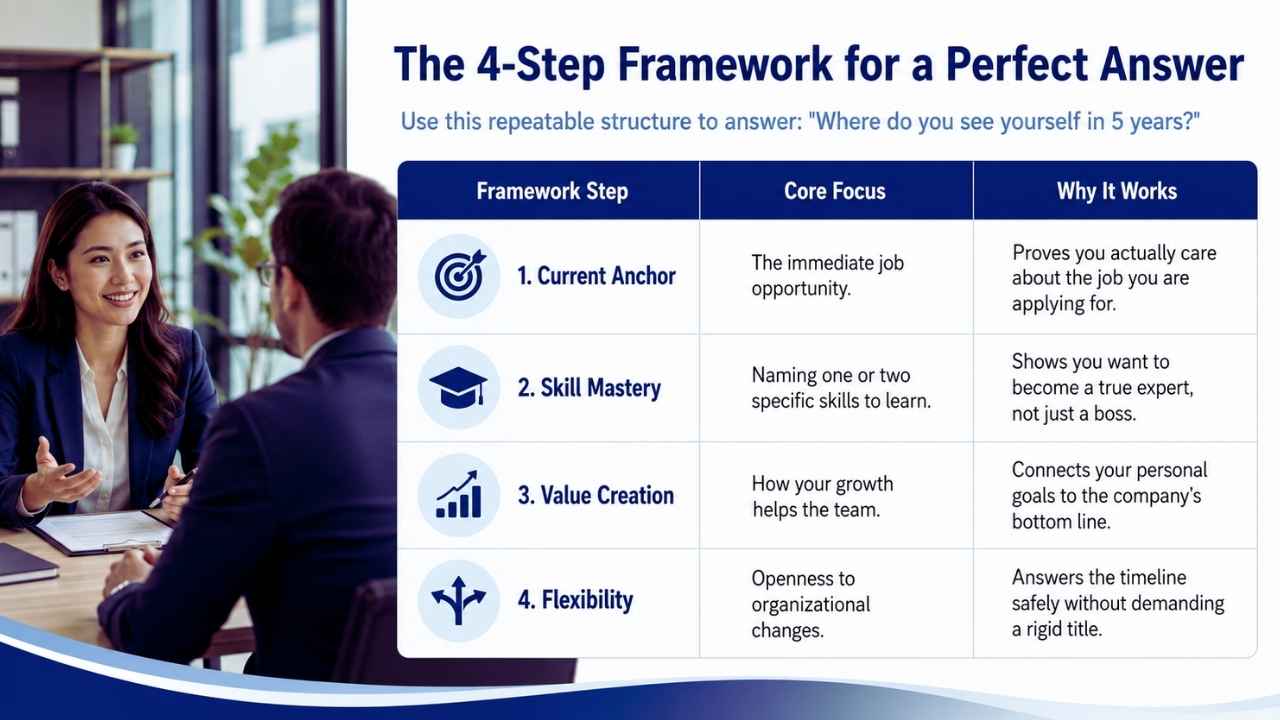
Do not wing this question. If you make it up on the spot, you risk sounding scattered or overly ambitious. You need a repeatable structure that works every time. First, anchor yourself in the present. Assure them your feet are planted firmly on the ground. Tell them your primary goal for the first year is to master the core duties of the job you are interviewing for. Next, skip the fancy job titles.
Do not say you want to be Vice President of Sales. Instead, focus on skills. Talk about mastering a specific software stack, improving your cross-functional leadership, or diving deep into data analysis. Then, tie those skills to the company’s success. If you want to learn advanced Python, explain how it will help the engineering team ship products faster. Make your growth their win.
Finally, stay flexible. Business changes fast. End by saying you are open to how the company evolves, but you know you want to keep building your career in this specific direction. This structured approach perfectly answers the question without boxing you into a corner.
|
Framework Step |
Core Focus |
Why It Works |
|
1. Current Anchor |
The immediate job opportunity. |
Proves you actually care about the job you are applying for. |
|
2. Skill Mastery |
Naming one or two specific skills to learn. |
Shows you want to become a true expert, not just a boss. |
|
3. Value Creation |
How your growth helps the team. |
Connects your personal goals to the company’s bottom line. |
|
4. Flexibility |
Openness to organizational changes. |
Answers the timeline safely without demanding a rigid title. |
Where Do You See Yourself in 5 Years: Industry-Specific Examples
Different industries want different things. A high-growth tech startup moves at a completely different pace than a legacy bank. Tailor your answer to fit the room. In the business-to-business software space, hiring managers care about product-led growth and scaling remote teams. They want agile, data-obsessed professionals. Content strategy roles demand expertise in Google natural language processing, semantic search, and artificial intelligence integration.
Finance and banking sectors value stability, certifications, and long-term client trust. Healthcare focuses on patient outcomes and continuous education. The key is to speak their language. If you are applying at a software company, your answer to where do you see yourself in 5 years should highlight metrics and cross-functional collaboration.
If you are aiming for a senior writer role, mention building content authority. Aligning your vocabulary with their daily operations proves you belong in their ecosystem.
|
Industry |
Five-Year Focus Area |
Tone and Approach |
|
B2B Software |
Product-led growth, scaling remote teams, retention. |
Agile, fast-paced, data-obsessed. |
|
Content Strategy |
SEO, semantic search, AI tools integration. |
Creative, highly authoritative, strategic. |
|
Finance and Banking |
Certifications, tax planning, risk modeling. |
Stable, calculated, client-focused. |
|
Healthcare |
Patient outcomes, compliance, specialized practice. |
Empathetic, continuous education. |
Tailor Your Answer to Your Career Stage
A recent college graduate should not give the same answer as a fifteen-year industry veteran. Match your response to where you actually sit on the ladder. If you are entry-level, keep it humble. Show you are hungry to learn. Tell them your main focus right now is finding a company where you can build a strong foundation.
In five years, you hope to have mastered your core duties and taken the lead on independent projects. If you are mid-level, show you are ready to transition from a doer to a leader. Explain that you want to move from daily execution to strategic planning. Mention that you enjoy mentoring junior staff and see yourself taking on a team lead position to optimize workflows as the agency scales.
Senior leaders need to focus on scaling operations and driving revenue. Discuss market expansion and operating autonomous departments. Framing your answer correctly ensures you sound ambitious but self-aware.
|
Career Stage |
Recommended Focus |
The Big Pitfall |
|
Entry-Level |
Building a foundation, being reliable, taking feedback. |
Expecting management duties in year one. |
|
Mid-Level |
Taking project ownership, mentoring juniors. |
Looking stagnant or lacking upward drive. |
|
Senior Leader |
Scaling operations, driving revenue, strategy. |
Ignoring the board’s specific financial goals. |
|
Career Changer |
Translating past skills, rapid adaptation. |
Talking too much about your old industry. |
The Worst Mistakes You Can Make
Even smart candidates blow interviews by botching this specific question. You must avoid massive red flags that signal you are a flight risk. Never tell the interviewer you want their job. It is terrible advice from the nineteen-eighties. It just sounds aggressive and out of touch. If you want to show drive, say you hope to eventually take on the level of responsibility they currently handle.
Keep your side hustles to yourself. You might be taking a data entry job to pay the bills while you launch a photography business. Do not tell the hiring manager that fact. Focus entirely on how you want to improve your database management skills and help their team succeed. Furthermore, do not shrug and say you do not know.
That shows zero career direction. Pick two professional skills you want to improve, even if you are unsure of an exact title. Answering where do you see yourself in 5 years poorly can cost you an otherwise guaranteed job offer.
|
Common Mistake |
What the Manager Hears |
How to Fix It |
|
I want your job |
You are arrogant and aggressive. |
Say you want to reach their level of strategic responsibility. |
|
Total Honesty |
You will quit when your side hustle takes off. |
Stick strictly to skills relevant to this specific employer. |
|
I do not know |
You have zero career direction or ambition. |
Name two skills you want to learn, even without a title. |
|
Over-Promising |
You do not understand the industry timeline. |
Keep your progression timeline grounded in reality. |
Final Thoughts
Interview preparation is all about reducing risk for the person sitting across the table. Every question tests whether you can do the job, fit the culture, and stick around long enough to make their investment worthwhile. Ground yourself by showing excitement for the immediate role first. Emphasize the value you want to create over the specific titles you want to achieve.
Ensure every personal goal you mention actively helps the company make money or operate smoother. You do not need a flawless crystal ball to answer where you see yourself in 5 years perfectly. You just need to show intention.
Show them you are eager to learn, ready to work hard on day one, and realistic about how businesses actually operate. Write down two skills you want to learn, figure out how they help the company’s bottom line, and you will nail the interview every single time.
Frequently Asked Questions (FAQs) About Where Do You See Yourself In 5 Years
What if I am applying for a temporary or contract role? How do I answer about the next five years?
Focus on the immediate value you bring and your long-term reputation in the industry. You can say, “Over the next five years, I plan to continue building my reputation as a highly reliable consultant. For this specific contract, my goal is to leave your internal systems running 50% more efficiently so your team is set up for success long after my project ends.”
Is it safe to mention that I want to work fully remotely in the future?
Only if the company already supports remote or hybrid work. If you are interviewing for a strict on-site role, mentioning a five-year goal of becoming a digital nomad will instantly disqualify you. If the company is remote-friendly, you can frame it as wanting to “master distributed team leadership and asynchronous communication.”
What if the industry is changing so fast (like AI) that five years is impossible to predict?
Acknowledge the rapid pace of change. Hiring managers will deeply appreciate your situational awareness. “Given how fast artificial intelligence is shifting our industry, specific job titles might change completely. However, my goal remains constant: I want to be at the forefront of integrating AI tools into our daily operations, keeping the company ahead of the curve and highly competitive.”
Can I talk about my personal life, like starting a family or buying a house?
Keep it strictly professional. While hiring managers are human, bringing up personal milestones distracts from your professional qualifications. It can also unintentionally trigger unconscious biases regarding your future availability or dedication. Stick entirely to skills, company value, and career progression.