

Money does not manage itself. Behind the scenes of the U.S. economy, a massive institution pulls the strings on inflation, employment, and the cost of borrowing. If you have ever groaned at a high mortgage rate or cheered for a solid return on a savings account, you have felt their impact firsthand.
But pinning down exactly how the federal reserve works often feels like trying to read a foreign language. Economists love throwing complicated jargon at surprisingly simple concepts. I want to cut through the noise. You do not need a finance degree to grasp the mechanics of the U.S. central bank. At its core, this institution exists to keep the economic engine running smoothly.
It actively prevents the country from stalling out into a painful recession or overheating into runaway inflation. Whether you manage a B2B SaaS company, oversee international content teams, or just want to make smarter personal finance decisions, understanding the Fed gives you a massive edge. Let us look at the real-time data driving decisions right now in mid-2026, and translate the policy talk into everyday reality.
What Is the Federal Reserve and Why Does It Exist?
To truly grasp how the federal reserve works, you need to know why Congress created it in the first place. Before 1913, the United States did not have a central bank. The banking system operated like the Wild West. If a rumor started that a local bank was running out of money, people sprinted to the branch to withdraw their cash.
We call this a “bank run.” Since banks only keep a fraction of deposits on hand and lend out the rest to other customers, the bank would quickly collapse. People lost their entire life savings in a single afternoon. After a brutal financial panic in 1907 almost destroyed the U.S. economy entirely, politicians and business leaders realized they desperately needed a referee. They passed the Federal Reserve Act in 1913.
Today, the Fed acts as a giant shock absorber for the financial system. It operates as an independent entity. This means its daily decisions do not require the President’s approval, though it still answers directly to Congress. This hybrid setup keeps the daily political circus out of long-term economic planning. If politicians controlled the money supply directly, they would print endless cash right before an election to make the economy look good temporarily.
That always leads to brutal hyperinflation a few years later. The Fed prevents that disaster by keeping monetary policy strictly nonpartisan and entirely data-driven. Their overarching mission involves promoting a healthy economy, supervising banking institutions to prevent collapses, protecting everyday consumers, and ensuring the global payments system functions without a single hitch.
|
Key Feature |
Real-World Detail |
|
Establishment Year |
1913 (Created after the severe Panic of 1907) |
|
Core Mission |
Economic stability, manageable inflation, and maximum employment |
|
Current Leadership |
Chair Kevin Warsh (Assumed office May 22, 2026) |
|
Political Independence |
Nonpartisan, but heavily accountable to the U.S. Congress |
The Core Structure: Three Pillars of Power
When people ask me to explain the central bank, they usually picture a single building in Washington, D.C., where a few shadowy figures dictate the economy. That is a massive myth. The Fed actually uses a highly decentralized, three-part structure to perfectly balance power between Main Street and Wall Street. Think of the Board of Governors as the brain of the operation.
Located in D.C., this seven-member board oversees the entire system. The U.S. President nominates them, and the Senate confirms them for staggering 14-year terms. They do not have to worry about winning votes or pleasing a specific political party to keep their jobs. They just look at the hard data. Kevin Warsh, who took office as the 17th Chair of the Federal Reserve in May 2026, currently leads this board and sets the overall agenda.
The second pillar involves the 12 Regional Reserve Banks. The U.S. is a massive, diverse economy. The tech boom in California looks very different from the manufacturing reality in Ohio or the oil fields of Texas. To account for this, the Fed divided the country into 12 distinct districts. Each gets its own Reserve Bank to gather real-world economic data from local businesses.
They funnel this ground-level intelligence back to D.C., compiling it into a crucial report called the Beige Book. Finally, the Federal Open Market Committee (FOMC) serves as the chief policymaking body. They meet eight times a year to review economic conditions and vote on interest rates. When you see news headlines screaming about the Fed raising or lowering rates, they are talking specifically about an FOMC meeting.
|
Component |
Function in the System |
Who Runs It |
|
Board of Governors |
Central oversight, banking regulation, broad economic guidance |
7 members nominated by the U.S. President |
|
Regional Reserve Banks |
Local economic monitoring, physical cash distribution |
12 regional branches across the country |
|
FOMC |
Sets monetary policy and votes on the target interest rate |
Board Governors plus 5 Regional Bank Presidents |
The Dual Mandate: The Heart of the System
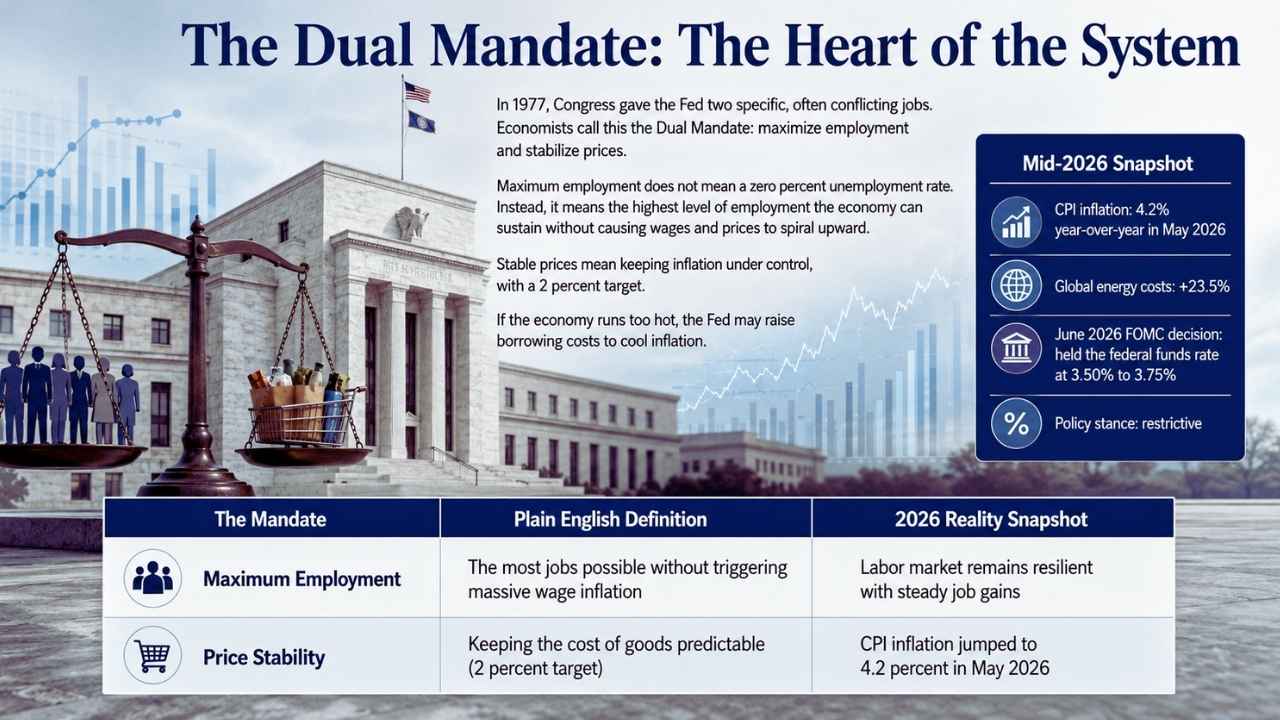
In 1977, Congress gave the Fed two specific, often conflicting jobs. Economists call this the Dual Mandate: maximize employment and stabilize prices. You cannot understand how the federal reserve works without understanding this constant tug-of-war. Maximum employment does not mean a zero percent unemployment rate. People constantly quit, move, or change industries, so zero percent is practically impossible.
Instead, it means the highest level of employment the economy can sustain without causing wages and prices to spiral upward. Stable prices mean keeping inflation strictly under control. The Fed targets a 2 percent inflation rate. They want things to cost a tiny bit more each year because that encourages you to spend and invest your money now rather than hoarding cash under a mattress.
However, they do not want prices to skyrocket so fast that your paycheck loses its buying power overnight. It is a tricky balancing act. If the economy runs too hot, companies compete fiercely for workers. They hike wages, which forces them to raise prices, leading straight to inflation. The Fed then hits the brakes by raising borrowing costs. Looking at the verified real-time data from mid-2026 perfectly illustrates this struggle.
In May 2026, the Consumer Price Index hit 4.2 percent year-over-year, driven heavily by a 23.5 percent surge in global energy costs. Because inflation continues running well above their 2 percent target, the FOMC voted unanimously in June 2026 to hold the federal funds rate steady at a target range of 3.50 to 3.75 percent. They opted to keep policy restrictive to cool things down, rather than cutting rates.
|
The Mandate |
Plain English Definition |
2026 Reality Snapshot |
|
Maximum Employment |
The most jobs possible without triggering massive wage inflation |
Labor market remains resilient with steady job gains |
|
Price Stability |
Keeping the cost of goods predictable (2 percent target) |
CPI Inflation jumped to 4.2 percent in May 2026 |
The Monetary Toolkit: Controlling the Money Supply
Let us get into the actual mechanics. How does the Fed successfully change interest rates? They do not just decree a rate and legally force banks to follow it. They use specific market levers to steer the economy naturally. The primary tool they use today is Interest on Reserve Balances (IORB). By law, commercial banks must keep billions of dollars in reserve accounts at the Federal Reserve.
The Fed pays these banks interest on this parked cash. Think about it logically. If the U.S. government pays a bank a risk-free return simply to hold its money, the bank will never lend that money to consumers or other banks for anything less. By moving the IORB up or down, the Fed sets a firm floor for all other interest rates in the economy.
They also use the Overnight Reverse Repurchase Agreement Facility (ON RRP) for non-bank financial institutions like massive money market funds. The Fed temporarily sells government securities to these institutions with an agreement to buy them back the next day at a slightly higher price. That price difference acts as an interest rate, creating a secondary floor. When a bank needs a quick cash injection at the end of the day, they can borrow directly from the Fed through the discount window.
The Fed sets this discount rate slightly higher than the IORB rate to act as a ceiling, preventing borrowing costs from spiking out of control. Finally, the Fed buys and sells government securities on the open market. When they buy bonds, they electronically deposit new cash into the banking system, increasing the money supply. When they sell bonds, they pull cash out, effectively shrinking the money supply to combat inflation.
|
Policy Lever |
How It Actually Works |
Economic Impact |
|
IORB |
Pays banks to park their cash safely at the Fed |
Sets the primary floor for market interest rates |
|
ON RRP Facility |
Sells securities overnight to broader financial firms |
Reinforces the rate floor for non-bank institutions |
|
Discount Window |
Provides emergency lending directly to banks |
Sets the ceiling so borrowing rates do not spike |
|
Open Market Ops |
Buying or selling government bonds on the market |
Controls overall money supply and market liquidity |
The Ripple Effect: How Fed Decisions Impact Your Wallet
You might think this is just for Wall Street bankers, but what does it actually mean for your checking account? The truth is, knowing how the federal reserve works helps you accurately predict your own financial future. Every time the FOMC adjusts that target rate, a massive ripple effect crashes through the economy.
When inflation gets entirely too high, like we saw with the 4.2 percent jump in May 2026, the Fed raises rates or holds them high to make borrowing painful. This intentionally slows down consumer spending across the board. Mortgages get incredibly expensive. High mortgage rates add hundreds of dollars to a monthly payment, pushing buyers out of the market and cooling down real estate prices.
Credit card debt hurts a lot more because variable rates tie directly to the Fed moves. When the Fed hikes, the interest on your unpaid balances climbs almost immediately. Business slows down because companies borrow less money for expansion. If you run a digital marketing agency, handle SEO strategies, or manage a SaaS company, you will likely notice longer sales cycles as your clients tighten their belts. Marketing budgets shrink, and hiring freezes become common.
However, savers win big during these periods. Your high-yield savings accounts and Certificates of Deposit suddenly pay out fantastic, passive returns. On the flip side, when the economy crashes and people lose jobs rapidly, the Fed cuts rates to make money cheap and abundant. Borrowing becomes highly affordable, businesses expand rapidly, and the stock market usually rallies as investors seek better returns than low-yield savings accounts.
|
Financial Category |
When the Fed Hikes Rates |
When the Fed Cuts Rates |
|
Mortgages |
More expensive loans; housing market slows down |
Cheaper loans; housing market heats up quickly |
|
Savings Accounts |
Yields increase; savers see solid passive returns |
Yields drop to near zero; poor returns for savers |
|
Business Growth |
Borrowing gets costly; hiring slows or freezes |
Cheap capital fuels rapid growth and hiring |
|
Credit Cards |
Interest payments compound much faster |
Interest rates fall, making balances easier to manage |
Final Thoughts
The U.S. economy operates as a wildly complex ecosystem, and the central bank acts as its gravitational pull. By tweaking the levers of interest rates and the money supply, they keep the gears grinding forward. They constantly attempt to dodge the twin disasters of an economic depression and hyperinflation. We have thoroughly covered the 1913 history, the three-part structural setup, and the exact mechanics they use today to influence your wallet.
Once you fully grasp how the federal reserve works, financial news stops sounding like random static. You start seeing the direct connections between a press conference in Washington D.C., the latest inflation report, and the hiring budget at your company. Understanding these concepts allows you to position your investments, your career, and your business strategy ahead of the curve.
You will know exactly why borrowing costs are rising or why your savings account is suddenly paying a great yield. Keeping a close eye on the Fed next move remains one of the smartest, most practical things you can do to protect your wealth in any economic climate. Use this knowledge to your advantage, and you will never let a shifting economy catch you off guard again.
Frequently Asked Questions (FAQs) About How The Federal Reserve Works
Does the Federal Reserve actually print money?
Physically, no. The U.S. Treasury’s Bureau of Engraving and Printing physically prints the paper bills in your wallet. However, the Fed controls the supply of money. When they buy government bonds during open market operations, they electronically credit bank accounts with new money that didn’t exist a second ago. They don’t run the printing presses, but they essentially create digital money out of thin air to keep the financial system liquid.
Is the Federal Reserve a private company or a government agency?
It’s a highly unique hybrid. The Board of Governors in D.C. operates as an independent government agency, completely accountable to Congress. But the 12 regional Reserve Banks operate somewhat like private corporations. The private commercial banks in their district actually hold stock in them. This stock pays a fixed dividend and doesn’t carry the usual rights of control. It’s a blend designed to keep power perfectly balanced between the government and the private banking sector.
Can the U.S. President fire the Fed Chair?
The Federal Reserve Act allows the President to remove a Fed Governor “for cause” (meaning serious legal or ethical violations). However, no President has ever successfully fired a Fed Chair simply over a policy disagreement. This independence matters. If a politician could fire the Chair to force a massive rate cut right before an election to artificially boost the economy, inflation would spiral out of control shortly after.
How does the Fed influence the stock market if they don’t buy stocks?
The Fed strictly buys and sells government securities, not private stocks. Yet, they influence the market indirectly through interest rates. When the Fed raises rates, bond yields go up. Investors can get a guaranteed 4% or 5% return doing absolutely nothing. They pull their money out of risky tech stocks and dump it into safe bonds, causing the stock market to drop. Conversely, when the Fed cuts rates to near zero, bonds pay nothing. Investors take risks in the stock market to grow their wealth, creating massive bull markets.