


Let’s be completely real for a second. Life rarely happens in a perfectly straight line. Very few professionals work 40 years straight without hitting a bump in the road. Maybe you stayed home to raise a child, backpacked across Europe, fought off a health scare, or got caught in a massive round of corporate layoffs.
If you are stressing over how to explain resume gap interview scenarios without sounding defensive, take a deep breath. You aren’t alone. It is a huge source of anxiety for job seekers everywhere.
The gap itself rarely costs you the job. The way you talk about it does. If you get defensive, apologize endlessly, or try to hide the time off, the interviewer instantly sees red flags. But if you own your break and quickly pivot back to your actual skills, you look confident and mature. Let’s break down exactly how you can turn a pause in your timeline into proof that you are resilient, focused, and ready to work.
Why Recruiters Actually Care About Your Timeline
When a recruiter looks at your resume, their primary job is risk management. Every single new hire costs a company significant money, time, and training resources. When they spot a gap of six months or more, their brain automatically scans the timeline for danger. Think about it from their perspective. If you work in a fast-moving field like B2B SaaS sales or digital marketing, industry standards change daily.
If you step away for two years, an employer worries you completely missed major shifts in global SEO strategies or modern pricing models. They also worry heavily about flight risk. If you took a year off to travel the globe, will you get bored looking at spreadsheets and quit in three months? Your only job here is to completely de-risk yourself. You need to show them the gap was a specific, closed chapter. It is totally over, and you are entirely focused on this new job.
|
Recruiter Concern |
What They Are Secretly Thinking |
Your Best Strategy to Fix It |
|
Skill Fade |
Are your industry skills outdated right now? |
Talk about the books, courses, or freelancing you did. |
|
Reliability |
Will you quit on me when things get hard? |
Prove you are energized and want a long-term role. |
|
Performance |
Were you fired for being terrible at your job? |
Keep your answer brief, honest, and completely neutral. |
|
Commitment |
Do you actually want this specific open role? |
Connect your past experience directly to their company. |
Real 2026 Data on Career Gaps and Hiring Trends
You might feel totally alone when staring at a blank space on your timeline, but the numbers tell a completely different story. Recent hiring data from 2026 shows that at least 68 percent of professionals have some kind of gap on their resume. Furthermore, nearly 70 percent of employers have recently shifted strictly to skills-based hiring, meaning they care far more about what you can do today than rigid employment dates. The average job search right now takes anywhere from three to six months.
Current labor reports show the average search stretching to 139 days for many candidates. This means recruiters fully expect to see recent gaps because simply finding a job takes a long time. Over 20 percent of unemployed workers have been looking for more than 27 weeks. The gap itself rarely disqualifies you in this modern market. The way you confidently talk about it is what actually secures the job offer.
|
2026 Hiring Statistic |
What It Means for You |
How to Use This Data |
|
68% of pros have a gap |
You are in the majority, not the minority. |
Stop apologizing for your timeline break. |
|
70% use skills-based hiring |
Employers care about current abilities. |
Highlight recent certifications or freelance projects. |
|
Average search is 139 days |
A 4-to-6 month gap is perfectly normal. |
Do not panic over a recent short-term gap. |
|
20% are long-term job seekers |
Extended searches happen to great workers. |
Focus on your daily upskilling efforts. |
Prep Work Before They Ask “Explain Resume Gap Interview” Questions
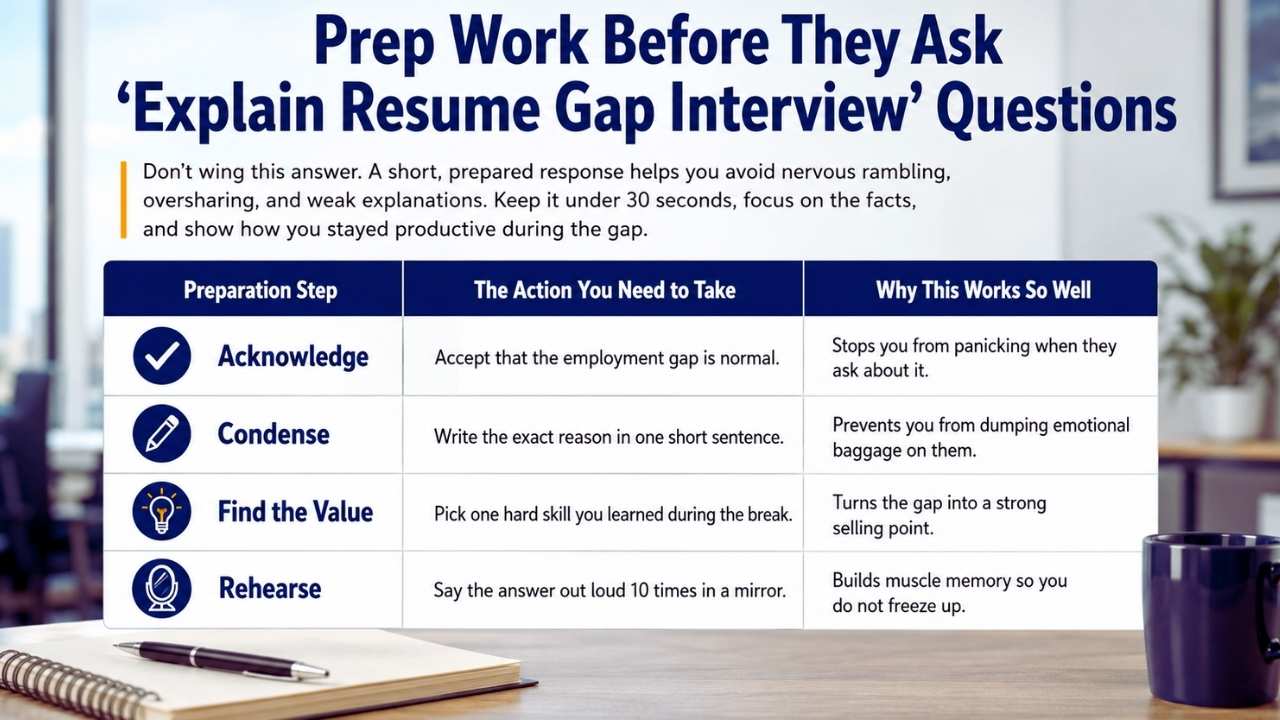
You absolutely cannot walk into the interview room and just wing this part of the conversation. When job candidates hate silence, they fill it with nervous, unprepared rambling. Rambling almost always leads to oversharing deeply personal details that the interviewer never wanted to know. When you prepare to explain resume gap interview questions, you need a tight, highly structured game plan. First, you must accept that the gap is completely normal so you do not panic when they bring it up.
Grab a pen and write down exactly what happened, and then edit it down mercilessly. You want an answer that takes less than 30 seconds to say out loud. Interviewers do not want the deep emotional backstory of your company’s bankruptcy. I always tell candidates to use the stacking trick. Tell them about the industry newsletters you read, the cheap online certifications you grabbed, or the freelance gigs you handled.
|
Preparation Step |
The Action You Need to Take |
Why This Works So Well |
|
Acknowledge |
Accept that the employment gap is normal. |
Stops you from panicking when they ask about it. |
|
Condense |
Write the exact reason in one short sentence. |
Prevents you from dumping emotional baggage on them. |
|
Find the Value |
Pick one hard skill you learned during the break. |
Turns the gap into a massive selling point. |
|
Rehearse |
Say the answer out loud 10 times in a mirror. |
Builds muscle memory so you do not freeze up. |
Taking Time for Family and Caregiving
Raising a child or taking care of an aging parent is incredibly hard, demanding work. You do not need to hide this or feel embarrassed about prioritizing your family. Keep your explanation extremely short and incredibly firm. State directly that you stepped away to handle family needs. Then, immediately confirm that those needs are now fully managed.
You must reassure them that you are pumped to get back to your career full-time. Employers respect boundaries when you state them clearly. Do not complain about the stress of family drama or the exhaustion of caregiving. Keep the tone completely professional and forward-looking. Your goal is to show that this chapter is fully closed and you have the daily support system in place to thrive at work.
|
The Caregiving Angle |
What You Should Say |
What You Must Avoid Saying |
|
The Setup |
“I took a planned break for family reasons.” |
“I was so stressed out dealing with my family.” |
|
The Resolution |
“That situation is now fully resolved.” |
“Things are still a bit crazy at home right now.” |
|
The Pivot |
“I am ready to bring my skills to your team.” |
“I just really need a paycheck at this point.” |
|
The Tone |
Confident, brief, and highly professional. |
Apologetic, exhausted, or emotionally drained. |
Personal Health and Medical Leaves
Medical issues make interviewers sweat because they do not know what they are legally allowed to ask you. Do them a massive favor and take the pressure off the room immediately. You never need to say your actual diagnosis or share your private treatment plan. You simply say you dealt with a medical issue, you are fully recovered, and you are cleared to work. Saying “fully recovered” is the ultimate magic phrase in this scenario. It instantly kills any lingering worries they might have about your daily attendance.
You could even mention that you used the recovery time to read up on workplace wellness or office ergonomics, showing you stayed engaged. Never use words like “exhausted” or “burnt out” when discussing health breaks. Call it an intentional pause to address a health matter that is now completely behind you. They want peace of mind, so give it to them confidently.
|
The Medical Angle |
The Right Approach |
The Wrong Approach |
|
The Diagnosis |
Keep it entirely private. |
Oversharing your exact medical condition. |
|
The Status |
Use the phrase “fully recovered.” |
Hinting that you might need more time off soon. |
|
The Upskill |
Mention a book or topic you studied. |
Acting like you completely disconnected from the world. |
|
The Vibe |
Positive, energized, and forward-looking. |
Focusing heavily on the pain of the recovery process. |
Layoffs, Downsizing, and Market Shifts
If a company layoff caused your gap, say so right away without any hesitation. Layoffs are simple business math, not a reflection of your personal performance. Tell them clearly that your department got restructured or the company faced major cuts. Point out that you actively took some time to find the right job instead of just grabbing the first thing you saw. This makes your time off look like a smart, strategic career choice.
Never badmouth your former boss or trash your old company, even if they handled the layoff poorly. Keep your emotions completely out of the answer. You can mention that you spent the downtime studying emerging technology, AI tools, or global energy policies. This proves you are a self-starter who does not wait around for things to happen. Turn their attention immediately to how your upgraded skills fit their open role.
|
The Layoff Angle |
The Smart Play |
The Dangerous Mistake |
|
The Cause |
State it was a business restructuring. |
Making it sound like you were singled out. |
|
The Old Boss |
Keep your opinion completely neutral. |
Trashing your former manager or company. |
|
The Break |
Frame it as an intentional search period. |
Admitting you applied blindly to hundreds of jobs. |
|
The Proof |
Mention an online course you took recently. |
Waiting around without upgrading your skills. |
Steal These Real-Life Interview Scripts
Knowing the exact theory is great, but candidates who consistently beat this question practice out loud with actual scripts. You need to build muscle memory so you do not freeze under pressure. For a layoff, you might say your company restructured and you intentionally took a few months to grab a data analytics certification. For a medical issue, keep it strictly to the facts by stating the issue is resolved and you are ready to return.
For a caregiving gap, mention that you stepped away for family, the situation is completely settled, and you are eager to bring your exact skills to their team. Look at the exact structure of these answers. You state the basic fact, give a tiny bit of context, declare the break is over, and immediately shift the spotlight. You force the interviewer to stop looking at your past and start looking at your current qualifications.
|
Scenario |
The Script You Can Steal |
Why This Script Kills It |
|
Medical Break |
“I took time off for a health issue. It is completely resolved, and I am ready to return.” |
Direct, sets boundaries, and looks to the future. |
|
Caregiving |
“I acted as a primary caregiver. That chapter is closed, and my focus is back on work.” |
Professional, firm, and highly reassuring. |
|
Layoff Cuts |
“My old company cut my division. I used this time to upskill and find the right fit.” |
Removes all blame and shows you are proactive. |
|
Global Travel |
“I took a planned break to travel. I am energized and ready to dive into this role.” |
Shows solid planning and highlights readiness. |
The Art of the Pivot in an Interview
The absolute smartest way to handle any timeline question is to pivot fast and hard. You want to spend 10 percent of your breath talking about the past and 90 percent talking about right now. State the reason without any emotion. Confirm the gap is totally over and will not happen again. Connect your past break directly to the current job description. Finally, ask a question to force them to move on to a new topic.
Deliver your short script, smile warmly, and stop talking completely. Do not add random filler words just because the room gets quiet. Try something like asking them how their current content team is structured. When you pivot like this, you completely grab control of the room. You prove that you dictate the conversation, which is exactly how you handle explain resume gap interview pressure.
|
Pivot Phase |
Your Ultimate Goal |
What You Should Say |
|
The Fact |
State the reason without any emotion. |
“I took time off for family reasons.” |
|
The Fix |
Confirm the gap is totally over. |
“That situation is now fully settled.” |
|
The Pivot |
Connect to the exact job description. |
“Which lets me focus completely on this role.” |
|
The Hook |
Ask a question to force them to move on. |
“How is your current marketing team structured?” |
Resume Tweaks to Handle the Gap Upfront
Sometimes, you can stop the question from ever being asked just by tweaking how your resume looks. You should absolutely never lie, but you can format your document to highlight your skills over rigid dates. If you have a gap of just a few months, switch your dates from months and years to just years. Writing “2025 to 2026” reads a lot smoother than listing exact months that highlight a four-month hole.
Most modern recruiting software and human readers accept the years-only format without a second thought. If you took a much longer break, just list it proudly on the page. Put “Planned Career Break” right there in the main experience section. Underneath it, add bullet points for any freelance work, volunteering, or online courses you did. It proves you stayed engaged with the professional world even without a corporate paycheck.
|
Formatting Trick |
How You Actually Do It |
When You Should Use It |
|
Years Only |
Write “2024 to 2025” instead of exact months. |
The gap is under a year and happened very recently. |
|
Hybrid Style |
Put a massive skills section at the very top. |
You have a long gap but highly relevant tech skills. |
|
List the Break |
Write “Career Break” as a job title with bullets. |
You spent the time traveling, studying, or freelancing. |
|
Cut the Fat |
Delete jobs from 15 plus years ago completely. |
You want to easily shorten a highly dense resume. |
Final Thoughts
Figuring out how to explain a resume gap in an interview does not have to be a nightmare. It actually gives you a massive edge over candidates who stumble, sweat, and ramble through their answers. Remember, a gap does not define what you are worth. It is just a pause in the timeline. Write down your short, honest story.
Practice saying it out loud until you do not even have to think about it. When they ask the question, drop your answer smoothly, confirm you are ready to work, and immediately pivot to the value you bring. Own your story, master how to explain resume gap interview scenarios, and they will respect you for it.
Frequently Asked Questions (FAQs) About Explain Resume Gap Interview
Will hiring software automatically reject my resume if there’s a gap?
No. Modern applicant tracking systems look for keywords and job titles. They don’t automatically trash your file just because of a date gap. Rejections usually happen later when a human looks at it and gets confused by a massive, unexplained five-year hole.
Do background checks look at what I did during my time off?
Not usually. They verify your past job dates, your education, and your criminal record. Nobody is hiring a private investigator to see if you actually read marketing books during your break. But, if you claim you earned a specific degree during your gap, they will check that.
Is a three-month gap a red flag?
Absolutely not. The hiring process itself takes two to three months right now. Recruiters don’t even blink at gaps under six months.
Should I explain the gap in my cover letter?
Only if the gap is longer than a year. If you do, keep it to one single sentence. Your cover letter needs to be a sales pitch for what you can do for them, not an apology tour for your timeline.