


You just booked a flight for your best friend’s wedding. Then your car registration renewal hits your mailbox. Two days later, your dog eats a sock, landing you a massive vet bill. Suddenly, you are staring at a giant credit card balance, wondering where your budget fell apart. If this hits close to home, do not beat yourself up.
You have plenty of company. A 2026 Bankrate report showed that 29 percent of Americans carry more credit card debt than they have in emergency savings. It is a stressful way to live, especially with the cost of daily essentials creeping up year after year. We usually rely on one generic savings account to catch every financial curveball. When that account runs dry, out comes the plastic.
But you do not have to live paycheck-to-paycheck or swipe-to-swipe. There is a better, stress-free way to manage your cash, and it starts by answering one question: what are sinking funds? Instead of crossing your fingers and hoping you have enough cash when a big bill hits, you plan for it. Let’s break down this painfully simple budgeting trick. I will show you the real-world math and how it can completely flip the way you save and spend.
Let’s Break It Down: What Are Sinking Funds?
If you are still wondering what are sinking funds in a practical sense, think of them as grown-up piggy banks. A sinking fund is just a savings account dedicated to a specific, upcoming expense. Instead of trying to magically produce a massive lump sum all at once, you save a tiny amount every month until you hit your target. You are actively “sinking” money into a fund for a specific reason. I used to panic every December when the holiday bills rolled in. Now? I know I spend a set amount on gifts.
So, I do not wait until November to stress out. I set up a sinking fund in January and toss in a small chunk of change every single month. By Black Friday, the money is just sitting there, waiting for me to spend it. This completely changes the game. You stop reacting to expenses and start anticipating them. Better yet, it kills the guilt. You already earmarked that cash, so you can spend it without a second thought. You regain absolute control over your money because every dollar has a job before the month even begins.
|
The Basics |
How It Works in Real Life |
|
The Main Goal |
Saving for a planned, specific future expense. |
|
The Execution |
Stashing away small, regular amounts over time. |
|
The Payoff |
Zero financial shock and absolutely no new credit card debt. |
|
The Mindset |
Moving from a stressed, reactive state to calm and prepared. |
Sinking Funds vs. Emergency Funds: Know the Difference
People mix these two concepts up constantly, and that is a huge mistake. Dumping all your cash into one giant “savings” bucket sets you up to fail. When you need new tires, you dip into savings. When you book a hotel, you dip into savings. Eventually, you drain the bucket completely. Your emergency fund is your safety net for the terrifying unknown. You lose your job, a tree falls on your roof, or you end up in the emergency room. You hope you never have to touch this money.
Sadly, current financial data shows that 24 percent of Americans have zero emergency cash. Protect this fund at all costs. A sinking fund, on the other hand, is for the known expenses. Christmas happens every December 25th. Your car will eventually need new brakes. You want to spend this money. If you drain your emergency fund to buy a new laptop, you are totally exposed when your car breaks down the next week. Keep them completely separate to protect your financial foundation.
|
Core Feature |
The Emergency Fund |
The Sinking Fund |
|
What It Is For |
The unknown disasters (job loss, major medical crises). |
The known events (vacations, holidays, car repairs). |
|
Target Amount |
Three to six months of basic living expenses. |
The exact cost of the specific item or event. |
|
When You Use It |
Only for true, survival-level emergencies. |
You spend it completely when the goal arrives. |
|
How It Feels |
Provides deep, underlying peace of mind. |
Gives you guilt-free, instant gratification. |
The Mechanics: How to Actually Do It
Setting this up takes about five minutes of basic math. You do not need a crazy spreadsheet or a degree in finance. You just need to know what you are buying and when you need the cash. Here is the cheat code: take the total target amount and divide it by the months until you need it. Let’s say you want to take a 2,400 dollar trip to Mexico in 12 months. Divide 2,400 by 12, and you get 200 a month. Boom. Move 200 dollars into your vacation fund every month.
That is way easier than pulling two grand out of thin air next July. Maybe you pay your auto insurance every six months to score a discount, and the bill is 900 dollars. Divide that by six, and you get 150 dollars a month. Treat it like a 150 dollar monthly bill. When the invoice arrives, you just pay it and move on. Automation is your best friend here. Do not rely on your own discipline to move the cash manually. You will forget, or you will spend it on takeout. Log into your bank app and set up an automatic transfer for the day after payday. If the money leaves your checking account before you even see it, you will not blow it.
|
The Step |
Action Required |
|
1. Pick a Target |
Name the exact goal and the deadline (like a Vacation in 10 months). |
|
2. Do the Math |
Divide the Target Cost by the Months Left. |
|
3. Make a Home |
Open a distinct savings account or a digital checking bucket. |
|
4. Automate It |
Set up a recurring bank transfer for the day after you get paid. |
The Budget Wreckers: Funds You Actually Need
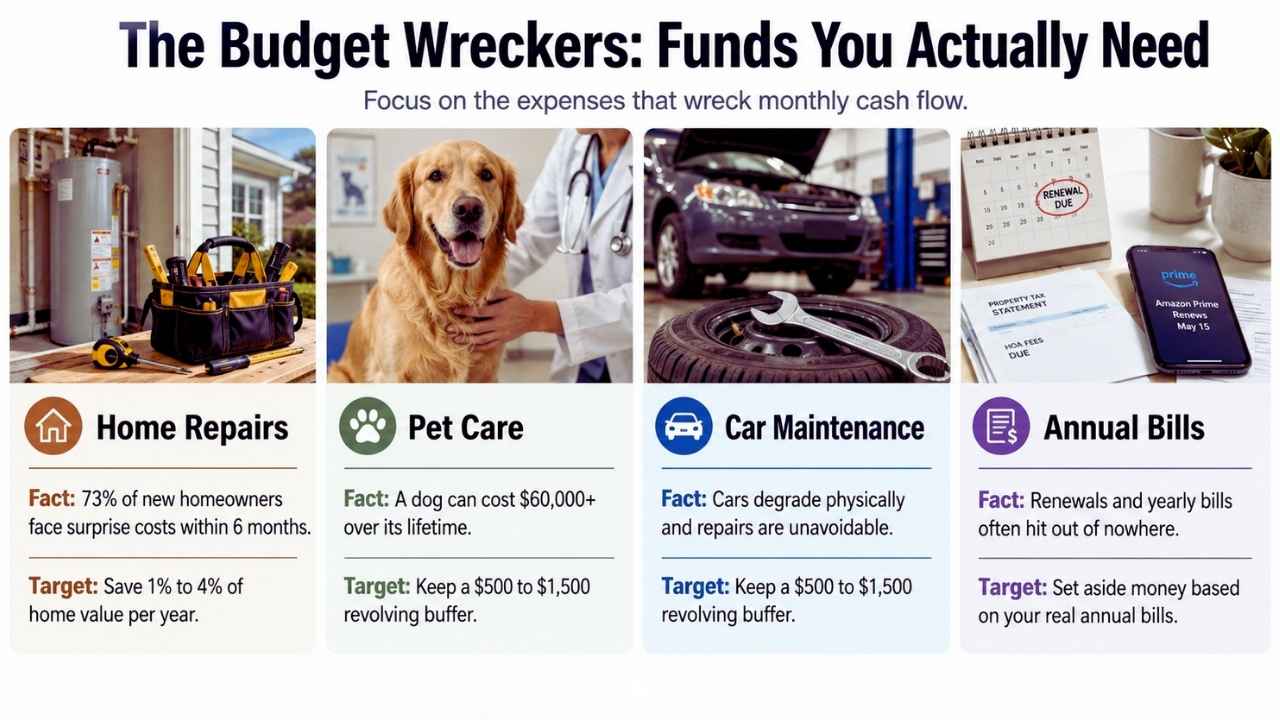
You can create a fund for absolutely anything, but do not go crazy. Managing 45 different micro-accounts is exhausting. Stick to the heavy hitters—the expenses that historically wreck your monthly cash flow. Based on recent consumer data, you should start with home repairs. Houses break. A 2026 AmeriSave study found that 73 percent of new homeowners get hit with surprise costs within six months of moving in. Keep a home repair fund so a broken water heater does not force you into a high-interest personal loan. Next, focus on the vet bill. I love my pets, but they cost a fortune.
A Synchrony study showed the lifetime cost of a dog runs tens of thousands of dollars. Shots, teeth cleanings, and random illnesses add up incredibly fast. Car maintenance is another non-negotiable. Tires bald, brakes grind, and oil gets dirty. Stashing away 50 to 100 dollars a month means you just hand the mechanic your debit card instead of internally panicking. Finally, tackle those sneaky annual subscriptions like Amazon Prime, HOA fees, or property taxes. We always forget about them until the notification pops up on our phones.
|
The Category |
The Cold Hard Facts |
Good Target Amount |
|
Home Repairs |
73 percent face surprise costs in the first 6 months. |
1 to 4 percent of home value every single year. |
|
Pet Care |
A dog can cost upwards of 60,000 dollars over its lifetime. |
500 to 1,500 dollar revolving buffer. |
|
Car Maintenance |
Cars degrade physically; repairs are unavoidable. |
500 to 1,500 dollar revolving buffer. |
|
Annual Bills |
Keeps the panic away when renewals hit out of nowhere. |
Depends entirely on your specific life and bills. |
Where to Stash the Cash: Finding the Best Accounts
You have the math figured out. You have your core categories selected. Now, where does the money actually go? First rule: keep it out of your main checking account. If your vacation money sits right next to your grocery money, you will accidentally spend it at Target. It needs its own space, but it still needs to be liquid. High-Yield Savings Accounts are the holy grail for this strategy. Online banks pay significantly more interest than the giant brick-and-mortar bank on your corner. If you are saving for a trip next year, let that cash earn 4 or 5 percent while it sits there.
A lot of modern online banks also have a bucket or vault feature. This is genius. Instead of opening five separate accounts, which is a massive headache, you open one savings account and split the cash into visual folders on your app. You log in and instantly see 500 dollars in Car Stuff and 1,000 dollars in Christmas. Do not put this cash in a brokerage account. Sinking funds are short-term, meaning you will spend the money in one to three years. The stock market swings wildly in the short term. Keep it safe and boring.
|
Where to Put It |
Best Used For |
The Good and The Bad |
|
High-Yield Savings |
Large goals, earning completely free interest. |
Good: Safe growth. Bad: Takes a few days to transfer. |
|
Savings with Buckets |
Managing multiple funds cleanly and easily. |
Good: Visually organized. Bad: Only at specific banks. |
|
Cash Envelopes |
Small, frequent spending limits. |
Good: You literally cannot overspend. Bad: Easy to lose. |
|
Stocks and Investing |
Long-term wealth building over 5 years out. |
Good: Massive growth. Bad: Way too risky for this money. |
How to Avoid Sinking Fund Burnout?
When people first learn what are sinking funds, they tend to get a little overzealous. They make one for haircuts, one for streaming services, one for coffee, and one for new shoes. Stop right there. You will burn out in three weeks flat. Tracking 30 different categories feels like a part-time accounting job, and you will eventually abandon the whole system. The trick is to consolidate. Instead of separate funds for Christmas, Mother’s Day, and birthdays, just make one big Gifts fund.
Start with three to five heavy hitters that cause you the most anxiety. Let your regular checking account handle the little stuff like a 20 dollar haircut. Keep the system simple, or you will not stick with it. Behavioral finance shows us that decision fatigue is real. If you have to manually transfer money to 15 different accounts every payday, your brain will reject the habit. Automate the biggest stressors, keep your fund count low, and let the process run in the background of your life.
|
The Common Trap |
The Easy Fix |
|
Too Many Micro Funds |
Consolidate categories (lump all holidays into a Gifts fund). |
|
Moving Cash Manually |
Set up auto-transfers so you literally never think about it. |
|
Crazy Timelines |
Do not try to save 3,000 dollars in two months. Give yourself runway. |
|
Tracking and App Fatigue |
Use a bank app with visual buckets to do the mental math for you. |
Final Thoughts
Once you get this system up and running, your daily money stress vanishes completely. You do not flinch when the mail arrives. You actually enjoy your vacations because you know the money is already sitting there, waiting to be spent. You stop dreading the holiday season and start enjoying it. If you take nothing else away from this, remember this core rule: planning always beats reacting.
Now that you know exactly what are sinking funds and how to put them in motion, you can build a massive buffer between your checking account and a total financial disaster. You take your power back from credit card companies. Pick one upcoming expense right now. Calculate the simple math, set up the automatic transfer, and watch how fast you take your financial confidence back. You will wonder how you ever managed your money without this strategy.
Frequently Asked Questions (FAQs) About What Are Sinking Funds
Should I stop my sinking funds to pay off debt?
It’s a tricky balance. If you have toxic credit card debt, attack it aggressively. But you must keep basic funds alive—like car and home repairs. Think about it: if you pause your car fund and your transmission blows, how are you paying for it? Exactly. With the credit card. Keep the repair funds alive, but pause the vacation and luxury funds until the debt is gone.
What if I don’t spend all the money in the fund?
That’s the best problem you can have. If you save $1,000 for car repairs and only spend $600, just leave the $400 in there. Now you have a massive head start for next year, and you can lower your monthly contribution. Or, sweep it into your emergency fund.
Can I just use my emergency fund to jumpstart these?
Hard no. Leave your emergency fund alone. It’s for crises, not for a planned trip to Florida. Build these from your monthly income, step by step.