
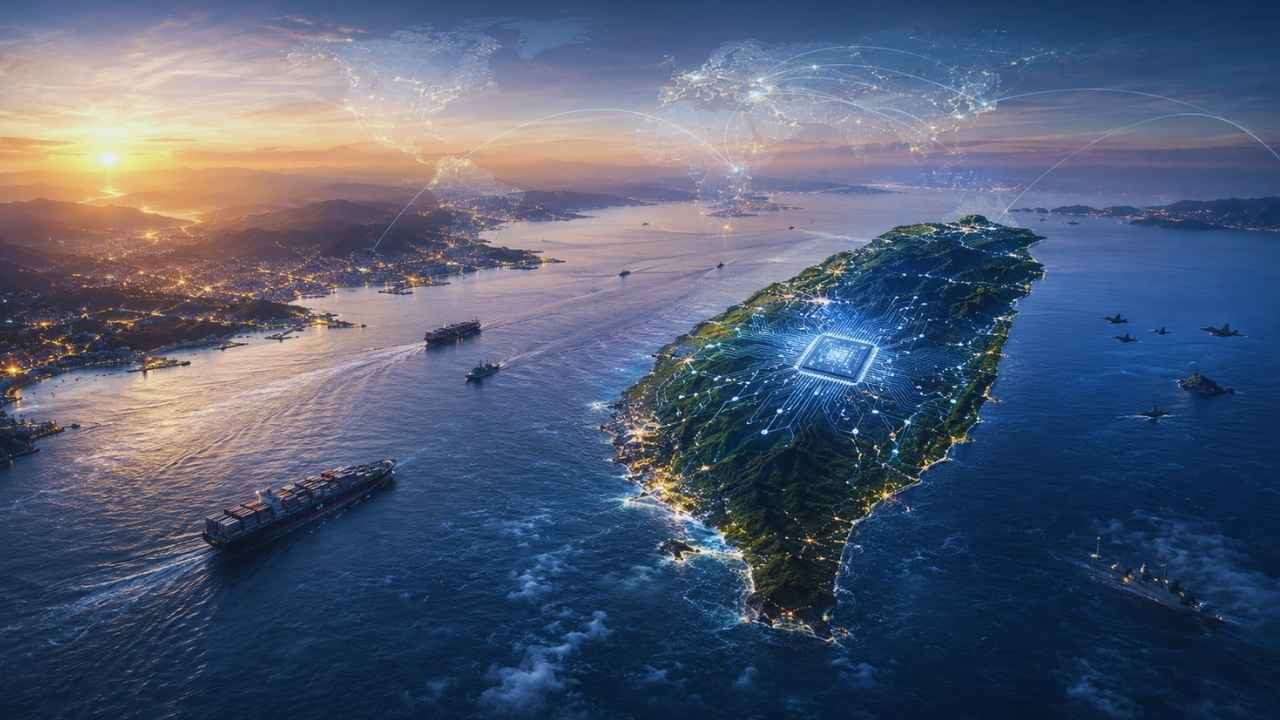
Look at the device in your hand. Whether you are swiping on a premium smartphone or scrolling on a high-end laptop, its brain almost certainly came from a mountainous island off the eastern coast of mainland China.
The Taiwan Strait is just a 100-mile stretch of water, yet it holds the modern world’s economy hostage. If guns start firing across these waves, we are not just looking at a regional tragedy. We are looking at an instant crash of global supply chains, a freeze on tech manufacturing, and a worldwide recession that makes the 2008 financial crisis look like a minor speedbump.
For decades, the standoff between Beijing and Taipei operated as a slow-burning geopolitical headache. But lately, the stakes have shot through the roof. Thanks to the explosion of artificial intelligence, fragile global shipping routes, and an escalating tech war between Washington and Beijing, we cannot ignore the facts. The world simply cannot afford a war in Taiwan.
If you want Taiwan-China tensions explained without wading through dry political jargon, you are in the right place. Let us break down the history, the trillion-dollar shipping lanes, the magic of Taiwanese microchips, and exactly why this small island is the undisputed center of the geopolitical universe today.
Taiwan-China Tensions Explained: The 1949 Split and Modern Power Play
To grasp the current hostility, we have to rewind to 1949. This isn’t just a recent trade spat; it is the messy, unresolved fallout of the Chinese Civil War. Back in the late 1940s, the Chinese Communist Party, led by Mao Zedong, defeated the Nationalist government, led by Chiang Kai-shek. Mao took control of the mainland and established the People’s Republic of China. The defeated Nationalist government fled across the water to Taiwan and set up their own government, the Republic of China. For years, both sides stubbornly claimed they were the legitimate government of all of China. The 1950s even saw intense artillery fire over small offshore islands, which prompted the U.S. Navy to intervene and physically separate the two sides.
Fast forward to today, and the political reality has completely shifted. Officials in Beijing view Taiwan as a breakaway province that must be reunified with the mainland. Beijing frequently states they will use military force to achieve this if necessary. Meanwhile, Taiwan operates as a fully functioning, democratic state. It has its own constitution, military, currency, and fiercely contested elections. Most of its 23 million citizens now identify simply as Taiwanese, not Chinese. They want to preserve their democratic way of life and are incredibly hostile to the idea of Beijing taking control.
Beijing refuses diplomatic ties with any country that officially recognizes Taiwan as a sovereign nation. This ultimatum forces Taiwan into a bizarre diplomatic limbo. Most of the world, including the United States, officially recognizes Beijing under the “One China” policy but maintains highly robust, “unofficial” economic and military ties with Taipei. This fragile dance keeps the peace, but as China’s military power rapidly expands, Beijing tests the boundaries constantly by flying fighter jets into Taiwan’s air defense zone and staging massive naval blockades.
|
Historical Phase |
Key Event / Milestone |
Global Geopolitical Impact |
|
1949 Split |
The Nationalist government flees to Taiwan; mainland falls to communism. |
Creates two distinct political entities claiming sovereignty. |
|
1950s Crises |
Artillery bombardments over small offshore islands. |
The U.S. intervenes, cementing its role as Taiwan’s primary security backer. |
|
1971 UN Shift |
The UN officially recognizes Beijing as the legitimate representative of China. |
Taiwan loses its UN seat, entering decades of diplomatic isolation. |
|
Modern Era |
Democratic elections and a distinct Taiwanese cultural identity take root. |
A profound political shift away from reunification toward de facto independence. |
The Semiconductor Monopoly: TSMC’s 73 Percent Grip
Understanding the current landscape requires having Taiwan-China tensions explained through the lens of modern economics and Silicon. Data is the new oil, and microchips are the engines that refine it. Right now, Taiwan essentially owns the world’s most advanced engines. At the center of this tech empire is the Taiwan Semiconductor Manufacturing Company (TSMC). You probably will not find their name on a consumer electronics box, and that is entirely by design. They operate as a foundry. Tech giants like Apple, Nvidia, and Google design their own advanced chips, and TSMC actually prints and builds them on physical silicon wafers.
The market dominance of this single company is hard to wrap your head around. According to recent market data from Counterpoint Research, as of the first quarter of 2026, TSMC captured a massive 73 percent of the global pure-play foundry market. Even more critically, Taiwan produces nearly 90 percent of the world’s most advanced chips. These are the incredibly tiny components required to power artificial intelligence servers, advanced military hardware, and next-generation smartphones. The artificial intelligence boom has pushed TSMC’s production facilities to their absolute limits, and global reliance on these specific factories has never been higher.
This sheer dominance gives Taiwan what military strategists call a “Silicon Shield.” The theory is simple. Beijing will hesitate to bomb or invade the island because destroying TSMC’s factories would completely cripple China’s own booming tech sector. Similarly, the United States will forcefully defend the island because losing access to these chips would bring the American tech industry to a grinding halt. While the U.S. and Europe are injecting billions to jumpstart domestic manufacturing, replicating Taiwan’s hyper-specific ecosystem of chemicals, robotic tools, and elite engineers abroad is proving agonizingly slow and incredibly expensive.
|
Tech Dynamic |
Reality / Market Data Point |
Consequence for the Global Economy |
|
Market Dominance |
TSMC hit a record 73 percent pure-play foundry market share in Q1 2026. |
The entire world relies heavily on one geographic location for hardware. |
|
Advanced Chips |
Around 90 percent of advanced logic chips are manufactured in Taiwan. |
Artificial intelligence, modern militaries, and smartphones depend entirely on TSMC. |
|
Global Response |
The US and EU are passing massive laws to build local factories. |
Subsidizing local plants takes years and massive cash to build alternative chains. |
|
Silicon Shield |
Total global tech reliance deters reckless military action. |
Both China and the US would suffer catastrophic economic damage in a hot conflict. |
The Taiwan Strait: A 2.45 Trillion Maritime Chokepoint
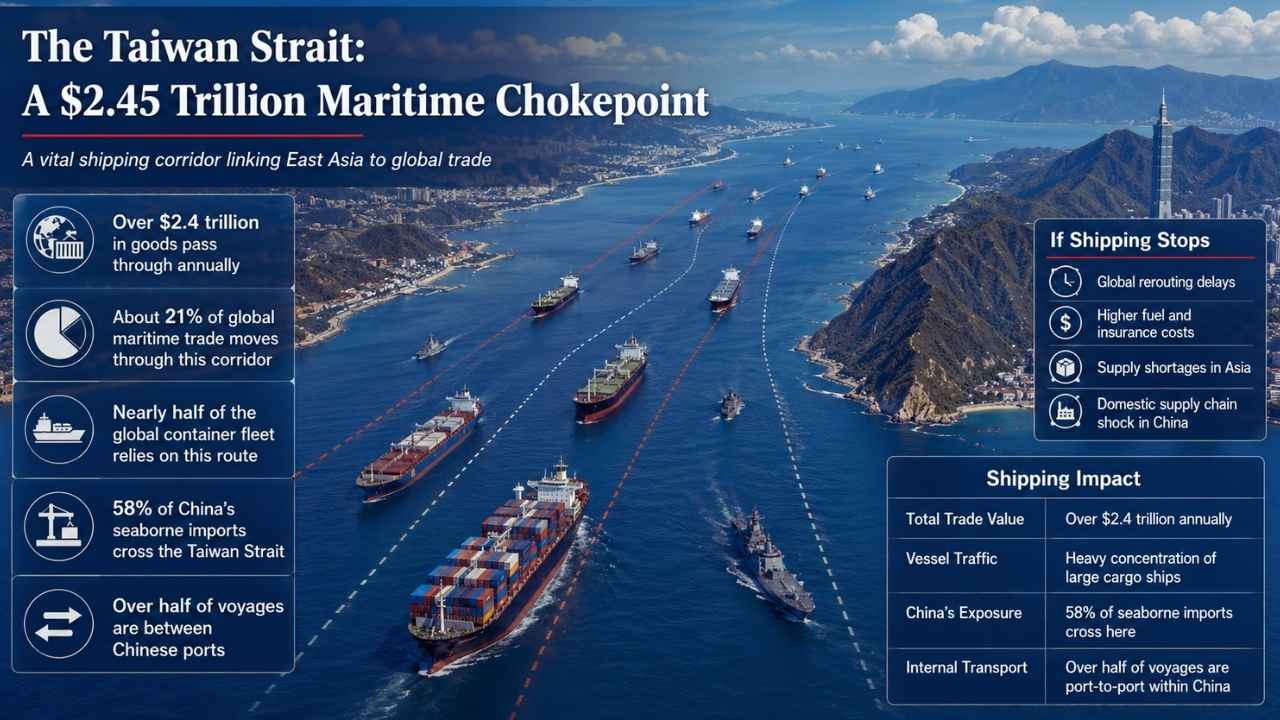 While microchips dominate the headlines, the actual ocean separating Taiwan from China is equally critical to the global economy. The Taiwan Strait is not just a body of water; it is one of the busiest, most congested commercial highways on earth. The Center for Strategic and International Studies (CSIS) estimates that over 2.4 trillion dollars worth of goods pass through the Taiwan Strait annually, accounting for roughly 21 percent of all global maritime trade. Nearly half of the entire global container fleet relies on this corridor, alongside a huge chunk of the world’s largest container cargo ships.
If Beijing enacted a naval blockade rather than launching a bloody invasion, shipping through the strait would instantly halt. Insurance companies would refuse to cover cargo ships entering a designated war zone. Vessels would have to divert through the Philippine Sea, which adds weeks to transit times, burns massive amounts of extra fuel, and dramatically spikes global shipping costs. Regional economies like Japan and South Korea, which rely heavily on the strait for importing Middle Eastern energy supplies, would face immediate fuel shortages and logistical nightmares.
Ironically, China would suffer massive collateral damage from closing the strait. A staggering 33 percent of China’s total imports and 58 percent of its seaborne imports pass right through the Taiwan Strait. Furthermore, over half of all voyages through the strait are actually ships traveling from one Chinese port to another. A blockade would force China to shift maritime freight to overland rail and road networks, dramatically increasing transport costs and creating immediate inland bottlenecks. Closing the strait hurts China’s own internal economy just as brutally as it hurts everyone else.
|
Shipping Metric |
Global Data Point |
Impact of Disruption or Blockade |
|
Total Trade Value |
Over 2.4 trillion dollars annually. |
An immediate freeze on roughly one-fifth of global maritime trade. |
|
Vessel Traffic |
Heavy concentration of large cargo ships. |
Massive rerouting delays, spiking insurance premiums, and supply shortages. |
|
China’s Exposure |
58 percent of China’s seaborne imports cross here. |
A severe domestic supply chain shock for Beijing’s own economy. |
|
Internal Transport |
Over half of voyages are port-to-port within China. |
Cripples China’s domestic supply chain and energy imports. |
The 10 Trillion Shockwave: What Happens If War Breaks Out
We have talked about supply chains and cargo ships, but to get Taiwan-China tensions explained fully, we have to look at the raw financial devastation a war would trigger. Economic modeling from Bloomberg Economics puts the price tag for a hot war over Taiwan at a staggering 10 trillion dollars. To put that in perspective, 10 trillion dollars equals roughly 10.2 percent of total global GDP. That single event would dwarf the economic fallout of the war in Ukraine, the 2008 Global Financial Crisis, and the COVID-19 pandemic combined.
If China actually invades, Taiwan’s heavily coastal economy would be utterly devastated, dropping an estimated 40 percent in the first year. China itself would take a massive 16.7 percent GDP hit because it would instantly lose access to advanced semiconductors and face crushing global trade sanctions. The United States, despite being thousands of miles away, would suffer a 6.7 percent GDP slump simply due to its heavy reliance on Asian electronics and Apple’s sprawling supply chain. Even a softer blockade scenario would plunge the global economy into a 5 percent contraction.
This wouldn’t just be numbers moving on a Wall Street ticker. A 10 percent drop in global GDP means massive job losses worldwide. It means auto manufacturers shutting down assembly lines because they cannot source basic microcontrollers. It means inflation skyrocketing because the cost to ship basic household goods doubles overnight. The ripple effects would hit every grocery store, car dealership, and electronics shop on the planet. The sheer scale of this financial devastation is currently acting as the strongest deterrent against a full-scale war.
|
Nation / Region |
War Scenario (Invasion) GDP Hit |
Blockade Scenario GDP Hit |
|
Taiwan |
Drops by 40.0 percent |
Drops by 12.2 percent |
|
China |
Drops by 16.7 percent |
Drops by 8.9 percent |
|
United States |
Drops by 6.7 percent |
Drops by 3.3 percent |
|
Global Economy |
Drops by 10.2 percent (10 Trillion) |
Drops by 5.0 percent |
Military Realities: Porcupines, Ambiguity, and the Malacca Dilemma
When you peel back the economics, the core of this tension comes down to hard military deterrence. Beijing has spent the last twenty years aggressively modernizing its military with one primary goal. They want the capability to take Taiwan by force while actively preventing the U.S. Navy from intervening in the region. Taiwan knows it cannot defeat China in a traditional, head-to-head war. Instead, Taipei adopted a “porcupine strategy.” This asymmetric warfare doctrine is designed to make an invasion so painful and costly that Beijing simply will not try it.
Rather than buying massive fleets of expensive fighter jets, Taiwan heavily invests in highly mobile anti-ship missiles, sea mines, and portable air-defense systems. They want to turn the Taiwan Strait into a brutal meat grinder for any invading force. Meanwhile, the United States maintains a deliberate policy known as “strategic ambiguity.” Washington provides Taiwan with billions in defensive weaponry but intentionally stays vague about whether American troops would directly shoot at Chinese forces during an invasion. This ambiguity keeps Beijing guessing and cautious, while also discouraging Taiwan from formally declaring independence.
But as China grows bolder, the surrounding region is getting incredibly nervous. U.S. allies are rapidly arming up. Security coalitions like the AUKUS pact and the Quad are designed specifically to check Chinese expansion. Japan, sitting just north of Taiwan, explicitly stated that a conflict in the strait would directly threaten Japanese national security. This prompted Tokyo to authorize its largest military buildup since World War II. The entire Pacific region is now locked in an escalating arms race to ensure the cost of war remains higher than the benefit of peace.
|
Defense Element |
Doctrine Description |
Core Strategic Purpose |
|
Porcupine Strategy |
Taiwan’s focus on mobile, asymmetric weapons. |
Make an invasion incredibly bloody and costly for China to attempt. |
|
Strategic Ambiguity |
U.S. policy of not confirming direct military intervention. |
Deters China from attacking, while deterring Taiwan from declaring independence. |
|
Regional Alliances |
Growth of AUKUS, the Quad, and Japanese military shifts. |
Creates a unified front of Pacific nations checking Chinese naval power. |
|
Military Modernization |
China’s massive naval, cyber, and missile buildup. |
Designed to overwhelm Taiwan quickly and push the U.S. military out of the region. |
Final Thoughts
The standoff playing out in the South China Sea and the Taiwan Strait is a high-stakes balancing act. We are looking at a scenario where a localized conflict over an island of 23 million people could plunge the entire globe into a historic economic depression. Having Taiwan-China tensions explained reveals that this absolutely is not just a territorial dispute between two old rivals. It is a high-stakes battle over the future of the global tech supply chain, the security of international shipping lanes, and the long-term balance of power between the United States and China.
Thankfully, a hot war is not inevitable. The “Silicon Shield” is holding steady, and the sheer economic destruction that a conflict would cause serves as a massive deterrent for everyone involved. However, the world is not taking that peace for granted anymore. From new semiconductor plants breaking ground in Arizona to shifting military alliances across the Pacific, the global economy is frantically trying to de-risk itself. Until those backup plans are fully functional, the modern world will continue to hold its breath every time a warship sails through the Taiwan Strait.
Frequently Asked Questions (FAQs) About Taiwan-China Tensions Explained
Does China actually rely on Taiwan’s economy?
Yes, immensely. Despite the harsh political rhetoric, China and Taiwan have deeply intertwined economies. Thousands of Taiwanese businesses operate massive factories on the mainland. Furthermore, China’s massive tech manufacturing sector desperately needs the high-end semiconductors that only Taiwan produces to build the world’s electronics.
What happens if TSMC is captured intact by China?
It’s virtually impossible. TSMC’s factories rely on a real-time, global supply chain of software updates from the U.S., specialist chemicals from Japan, and highly complex machinery from Europe. If China invaded, Western nations would instantly embargo these inputs. The multi-billion-dollar foundries would turn into useless, empty brick buildings within days.
Why doesn’t Taiwan just formally declare independence?
Because Beijing explicitly drew a line in the sand: a formal declaration of independence triggers an immediate military invasion. Right now, Taiwan enjoys all the practical benefits of an independent country—its own passports, military, economy, and democratic elections. Most Taiwanese citizens prefer to maintain this peaceful “status quo” rather than risk a catastrophic war just to change their official paperwork.
What is the “Malacca Dilemma” and how does it affect Taiwan?
China imports massive amounts of oil and natural gas through the Strait of Malacca near Singapore. Military analysts note that if China blockades Taiwan, the U.S. and allied nations could lawfully counter-blockade the Malacca Strait. This would instantly choke off China’s energy supplies and paralyze its domestic economy. This mutual vulnerability is a major reason China hasn’t acted rashly.