

If you keep an eye on the news, you have probably noticed a specific acronym completely dominating headlines about global finance, geopolitics, and international trade. World leaders are flying across the globe for massive summits, central banks are hoarding gold at record speeds, and financial experts keep arguing about the fate of the US dollar.
At the center of all this noise sits a powerful bloc of nations actively pushing back against Western dominance. But beyond the political buzzwords and academic theory, you probably just want a straight, factual answer: what is BRICS explained in plain English?
I have watched this group transform from a catchy Wall Street marketing phrase into an absolute heavyweight on the geopolitical stage. We are not talking about a loose club of emerging economies meeting for coffee once a year anymore. By 2026, it has grown into a massive global force. It boasts its own financial institutions, a rapidly expanding 11-member list, and a serious, well-funded agenda to change exactly how global trade works.
If you want to understand where the global economy is heading next, you have to understand this group. Today, we are breaking down the history, the massive recent expansions that brought energy giants like Saudi Arabia and Indonesia into the fold, the hard reality around de-dollarization, and what this alliance actually means for your wallet and the rest of the world.
The Origin Story: From Wall Street Pitch to Global Powerhouse
Back in 2001, a Goldman Sachs economist named Jim O’Neill published a paper titled “Building Better Global Economic BRICs.” He used the term to describe four incredibly fast-growing economies consisting of Brazil, Russia, India, and China. He confidently predicted these four nations would eventually dominate the global market by the year 2050. At the time, he grouped them together strictly as a clever investment thesis to sell lucrative portfolios to wealthy corporate clients.
But the leaders of these four nations quickly realized O’Neill was onto something massive. They shared deep, common frustrations with a global financial system completely run by the United States and Europe. The devastating 2008 global financial crisis was the final straw that proved to these emerging markets that relying entirely on Western financial systems was incredibly dangerous.
When Wall Street crashed, developing nations paid the ultimate price. So, they took a Wall Street marketing term and transformed it into a real political club, holding their first official summit in Yekaterinburg, Russia, in 2009. A year later, they invited South Africa to join the party, officially adding the “S” to make it BRICS.
|
Milestone Year |
Key Event |
Global Significance |
|
2001 |
The Term is Coined |
Goldman Sachs identifies four major emerging markets purely for global investors. |
|
2006 |
First Informal Meeting |
Foreign ministers meet on the margins of the UN General Assembly to discuss cooperation. |
|
2009 |
First Official Summit |
Held in Yekaterinburg, Russia, marking the formal birth of the geopolitical bloc. |
|
2010 |
South Africa Joins |
The group officially becomes BRICS, securing a crucial diplomatic foothold in Africa. |
|
2014 |
Bank Establishment |
The group creates the New Development Bank to directly rival legacy Western institutions. |
What Is BRICS Explained: The Real Mission and Financial Goals
To truly get what is BRICS explained, you have to look at what these countries actually want to achieve on the ground today. It is incredibly tempting to simply label them a strict anti-Western alliance, but that characterization is not entirely accurate. Nations like India and Brazil continue to maintain massive trade networks and strategic military ties with the United States.
Instead, you should think of them as a massive “non-Western” alliance actively pushing for a multipolar world. They do not necessarily want to destroy the West; they just want a significantly bigger seat at the global governance table. Their main grievance stems from the fact that the global financial system actively punishes developing nations. After World War II, the United States and its allies created powerful institutions like the International Monetary Fund, the World Bank, and the SWIFT payment system. Those legacy institutions dictate the absolute rules of global finance.
If a developing country needs a critical loan to build a highway or survive a sudden currency crash, they usually have to swallow harsh, punishing economic reforms dictated entirely by Washington or Europe. The bloc wants to bypass this setup entirely. By launching the New Development Bank in Shanghai, they created a system that hands out major infrastructure loans without demanding those punishing political and economic concessions. They are essentially building an alternative set of financial plumbing for the world.
|
Core Pillar |
Description of Initiative |
Primary Goal for Member States |
|
New Development Bank |
A multilateral bank funding massive global infrastructure projects. |
Provide a viable, no-strings-attached alternative to the World Bank and IMF. |
|
Contingent Reserve |
A massive liquidity mechanism designed for short-term financial pressures. |
Protect member nations from sudden global financial shocks and currency runs. |
|
Multipolarity Push |
Advocating for shared global governance rather than US hegemony. |
Secure greater voting power and representation in international organizations. |
|
Financial Sovereignty |
Promoting local currency trade settlements instead of using the US dollar. |
Reduce vulnerability to crushing US sanctions and sudden global dollar shortages. |
The Big Expansion: Who Made the Cut in 2025 and 2026?
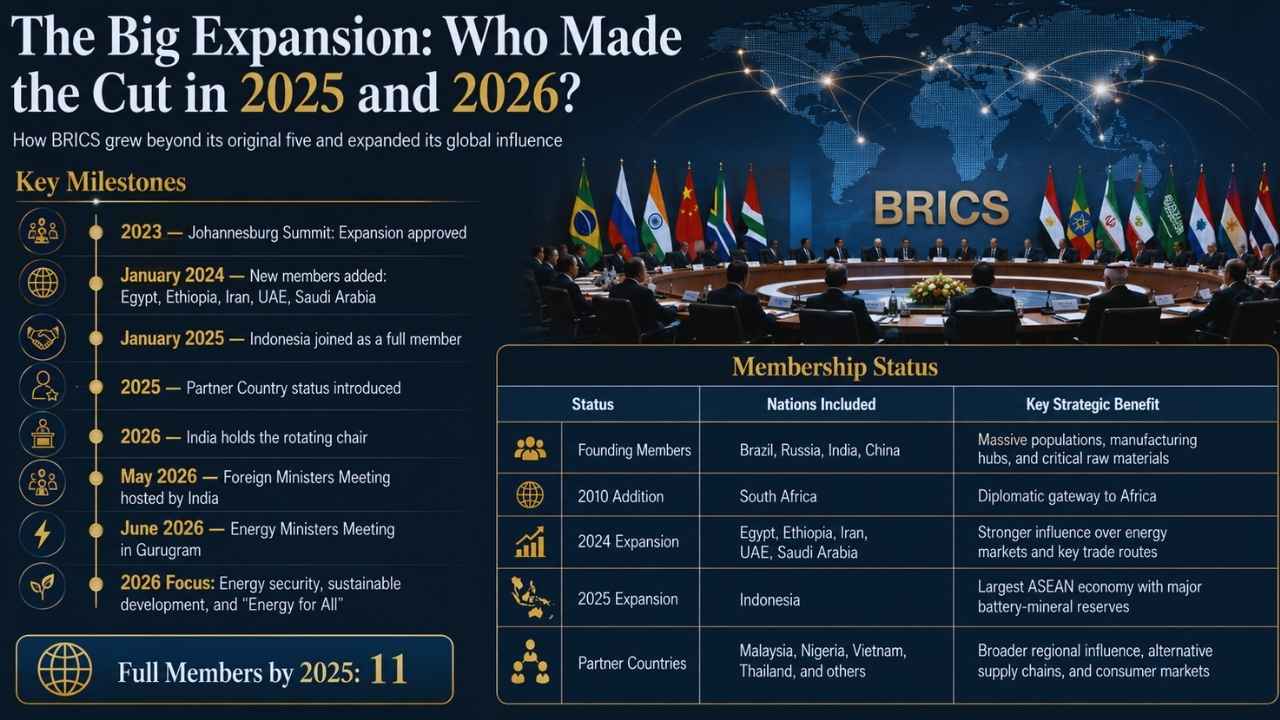
For over a decade, membership was a strictly closed five-nation club that rarely made aggressive geopolitical moves. Then came the massive geopolitical shifts of the early 2020s, which sent an absolute shockwave through the Global South. Suddenly, dozens of countries were knocking on the door, practically begging to join this alternative financial ecosystem. At the historic summit in Johannesburg in 2023, the bloc made a game-changing decision to expand.
By January 2024, they officially added five major players: Egypt, Ethiopia, Iran, the United Arab Emirates, and Saudi Arabia. This singular expansion completely rewired global energy politics by securing massive control over global oil production and vital shipping choke points in the Middle East. They absolutely did not stop there. In January 2025, Indonesia officially joined the bloc as a full member, bringing the core group to eleven powerful nations. Furthermore, to prevent massive political gridlock, they established a brilliant “Partner Country” status. This specific tier allows nations to get in on the lucrative trade benefits and bypass Western systems without demanding full political integration.
By 2025, exactly ten nations were inducted as partner countries, including fast-growing economies like Malaysia, Nigeria, Vietnam, and Thailand. Moving into 2026, India is holding the prestigious rotating chair under Prime Minister Narendra Modi. India hosted the critical Foreign Ministers meeting in May 2026 and the Energy Ministers meeting in Gurugram in June 2026, pushing heavy themes of energy security, sustainable development, and “Energy for All” to ensure the bloc remains focused on real economic growth.
|
Membership Status |
Nations Included |
Key Strategic Benefit to the Geopolitical Bloc |
|
Founding Members |
Brazil, Russia, India, China |
Deliver massive populations, manufacturing hubs, and critical raw materials. |
|
2010 Addition |
South Africa |
Serves as the essential diplomatic gateway to the entire African continent. |
|
2024 Expansion |
Egypt, Ethiopia, Iran, UAE, Saudi Arabia |
Grants absolute dominance over global energy markets and key trade routes. |
|
2025 Expansion |
Indonesia |
Adds the largest ASEAN economy, holding massive reserves of battery minerals. |
|
Partner Countries |
Malaysia, Nigeria, Vietnam, Thailand, etc. |
Expands regional influence, alternative supply chains, and consumer markets. |
The De-Dollarization Reality Check: Are We Losing the US Dollar?
If there is one single topic that makes Washington and Wall Street sweat profusely, it is the ongoing trend of global de-dollarization. For decades, the US dollar has been the undisputed, undefeated king of global trade, giving the United States government an incredible superpower. Because oil is priced in dollars and most cross-border transactions require dollars, the United States holds the unique ability to completely freeze another country out of the global economy just by cutting off their access to dollar clearinghouses. When the US and Europe froze hundreds of billions of dollars in Russian central bank reserves, it severely spooked the rest of the world.
Countries started asking a very logical question regarding their own safety and sovereignty. To grasp what BRICS is explained in a financial context, you have to look at exactly how they are fighting back. They are systematically reducing their heavy reliance on the US dollar, but they are not doing it by launching a mythical gold-backed currency tomorrow. Instead, they are doing something much more practical and dangerous to US financial dominance: they are simply trading in their own national money.
Between 2022 and 2026, nations like India and Russia settled billions in critical energy deals using rupees and rubles. China expanded its cross-border interbank payment system, processing trillions of yuan quarterly, while central banks across the bloc set up massive bilateral currency swap agreements. As a direct result, the share of US dollars in global foreign exchange reserves has steadily dropped to under 59 percent today.
|
Financial Strategy |
How It Actually Works in Practice |
Current Implementation Status in 2026 |
|
Local Currency Settlements |
Trading goods directly using national currencies like the Yuan or Rupee. |
Highly successful; a massive volume of intra-bloc trade uses this method today. |
|
Alternative Payment Systems |
Bypassing the Western SWIFT network using domestic systems like China’s CIPS. |
Experiencing rapid growth; CIPS handles massive volumes of global yuan clearing. |
|
Central Bank Currency Swaps |
Establishing direct credit lines between central banks in their own native currencies. |
Widely adopted across the bloc, significantly reducing the daily need to hold dollars. |
|
Unified Common Currency |
Attempting to create a single currency for the entire bloc, similar to the Euro. |
Completely stalled; major economic differences make this a very distant prospect. |
The Heavyweights: BRICS vs. The G7 Economic Showdown
For a remarkably long time, the G7 alliance—comprising the US, UK, Canada, France, Germany, Italy, and Japan—ran the entire global economy without any real competition. They produced the most wealth, consumed the most resources, and essentially wrote the economic rules of the game for everyone else to follow. That mathematical reality has officially flipped in a major way. When you look at the raw numbers in 2026, the expanded eleven-member bloc completely dwarfs the G7 in several incredibly critical areas. By 2026, the eleven core members account for an astonishing 49.5 percent of the global population.
Think about that staggering reality: nearly half the people on planet Earth live in a BRICS nation. Economically, these eleven nations are projected to record an average economic growth of 3.7 percent in 2026, significantly outpacing the sluggish 1.1 percent growth expected from the G7 economies. They now control roughly 40 percent of the global Gross Domestic Product based on purchasing power parity, alongside 26 percent of all global trade. With the key additions of Saudi Arabia, the United Arab Emirates, and Iran, this group now commands massive, undeniable sway over global oil and gas production.
With Indonesia joining alongside China and Brazil, they completely dominate the critical mining and processing of minerals desperately needed for electric vehicles and battery technology. The Global South is rising rapidly, and they finally have an organized, heavily populated, and well-funded platform to fiercely flex their economic muscle on the world stage.
|
Economic Metric |
Expanded Eleven-Member Bloc (2026) |
Group of Seven (G7) |
|
Global Population Share |
Accounts for an overwhelming 49.5 percent of humanity. |
Accounts for just around 10 percent of humanity. |
|
Share of Global GDP |
Controls approximately 40 percent of global purchasing power. |
Controls approximately 29 to 30 percent of global purchasing power. |
|
Expected 2026 Growth |
Projected to average a robust 3.7 percent economic growth rate. |
Projected to average a sluggish 1.1 percent economic growth rate. |
|
Strategic Global Advantages |
Dominates raw materials, manufacturing, population density, and energy. |
Holds high-end tech, financial market depth, and unified military alliances. |
The Cracks Inside the Club: Can Diverse Members Coexist?
It is absolutely not all smooth sailing for this rapidly expanding geopolitical alliance, and their biggest hurdle is not actually the United States. The alliance is incredibly diverse, intentionally throwing messy, vibrant democracies like India and Brazil into the exact same room as strict autocracies and absolute monarchies. Because the group operates purely on consensus—meaning absolutely everyone has to agree to pass a binding resolution—making fast, unified decisions is incredibly difficult and often frustrating. The most massive fault line runs right down the middle of Asia between India and China.
These two giant, powerful nations share a heavily militarized, fiercely disputed border and view each other as direct, aggressive regional rivals. India frequently pushes back hard against Chinese and Russian attempts to turn the bloc into an explicitly anti-American platform. India strongly prefers to keep the focus strictly on economic fairness, sustainable energy, and Global South development, which they heavily promoted during their 2026 Chairship.
Furthermore, some countries rely heavily on intra-bloc trade, while others definitely do not. Nations like Brazil, Russia, and Indonesia benefit massively from the group’s internal markets. But China, the primary economic anchor of the alliance, maintains a massive global export network that relies heavily on Western consumers. Replacing legacy United States dominance with unchecked Chinese dominance is exactly what countries like India and Brazil want to completely avoid.
|
Core Friction Point |
The Key Players Involved |
The Root Cause of the Ongoing Issue |
|
Militarized Border Disputes |
India versus China |
Ongoing military tensions along the Himalayan border actively prevent deep political trust. |
|
Divergent Ideological Goals |
Russia and Iran versus India and Brazil |
Russia wants a fiercely anti-Western bloc; India wants neutral, pragmatic economic cooperation. |
|
Severe Economic Imbalance |
China versus Everyone Else |
China’s economy is so massive that other members legitimately fear falling into Beijing’s orbit. |
|
Decision-Making Gridlock |
The Entire Eleven-Member Bloc |
Operating by absolute consensus means one single disagreement can stall a major initiative. |
Final Thoughts
The geopolitical tectonic plates are shifting faster right now than at any time since the end of the Cold War. The days when a few Western capitals could simply dictate the economic reality for the entire globe are rapidly winding down.
You do not need an advanced degree in international relations to see exactly why dozens of countries across Africa, Asia, and Latin America are eagerly lining up at the door to join this alternative financial ecosystem. Whether it involves bypassing the US dollar to sell oil, securing massive infrastructure loans without political strings attached, or just grabbing a louder voice on the global stage, this group offers a tangible, powerful alternative to the old way of doing things.
Getting a solid grip on what is BRICS explained is not just about memorizing a foreign policy acronym for a trivia night; it is about seeing the actual, undeniable roadmap for the next fifty years of global trade. The Global South has organized, expanded to eleven full members, and built the concrete plumbing for a truly multipolar world.
Frequently Asked Questions (FAQs) About What is BRICS Explained
Does the organization have a physical headquarters?
No. Unlike the UN (New York) or the EU (Brussels), the bloc itself doesn’t have a permanent central headquarters or a massive, bloated bureaucracy. The chairmanship rotates annually among the members. However, their financial arm, the New Development Bank (NDB), is physically headquartered in Shanghai, China.
Can a country be kicked out of the bloc?
There is no formal mechanism or treaty clause for expelling a member. The group operates purely on consensus. Because they fiercely prioritize non-interference in each other’s domestic affairs, they rarely criticize member states publicly, even when internal conflicts arise.
What exactly is a “Partner Country”?
Introduced formally in 2024, Partner Country status allows nations (like Malaysia, Nigeria, and Vietnam) to participate in trade initiatives, currency swap lines, and high-level summits without taking on the full political commitments of core membership. It’s a stepping stone that allows the bloc to expand its economic reach without diluting the voting power of the main 11 members.
Who is hosting the BRICS summits right now?
India holds the rotating Chairship for 2026. They are hosting the 18th summit, alongside massive sectoral meetings like the BRICS Energy Ministers’ Meeting in Gurugram in June 2026, giving New Delhi a massive opportunity to shape the global agenda.