


Taking off the uniform for the last time is a shock to the system. You spent years in a high-stakes environment where the chain of command was absolute, the mission was clear, and your team always had your back. Stepping into the corporate sector feels like landing on a different planet.
I have spent years studying how people handle high-stakes pressure. Watching a master at the crease blocking out the noise, standing his ground, and remaining entirely focused on the next ball always reminds me of the raw grit veterans bring to the table. You already own that elite focus. Now, you just need a new target. Building a successful military-to-civilian career takes strategy, patience, and a willingness to learn a totally new game.
The Reality of the Transition
Before you touch a resume, you have to understand the culture shock you are walking into. Corporate America does not run on military standard operating procedures. The incentives, timelines, and communication styles are entirely different. Many veterans think finding a job is the hardest part. The data says otherwise. It is really about identity and finding a new purpose. Who are you without the rank on your chest?
You are moving from a system that values the collective group to a corporate world that measures individual metrics. Acknowledging this mental hurdle is step one. Research points out that 44 percent of post-9/11 veterans find readjustment challenging. If you saw combat, the hill is even steeper. Nearly half of combat veterans struggle with the shift because they lose the tight-knit camaraderie, the daily routine, and the clear-cut purpose. You have to actively build a new support system and find a mission that drives you forward.
|
Metric / Demographic |
Transition Data Point |
What This Means for You |
|
General Transition Difficulty |
27 percent of all veterans find re-entry difficult |
You are not alone; expect a learning curve. |
|
Post-9/11 Veterans |
44 percent find readjustment challenging |
Modern service creates unique civilian hurdles. |
|
Combat Veterans |
46 percent report a difficult transition |
Lean heavily on veteran support networks. |
|
Non-Combat Veterans |
18 percent report a difficult transition |
The shift is smoother, but still takes work. |
2026 Veteran Job Market Trends
To win in your military-to-civilian career, you have to know the battlefield. As of April 2026, the overall veteran unemployment rate dropped to 3.6 percent, down from 3.9 percent in March 2026. That looks great on paper, but the number hides a lot of variation based on age and demographics. Younger veterans face an incredibly tough climb. The unemployment rate for veterans aged 18 to 24 was 7.9 percent in March 2026. They often joined right out of high school.
Now, they compete against civilians who spent those same years getting degrees and entry-level corporate experience. Additionally, of the unemployed veterans in April 2026, 64 percent were out of work for 15 weeks or more. You cannot just coast and expect a job to land in your lap. Older, mid-career veterans have an easier time, especially if they plug into the right networks. The jobs exist. You just have to know how to package your experience and aim at the right targets.
|
Demographic / Category |
Spring 2026 Unemployment Rate |
Market Context & Strategy |
|
All Veterans |
3.6 percent (April) |
Dropped from March; highly competitive market. |
|
Post-9/11 Veterans |
4.0 percent (April) |
Continues to trend downward. |
|
Ages 18 to 24 |
7.9 percent (March) |
The most vulnerable group; heavily requires upskilling. |
|
Female Veterans |
7.1 percent (March) |
Jumped up in early 2026; requires strategic networking. |
Translating Your Skills for Corporate Resumes
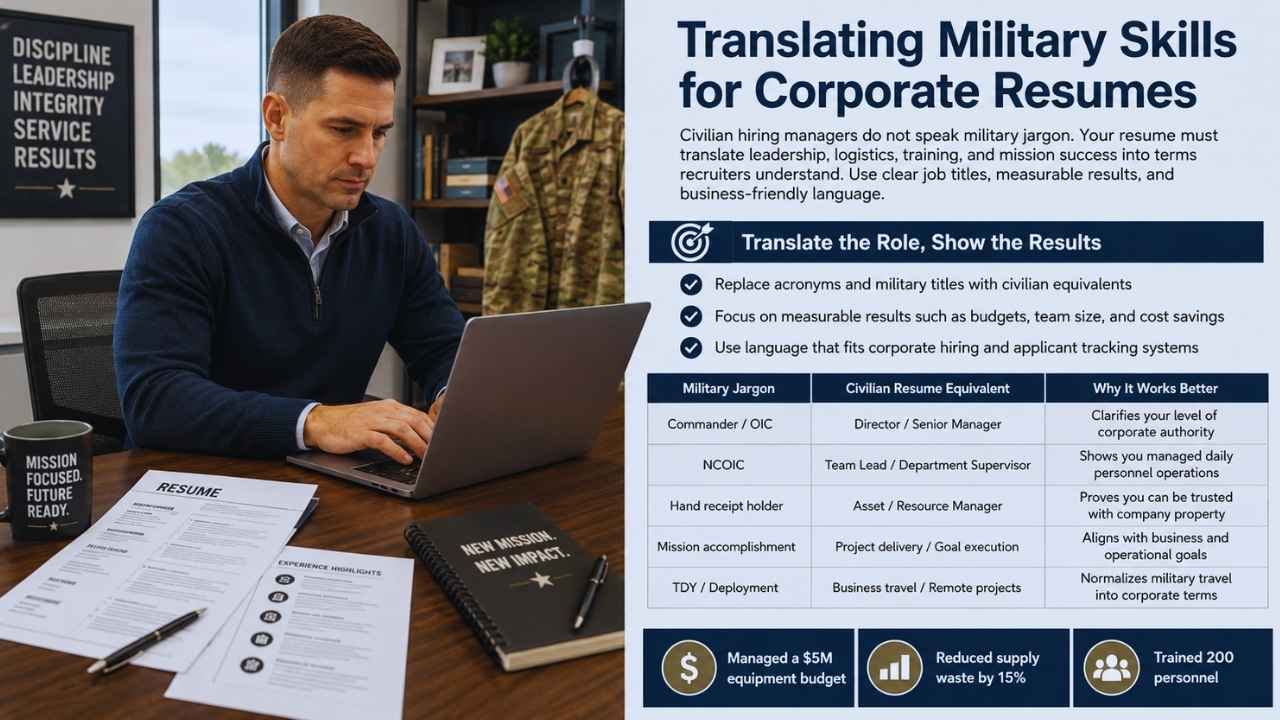
Civilian hiring managers do not speak military. If your resume is full of acronyms like NCOIC or OCONUS, automated applicant trackers will delete it, and human recruiters will ignore it. You have 15 to 20 seconds to capture a recruiter’s interest. You have to decode your past because they will not do it for you. Your resume is your translator. Do not use E-levels to describe your rank. You didn’t just “command a platoon”; you “managed a cross-functional team of 40 personnel.”
You were not the “S4”; you were the “Director of Logistics.” Focus heavily on hard numbers. Did you manage a 5 million dollar equipment budget? Did you cut supply waste by 15 percent? Did you train 200 people? Numbers make sense in any language. Employers know veterans bring elite leadership and reliability. You just have to show them the proof in a format they recognize.
|
Military Jargon |
Civilian Resume Equivalent |
Why It Works Better |
|
Commander / OIC |
Director / Senior Manager |
Clarifies your level of corporate authority. |
|
NCOIC |
Team Lead / Department Supervisor |
Shows you managed daily personnel operations. |
|
Hand receipt holder |
Asset / Resource Manager |
Proves you can be trusted with company property. |
|
Mission accomplishment |
Project delivery / Goal execution |
Aligns with business profit and operational goals. |
|
TDY / Deployment |
Business travel / Remote projects |
Normalizes military travel into corporate terms. |
Bridging the Gap with DoD SkillBridge
Sometimes you have the raw skills, but a company’s human resources software rejects you because you lack a specific piece of paper. This is where strategic upskilling saves your transition. The absolute best tool out there right now is the DoD SkillBridge program. If you have 180 continuous days on active duty, you can spend your last six months working a civilian internship. You stay on active duty, keep your military pay, and learn the corporate ropes. It completely removes the risk.
The company test-drives your skills, and you build your resume before the paychecks stop. You need command approval, usually at the O-5 level, and you need to start the process 12 months out for competitive spots. Programs like Microsoft MSSA place 96 percent of their graduates. If SkillBridge isn’t an option, chase high-ROI certifications. Use your GI Bill to grab a Project Management Professional credential or a CompTIA Security+ badge.
|
Program / Certification |
Best For |
Time to Complete |
Why It Matters |
|
DoD SkillBridge |
Active-duty members |
Up to 180 days |
Direct, paid civilian work experience before separating. |
|
PMP (Project Management) |
Officers & Senior NCOs |
2 to 3 Months |
Proves you can manage civilian budgets and timelines. |
|
CompTIA Sec+ / CISSP |
IT & Communications Personnel |
1 to 4 Months |
Baseline for entering the lucrative cybersecurity sector. |
|
Six Sigma (Green/Black) |
Logistics & Supply Chain |
1 to 3 Months |
Validates your ability to optimize processes. |
Best Industries for a Military to Civilian Career
Some industries naturally fit the discipline and technical skills you built in the service. With current workforce shortages, many sectors are actively hunting for veteran talent to build a solid pipeline. A lot of veterans find a great middle ground in the public sector. Recent data shows that 38.7 percent of employed veterans with a service-connected disability work in federal, state, or local government.
It offers a familiar bureaucratic structure, great benefits, and a continued sense of service. If you prefer the private sector, look extremely hard at cybersecurity, project management, and advanced manufacturing. Your mechanical aptitude, risk management skills, and strict adherence to safety protocols make you perfect for these fields. You just have to prove that your military background directly translates to their specific corporate pain points.
|
Target Industry |
Why It Fits Military Talent |
Common Target Roles |
|
Public Sector |
Heavy preference for veteran hires; retains a mission. |
Federal Analyst, Program Manager |
|
Cybersecurity |
Military roles involve secure systems and networks. |
Cyber Analyst, Network Engineer |
|
Project Management |
Mirrors mission planning and team coordination. |
Project Manager, Operations Manager |
|
Logistics |
Deep understanding of moving assets at scale. |
Supply Chain Manager, Logistics Coordinator |
Building a Corporate Network from Scratch
In the military, your network is issued to you. You eat, sleep, and train with your peers. In the civilian world, you have to hunt for it yourself. Networking is the actual engine behind a successful transition. Up to 80 percent of corporate jobs are filled through personal connections, not online applications. Get on LinkedIn today. Find veterans working at companies you like and message them.
A simple, “I am getting out of the Navy soon and would love to hear about your time at your company” works wonders. Veterans love helping veterans. Look into formal mentorships, too. Organizations like American Corporate Partners and Veterati pair you with corporate executives for free. They review your resume, run mock interviews, and open doors for you that online job boards simply cannot reach.
|
Platform / Program |
Primary Purpose |
How to Leverage It |
|
|
Broad professional networking |
Optimize your profile and message people directly. |
|
Veterati |
On-demand mentoring |
Schedule 1-hour calls with industry professionals. |
|
ACP |
Long-term mentorship |
Apply for a year-long mentorship with an executive. |
|
RecruitMilitary |
Direct employment connections |
Attend career fairs to bypass automated resume filters. |
Mastering the Civilian Job Interview
The military trains you to deflect praise. You say “we accomplished the mission.” In a corporate interview, you have to say “I.” If you do not claim your wins, the hiring manager assumes you didn’t do the work. Use the STAR method—Situation, Task, Action, Result—to answer behavioral questions. When they ask about overcoming a challenge, do not tell a crazy combat story.
It makes civilian recruiters uncomfortable. Instead, talk about fixing a broken supply chain or leading a team through a high-stress administrative deadline. Keep the stakes relatable. Practice in front of a mirror and remember to smile. When they ask, “Why should we hire you?” sell your adaptability. You spent years dropping into unfamiliar environments, learning new systems fast, and getting the job done. That ability to learn and stay calm is your absolute best asset.
|
Common Interview Question |
What the Recruiter Wants |
How to Answer as a Veteran |
|
“Tell me about yourself.” |
Are you articulate and a good fit? |
Summarize your service, highlight skills, explain why you want this job. |
|
“What is your biggest weakness?” |
Do you have self-awareness? |
Pick a real, minor weakness (e.g., civilian software) and explain how you are fixing it. |
|
“Describe a time you failed.” |
How do you handle setbacks? |
Share a training failure, own it, and detail your corrective action. |
|
“Why should we hire you?” |
What makes you stand out? |
Highlight your adaptability, leadership, and quick learning curve. |
Final Thoughts
The jump from a uniform to a corporate office is steep, but it is entirely manageable. You already survived boot camps, deployments, and operations that most people cannot even imagine. The civilian sector is just another environment to figure out. By dropping the military jargon, taking advantage of programs like SkillBridge, and aggressively building your network, you set yourself up for incredible success.
Securing a military to civilian career is just your next mission. Plan it out, execute the steps, own your future, and remember that your greatest asset is the resilience you built along the way.
Frequently Asked Questions (FAQs) About Military to Civilian Career
What is the DoD SkillBridge program, and who is eligible?
The DoD SkillBridge program permits active-duty service members to spend up to their last 180 days of service participating in industry training, internships, or apprenticeships. You must have completed at least 180 continuous days on active duty to qualify. You need command approval to participate, and it acts as a direct bridge to civilian employment while you still collect military pay.
How do civilian employers view combat experience?
It varies widely. Some employers highly value the rapid decision-making and stress tolerance forged in combat. However, your job is to translate that experience carefully. Focus on the planning, risk management, and team leadership aspects rather than the kinetic, tactical details.
Why is the transition so difficult for many veterans?
Statistics show 44% of post-9/11 veterans find the transition harder than expected. This is heavily tied to a loss of identity, a lack of clear guidance on translating skills, and the pressure of finding a new mission. Getting ahead of the psychological shift is just as important as writing a good resume.
What is the 180-day rule for military retirees?
The 180-day rule requires military retirees to wait 180 days after their official retirement date before they can enter a civil service position within the Department of Defense. There are waivers available, but it is a critical timing factor if you plan to become a federal civilian employee.