


We have all been there at some point, staring nervously at a smartphone screen, watching a three-digit number dictate whether we get an apartment, a car loan, or even a new job. It feels incredibly personal and stressful. When that number suddenly drops, the immediate panic sets in. You immediately start asking yourself exactly what hurts credit score numbers the fastest and just how bad the lasting damage is going to be.
I have seen plenty of people stress over minor things that barely move the needle while completely ignoring the daily financial habits quietly tanking their reputation with lenders. If you want to build or aggressively rebuild your credit, you need to stop guessing and look at the actual math. The FICO scoring model, which top lenders use to judge your creditworthiness, is not some closely guarded secret. It weighs specific behaviors heavily, while others barely register as a blip on the radar.
The national average FICO score dropped to 714 recently, showing that many Americans are actively feeling the financial squeeze and need to protect their ratings. Before we dive into the specific mistakes, you have to understand how the pie is sliced. FICO scores are calculated based on five major categories: payment history (35 percent), amounts owed (30 percent), length of credit history (15 percent), new credit (10 percent), and credit mix (10 percent). Let us break down exactly what behaviors destroy those categories, ranked from the absolute worst offenses to the minor, temporary dings.
What Hurts Credit Score Ratings the Most? Bankruptcies and Major Defaults
Bankruptcy and the Brutal Point Drop
Filing for bankruptcy is universally considered the single most damaging event that can ever hit your credit report. But here is the fascinating part about the FICO scoring model: the higher your score is before filing, the further it actually has to fall. FICO explicitly notes that a person with strong credit takes a much harder hit than someone whose score is already struggling. If you have a pristine credit score of 780, filing for bankruptcy can wipe out an estimated 220 to 240 points overnight. If your score is already sitting in the 500s because of missed payments and maxed-out cards, the bankruptcy causes a smaller additional drop since the system has already accounted for your financial distress.
Total bankruptcy filings in the U.S. reached over 574,000 cases recently, representing an 11 percent increase as economic pressures mount on everyday consumers. The type of bankruptcy dictates the timeline; Chapter 7 liquidates non-exempt assets and stays on your report for a brutal 10 years. Chapter 13 involves a court-structured repayment plan and falls off slightly faster, staying for seven years. The good news is the damage is not permanent, and your score can start recovering long before the mark falls off entirely.
|
Factor |
Estimated Score Drop |
Time on Credit Report |
|
Chapter 7 Bankruptcy |
130 to 240 points |
10 years |
|
Chapter 13 Bankruptcy |
130 to 240 points |
7 years |
Foreclosures, Charge-Offs, and Third-Party Collections
Losing a home to foreclosure or having an unpaid debt sold to a collection agency sits right behind bankruptcy in overall severity. When a lender gives up on trying to collect from you and sells your account to a third-party debt collector, your score is going to plummet. Lenders view this action as a total breakdown of trust and undeniable proof of high risk. Keep in mind that simply paying off a collection account does not magically remove it from your credit report.
The record of that severe collection action remains visible to lenders for seven years from the original delinquency date. According to current reporting rules, the damage lessens as the collection ages, but it still heavily restricts your access to favorable interest rates. If you are wondering what hurts credit score numbers permanently, charge-offs are right near the top because the original bank officially writes your debt off as a complete loss. Avoiding these massive derogatory marks is the absolute most important rule of basic credit management.
|
Derogatory Mark |
Financial Definition |
Score Impact |
|
Foreclosure |
Losing a home to the lender |
85 to 160 points |
|
Charge-Off |
Lender writes debt off as loss |
Severe and immediate |
|
Collections |
Debt sold to a third party |
50 to 100 points |
The Silent Credit Killer: Late Payments and Missed Deadlines
The Truth About the 30-Day Grace Period
You might think paying a credit card bill a few days late is not a massive deal in the grand scheme of things. The credit bureaus heavily disagree with that assumption and track every single detail. Payment history is the absolute foundation of your credit profile, making up a massive 35 percent of your total score. However, there is a massive difference between a late payment and a missed payment when it comes to your actual report.
If your credit card payment is due on the 15th and you pay it on the 22nd, you are late. Your bank will almost certainly slap you with a hefty financial late fee. But this lateness is not reported to the credit bureaus, and your credit score remains completely unaffected. Creditors cannot legally report a payment as delinquent until it is a full 30 days past due. This distinction gives you a small window to fix a simple mistake before it turns into a disaster.
|
Delinquency Timeline |
Credit Score Impact |
Financial Reality |
|
1 to 29 Days Late |
Zero Impact |
Expect bank late fees |
|
30 Days Late |
High Impact |
Bureau reporting begins |
|
60 Days Late |
Severe Impact |
Major red flag for lenders |
The Cascading Damage of Unpaid Bills
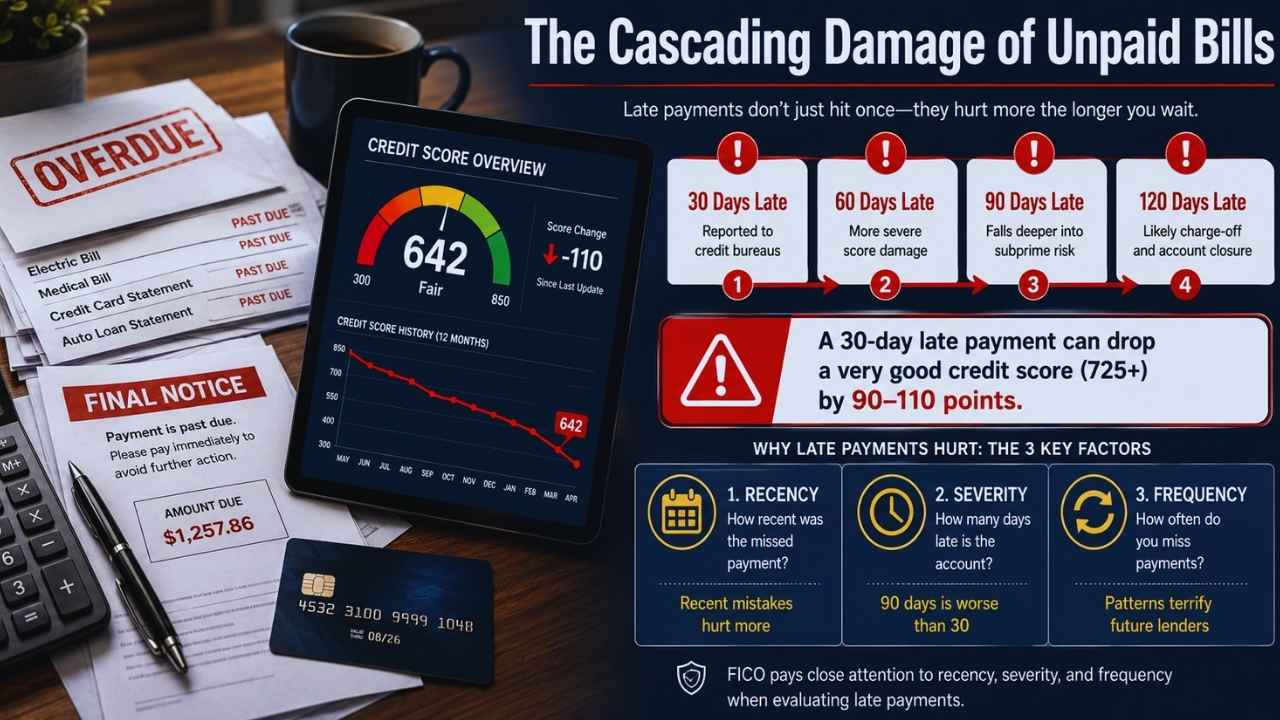
The second you cross that strict 30-day threshold, the issuer reports the delinquency to the bureaus, and the credit damage begins immediately. Data shows that if you have a very good credit score of 725 or above, a single 30-day overdue payment can cause your score to plummet by an astonishing 90 to 110 points. The damage gets progressively worse the longer you ignore the bill and refuse to pay. A 60-day late payment hurts significantly more than a 30-day one, dragging you further into the subprime lending tier.
By the time you reach 120 days past due, your lender will likely label your account as a charge-off and close it forever. When evaluating late payments, the FICO algorithm looks closely at three things: recency, severity, and frequency. A missed payment from last month stings much more than one from four years ago. Missing multiple payments establishes a terrifying pattern of high-risk behavior that will definitely scare away future lenders.
|
Late Payment Factor |
Evaluation Metric |
Why It Matters |
|
Recency |
How recent was the missed payment? |
Recent mistakes hurt more |
|
Severity |
How many days late is the account? |
90 days is worse than 30 |
|
Frequency |
How often do you miss payments? |
Patterns terrify future lenders |
Maxing Out Limits: The Danger of High Credit Utilization
Understanding Your Ratio and Score Impact
Right behind payment history is a category called amounts owed, which makes up 30 percent of your FICO score. The most important metric in this specific slice of the pie is your credit utilization ratio. Your credit utilization is the exact percentage of your total available credit that you are currently using at any given moment. Maxing out your credit cards is a massive red flag for financial institutions. When you max out your credit limit, your credit score takes an immediate and highly noticeable hit.
It tells scoring models that you are heavily reliant on borrowed money and might be dangerously overextended. While standard financial advice tells you to keep your utilization below 30 percent, people with elite credit scores usually keep it below 10 percent. A high utilization rate is exactly what hurts credit score numbers the fastest on a month-to-month basis. Since credit utilization has no memory in standard models, your score bounces back the month after you pay down balances.
|
Utilization Ratio |
Financial Health Indicator |
Score Impact |
|
0 to 9 Percent |
Elite |
Optimal management |
|
10 to 29 Percent |
Good |
Minimal negative impact |
|
30 to 49 Percent |
Caution Zone |
Score drops noticeably |
|
50 to 100 Percent |
Danger Zone |
Severely damages score |
Debt Averages and Economic Pressures
Carrying a massive balance makes it incredibly hard to get approved for other loans. When you apply for a mortgage, the lender immediately checks your debt-to-income ratio. If your cards are maxed out, lenders assume you already have more debt than you can reasonably handle. This assumption could instantly disqualify you from getting the keys to a brand new house. The average credit card debt per American recently hit $6,715, showing that many consumers are carrying significant balances.
As average credit card interest rates climb above 21 percent, paying down that revolving debt becomes even harder. High balances guarantee you pay astronomical interest charges while simultaneously depressing your FICO score. Lenders constantly monitor your outstanding debt to gauge how close you are to financial collapse. Keeping your balances as close to zero as possible is the ultimate defense against score drops.
Read also: How the 2008 Financial Crisis Happened: Plain English Guide
|
Economic Factor |
Current Reality |
Impact on Consumers |
|
Average Credit Card Debt |
Over 6,700 dollars per person |
High balances hurt scores |
|
Average Interest Rate |
Above 21 percent |
Makes paying down debt harder |
|
Inflation |
Rising costs of living |
Increases reliance on credit cards |
The Minor Dings: Hard Inquiries and Closed Accounts
How Hard Pulls Affect the Algorithm?
Every time you formally apply for a new loan or credit card, the potential lender checks your credit report to evaluate the risk. This formal action is universally known in the industry as a hard pull or a hard inquiry. An occasional hard pull creates only a small negative impact on your score, usually dropping it by less than five points. These specific inquiries stay on your credit report for exactly two years, though their impact fades much faster than that. Applying for a dozen credit cards in a single month, however, looks incredibly desperate.
What hurts credit score profiles more than anything else in this category is multiple hard pulls over a short period. The algorithms treat a massive flurry of applications with extreme suspicion because it signals potential financial distress. The major exception to this rigid rule is rate shopping for a single loan type. If you apply for five different auto loans within a 14-day window, the algorithm smartly groups them together as one single hard pull. Knowing when to apply for credit protects your score from unnecessary damage.
|
Action |
Score Impact |
Context and Lifespan |
|
Single Hard Inquiry |
Minor |
Stays on report for 2 years |
|
Multiple Hard Pulls |
Moderate |
Signals desperation to lenders |
|
Rate Shopping |
Negligible |
Grouped as one pull if done quickly |
Why Closing Old Accounts Backfires?
It feels absolutely amazing to finally pay off a stubborn credit card balance. Your first instinct might be to grab a pair of scissors, chop the plastic in half, and close the account entirely. Think twice before you make that call, because closing an old credit card actually hurts you in two distinct ways. First, closing the account instantly reduces your total available credit limit. If your balances on other cards remain the same, your overall credit utilization ratio spikes immediately, causing an instant score drop.
Second, closing your oldest active account will eventually shorten the average age of your credit history. Since credit age accounts for 15 percent of your score, you lose valuable points. If you have an old card with zero annual fees, the smartest move is to leave it open indefinitely. Use it occasionally for a small recurring subscription just to keep the account active and reporting positively.
|
Action |
Score Impact |
Context |
|
Closing Old Account |
Minor to Moderate |
Spikes credit utilization instantly |
|
Losing Credit Age |
Gradual Drop |
Shortens average history length |
|
Keeping Cards Open |
Positive |
Maintains high available credit limits |
Final Thoughts
Navigating the modern financial system does not require a degree in economics, but it definitely requires knowing the rules of the game. Understanding what hurts credit score numbers the most allows you to prioritize your financial energy effectively. You do not need to stress over checking your score on an app or having a single hard inquiry from buying a new car. The path to an excellent score is remarkably boring but wildly effective: pay every single bill on time, keep your credit card balances incredibly low, and never apply for credit unless you genuinely need it.
If you are already dealing with major derogatory marks like a bankruptcy or an account in collections, remember that the damage is not permanent. Time, combined with aggressive and consistent positive financial habits, is your absolute greatest weapon for recovery. Focus on the big categories, ignore the myths, and watch your credit score slowly climb back to the top.
Frequently Asked Questions (FAQs) About What Hurts Credit Score
Does checking my own credit score drop my rating?
Absolutely not. When you check your own credit report through an app or directly with the bureaus, it registers as a “soft inquiry”. Soft pulls have zero impact on your credit score. You can check your score ten times a day, every day, and it will never drop a single point.
Does my income or salary affect my credit score?
No. Your salary, job title, and overall net worth are not reported to the credit bureaus and are completely excluded from the FICO algorithm. You can make $35,000 a year and have an elite 800 credit score, or you can make $400,000 a year and be sitting at a 550 because you miss payments. However, lenders will ask for your income when you apply for a loan to calculate your debt-to-income ratio.
Do unpaid medical bills ruin my credit?
Medical debt is treated much more leniently than consumer credit card debt. Under current reporting rules, paid medical collections are no longer included on consumer credit reports. Furthermore, unpaid medical collections under $500 are also excluded. The credit bureaus also enforce a 365-day waiting period before eligible unpaid medical debt can be reported, giving you a full year to sort out insurance issues or payment plans before it impacts your score.
Will getting a divorce ruin my credit?
A divorce decree itself is a legal document and does not show up on your credit report. The danger lies in joint accounts. If you have a joint credit card or a joint mortgage with your ex-spouse, you are both legally responsible for the debt regardless of what the divorce judge says. If your ex-spouse angrily refuses to pay a joint bill, the late payment will tank your credit score just as much as theirs.