
Electricity demand is currently going through the roof. Think about it: massive data centers for AI, countries racing to ditch fossil fuels, and everyone buying electric cars. The world needs a ton of power. And we need power that flows around the clock, even when the wind stops and the sun sets.
That brings us back to one of the most brilliant, yet deeply misunderstood, engineering marvels we have. If you want to grasp where our power grid is heading, you need to understand how nuclear energy works. Forget the glowing green goo from the movies—it’s actually just a highly sophisticated, entirely carbon-free way to boil water.
Let’s cut through the jargon. Here is a breakdown of the science, the machinery, and why atomic power is making a massive comeback right now in 2026.
The Core Science: Breaking Down the Atom
Before we stare at those giant curved cooling towers, we need to zoom way in. Everything happening inside a plant relies on a mind-bending process called nuclear fission.
|
Term |
What It Actually Is |
Its Job in the Plant |
|
Atom |
The basic building block of all matter. |
The fundamental source of energy. |
|
Nucleus |
The dense, heavy center of an atom. |
What we physically split to release heat. |
|
Neutron |
A tiny particle with no charge. |
The “bullet” we fire to break the nucleus. |
|
Uranium-235 |
A specific isotope of a heavy metal. |
The go-to fuel because its nucleus is somewhat fragile. |
You, me, and everything in the universe are made of atoms, and every atom has a tightly packed core (a nucleus). Usually, they are incredibly stable. But some heavy elements, like uranium, have variations that are a bit delicate.
When a stray neutron slams into a uranium-235 nucleus, it gets absorbed. The nucleus becomes totally unstable and instantly rips itself into two smaller pieces. That split is called fission. And when it breaks, two vital things happen: it releases a massive burst of heat, and it spits out two or three more stray neutrons.
Those newly freed neutrons go flying, smash into neighboring uranium atoms, and cause them to split, too. This sets off a continuous, self-sustaining chain of splits—what we call a chain reaction.
Step-by-Step: How Nuclear Energy Works Inside a Reactor
Understanding how nuclear energy works means following the journey from a tiny uranium pellet to the electricity lighting your room. The reactor’s main job is simply to hold that violent atomic splitting and capture the heat safely.
Here is how it plays out inside a standard Pressurized Water Reactor (PWR), which currently makes up the vast majority of the global nuclear fleet:
|
Stage |
The Hardware |
What’s Actually Happening |
|
1. The Heat (Primary Circuit) |
Reactor Core & Fuel Rods |
Uranium pellets split, generating intense heat. Pressurized water surrounding the rods absorbs this heat, reaching a scorching $320^\circ\text{C}$ ($600^\circ\text{F}$) without ever boiling. |
|
2. The Steam (Secondary Circuit) |
Steam Generator |
The super-hot water flows through tubes, boiling a completely separate loop of water into high-pressure steam. |
|
3. The Spark (Power Generation) |
Turbine & Alternator |
The steam blasts through and spins massive turbine blades, turning a generator to create electricity. |
|
4. The Cool Down (Condensation) |
Condenser & Cooling Towers |
The steam cools off (using river, sea, or cooling tower water), turns back into a liquid, and heads back to be boiled again. |
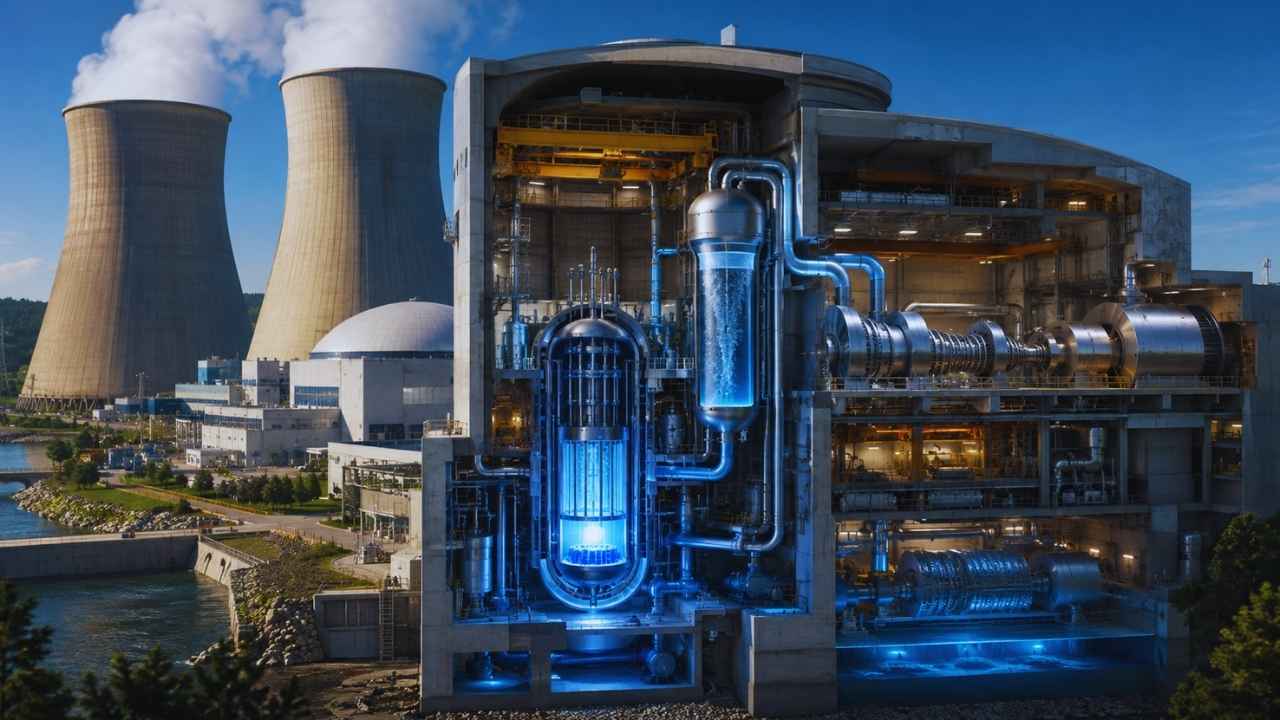
Check out this visual breakdown:
Inside the core, operators load ceramic pellets of uranium into long metal tubes called fuel rods. They bundle hundreds of these together into a fuel assembly. A typical reactor holds a few hundred assemblies, entirely submerged in water.
That water does two crucial jobs. First, it’s a coolant, carrying away the extreme heat. Second, it acts as a moderator. Neutrons actually shoot out of a split atom too fast to effectively hit the next one. The water slows them down just enough so they can find their targets and keep the chain reaction alive.
Mastering the Chain Reaction
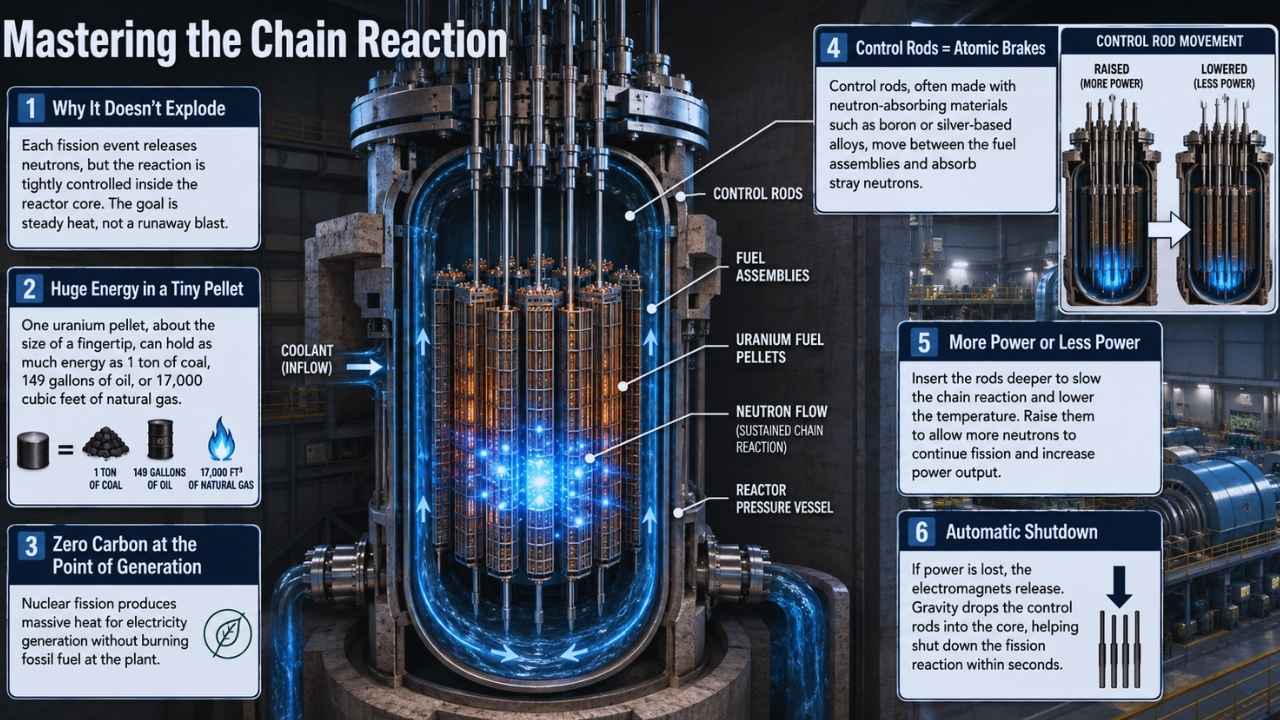
You might be wondering: if splitting atoms releases more neutrons, which split more atoms, why doesn’t the whole thing just explode? First off, the energy density is wild. A single uranium pellet (about the size of your fingertip) holds as much energy as one ton of coal, 149 gallons of oil, or 17,000 cubic feet of natural gas. And it burns with zero carbon emissions.
The real secret to keeping it safe is the control rods. Made from materials like silver or boron, they act like atomic brakes. Operators slide these rods up and down between the fuel assemblies. If things get too hot, they drop the rods deeper into the core. The rods absorb the stray neutrons, starving the chain reaction, and the temperature drops. Need more juice? Pull the rods up, letting more neutrons hit the uranium.
If the plant loses all power, electromagnets holding the control rods immediately fail. Gravity takes over, dropping them straight into the core, shutting down the reaction in seconds.
Reactor Designs: Moving Past Mega-Projects
While the physics stay the same, the engineering behind how nuclear energy works is evolving fast. We are seeing a massive shift away from those giant, expensive legacy projects.
|
Reactor Type |
Market Role |
How It Works |
|
Pressurized Water Reactor (PWR) |
Dominant Global Fleet |
Keeps water under crazy pressure so it won’t boil in the core; uses a second loop for steam. |
|
Boiling Water Reactor (BWR) |
Significant Global Share |
Lets water boil right inside the reactor, sending steam straight to the turbine. |
|
Small Modular Reactor (SMR) |
Emerging (The 2026 Trend) |
Factory-built, highly scalable micro-reactors you can ship on a truck and assemble on-site. |
Historically, building a nuclear plant took decades and billions of dollars. Today, everyone is looking at SMRs. The global small modular reactor market was valued at USD 5.96 billion in 2025 and is projected to hit USD 6.13 billion in 2026, pushing toward USD 8.77 billion by 2034.
Since SMRs are built in a factory and shipped out, they drastically cut down construction time and costs. Beyond just powering homes, they are stepping into heavy industry, like running energy-intensive desalination plants or coal repowering projects, which offer roughly 110 GW of brownfield opportunity worldwide.
Why 2026 is the Turning Point?
For the last twenty years, nuclear power was kind of stuck in neutral. Not anymore. We are now in what industry analysts are officially calling the “Golden Age of Nuclear.” As of 2026, the global operational fleet stands at roughly 417 reactors across 31 countries, generating about 379 GW of capacity.
|
2026 Nuclear Facts |
What’s Actually Happening |
|
Under Construction |
There are about 80 power reactors currently being constructed in 15 countries, totaling nearly 78 GW of new capacity. |
|
China’s Expansion |
Half of the capacity currently under construction globally is in China, targeting 100 GW by around 2030. |
|
Data Center Drain |
Data centers alone represent a massive 75 GW of identified SMR demand. |
|
Massive Investments |
The global build-out opportunity for SMRs by 2050 is estimated at a staggering 700 GW, requiring $0.5–1.5 trillion in capital. |
Why the sudden rush? Artificial intelligence and the desperate need to decarbonize. Training massive AI models sucks up electricity faster than utility companies can build solar panels. Tech giants need baseload power—electricity that flows non-stop. In a huge shift, major tech companies are now signing direct deals (Power Purchase Agreements) with nuclear developers. The willingness to pay for firm, clean power from data centers is reaching $130/MWh. They know nuclear fission is the only way to get that much power without trashing their climate goals.
Dealing with the Leftovers: Radioactive Waste
We can’t talk about how nuclear energy works without addressing the elephant in the room: nuclear waste.
|
Waste Level |
What It Is |
How We Handle It |
|
Low-Level Waste |
Tools, protective gear, rags. |
Compacted and safely buried in monitored trenches. |
|
Intermediate-Level Waste |
Chemical sludges, old reactor parts. |
Sealed in concrete and buried deep underground. |
|
High-Level Waste |
Spent uranium fuel assemblies. |
Cooled in deep pools for years, then locked in massive steel and concrete dry casks. |
Unlike fossil fuels that dump their waste invisibly into our lungs and atmosphere, the nuclear industry contains every single ounce of its waste. To put it in perspective, the total amount of waste generated is actually incredibly small considering the massive energy produced.
Even better, when a fuel rod is “spent,” it still holds about 90% of its potential energy. Countries like France actually recycle this spent fuel to generate even more electricity, creating a cleaner, closed-loop system.
Final Thoughts
The mechanics of how nuclear energy works really show what we are capable of engineering. By tapping into the forces holding atoms together, we generate massive amounts of clean, reliable power in a surprisingly small space.
As we dive deeper into 2026—a world obsessed with AI, electric cars, and cutting carbon—we can’t just rely on the weather to keep the lights on. We need heavy-duty, always-on power. Thanks to new tech like Small Modular Reactors and a huge push from the tech industry to secure data center power, nuclear energy isn’t just making a comeback. It’s becoming the absolute backbone of our modern grid.
Frequently Asked Questions (FAQs) About How Nuclear Energy Works
Is nuclear energy actually considered “clean” energy?
Yes. Unlike fossil fuels, nuclear power plants do not burn anything. Because they operate through fission rather than combustion, they generate massive amounts of electricity without emitting greenhouse gases like carbon dioxide or methane into the atmosphere. This makes nuclear a critical tool for climate change mitigation, alongside wind and solar.
What happens to all the nuclear waste, and where does it go?
It is a common misconception that radioactive waste is dumped haphazardly. To our knowledge, nuclear energy is the only energy sector where waste is meticulously tracked, accounted for, and safely stored. High-level waste (spent fuel) is initially kept deep underwater in reinforced pools to cool. Afterward, it is moved into massive, indestructible concrete and steel dry casks, safely isolating it from the environment.
Are we running out of uranium to fuel these plants?
No. Uranium is a relatively common metal found in rocks and seawater worldwide. With current consumption rates, identified terrestrial resources are sufficient for over a century. Furthermore, advancements in fast neutron reactors and fuel recycling technology (where spent fuel is reused) mean we could potentially power the globe for thousands of years using the fuel we have already mined.
If nuclear is so good, why are some people so opposed to it?
Opposition generally stems from three main concerns: the long-term management of radioactive waste, the fear of severe accidents (like Chernobyl or Fukushima), and the high upfront costs and long construction timelines of building legacy plants. There are also concerns regarding uranium mining practices and the water consumption required to cool the reactors.
Can a nuclear plant blow up like a nuclear bomb?
Absolutely not. It is physically impossible. Nuclear weapons require highly enriched uranium (over 90%). The uranium used in commercial power plants is only enriched to about 4-5%. While a reactor can overheat and melt down if cooling systems fail, the physics of the fuel simply do not allow for a nuclear explosion.