


Buying a car feels incredible right up until you have to deal with the finance office. Wading through the mandatory paperwork and trying to figure out how car insurance works can completely drain your excitement. Between climbing rates and industry jargon that sounds like a foreign language, picking the right policy often feels like throwing darts blindfolded.
The reality for 2026 is that auto coverage is getting more expensive across the board, with full protection policies hitting an average of $2,495 to $2,670 annually. Because you are dropping serious cash every month, understanding what you are actually buying is the only way to avoid throwing your money away. At its core, auto coverage is simply a financial safety net. You pay a company a monthly fee, and they agree to step in and cover the massive bills if you crash, get robbed, or a heavy storm destroys your roof.
Let’s cut through the noise entirely. This guide breaks down exactly what you are paying for, the real-world costs across different US states, and how you can game the system to snag a much cheaper rate this year.
The Basics: How Does Car Insurance Work?
Let’s start with the absolute basics. Figuring out how car insurance works means translating industry speak into plain English so you know what you are signing. When you buy a policy, you agree to pay a “premium.” You can think of this premium as your monthly subscription fee to stay financially protected on the road. If you accidentally bump into a delivery truck at a red light, you will need to file a “claim.” A claim is your official plea asking the company for cash to fix the mess you just made.
But before the insurer actually pays up for your car, you usually have to cover a “deductible” out of your own pocket. If the mechanic wants $3,000 and your deductible is set at $500, you have to hand the shop $500 of your own money first. The insurer then handles the remaining $2,500. You also have to deal with “limits,” which represent the absolute maximum amount the company pays per accident. If you cause a massive pileup that results in $100,000 of property damage but your limit is capped at $50,000, you personally owe the victim the remaining $50,000. Going cheap on your limits can literally bankrupt you in a heartbeat, so you have to choose these numbers carefully.
|
Term |
What It Means in Plain English |
Real-World Example |
|
Premium |
The recurring bill you pay to keep coverage active. |
Paying $223 every month directly to your agent. |
|
Deductible |
The cash you pay up-front before coverage kicks in. |
Handing the body shop $500 before the insurer pays the rest. |
|
Limit |
The absolute max the insurer pays for a covered incident. |
A $50,000 cap on property damage payouts. |
|
Claim |
Your formal request for the insurer to pay for damages. |
Calling your company after a minor fender bender. |
|
Quote |
An estimate of what your monthly premium will be. |
Filling out a web form and seeing a $2,670 yearly price tag. |
Decoding the Main Types of Auto Coverage
Insurance is never just one big blanket that magically pays for everything you hit. It is actually a highly customizable bundle of different products. Some of these parts are legally required by your state government, while others just keep your personal bank account safe from disaster. People toss around the phrase “full coverage” constantly at dealerships, but it is not an official legal term. It just means you bought liability, collision, and comprehensive coverages packaged together. It definitely costs more every month, but it guarantees your car gets fixed even if you caused the wreck entirely.
Liability coverage is the non-negotiable part. Almost every state forces you to buy this before you can drive off the lot. It has two parts: Bodily Injury, which pays the hospital bills for people you hit; and Property Damage, which fixes their car or the city street light you flattened. It never pays for your own car or your own injuries; it just stops you from getting sued. Collision coverage fixes your ride if you hit a tree, a guardrail, or another vehicle, no matter whose fault it is. If you have a car loan, your bank makes you buy this. Comprehensive coverage is your “bad luck” protection. It handles damage that isn’t from a crash, like stolen cars, hail damage, or a deer running across a dark highway.
Read Also: How to Refinance a Loan: When It Saves Money and When It Doesn’t?
|
Coverage Type |
Who Does It Protect? |
What Exactly Does It Pay For? |
Required? |
|
Bodily Injury Liability |
The other driver and their passengers. |
Their medical bills if you cause a crash. |
Yes, in almost every state. |
|
Property Damage Liability |
The other driver’s physical property. |
Fixing the vehicle or fence you hit. |
Yes, in almost every state. |
|
Collision |
You and your personal vehicle. |
Fixing your car after a crash you cause. |
Optional unless you have a loan. |
|
Comprehensive |
You and your personal vehicle. |
Damage from weather, theft, fire, or animals. |
Optional unless you have a loan. |
|
Uninsured Motorist (UM) |
You and your passengers are inside the car. |
Your bills if you are hit by an uninsured driver. |
Required in roughly half the states. |
|
Personal Injury Protection |
You and your passengers are inside the car. |
Your medical bills and lost wages. |
Required in “no-fault” states. |
Average Cost of Auto Coverage in 2026
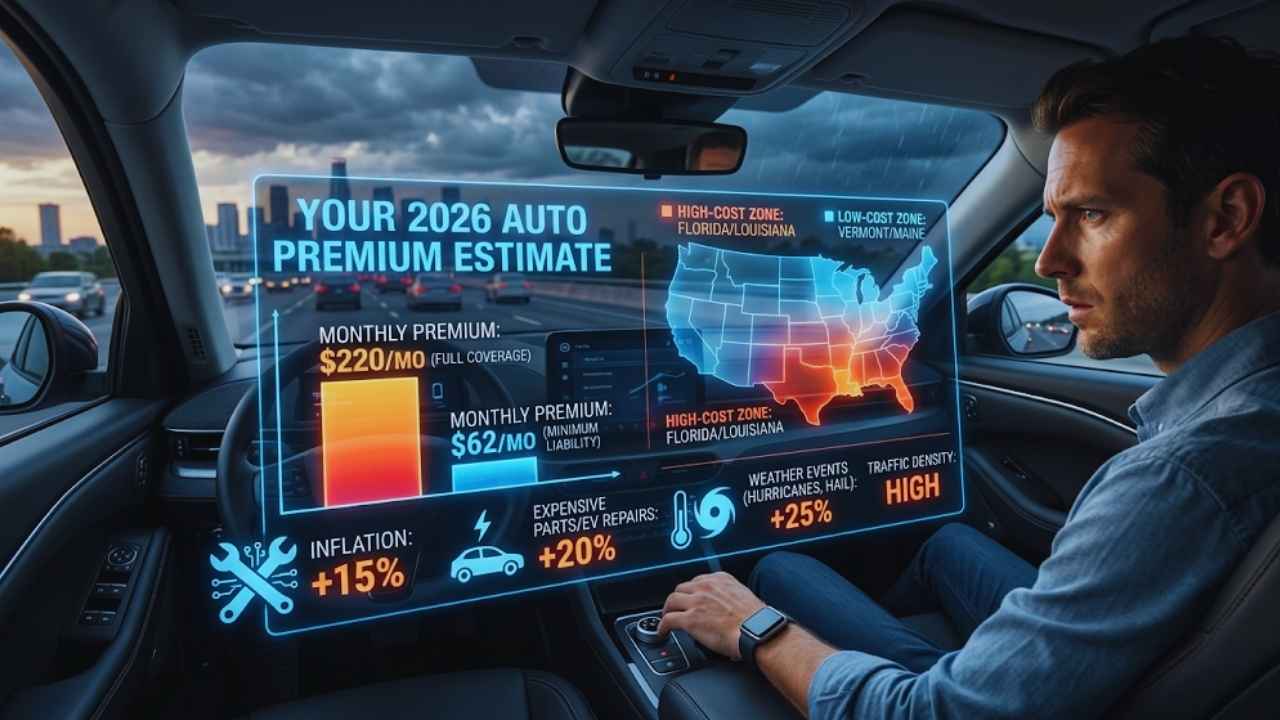
Let’s look at the hard numbers for this year. Insurance is getting significantly pricier thanks to massive inflation, unpredictable weather events, and highly expensive car parts that mechanics hate dealing with. Right now in 2026, a full coverage policy averages around $2,495 to $2,670 annually, which breaks down to about $208 to $223 a month. If you decide to strip your policy down to the bare minimum liability limits allowed by law, that price drops to roughly $722 to $773 a year, or about $60 to $64 a month.
However, looking at national averages does not mean much for your specific budget because your zip code changes everything. Drivers in quiet spots like Vermont or Maine pay as little as $1,408 to $1,624 a year for incredible coverage. Live in Florida, Louisiana, or Maryland? You might easily pay between $3,229 and $4,193 a year because of dense traffic, wild hurricanes, and a ridiculous number of uninsured drivers on the road. Even moving across town can spike your rates if your new neighborhood has higher car theft statistics.
Try messing around with the inputs below to see how these factors hit your own monthly budget:
|
State / Region |
Average Annual Full Coverage |
Why The Price Difference? |
|
Vermont (Cheapest) |
$1,539 – $1,624 |
Small population, light traffic, few severe weather claims. |
|
Maine |
$1,554 – $1,705 |
Rural roads, low accident frequency, and low uninsured rates. |
|
Florida |
$3,229 – $3,730 |
Dense traffic, tons of uninsured drivers, massive hurricane risks. |
|
Louisiana |
$3,481 – $3,919 |
High lawsuit rates, severe weather, and terrible road conditions. |
|
Maryland (Expensive) |
$2,453 – $4,193 |
Heavy traffic density, frequent claims, tough state regulations. |
Factors That Shift Your Monthly Premium
Insurers really just want to predict the future so they do not lose money. They dump your life details into a massive algorithm to calculate your personal risk level. If you look risky on paper, you pay significantly more. Age is brutal; teens pay outrageous prices because they crash constantly. For example, national data shows a 16-year-old might face full coverage premiums over $8,500 a year, whereas a 30-year-old pays closer to $2,431. Thankfully, your rates naturally drop as you hit your late twenties and bottom out completely in your fifties.
Your driving record acts exactly like a resume. Keep it clean, and you get the baseline price everyone wants. If you get a speeding ticket or cause a bad crash, expect a massive price hike. One single at-fault accident can bump your premium up by hundreds of dollars instantly, and getting a DUI can shoot your rates up by 88%. What you drive matters too. A brand-new sports car costs way more to insure than an old sedan because repair costs and theft stats are higher. Even your credit score heavily changes your bill; drivers with poor credit can pay up to $5,478 a year, which is basically double what someone with good credit pays.
|
Factor |
How It Affects Your Rate |
Typical Financial Impact |
|
Age |
Young drivers pay extreme premiums due to accident rates. |
16-year-olds can pay over $8,500 a year for full coverage. |
|
Driving History |
Tickets and crashes guarantee a massive rate hike. |
A DUI can increase your rates by almost 90%. |
|
Credit Score |
Low scores mean higher perceived risk for the company. |
Poor credit can bump your yearly bill past $5,000. |
|
Vehicle Type |
Fast, expensive, or highly stolen cars cost way more. |
Luxury EVs and heavy sports cars are the priciest to cover. |
|
Annual Mileage |
Driving less means much lower odds of actually crashing. |
Low-mileage discounts shave 5% to 10% off your total bill. |
Why Are Insurance Rates Rising in 2026?
If you are wondering why your bill creeps up every single time you renew your policy, it is mostly about modern car technology. Cars are essentially driving computers right now. A minor bumper tap ten years ago cost a mechanic $300 to fix with some plastic and cheap paint. Now, that exact same tap means you are replacing backup cameras, ultrasonic parking sensors, and radar arrays for adaptive cruise control, which easily costs $2,500 just in parts.
Beyond the tech inside the cars, severe weather is wiping out entire neighborhoods. Massive hail storms in the Midwest and relentless hurricanes on the coast mean insurers are paying out billions in comprehensive claims, and they pass those losses directly onto you. Add in the medical inflation that makes bodily injury payouts much more expensive, and you get naturally higher premiums across the entire board. Sometimes states even force higher legal minimums, meaning the cheapest baseline policy gets legally eliminated.
|
Factor |
Why It Drives Prices Up Every Year |
|
Advanced Car Tech |
Sensors and cameras make minor bumper repairs incredibly expensive. |
|
Severe Weather Events |
More floods and hurricanes mean more comprehensive payouts for insurers. |
|
Medical Inflation |
Rising healthcare costs make bodily injury accident payouts much more expensive. |
|
State Mandates |
When states force higher legal minimums, average base premiums naturally rise. |
|
Uninsured Drivers |
Honest drivers end up subsidizing the costs when uninsured people cause crashes. |
Step-by-Step Guide: How to Buy the Right Policy
You absolutely do not have to sit in a boring office to buy insurance anymore. You can handle the entire process from your couch on a Sunday afternoon. But do not just click the very first quote you see on a random website, or you will burn your own cash. The smartest way to shop in 2026 involves knowing your exact needs before you let any company run your numbers. First, you have to check your state’s minimum legal limits online so you know the baseline.
Next, look at what is sitting in your driveway. If you drive a $2,000 clunker that barely runs, do not pay $1,500 a year for full coverage because it mathematically makes zero sense. Stick to liability. If you drive a brand new SUV, you absolutely must get full coverage. Then, pick your deductible. A $500 deductible is the normal standard, but if you bump it up to $1,000, your monthly bill drops nicely. Just make sure you actually have a grand sitting in the bank in case you hit someone tomorrow. Always pull quotes from at least three different companies because Geico might want $150 a month while State Farm wants $220 for the exact same limits.
|
Step |
What You Actually Do |
Why It Heavily Matters |
|
1. Gather Your Info |
Grab your license, VIN, and current odometer reading. |
Insurers need precise data to give you an accurate quote. |
|
2. Set Your Limits |
Choose liability limits and decide on full coverage vs minimum. |
This dictates your actual financial safety net in a lawsuit. |
|
3. Compare Prices |
Pull quotes from at least three different massive companies. |
You have to shop around to find the lowest baseline rate. |
|
4. Apply Discounts |
Ask your agent directly about bundling and safe driving apps. |
It is the easiest way to permanently lower your monthly bill. |
What Happens When You File a Claim?
Paying your premium every month is incredibly easy, but actually using the coverage when you crash is incredibly stressful. If you get into a wreck, you have to prioritize your personal safety first. Move your car off the busy road if you can and immediately call the police because you absolutely need an official report to make things smooth. While you wait, snap clear pictures of everything on your phone, including both cars, the road conditions, and the license plates.
Next, you will use your insurer’s mobile app to officially file the claim. The company will assign you an “adjuster” who acts as the detective; they figure out who caused the mess and how much it costs to fix the cars. You take your damaged vehicle to the approved shop, pay your deductible directly to the mechanic, and the insurer writes a massive check for the rest of the balance. If the car is totally trashed and cannot be saved, they cut you a check for exactly what the car is currently worth on the open market, not what you originally paid for it.
|
Phase |
What Actually Happens Behind the Scenes |
Your Immediate Responsibility |
|
The Incident |
A crash, massive theft, or weather event destroys your car. |
Get to safety, call the cops immediately, and take lots of photos. |
|
Filing the Claim |
You tell the insurer you need to actually use your policy. |
Give honest, detailed facts via their app or on a phone call. |
|
The Evaluation |
An adjuster looks at who is at fault and checks repair costs. |
Cooperate fully and take the car in for an official estimate. |
|
The Resolution |
The insurer approves the payout to fix the damage. |
Pay your deductible to the shop; let the insurer pay the rest. |
Proven Strategies to Lower Your Insurance Bill
If you really want to beat the system and keep your money, you have to aggressively track down discounts because companies rarely hand them out automatically. Bundling is still the absolute king of savings. If you buy your car insurance and your homeowners or renters insurance from the exact same company, you easily save 10% to 20% on both policies immediately. It is the fastest way to slash your expenses.
You also need to look into telematics if you consider yourself a good driver. You let the insurer track your driving via a smartphone app for a few months. If you do not speed like a maniac, brake incredibly hard, or drive at 2 AM, they slash your rates based on your actual driving habits rather than just judging your age or credit score. Furthermore, if you can afford it, paying your entire six-month premium upfront instead of doing it monthly usually knocks another 5% to 10% off the total price.
|
Discount Type |
How You Actually Qualify |
Potential Expected Savings |
|
Multi-Policy (Bundling) |
Buy ‘home/renters’ and auto coverage from the exact same carrier. |
10% to 20% off your total bill |
|
Telematics / Safe Driver |
Let the insurer track your driving habits via an app in your car. |
10% to 30% off (if you drive safely) |
|
Good Student |
Keep a B average or higher in high school or university. |
10% to 15% off for young drivers |
|
Pay in Full |
Pay your entire 6-month premium upfront on day one. |
5% to 10% off the premium |
|
Multi-Car |
Insure more than one vehicle on the exact same policy. |
10% to 25% off the policy |
Final Thoughts
Dealing with auto policies definitely does not have to be a recurring nightmare every six months. When you truly grasp how car insurance works, you hold all the cards in the negotiation. You can pick the exact limits you need, easily dodge sleazy upsells from agents, and keep a lot more cash in your pocket.
Protect yourself with solid liability limits, ditch full coverage on cheap beaters, and always shop around when it is time to renew. Drive safely; aggressively track down those discounts, and you will be completely set for whatever the road throws at you this year.
Frequently Asked Questions (FAQs) About How Car Insurance Works
Can I choose my own car repair shop after an accident?
Most insurance providers actually have a pre-approved list of accredited repair shops. While some companies let you pick your own mechanic, others strongly push you toward their preferred network. If you go outside their network, you might face delays or have to cover the cost difference if your mechanic charges more than the insurer’s estimated hourly rate.
What happens if I let my policy completely lapse?
Letting your coverage expire before renewing is a massive financial mistake. You immediately lose all protection, meaning you pay entirely out of pocket if you crash your vehicle. Worse, driving without insurance is completely illegal. When you finally try to buy a new policy, companies will flag you as a high-risk driver and charge you significantly higher premiums just because you had a coverage gap.
Does my coverage follow the car or the driver?
In almost all situations, your auto policy follows the car itself. If you lend your truck to a buddy to move furniture and he crashes it, your insurance is the one that pays out the money. Consequently, that means your rates are the ones going up, not his. Never lend your vehicle to someone unless you completely trust their driving skills and are willing to take the hit on your record.
Do I need different insurance to drive for Uber or food delivery apps?
Absolutely. Standard personal policies immediately void your coverage if you use your vehicle to make money by ferrying passengers or delivering goods. You have to call your agent and add a specific rideshare endorsement or commercial policy to stay protected while working on those apps.
Can I switch my provider in the middle of my policy?
You definitely can switch providers mid-policy if you find a much better rate online. You do not have to wait for your six-month renewal date to make a move. Just be aware that your old insurer might charge a small cancellation fee for leaving early. Make absolutely sure your new policy is completely active before canceling the old one to avoid a coverage gap.