


Starting out as an independent professional feels a lot like stepping onto a massive sports pitch for your very first match. Watching legends like Sachin Tendulkar provides powerful early lessons in focus and resilience. You learn that you must believe deeply in your fundamental skills, even when the professional scoreboard is completely blank.
Every single independent worker hits this exact hurdle at the beginning. Clients want to see your past work before they hire you, but you need them to hire you so you can actually do the work. It feels completely impossible when you stare at a blank screen. You can absolutely build a highly effective freelance portfolio no experience to your name. You just have to manufacture your own opportunities. You do not need a massive roster of past clients or a fancy agency background. You just need to prove you can solve a specific, painful problem for a business. Here is exactly how you build that proof from the ground up to get your first paying client today.
The 2026 Freelance Economy Is Booming
Before you worry about your lack of past clients, you need to look at the sheer size of the current opportunity sitting right in front of you. The market is absolutely massive, and companies are desperate for reliable, fast-moving talent. In fact, nearly 72.9 million independent workers in the United States alone generated a staggering $1.5 trillion in earnings in 2025. Experts now project that the United States independent workforce will hit 86.5 million people by 2027.
Global businesses are adapting rapidly to this new reality because they need specialized problem solvers to stay competitive. Upwork, one of the biggest platforms, reported having 784,000 active clients in the first quarter of 2026. These clients spend billions annually because hiring independent talent saves them money and time. You are entering a market bursting with budget and opportunity. You just need to show them you have the exact skills they require.
|
Market Data Point |
What This Means for You |
Action Step |
|
86.5 million U.S. freelancers by 2027 |
Freelancing is a completely normal, stable career path. |
Stop treating it like a side hustle. Build professional assets. |
|
$9.91 billion global platform market |
Massive budgets exist for skilled problem solvers. |
Pick a high-value niche like web development or copywriting. |
|
784,000 active Upwork clients |
High demand means clients constantly take chances on rookies. |
Optimize your profiles to catch overflow demand. |
|
$1.5 trillion in U.S. earnings (2025) |
You can build a highly profitable business from scratch. |
Focus on solving expensive problems for businesses. |
Overcoming the Blank Slate Problem
The absolute biggest hurdle for new independent workers is completely mental. You look at established professionals with slick websites and dozens of brand logos, and you instantly feel inadequate. You have to stop comparing your day one to their day one thousand. Clients do not review your work history the way a corporate human resources manager reviews a traditional resume. When they ask for examples of your work, they are asking a very selfish, urgent question.
They want to know if you can fix their specific issue right now. If your projects answer that question with a loud yes, they will hire you on the spot. You must shift the focus entirely from what you did in the past to what you can do for them today. Building a freelance portfolio no experience requires you to stop worrying about your lack of history and start demonstrating your present capabilities. Quality beats quantity every single time, so a beginner showcase of three to five polished projects is more than enough to start pitching.
|
The Mental Hurdle |
The Reality of Hiring |
How to Fix It |
|
“I want someone with 10 years of experience.” |
They actually want someone who understands their current pain point. |
Write a detailed case study tackling a specific industry problem. |
|
“I need to see famous brand logos.” |
They just want proof that you can execute the technical work. |
Build clean, functional mock projects that work flawlessly. |
|
“My website looks completely empty.” |
Clients are busy. They want a frictionless way to check your skills. |
Post 3 deep, scannable projects. Keep the layout minimal. |
|
“Nobody will trust a beginner.” |
Clients trust transparent problem-solvers over arrogant veterans. |
Frame your work as clear solutions to common business pain points. |
Manufacture Your Own Work With Mock Projects
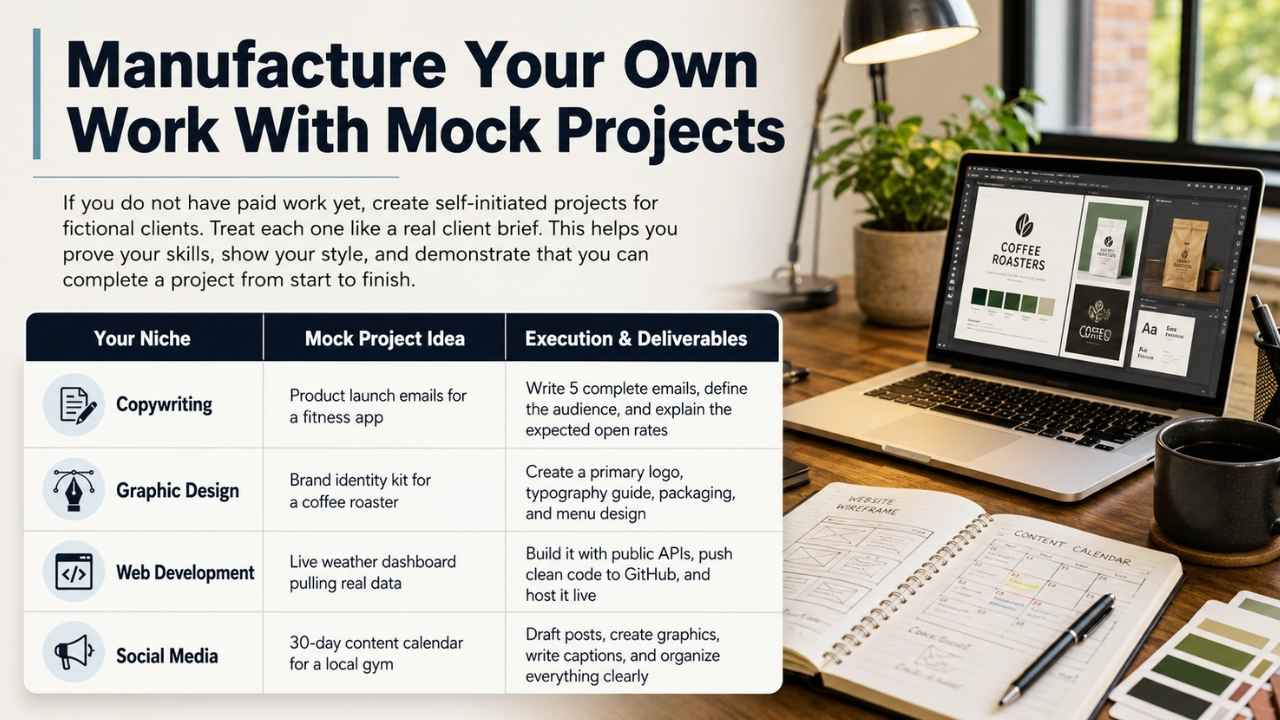
You desperately need work to show potential buyers. If nobody pays you to do the work yet, you have to do it for free on your own time. Industry professionals call this speculative work or self-initiated projects, and it is a perfectly valid way to prove your skills. Put your head down, block out all distractions, and build the foundation of your business from scratch. You control the entire process here, meaning you get to choose the perfect fake client and the exact project scope.
This allows you to show off your absolute best skills without a real-world client forcing you to make terrible design or writing choices. Experts explicitly recommend creating these personal projects for fictional clients to show your range and unique style. Just make sure you define a strict brief for yourself and treat the project with the exact same seriousness as paid work. Doing this proves to clients that you can execute complex tasks from start to finish without needing hand-holding.
|
Your Niche |
Mock Project Idea |
Execution & Deliverables |
|
Copywriting |
Product launch emails for a fitness app. |
Write 5 complete emails. Detail the audience and expected open rates. |
|
Graphic Design |
Brand identity kit for a coffee roaster. |
Create a primary logo, typography guide, packaging, and menu design. |
|
Web Development |
Live weather dashboard pulling real data. |
Build using public APIs, push clean code to GitHub, and host it live. |
|
Social Media |
30-day content calendar for a local gym. |
Draft posts, create graphics, write captions, and organize them well. |
The Power of the Proactive Redesign
If creating something out of thin air feels too intimidating right now, you should start by fixing something that already exists. The internet is absolutely packed with terrible websites, clunky mobile applications, and incredibly boring blog posts. You can find them, fix them, and put the stunning results straight into your freelance portfolio no experience or not. This strategy shows massive initiative and raw hustle to potential clients.
It proves you can independently identify a glaring weakness, strategize a smart fix, and execute the improvement flawlessly. For example, if you are a user experience designer, find a popular app where the checkout process is frustratingly slow and redesign those specific screens to reduce friction. Just ensure you clearly state this was an unsolicited redesign and not official client work. Show the ugly original right next to your polished version so the stark contrast does all the heavy selling for you.
|
Redesign Target |
What to Look For |
How to Present It |
|
Local Websites |
Outdated layouts, terrible mobile responsiveness. |
Large, side-by-side screenshots highlighting your targeted updates. |
|
Articles/Blogs |
Massive blocks of text, zero SEO structure. |
Link to the original alongside your clean, optimized rewrite. |
|
Brand Logos |
Overly complex, pixelated local business artwork. |
A modern brand style guide showing the new logo on merchandise. |
|
Video Editing |
Sluggish pacing, poor color grading on a vlog. |
A split-screen video showing the original cut versus your dynamic edit. |
Leverage Volunteer Gigs and Open Source
Sometimes you strongly prefer working with real constraints, actual human feedback, and hard deadlines. If that is the case, you should look into volunteering your skills for a short period. Many local non-profits, community groups, and small charities desperately need professional help but completely lack the budget to hire expensive agencies. You can offer your services for a specific, strictly time-boxed project to gain real experience.
Never offer unlimited free work, but instead tell them you will build a specific three-page website or write a single email sequence. Treat these organizations exactly like high-paying clients to build your professional habits. In exchange, you get a real-world project, a powerful written testimonial, and measurable results to show future prospects. Software developers can also contribute to open-source projects on platforms like GitHub to leave a highly public trail of their coding competence.
|
Unpaid Strategy |
Expected Time Commitment |
Core Portfolio Benefit |
|
Local Charities |
1 to 2 weeks (keep the scope fixed). |
Real-world constraints, strong community testimonials. |
|
Open Source (GitHub) |
Ongoing and highly flexible. |
Rigorous peer review and proven ability to code collaboratively. |
|
Friends & Family |
Weekend sprint project. |
Low pressure, fast turnaround, and incredibly easy communication. |
|
Online Hackathons |
48 hours of intense focus. |
Forces rapid problem-solving and delivers a finished product quickly. |
Write Compelling Case Studies Using the STAR Method
A massive mistake beginners make is dropping a final image onto a webpage and calling it a finished portfolio. The final product only tells half the story, and the client desperately needs to know how your brain works. You absolutely must write detailed case studies for every single project you upload. Break down the initial problem, your strategic approach, and the final result clearly.
Industry experts highly recommend using the STAR method for project descriptions, which stands for Situation, Task, Action, and Result. Even if the project is entirely fake, you can thoroughly explain the fictional constraints you set for yourself. Make it highly scannable with bullet points so busy clients can read it in under sixty seconds. Writing strong case studies transforms a basic freelance portfolio no experience asset into a compelling story of professional problem-solving.
|
The STAR Method |
What You Must Include |
Why Clients Care |
|
Situation (Problem) |
The core challenge you set out to solve. |
Shows you understand overarching business goals. |
|
Task (Your Role) |
Your specific responsibilities. |
Clarifies exactly what parts of the project you owned. |
|
Action (Process) |
How you solved the problem entirely. |
Proves you have a repeatable, professional workflow. |
|
Result (Outcome) |
Intended impact or real metrics. |
Shows you care deeply about return on investment. |
Choose the Right Platform for Your Portfolio
You absolutely do not need to spend three weeks coding a custom website from scratch unless you actually sell web development services. Your online showcase just needs to be clean, fast, and incredibly easy for a stranger to navigate. Keep the overall design minimalist so your actual work stands out loudly. Remove any friction for the user and make sure your contact information is highly visible on every single page.
A confused potential client will simply close the tab and hire someone else within seconds. Platforms like Behance are incredible for visual creatives, while Upwork allows you to manually build a showcase directly on your profile. Writers and business strategists can easily use a tool like Notion to build a clean, text-forward presentation in under an hour. Pick a platform that fits your exact niche, get your projects uploaded today, and start pitching clients with confidence.
|
Portfolio Platform |
Best Suited For |
Key Advantage |
|
Behance / Dribbble |
Graphic Designers, UI/UX, Illustrators. |
Built-in audience of clients actively searching for creative talent. |
|
Upwork Native |
All independent niches. |
Direct integration with job proposals and verified client feedback. |
|
Notion |
Writers, Marketers, Strategists. |
Extremely fast to build; handles text and embedded links beautifully. |
|
Carrd / Webflow |
Web Developers, specialized agencies. |
Shows off technical skills natively; offers ultimate SEO control. |
Final Thoughts
Building an independent business from scratch demands intense patience and a refusal to wait for permission. You are actively proving your worth in real-time by creating your own opportunities instead of waiting for a lucky break. By creating highly targeted mock projects, proactively redesigning existing bad work, and documenting your exact process through smart case studies, you completely bypass the traditional corporate gatekeepers.
You do not need anyone to tell you that you are ready to start doing the work. You simply do it, clearly display it, and confidently pitch it to the people who need your help the most. Execute these exact steps, adapt to current market demands, and your freelance portfolio no experience hurdle will quickly become a thing of the past. Stay focused, trust your fundamental skills, and start building your assets today.
Frequently Asked Questions (FAQs) About Freelance Portfolio no Experience
Can I use work I did at my 9-to-5 job?
Yes, but check your employment contract first. Some companies own everything you produce. If you get the green light, specify your exact role. If you were part of a team, never claim you did the whole thing yourself.
How do I handle NDAs (Non-Disclosure Agreements)?
Write a “blind” case study. Strip out the brand name, exact financials, and logos. Call them “a mid-sized tech startup” and talk about the general problem you solved.
Should I list my prices on my portfolio?
Leave them off when you start. Get clients on a call to understand their budget and prove your worth. Listing prices too early usually scares people away before you even pitch.
Can I put mock projects on an Upwork profile?
Absolutely. Upwork explicitly allows mock-ups or personal projects. Just add a quick note in the description that it is a spec project, not paid client work.