


Ever stare at an app you use every day for free and think about how those developers keep the lights on? I used to wonder the exact same thing. You tap a screen and get endless entertainment without spending a single dime. It feels like absolute magic. But behind the scenes, a very deliberate engine is pulling the strings.
A company’s survival comes down to one critical thing. They need a realistic blueprint for generating cash. If you do not nail this down, you do not have a business. You just have a very expensive hobby. Whether you are launching a startup, investing in stocks, or just trying to decode the corporate world, you need to understand how the money actually flows. By the time you finish reading, you will have all the common business models explained. I am giving you a crystal-clear look at how today’s biggest brands make money, cover their costs, and keep investors happy in a fast-moving economy.
What Exactly Is a Business Model?
Let’s strip away the corporate jargon right now. A business model is not some massive document stuffed with pie charts that nobody reads. It is simply the core mechanism of how a company creates, delivers, and captures value. Think of it as answering a few direct questions. What are you selling? Who is buying it? How do you get them to pay more than it costs you to make it?
When a company drops a new product, this underlying model dictates everything from pricing to marketing to keeping customers around. A solid framework lays out your value proposition, your target audience, your costs, and your revenue streams. You could build a killer product right now. But if you price it wrong or pitch it to people with no budget, you will crash and burn. You need a clear map of how cash enters and exits your bank account. Without it, you are just guessing.
|
Component |
What It Actually Means |
Real-World Example |
|
Value Proposition |
Why someone should care about your product. |
We make project management less annoying. |
|
Target Market |
The specific group of people with the money and desire to buy. |
Freelance graphic designers making over $50k a year. |
|
Cost Structure |
Every expense required to keep the business running. |
Server costs, employee salaries, advertising spend. |
|
Revenue Stream |
How the cash actually enters your bank account. |
A $15 monthly recurring charge. |
Why Your Strategy Dictates Your Survival?
You might have the best software in the world. But if your strategy to monetize it is broken, your company will eventually fold. A lot of startups crash not because their code was buggy, but because the math just did not work. If you drop $100 on Facebook ads to acquire a customer who only spends $10 with you, you run a charity. Nailing down your strategy ensures total alignment across your team. Your sales reps know exactly who to target. Your product team builds features that actually matter to paying users.
And your investors see exactly how you plan to give them a return. I have sat through pitches where founders rely on the hope that they will figure out the money later. That might have worked a decade ago when venture capital flowed freely. Today, you need a realistic plan on day one. You have to track specific metrics to know if your engine works. Industry benchmarks in 2026 show a healthy startup aims for a Lifetime Value to Customer Acquisition Cost ratio of 3 to 1. Spend a dollar to get a customer, make three dollars back over time. Anything lower, and you bleed cash.
|
Warning Sign |
What It Means |
How to Fix It |
|
High Customer Acquisition Cost |
You spend too much money just to get one person to buy. |
Shift to organic marketing or increase the product price. |
|
Low Lifetime Value |
Customers buy once and never come back. |
Introduce a subscription or upsell complementary products. |
|
Thin Profit Margins |
Your costs to deliver the product eat up all the revenue. |
Automate services, cut overhead, or negotiate cheaper materials. |
|
Poor Conversion Rates |
People visit your site but leave without purchasing. |
Improve your sales copy and streamline the checkout process. |
Common Business Models Explained: The Core Blueprints
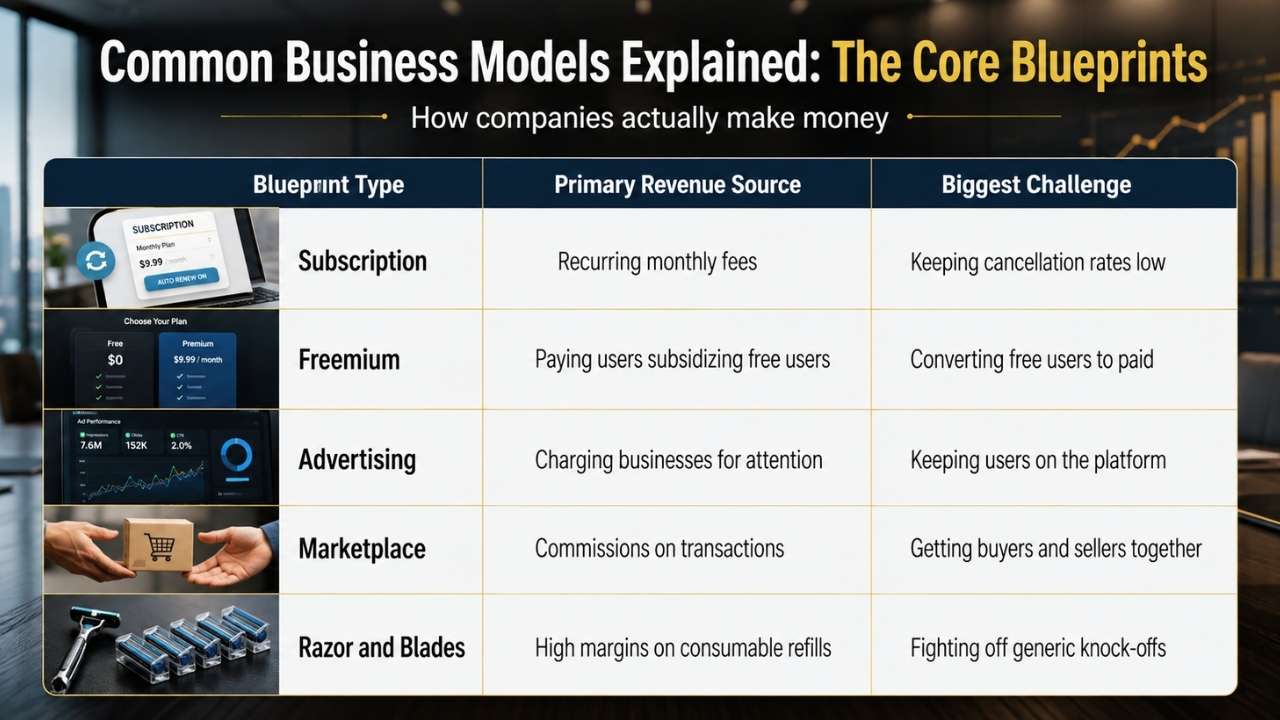
This is where the rubber meets the road. I want to break down the actual frameworks companies use to get you to open your wallet. There are dozens of variations out there. But most successful brands rely on a handful of proven blueprints. Let’s dive into how these operations actually work in the real world.
We will look at hard numbers and current market data. Understanding these specific structures separates the amateurs from the professionals. I will show you exactly where the cash comes from for each approach.
|
Blueprint Type |
Primary Revenue Source |
Biggest Challenge |
|
Subscription |
Recurring monthly fees |
Keeping cancellation rates low |
|
Freemium |
Paying users subsidizing free users |
Converting free users to paid |
|
Advertising |
Charging businesses for attention |
Keeping users on the platform |
|
Marketplace |
Commissions on transactions |
Getting buyers and sellers together |
|
Razor and Blades |
High margins on consumable refills |
Fighting off generic knock-offs |
The Subscription and SaaS Model
Instead of selling you a product once, a company charges a recurring fee to access a service. You pay continuously for access, not ownership. Cloud-based software companies call this Software as a Service. Predictable, recurring revenue makes this approach incredibly attractive. If a company has 10,000 subscribers paying $10 a month, they know $100,000 is hitting the bank next month.
This makes hiring and financial planning incredibly easy. The hardest part is managing the churn rate, which is the percentage of users who cancel. If people do not see continuous value, they leave. The global SaaS market hit a massive valuation of $375.57 billion in 2026. At the same time, customer acquisition costs skyrocketed. The industry average cost to acquire a new customer reached $702 this year. Best-in-class software companies push hard to keep their monthly churn low because replacing lost users is more expensive than ever.
|
SaaS Metric |
2026 Industry Standard |
What It Means For Founders |
|
Global Market Size |
$375.57 Billion |
The industry is massive and still growing rapidly. |
|
Average CAC |
$702 per customer |
Marketing and sales expenses are extremely high right now. |
|
LTV to CAC Ratio |
3 to 1 |
You must make three times what you spend to acquire a user. |
|
Annual Churn Rate |
5 to 7 percent |
Most businesses lose a small chunk of their user base yearly. |
The Freemium Model
You offer a basic version of your product entirely for free. Then you charge for premium features, extra storage, or removing ads. The free version acts as a massive marketing funnel. The goal is to hook millions of users, knowing a tiny percentage will actually pull out their credit cards. It drops the barrier to entry to absolute zero. People love free stuff, so user growth can explode overnight.
The catch is that paying users have to generate enough cash to subsidize all the free users. If your server costs for free users spike too high, you go bankrupt very fast. Converting those free users into paying customers requires constant testing and feature updates. You have to find the exact line between giving away enough to be useful, but not giving away everything. Slack and Dropbox built billion-dollar empires using this exact strategy.
|
Freemium Factor |
Detailed Explanation |
Real-World Example |
|
Primary Revenue |
A small slice of paying users upgrading for better features. |
Spotify Premium users paying to skip advertisements. |
|
Biggest Hurdle |
Balancing free features so they are useful, but not complete. |
Giving users 5GB of free storage, then charging for 100GB. |
|
Key Metric |
The free-to-paid conversion rate. |
Tracking how many free users upgrade within 30 days. |
|
Growth Driver |
Word-of-mouth marketing fueled by zero entry cost. |
Coworkers inviting each other to a free Slack workspace. |
The Advertising and Attention Model
You offer a free product, gather a massive audience, collect data on them, and then charge other businesses for the right to show them ads. You are not selling a product to the user. You are selling the user’s attention to advertisers. This approach scales infinitely. Once you build the platform, adding more users just means you can charge more for ad space.
The hard part is that you need millions of active users before advertisers will even take your calls. You rely entirely on keeping people glued to their screens. Algorithms constantly shift to maximize watch time and engagement. If a new app steals your users’ attention, your ad revenue drops immediately. Meta and YouTube are the ultimate examples of this attention economy in action.
|
Advertising Factor |
Detailed Explanation |
Core Focus |
|
Revenue Source |
Selling targeted screen time to other businesses. |
Cost per click or cost per thousand impressions. |
|
Biggest Challenge |
Fighting algorithm changes and keeping user attention. |
Retaining daily active users against new competitors. |
|
Core Asset |
Deep user data and behavioral insights. |
Knowing exactly what products a user wants to buy. |
|
Scale Requirement |
Millions of users needed to attract large ad budgets. |
Reaching a critical mass of daily engagement. |
The Marketplace Model
You do not own any inventory or provide the service yourself. Instead, you build a digital platform that connects buyers with sellers and take a percentage cut of every transaction. You act entirely as the middleman. You provide trust, secure payment processing, and basic customer support. Companies love this because there are zero inventory costs.
You do not have to build cars or buy houses. You just connect people with a need to people with a supply. The global digital marketplace generated substantial revenue, projected to hit $748.6 billion in 2026. But solving the cold start problem is brutal. Buyers will not use the app if there are no sellers. Sellers will not sign up if there are no buyers. You have to spend heavily to subsidize one side of the network until it balances out. Airbnb and Uber proved this model works globally.
|
Marketplace Metric |
Industry Data & Strategy |
Execution Focus |
|
2026 Market Size |
$748.6 Billion globally |
High demand for platform-based digital commerce. |
|
Primary Revenue |
A percentage commission on every sale. |
Setting the right take rate to keep sellers happy. |
|
Biggest Hurdle |
Getting both buyers and sellers to show up at the same time. |
Subsidizing supply until organic demand kicks in. |
|
Advantage |
Scaling globally without buying physical inventory. |
Expanding into new cities using localized marketing. |
The Razor and Blades Model
You sell a core product at a massive discount, sometimes at a loss, just to lock the customer into your ecosystem. Then you charge a massive markup on the necessary consumable parts. The initial purchase is simply bait. The real money hides in the frequent refills. This creates a deeply captive audience. Once someone buys the base unit, they are forced to keep buying your specific refills to make it work.
Competitors will aggressively try to make generic, cheaper refills that fit your base unit. You have to rely on patents, complex designs, or proprietary computer chips to block them. If you lose the refill business, the whole company collapses because the base unit loses money. Gillette practically invented this with cheap razors and expensive blades. HP does the exact same thing today with dirt-cheap printers and incredibly expensive ink cartridges.
|
Razor & Blades Factor |
Detailed Explanation |
Real-World Application |
|
The Bait |
Selling the core hardware at a significant loss. |
Buying a brand-new printer for under fifty dollars. |
|
The Hook |
High profit margins on consumable, required refills. |
Paying sixty dollars for a tiny black ink cartridge. |
|
Biggest Threat |
Fighting off generic third-party knock-offs. |
Off-brand coffee pods that fit into a Nespresso machine. |
|
Customer Dynamic |
High lock-in effect once the initial purchase happens. |
Customers refuse to buy a new base unit to switch brands. |
The Affiliate and Creator Model
You promote other people’s products on your website, blog, or social media pages. When someone clicks your special tracking link and makes a purchase, you get a small cash commission. You drive the traffic and build the trust. The seller handles the physical inventory, global shipping, and all customer service complaints. This requires extremely low startup costs.
You just need a laptop, decent internet, and the ability to grab attention online. But you are completely at the mercy of search engine algorithms and the seller’s commission rates. If a partner slashes their affiliate payouts, your monthly income drops overnight. This space is highly competitive and requires constant content creation to stay relevant. Travel bloggers and product review websites rely heavily on this exact setup.
|
Affiliate Factor |
Detailed Explanation |
Strategy Focus |
|
Primary Revenue |
Small percentage commissions for driving successful sales. |
Recommending high-ticket items for larger payouts. |
|
Biggest Hurdle |
Relying entirely on SEO algorithms and platform reach. |
Diversifying traffic sources across video and text. |
|
Best Fit For |
Content creators, niche bloggers, and product reviewers. |
Building deep trust with a highly specific audience. |
|
Cost Advantage |
Zero inventory, shipping, or customer service overhead. |
Operating a highly profitable business from a laptop. |
Direct-to-Consumer (D2C) Retail
Instead of selling your physical products wholesale to big-box stores, you sell them directly to the end customer via your own website. You control the entire supply chain, from manufacturing to the final unboxing experience at the customer’s front door. This gives you vastly better profit margins because there is no corporate middleman taking a cut. You also keep all the first-party customer data, which is crucial for targeted email marketing.
However, you have to handle all the grueling logistics, expensive shipping costs, returns, and customer service yourself. Global e-commerce sales reached a staggering $6.88 trillion in 2026. Capturing a tiny slice of that market can build a massive brand. But rising shipping costs and warehouse fees constantly eat into those sweet profit margins. Warby Parker and Gymshark built massive audiences by cutting out traditional retail stores.
|
D2C Retail Metric |
Industry Reality |
Strategic Value |
|
2026 Market Size |
$6.88 Trillion in global e-commerce sales |
Massive online spending habits drive direct purchases. |
|
Primary Revenue |
Direct online sales with zero wholesale markup. |
Keeping a larger percentage of the final retail price. |
|
Biggest Hurdle |
Managing complex physical supply chains and shipping. |
Negotiating bulk rates with major shipping carriers. |
|
Core Advantage |
Total control over brand identity and customer data. |
Building loyalty programs and direct email lists. |
Open-Source Monetization
You write code, build software, and give it away entirely for free. Developers everywhere can download it, modify it, and use it without paying a dime. Since the core software is completely free, you make your money by charging massive enterprise companies. You sell them premium security patches, custom features, dedicated cloud hosting, and around-the-clock technical support. It drives massive, rapid adoption within the global developer community.
The open-source service market size hit roughly $44.12 billion in 2026. A massive 98 percent of organizations increased or maintained their open-source usage recently. The hardest part is converting those happy free users into paying corporate clients before you run out of startup funding. Red Hat and WordPress built massive corporate valuations using this exact path.
|
Open-Source Factor |
2026 Market Reality |
Execution Strategy |
|
2026 Market Size |
$44.12 Billion to $45 Billion |
High demand for reliable enterprise support services. |
|
Primary Revenue |
Enterprise tech support and premium cloud hosting. |
Signing multi-year contracts with massive corporations. |
|
Adoption Rate |
98 percent of orgs maintain or increase usage |
Code spreads rapidly because there is no paywall. |
|
Biggest Hurdle |
Generating enough paid clients to support free developers. |
Proving that free software requires paid security oversight. |
The Hidden Machinery: Hybrid Ecosystems
Once you see common business models explained in action, you will realize tech giants never rely on just one. The biggest companies layer multiple strategies on top of each other to build massive economic moats. Look closely at Amazon. They started as a simple direct-to-consumer retailer selling books out of a garage. Today, they are a hybrid monster dominating multiple sectors. They still do traditional retail. But they also run a massive digital marketplace where third-party sellers pay them a huge cut.
They run a massive subscription business via Amazon Prime. They run a booming advertising platform for sponsored products. And they run a massive cloud computing service. Apple operates the exact same way. They sell premium hardware directly to you. Then they take a cut of every single app you buy. Finally, they lock you in by selling you music and digital storage. By layering these strategies, companies ensure that if one revenue stream takes a hit, the others carry the heavy weight.
|
Tech Giant |
Original Core Model |
Layered Secondary Models Today |
|
Amazon |
Direct Retail |
Subscriptions, Marketplace, Advertising, Cloud Services |
|
Apple |
Direct Hardware Retail |
Digital Marketplace, Cloud Subscriptions |
|
|
Freemium Networking |
Advertising, Premium Subscriptions, B2B Recruiting |
|
Spotify |
Freemium Audio |
Premium Subscriptions, Podcast Advertising |
How to Choose the Right Strategy for Your Startup?
When looking at business structures in textbooks, you might think you can just pick one out of a hat. You absolutely cannot do that. The model has to perfectly match the reality of what you are selling and who you are selling it to. First, look closely at your available capital. If you want to start a heavy manufacturing company, you need a ton of cash up front for raw materials and factory space. If you want to start an affiliate blog, you need almost zero cash.
Second, figure out your customer’s actual willingness to pay. If you build a tool that helps people find funny internet memes, nobody is paying a twenty-dollar monthly subscription for that. You have to use an ad-based or freemium approach. But if you build an artificial intelligence tool that saves an accounting firm fifty thousand dollars a year, you can easily charge a massive recurring fee. Match your pricing strategy directly to the pain point you solve. Do not force a subscription on a product people only need to buy once.
|
If Your Product Is… |
You Should Probably Use… |
Because… |
|
High-value B2B software |
Subscription model |
Businesses expect to pay recurring fees for tools that save time. |
|
A consumer social media app |
Advertising model |
Consumers rarely pay for social apps directly. |
|
A physical consumer good |
Direct-to-Consumer model |
You keep higher margins without splitting profits with stores. |
|
A two-sided service network |
Marketplace model |
You do not carry inventory, you just facilitate the connection. |
Final Thoughts
Getting these common business models explained is not just a theoretical exercise for a college classroom. Understanding these strict frameworks gives you a completely different lens to view the commercial world. Next time you sign up for a free trial, buy a cheap printer, or book a ride on your phone, you will know exactly how the underlying math works. If you are an entrepreneur, remember that you do not need to reinvent the wheel.
The most successful founders pick a proven structure, apply it to a brand new niche, and execute it relentlessly. Focus on creating real value every single day. Keep your customer acquisition costs significantly lower than your lifetime value. Choose the specific strategy that makes the absolute most sense for your exact target audience. If you nail the mechanics, the revenue will naturally follow.
Frequently Asked Questions (FAQs) About Common Business Models Explained
Why do some startups offer “lifetime deals” if it hurts recurring revenue?
Sometimes early-stage software companies offer their tool for a one-time fee of $99 for life, instead of charging $10 a month. They do this to generate a rapid influx of upfront cash to fund their development. It’s a short-term survival tactic to get off the ground; they almost always switch to a subscription model later.
Do “free shipping” models eat into profit margins completely?
Yes, logistics are incredibly expensive. Companies that constantly offer “free shipping” usually just bake the average cost of shipping into the retail price of the product. If a shirt costs $10 to make and $5 to ship, they simply price the shirt at $25 and call the shipping “free.”
How do free messaging apps like WhatsApp actually generate cash?
WhatsApp doesn’t run traditional display ads in your personal chats. Instead, Meta makes money by charging medium and large businesses to use the WhatsApp Business API. If an airline wants to automatically send your boarding pass via WhatsApp, they pay Meta for that privilege.