


I remember watching Sachin Tendulkar at the crease years ago. The intense focus and unshakeable resilience taught me early on that true performance isn’t about where you stand. It is entirely about how you execute under pressure. In our daily grind, that translates directly to how we manage our time, energy, and location.
You don’t need a cubicle to be dialed in and deliver exceptional results. If you want to drop the daily commute and bring that level of focus to your home office, you need a solid game plan. Getting a “yes” when you ask to work remotely is never about crossing your fingers or relying on luck. It’s about building a business case your boss can’t ignore or refute. Honestly, your manager doesn’t care about your commute time, your gas bill, or your pet. They care about output, communication, and team results. To win them over, you must frame your request entirely around how workplace flexibility helps the company win big.
Read the Room Before You Pitch
You can’t just walk into a meeting and drop a massive schedule request out of nowhere. Managers despise surprises, and they hate perceived workplace risks even more. Before you even think about scheduling the conversation, you must do some serious corporate digging. Look closely at your company’s current policies and the overarching industry climate. Are other people on your team already working from home successfully?
Did leadership just mandate a strict return to the office that you have to navigate around? You absolutely need to know what you are up against before you open your mouth. Next, take a hard, objective look at your own professional track record. You need undeniable leverage to make this work. If you blew a major deadline last month, now is definitely not the time to push for a schedule change. Wait for a big win, like closing a huge sale or shipping a massive content project ahead of time.
|
Preparation Step |
Action to Take |
Why It Works |
|
Policy Check |
Read the employee handbook and observe team schedules. |
Shows you the baseline rules you have to work with or around. |
|
Track Record |
Write down your top 3 recent wins and metrics. |
Proves you get things done without someone hovering. |
|
Timing |
Pitch immediately following a successful project launch. |
Rides the wave of your manager’s high confidence in you. |
|
Market Data |
Find current stats on remote work output in your field. |
Turns subjective feelings into hard business facts. |
How to Ask to Work Remotely: The Step-by-Step Playbook
When your timing is perfect and you have your performance data ready, you need to set up the actual conversation. Please don’t do this over a quick Slack message or mention it casually by the coffee machine. You need a dedicated, focused meeting on the calendar to show you are taking this seriously. Send a short, professional email asking for fifteen minutes to discuss working styles and upcoming quarterly goals. During the chat, lead immediately with your value and highlight a recent, measurable win.
Then, go straight into the pitch by stating that you get your best deep work done when you have uninterrupted time. Tell them you want to shift your schedule to two days a week at home starting next month to focus entirely on core metrics. Notice the psychology here: you state an observation, make a direct request, and tie it straight to a tangible business win. Then, stop talking completely and let them process the information. People naturally try to fill awkward silence with rambling excuses about traffic, but you must make the pitch and wait quietly.
|
Step |
Action |
How to Execute |
|
1. The Invite |
Book a formal meeting. |
Ask for a 1-on-1 specifically about workflow optimization. |
|
2. The Hook |
Highlight a win. |
Remind them of a project you just nailed. |
|
3. The Pitch |
Make the request. |
State the exact days you want at home and the business goal it serves. |
|
4. The Silence |
Stop talking immediately. |
Give your manager space to process without over-explaining. |
Draft a Bulletproof Remote Work Proposal
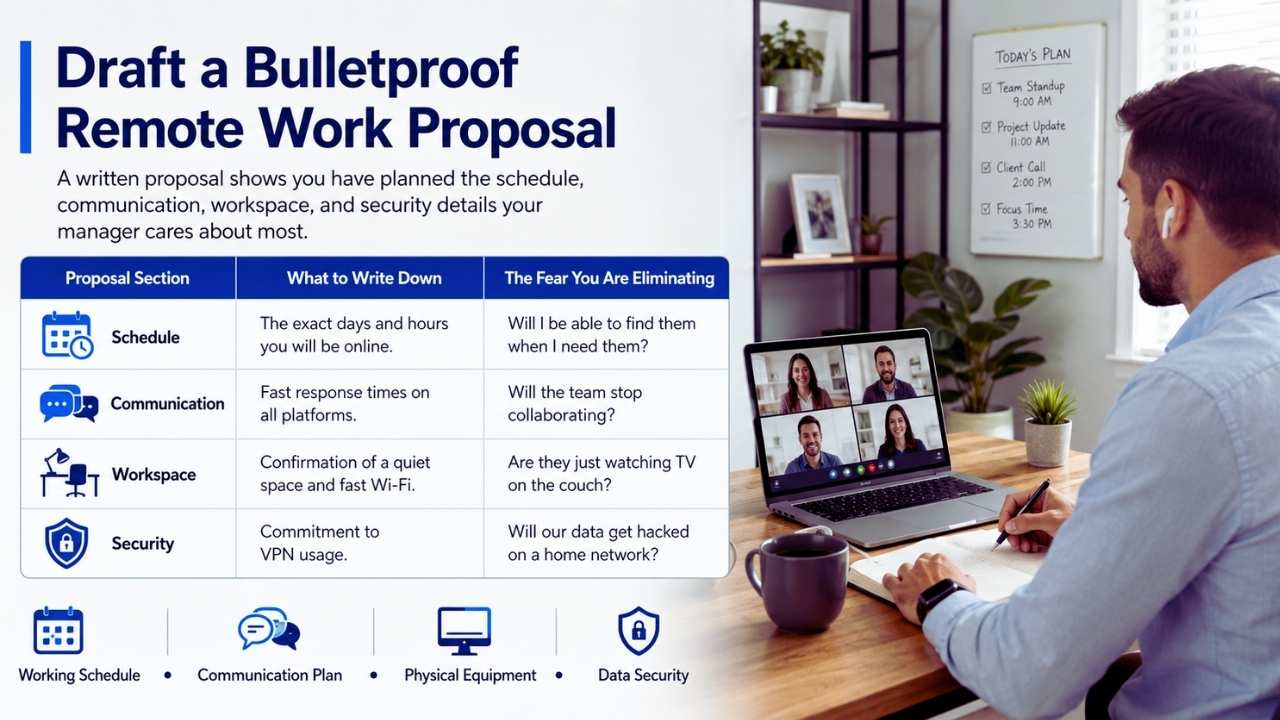
Talking through your ideas is great, but a written proposal is what actually gets the green light from upper management. Handing over a physical, one-page document shows you mean business and separates you from people just complaining about their drive. It proves you have thought through the exact daily logistics that keep your boss awake at night. Your proposal needs to hit four main areas: your working schedule, your communication plan, your physical equipment, and data security.
First, lock down your hours by specifying if you are working the standard nine-to-five or if you need asynchronous hours. Next, outline exactly how you will communicate, as this is always a manager’s biggest fear. Tell them exactly how to reach you, set guaranteed response times for emails, and promise to keep your camera on during virtual meetings. Wrap it up by confirming you have fast internet, a quiet room, and a strict commitment to use the company VPN for security.
|
Proposal Section |
What to Write Down |
The Fear You Are Eliminating |
|
Schedule |
The exact days and hours you will be online. |
“Will I be able to find them when I need them?” |
|
Communication |
Fast response times on all platforms. |
“Will the team stop collaborating?” |
|
Workspace |
Confirmation of a quiet space and fast Wi-Fi. |
“Are they just watching TV on the couch?” |
|
Security |
Commitment to VPN usage. |
“Will our data get hacked on a home network?” |
Field Your Boss’s Objections Like a Pro
No matter how flawless your written proposal is, you must expect some pushback when you ask to work remotely. Managers mitigate company risk for a living, and changing how an employee works always feels like a risk to them. The secret is to anticipate their arguments before the meeting and have calm, factual answers ready to go. If they say they need you in the office to collaborate, pivot smoothly and tell them you will stack all collaborative meetings on your office days.
If they worry that letting you work from home means they have to let everyone do it, keep the spotlight strictly on your specific job duties. Remind them that your current role requires heavy data analysis or intense writing, which demands a quiet space away from office chatter. Suggest treating your arrangement as an isolated pilot program designed just for your specific workflow. If they worry about visibility, offer to send a fast, three-bullet email every day at closing time listing exactly what you accomplished.
Read Also: How to Work Remotely from Anywhere: Digital Nomad Guide 2026
|
What the Boss Says |
How You Respond |
|
“We need you here to collaborate.” |
“I will schedule all group meetings strictly for my office days.” |
|
“It’s unfair to the rest of the staff.” |
“My current project needs deep focus that differs from standard tasks.” |
|
“I won’t know what you are doing.” |
“I’ll send a fast, three-bullet update at 5 PM daily showing completed tasks.” |
|
“Our team culture will suffer.” |
“I will never miss an all-hands meeting or a team social event.” |
Pitch a Low-Risk Trial Period
Sometimes, you just can’t get an immediate, permanent approval due to rigid company politics or a stubborn executive team. If you feel a flat rejection coming, you need to pivot instantly to a compromise so you don’t leave the room empty-handed. Proposing a short trial run drastically lowers the stakes for everyone involved. It magically turns a permanent policy shift into a safe, temporary, and easily reversible experiment.
Try telling your manager that you understand their reservations and suggest trying the new schedule for just thirty days. Promise that you can set exact performance metrics, and if your output drops at all, you will come right back to the office full-time. It is incredibly hard for a logical manager to reject a low-risk, measurable test that has a clear out for them. If you get the green light for this trial, you have to over-perform, answer messages instantly, and turn in all your work early.
|
Trial Phase Element |
The Strategy |
The Ultimate Goal |
|
Timeframe |
Pitch a strict 30-day window. |
Make it feel temporary and reversible. |
|
Metrics |
Agree on 2 clear KPIs to measure. |
Prove with numbers that you didn’t slack off. |
|
Check-ins |
Do a quick weekly review. |
Fix communication hiccups before they ruin the trial. |
|
The Review |
Schedule the final evaluation immediately. |
Guarantee a clear path to making it permanent. |
Final Thoughts
Scoring a flexible schedule changes your entire life by buying back your hours and guarding your daily focus. It gives you total control over your day, but you have to remember that flexibility is a privilege earned through hard work. You have to earn this perk because workplace flexibility consistently goes to the people who deliver undeniable results. Build your pitch on hard market data, expect the inevitable pushback, and make sure every point you make highlights how the business wins.
Stick to this proven playbook, leave your personal emotions at the door, and present a rock-solid business case. When you ask to work remotely, you are essentially pitching yourself as an independent, high-value asset to the company. Take the time to draft that written proposal, time your conversation perfectly, and go get your personal time back. The freedom of a home office is entirely within your reach if you treat the negotiation like a true professional.
Frequently Asked Questions (FAQs) About Negotiating Location Independence
What if I need to work from home for medical reasons?
This changes the game. Under the Americans with Disabilities Act (ADA), working from home can be a reasonable accommodation. Don’t just ask your boss casually. Go straight to HR with a written proposal explaining how your medical situation requires a home office. You will need to show you can still do the core functions of your job, and you should bring medical documentation.
What if my boss is a massive micromanager?
Micromanagers act out of anxiety. Cure their anxiety with overwhelming transparency. Set up a project management dashboard (like Trello or Asana). Track every single task in real-time. Give them the login so they can watch your progress without standing behind your chair.
Can I pitch this if I just started a new job?
Unless you negotiated it during the interview, wait at least 90 days. You have to build trust first. Your manager needs to see your work ethic in their native environment before they let you take it off-site.
Should I bring up how much the commute hurts my mental health?
Be careful here. Mental health matters, but businesses run on the bottom line. Reframe the commute problem around energy and output. Global data shows remote workers save about 72 minutes a day skipping the drive, and they pour 40% of that time right back into their work. Tell your boss, “By skipping the traffic, I can log on at 8 AM sharp with a full tank of energy, knock out our biggest accounts, and give that extra hour straight back to the team.”