

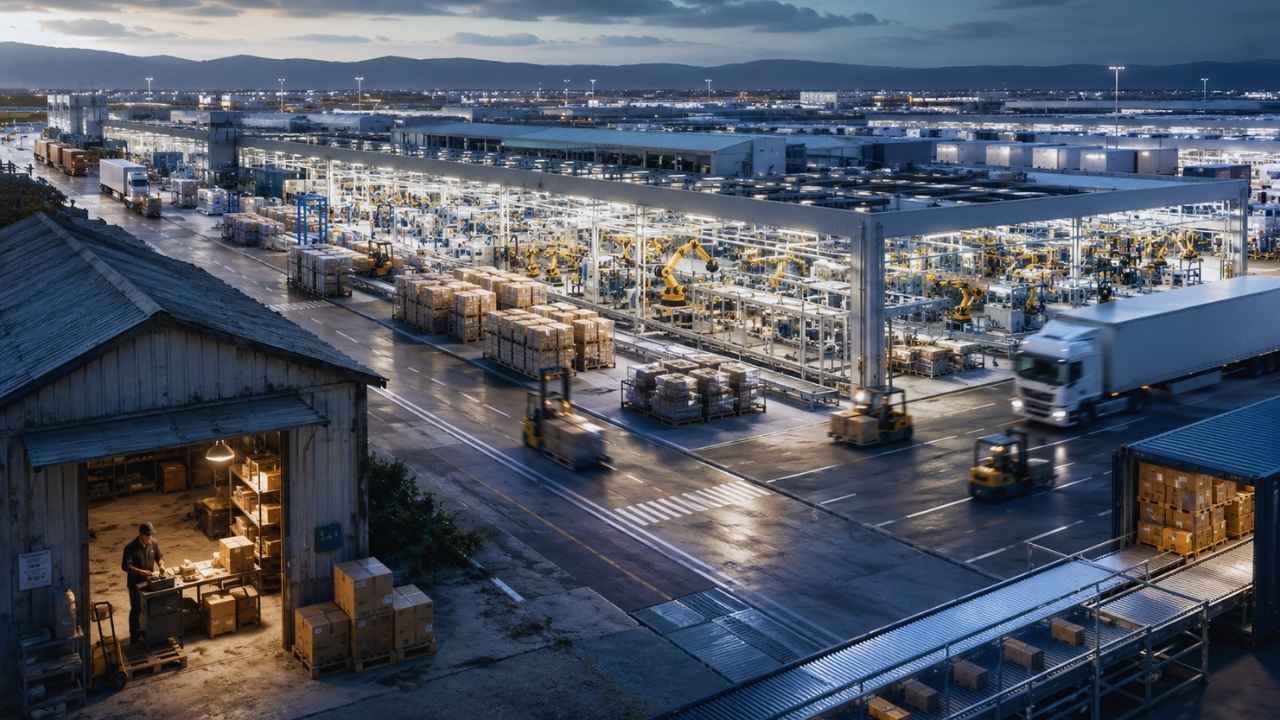
Picture your last Costco run. You probably grabbed a massive 30-pack of paper towels for a fraction of what a single roll costs at the corner store. Why? You bought in bulk. Apply that exact logic to a massive corporation. When a company buys raw materials or ships goods by the millions, the cost to make each item plummets.
If you want to understand what is economies of scale, look at it this way: as a business grows and pumps out more products, its cost per unit drops. It is the ultimate secret weapon. It lets giants crush smaller rivals, slash prices, and rake in massive profits.
Let’s break down how this actually works, why heavyweights like Amazon and TSMC seem untouchable, and what happens when a company gets too big for its own good.
The Core Concept: Fixed Costs, Variable Costs, and the Cost Curve
To see how businesses build these massive moats, we need to talk math. Every business pays two types of bills: fixed and variable. Fixed costs do not care how much you sell. Factory rent, expensive software, and management salaries stay exactly the same whether you bake one loaf of bread or a million. Variable costs change based on your output. Think raw materials and hourly wages. When a business ramps up production, it spreads those heavy fixed costs across way more products.
Say your factory rent is $10,000 a month. If you make 1,000 widgets, rent adds $10 to each widget’s cost. But if you make 10,000 widgets? That rent burden drops to just $1 a pop. That $9 difference goes straight to the bank. Economists map this out using the long-run average cost curve. It looks like a giant “U.” At first, costs dive as the company grows. Eventually, the curve bottoms out at the minimum efficient scale. At this sweet spot, a company runs at peak efficiency. But if it keeps growing past that point? The curve slopes back up, and things get messy and expensive.
|
Cost Component |
The Simple Definition |
Business Example |
What Happens When You Scale? |
|
Fixed Costs |
Bills that stay flat regardless of sales volume. |
Rent specialized machines and software licenses. |
Cost per unit drops fast. This is the main driver of scale. |
|
Variable Costs |
Bills that go up or down based on production. |
Raw materials, hourly labor, shipping boxes. |
Cost per unit stays mostly flat, though bulk buying helps a bit. |
Internal vs. External: What Is Economies Of Scale Practically?
When people search for what economies of scale are in the real world, they usually picture huge buying power. But companies actually boost efficiency in two distinct ways: internally and externally. You control internal perks directly by growing your business. Big companies buy mountains of raw materials. Because their orders are huge, they bully suppliers into deep discounts.
Small business owners wear five hats, but massive corporations hire elite specialists who find ways to shave millions off operating costs. Banks also love safe bets. Giant corporations score loans at dirt-cheap interest rates, which means cheaper money for faster expansion. Giant manufacturers buy hyper-efficient robots. A massive auto plant runs around the clock. The robots cost a fortune upfront, but they make the cost per car practically zero.
Sometimes your costs drop just because your whole industry grows in your specific city. We call this external scale. Think Silicon Valley for software or Wall Street for finance. Companies spend way less recruiting and training because top-tier talent already lives next door. When a region becomes an industry hotspot, local governments step in. They build better roads, ports, and power grids just to keep those businesses happy and running smoothly.
|
Advantage Type |
Where It Comes From |
Real-World Example |
The Big Benefit |
|
Internal (Buying) |
Massive bulk orders. |
A retail giant forcing vendors to cut prices. |
Drops variable costs instantly. |
|
Internal (Cash) |
Great credit scores. |
Tech giants issuing bonds at low rates. |
Cheaper money for growth. |
|
External (Labor) |
Industry hubs. |
Tech talent clustering in California. |
Slashes hiring and training costs. |
|
External (Supply) |
Nearby vendors. |
Car parts suppliers setting up near Ford plants. |
Cuts shipping time and freight costs. |
The Giants Who Mastered the Concept
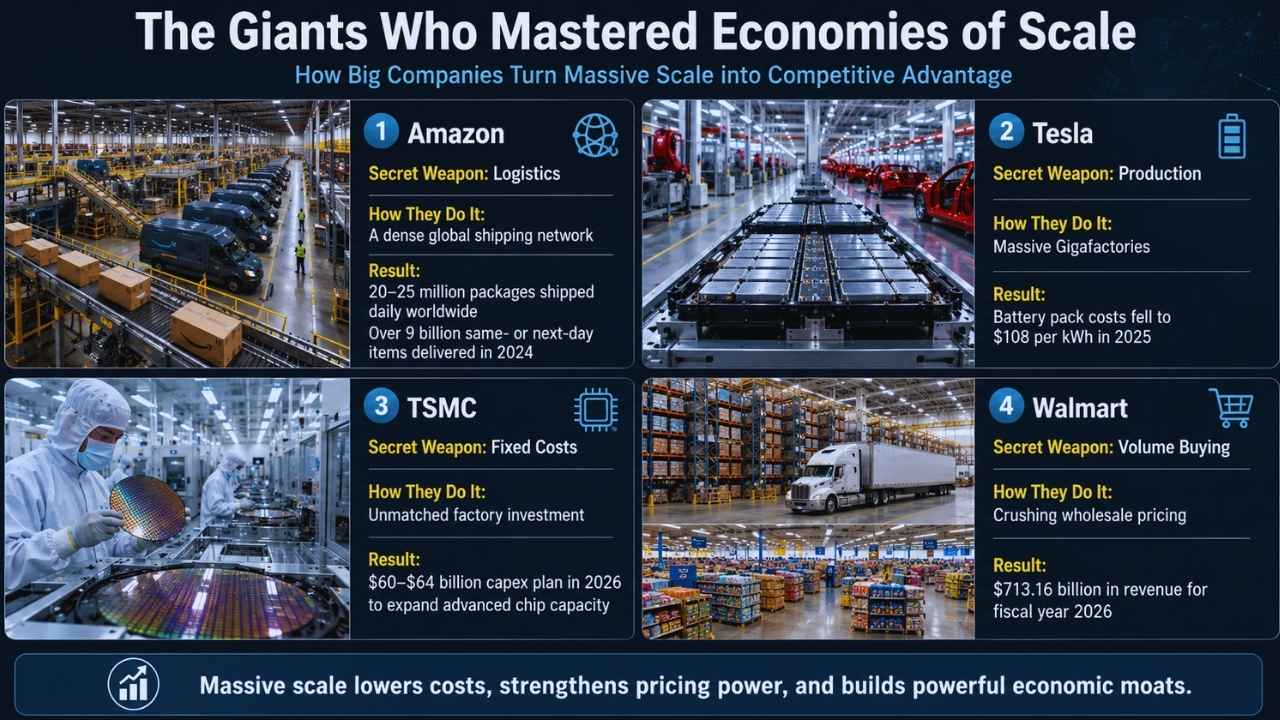
Want to see this theory in action? Look at the stock market’s heavyweights. Big companies win because they use their massive size to build economic moats. Startups simply cannot compete on price. Amazon did not conquer retail with just a neat website. They dumped billions into a shipping network nobody can match. As of 2025, Amazon handles 20 to 25 million packages globally every single day. They delivered over 9 billion items on the same or next day in 2024 alone. They move so much volume they even sell their delivery services to outside businesses.
Tesla did the exact same thing with batteries. Early electric cars cost a fortune because making small batches of batteries was horribly inefficient. Tesla fixed this by building Gigafactories. By pouring billions into massive battery plants, they scaled production to the moon. Thanks to this industry-wide scale, lithium-ion battery pack prices crashed to a record low of $108 per kWh in 2025. Taiwan Semiconductor Manufacturing Company perfectly shows off technical scale.
Making modern AI chips requires extreme ultraviolet lithography machines that cost hundreds of millions of dollars each. TSMC plans to drop a massive $60 to $64 billion on capital expenditures in 2026 just to build more advanced capacity. They stay dominant by spreading those insane fixed costs over billions of microchips. Add in Walmart, which hit $713.16 billion in revenue for fiscal year 2026, and you see exactly how massive volume crushes the competition.
|
Company |
Their Secret Weapon |
How They Do It |
The Real-World Result |
|
Amazon |
Logistics |
A dense global shipping network. |
20-25 million daily packages shipped worldwide. |
|
Tesla |
Production |
Massive Gigafactories. |
Crashing battery pack costs down to $108/kWh. |
|
TSMC |
Fixed Costs |
Unmatched factory investments. |
Over $60 billion spending plan to dominate AI chips. |
|
Walmart |
Volume Buying |
Crushing wholesale pricing. |
Over $713 billion in annual global revenue. |
Digital Scale: The Magic of Zero Marginal Cost
Figuring out what is economies of scale gets wild when you move online. If you build physical stuff, you still have to buy plastic or metal for every new gadget. But with software? The cost to make one extra copy is basically zero. We call this the marginal cost. Take a software startup. A team burns $10 million writing code for a new productivity app. That is a massive fixed cost. But once the app launches, it costs the exact same to let ten people download it as ten million people. The only variable cost is a few extra pennies for server space.
Netflix plays the exact same game with entertainment. They drop $200 million on a blockbuster action movie. If a traditional studio does that, they have to pray millions of people buy movie tickets.
Netflix just spreads that massive bill across hundreds of millions of global subscribers. The actual cost per viewer drops to pennies. Traditional television networks just cannot keep up with that math. The digital space allows for practically infinite scaling without the nightmare of managing physical inventory, shipping crates, and warehouse workers.
|
Feature |
Making Physical Stuff |
Making Digital Stuff |
|
Fixed Costs |
Huge (Factories, heavy machines). |
Huge (Coding, initial production). |
|
Variable Costs |
High (Raw materials, labor). |
Almost zero (Just server space). |
|
The Limit |
Choked by physical supply chains. |
Basically infinite. |
Diseconomies of Scale: When Getting Bigger Hurts
If scaling up makes everything cheaper, companies should just grow forever, right? Wrong. Eventually, companies blow past their sweet spot and hit what we call diseconomies of scale. The business gets so bloated that the cost per unit actually starts climbing. It usually boils down to human nature and red tape. Startups make decisions over coffee in ten minutes. Massive corporations need approval from legal, compliance, and six vice presidents just to change a button color. It kills momentum.
When you have 100,000 employees worldwide, the left hand rarely talks to the right. Teams duplicate work, wasting time and payroll. Plus, employee burnout becomes a massive issue. In a small shop, your work matters, and the founder knows your name. In a massive conglomerate, you are just a number.
That kills motivation and spikes turnover, forcing the company to spend millions constantly hiring and retraining replacements. You might also outgrow your local supply chain, forcing you to pay premium prices to ship raw materials from halfway across the world just to keep the machines running.
|
The Problem |
Why It Happens |
How It Hurts the Business |
|
Slow Decisions |
Too many middle managers. |
You miss out on new trends. |
|
Siloed Teams |
Awful internal communication. |
Paying two teams to do the exact same job. |
|
High Turnover |
Employees feel invisible. |
Burning cash on endless retraining. |
How Small Businesses Survive in a Scale-Dominated World
If massive companies hold all the cards, why do startups even bother? Because small businesses play a totally different game. You cannot beat Amazon on shipping speed, and you cannot beat Walmart on price. But you can absolutely destroy giant corporations in areas where their massive size makes them slow and sloppy. A startup can completely rewrite its business model over the weekend based on quick customer feedback. A massive brand takes six months just to agree on a new logo design.
People also crave real human connection. Big brands force you to talk to a glitchy chatbot when you have a problem. A local founder knows their top clients by name and customizes the service directly for them. Massive companies need to sell millions of units to care about a product line.
Small businesses thrive by dominating tiny, highly profitable niches. Think about custom-built mechanical keyboards or specialized dietary bakeries. Giants ignore these markets entirely because they do not move the needle on their quarterly earnings reports.
|
Focus Area |
The Corporate Advantage |
The Startup Advantage |
|
Pricing |
Lowest possible cost through volume. |
Premium prices for premium, exclusive quality. |
|
Customer Service |
Automated, highly scalable chatbots. |
Real, human-to-human relationships. |
|
Target Market |
Generic products for the masses. |
Hyper-specialized gear for passionate niches. |
Final Thoughts
At the end of the day, if you want to nail down exactly what is economies of scale, just think of it as the ultimate engine powering corporate dominance. It is the raw math proving that doing things in massive volumes makes those things fundamentally cheaper.
By spreading huge fixed costs over millions of items, massive companies unlock profit margins startups can only dream of. They use those savings to slash prices, build crazy logistics networks, and lock out the competition.
But size is not a magic shield. Red tape and awful communication can turn massive scale into a massive headache. For small players, understanding how the giants operate is your survival guide. Focus on speed, own your niche, and deliver real human interaction. That is how you build a wildly profitable business right in the blind spots of the giants
Frequently Asked Questions (FAQs) About What is Economies of Scale
Are external scale advantages just about supply chains?
Nope. They also rely heavily on knowledge sharing. When one major tech firm sets up in a city, venture capitalists follow. That funds more startups, creating a massive innovation loop you simply can’t buy.
Do service-based businesses actually scale?
Absolutely. A consulting firm scales by building proprietary software and standardized training. Once an accounting firm builds a custom digital tax platform, adding a new client costs them next to nothing.
What is the difference between scale and scope?
Scale is making more of the exact same thing to drop per-unit costs. Scope is using the same resources to make different things. If a bakery uses its existing ovens and staff to start selling cookies alongside bread, that’s an economy of scope.