


You sit down, open your laptop, and stare at a grid of faces for an hour. The call ends, and you immediately think, “Well, that could have been an email.” Sound familiar? It is a running joke in the corporate world, but it actually ruins our workdays. Bad meetings drain your energy. They kill your team’s focus.
And honestly, they waste a massive amount of company cash. Right now, calendar overload is totally out of control. Recent data from Microsoft and Asana shows the average office worker spends roughly 103 hours a year stuck in entirely unnecessary meetings. That is nearly three full workweeks just talking about work instead of actually doing it.
The kicker? People in those rooms say 72 percent of those meetings are completely useless and fail to hit their goals. It does not have to be this miserable. Getting your team together should spark great ideas and solve real problems. You just need a better system. If you want to know how to run effective meeting sessions that actually leave your team energized, you need to rethink your calendar from scratch. This guide skips the typical corporate jargon. Instead, I will walk you through the exact, tested steps to take back your time, keep conversations on track, and make every single minute count.
The Real Cost of Our Broken Calendars
When we all shifted to remote and hybrid work a few years ago, we did not just change where we worked. We changed how often we talked. Microsoft’s Work Trend Index showed weekly meeting times shot up by a staggering 252 percent since the start of 2020. We traded five-minute desk chats for formal 30-minute calendar invites, creating massive calendar bloat. The main problem is a total lack of purpose. If you drag people into a room just to read project updates out loud, they naturally check out. If half the room is quietly catching up on emails while someone shares their screen, you have already lost the room entirely. Workers admit to multitasking in 55 percent of all meetings, proving that attention spans are totally fractured.
Then there is the financial hit. Unproductive syncs cost U.S. businesses between 37 billion and 259 billion dollars a year, depending on the scale of the metric you look at. Do the math for your own team. If ten people sit in a room, and they each make 50 dollars an hour, that meeting costs the company 500 dollars in raw payroll. Was the result of that chat actually worth that money? Bad meetings also mess with your head. Dr. Steven Rogelberg, a researcher who studies workplace behavior, calls it the meeting hangover. His data shows 90 percent of workers feel stressed and annoyed long after a bad call ends. It takes about 23 minutes to get back into the zone after an interruption. So, a pointless 30-minute call actually steals over an hour of deep work from your team.
|
The Hidden Cost |
The Hard Data Behind It |
The Real-World Impact |
|
Wasted Time |
Workers lose 103 hours per year to bad syncs. |
Nearly three full workweeks lost to scheduling overhead. |
|
Wasted Money |
Costs U.S. businesses up to $259 billion yearly. |
Massive payroll spent on non-revenue-generating talk. |
|
Pointless Calls |
72% of meetings are rated totally ineffective. |
Teams walk away confused without clear next steps. |
|
Brain Drain |
90% experience a post-meeting mental drain. |
Ruins team morale and kills afternoon productivity. |
The Core Framework: How to Run Effective Meeting Structures
Ask yourself if you actually need to talk live. You should only book a meeting for the three Ds: Discuss, Debate, and Decide. If you just want to announce a new policy, share a spreadsheet, or give a weekly status update, completely skip the meeting. Lean on asynchronous communication instead. Record a quick three-minute Loom video. Write a clear Slack update. Send a structured email. Synchronous time—making everyone stop what they are doing to listen at the exact same moment—is incredibly expensive and disruptive. Save it exclusively for complex issues that need instant back-and-forth friction to solve a problem.
Adopt the 40-20-40 rule to restructure your team’s approach to collaboration. This framework dedicates 40 percent of your effort to pre-meeting preparation, 20 percent to the actual execution inside the room, and the final 40 percent to rigorous post-meeting follow-up. We usually book 60 minutes just because calendar apps default to an hour. This triggers Parkinson’s Law, which states work expands to fill the time you give it. Give people an hour, and they will stretch a 15-minute topic to fill the whole 60 minutes. Cut your default meeting times in half. Book 15, 20, or 45-minute sessions instead. You will be amazed at how fast people skip the small talk and get to work when the clock is ticking down. Start exactly on time, and never wait for stragglers.
|
The Old Habit |
The Golden Rule Replacement |
Why It Actually Works |
|
Status Updates |
The 3 D’s Only |
Makes meetings active (Discuss, Debate, Decide) instead of passive. |
|
Default 60 Mins |
Strict Timeboxing |
Respects schedules, forces quick thinking, and beats Parkinson’s Law. |
|
Calling a Sync |
Default to Async |
Uses video/Slack for updates, freeing up time for deep work. |
|
Waiting Around |
Start on the Dot |
Shows the team you mean business when it comes to start times. |
Pre-Meeting Prep: The “No Agenda, No Attendance” Rule
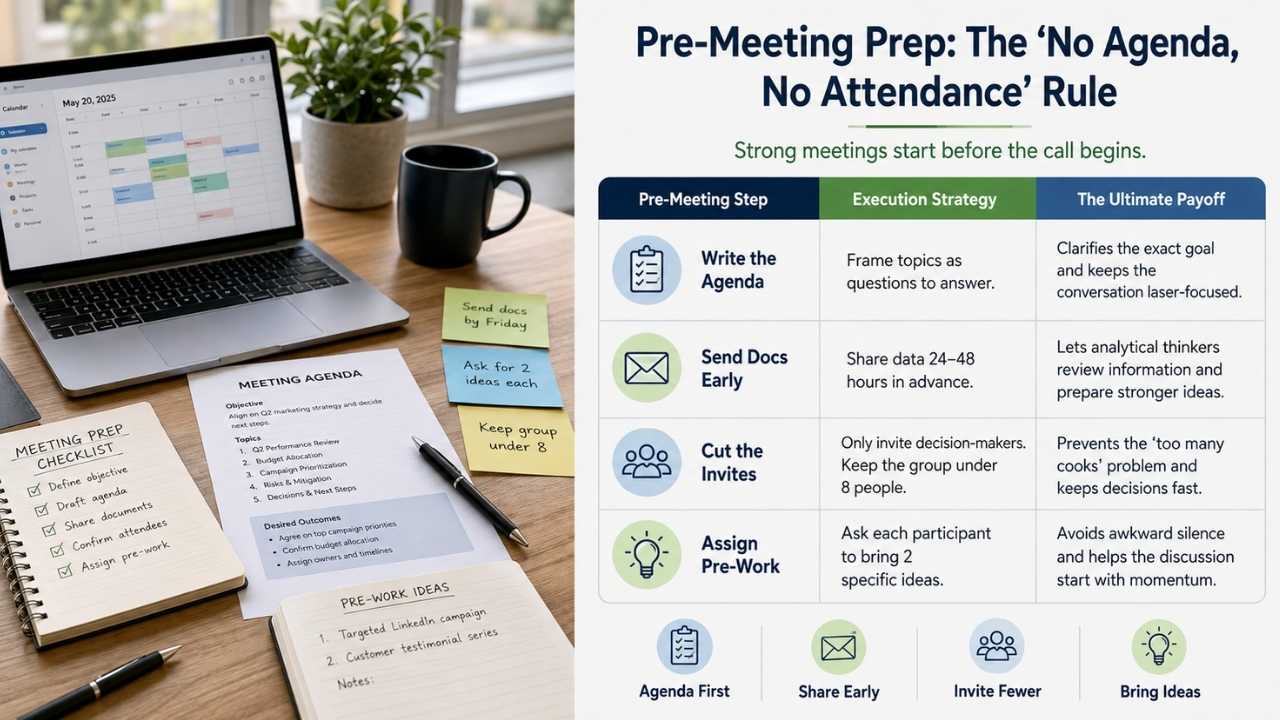
Great meetings are won or lost before anyone clicks the Zoom link. Prep work is absolutely everything. Your best tool is the agenda, and you must make this a hard rule across your team: No agenda, no attendance. If an invite shows up on your calendar without a detailed list of what you are talking about, you have full permission to decline it. A strong agenda is not just a vague list of words. Frame your topics as specific questions you need to answer. Do not write “Marketing Budget.” Write “What cuts do we need to make to keep the Q3 marketing budget under 50K?” This primes everyone’s brain for active problem-solving before they even sit down.
Send that agenda, plus any data or documents, at least 24 to 48 hours ahead of time. A massive part of mastering how to run effective meeting environments involves respecting your introverts. Analytical thinkers need time to digest numbers and process complex information. If you drop a massive spreadsheet on the table and demand immediate thoughts, you will only hear from the loudest extroverts in the room, not necessarily the smartest people. Be ruthless with your invite list. Apple uses a great concept called the Directly Responsible Individual. If a person is not directly responsible for the project, or they do not have the power to make a decision, they do not need to be there. Keep your decision-making groups under eight people. Studies prove that once you add a ninth person, the dynamic shifts. It stops being a collaborative brainstorm and turns into a one-way presentation.
Read Also: Are Google Career Certificates Worth It in 2026?
|
Pre-Meeting Step |
Execution Strategy |
The Ultimate Payoff |
|
Write the Agenda |
Frame topics as questions to answer. |
Clarifies the exact goal and keeps the conversation laser-focused. |
|
Send Docs Early |
Share data 24-48 hours in advance. |
Let quiet, analytical thinkers process info and prep solid ideas. |
|
Cut the Invites |
Only invite decision-makers (under 8 people). |
Stops the “too many cooks” problem and keeps the group fast. |
|
Assign Pre-Work |
Ask everyone to bring 2 specific ideas. |
Kills the awkward silence at the start and jumps right into brainstorming. |
Inside the Room: Advanced Facilitation Secrets
You did the prep. The right people are in the room. Now you have to steer the ship. As the host, you are not there to talk the whole time. Your job is to guide the chat, keep the pace up, and make sure everyone gets a word in. Right at the start, assign roles. Grab a note-taker so the rest of the team can actually focus on talking instead of typing out details. Grab a timekeeper to give a five-minute warning before you need to move to the next topic. If you try to talk, take notes, and watch the clock all by yourself, the meeting will crash and burn. For high-stakes brainstorming, try silent starts. Give everyone the first five minutes to quietly read the document or write down ideas before anyone speaks. This levels the playing field instantly.
People go on tangents. It happens every single day, and you need a polite way to shut them down. Use the parking lot technique. When someone brings up a cool but off-topic idea, say that it is a great point, but it is outside today’s scope. Put it in the parking lot and tackle it on a separate thread later. Write it down on the whiteboard, and pivot straight back to the agenda. You validate their idea without letting them hijack your time. Watch the room carefully. Usually, two extroverts will dominate the whole hour. Step in gently. Call on people who have the expertise but have not spoken up. It keeps engagement high and stops people from secretly checking their phones under the desk. If you are in the office, set a strictly enforced screens-down rule. Unless someone is presenting or taking the official notes, laptops shut and phones go away.
|
Facilitation Tactic |
How to Execute It Live |
The Expected Outcome |
|
Assign Roles |
Pick a note-taker and timekeeper instantly. |
Frees you up to actually listen and smoothly guide the room. |
|
The Parking Lot |
Write off-topic ideas down for later. |
Validates the speaker without destroying your tight agenda. |
|
Pull People In |
Directly ask quiet experts for their take. |
Gets diverse ideas and stops the loudest voices from taking over. |
|
Tech Etiquette |
Enforce strict “laptops down” rules. |
Kills multitasking and keeps everyone fully present in the moment. |
Post-Meeting Action: Securing the Return on Investment
A fantastic brainstorming session means absolutely nothing if everyone walks out, forgets what was said, and goes back to their normal day. The most important part of the whole process happens right after you hang up. When you figure out how to run effective meeting follow-ups, your team will start moving twice as fast. Leave the last five minutes of every call for a quick recap. Do not bring up new ideas here. Just review the decisions you made and call out the action items out loud. Doing this while everyone is still looking at each other ensures absolutely zero confusion about who is doing what before they scatter back to their desks.
An action item is not a vague suggestion. It is a specific task, owned by one person, with a hard deadline attached to it. Saying the marketing team will look into new software is a terrible action item because nobody owns it, so nobody will actually do it. Assigning John to email three vendors for pricing quotes by Thursday at 5 PM is a bulletproof action item where accountability is perfectly clear. Within an hour of wrapping up, your note-taker needs to send a written summary to everyone who attended, as well as the people you left off the invite list. The summary needs three things: the decisions you finalized, the random ideas you threw in the parking lot, and the bulleted list of strict action items. This creates a paper trail and totally prevents that awkward conversation two weeks later where someone says they thought someone else was handling the job.
|
Post-Meeting Task |
What You Need to Do |
Why It Matters for Growth |
|
The Wrap-Up |
Summarize choices out loud in the final 5 mins. |
Gets everyone on the exact same page before they leave. |
|
Action Items |
Define exactly Who does What by When. |
Kills ambiguity and guarantees the actual work gets done. |
|
Share the Notes |
Send a quick written summary within an hour. |
Creates a searchable record for the whole team to reference. |
|
Follow-Up Check |
Ask about action items at your next sync. |
Builds a tough, reliable culture of absolute accountability. |
Final Thoughts
Figuring out how to run effective meeting routines is not a magic trick. You do not need expensive consultants or fancy new software platforms. It all boils down to basic respect. You have to respect your team’s time, respect their deep-work focus, and respect the company’s financial goals. When you start enforcing strict agendas, cutting your guest lists, setting hard boundaries, and following up with real action items, your whole culture shifts entirely.
Meetings stop being the worst part of the day. They stop being a black hole for productivity and employee morale. Instead, they turn into exactly what they should be: a dynamic space for smart people to solve hard problems together. Start small today. Look at your calendar right now. Cancel one unnecessary recurring meeting this week. Demand an agenda for the rest. Watch how fast your team’s mood and output skyrocket when you give them their time back.
Frequently Asked Questions (FAQs) About How to Run Effective Meeting
How do I calculate the exact financial cost of a gathering?
It is simple math that will shock most managers. Take the estimated hourly wage of everyone in the room and multiply it by the meeting length. If ten people who make about 40 dollars an hour sit on a 90-minute call, you just spent 600 dollars of company money. Use a free online meeting cost calculator to prove to your boss that your weekly sync is bleeding cash without delivering any real return on investment.
Can we just cancel all our recurring weekly status calls?
Honestly, yes, you absolutely can and probably should. Try declaring meeting bankruptcy. Cancel all recurring internal syncs for two full weeks and see what actually breaks. You will usually find that 80 percent of them were totally useless and can be permanently swapped for a weekly digital thread or a shared project dashboard, saving your team countless hours.
What do I do if my boss is the one rambling and wasting time?
Managing up is tough because you cannot just tell your boss to be quiet. Instead, lean heavily on the timekeeper role and the pre-set agenda. Interrupt politely by saying those are great points, but looking at the clock, you only have ten minutes left to hit the final agenda item. Ask to jump to that so you do not keep them late. Blame the clock, not the boss.
What if someone drops the ball on an action item?
Address it fast, but always keep it private. Do not shame them in front of the group, but do not let it slide either. Ask them what got in their way and adjust the deadline if necessary. Make it crystal clear that hitting deadlines is how your team operates and that accountability is a core value of your culture.