


You absolutely nailed the deadline. You mapped out the layout structures perfectly, perfected the keyword optimization, and sent your final invoice with a polite thank-you note. Now? Total silence. Dealing with a freelance client not paying is easily one of the most maddening parts of running your own business.
It kills your cash flow, drains your creative energy, and forces you to play debt collector when you should be writing. But losing your temper or firing off an angry email will not fix the problem or get your money any faster. You need to separate your raw emotions from the money and the business transaction. Keep your composure and track down your cash systematically.
Let’s break down exactly how to handle this situation step by step. We will look at everything from a friendly nudge to formal legal threats, ensuring you get paid and get back to doing the work you actually enjoy. Whether you are running a massive editorial platform or just taking on side gigs, knowing how to protect your income is non-negotiable.
The Harsh Reality of Overdue Invoices
Late payments plague the independent workforce across the globe. Large corporations often string freelancers along with strict payment terms to protect their own cash reserves. Meanwhile, smaller clients just lose track of their paperwork and forget to pay you. When you run a solo business, you wear every single hat: talent, CEO, and accounting team. Managing all these roles means that when a client ignores an invoice, your entire operation grinds to a halt. Recent data highlights just how massive this problem has become for independent workers.
In 2025, 58 percent of freelancers globally encountered non-payment or delayed payments. This is not just a minor inconvenience; it is a financial disaster. Late payments cost freelancers an estimated 11.5 billion dollars annually in delayed cash flow and productivity losses. Furthermore, small businesses and individual clients account for 70 percent of non-payment cases, often blaming tight budgets or internal chaos.
Around 40 percent of freelancers experience payment delays exceeding 30 days, completely wrecking their ability to cover basic living expenses. A smart business owner anticipates these bumps and builds systems to handle them before they cause financial ruin. You cannot let one bad client ruin your entire month, so understanding the landscape is your first step to survival.
|
Reality Check Scenario |
What It Usually Looks Like |
Your Immediate Next Move |
|
Administrative Error |
Missing PO number, bounced email, or invoice hit the spam folder. |
Send a quick, polite reminder and ask if they need the invoice re-sent. |
|
Cash Flow Trouble |
The client apologizes and asks for more time to gather funds. |
Negotiate a strict payment plan, because partial payment beats zero payment. |
|
The Intentional Ghost |
Total silence after multiple emails while they still use your work. |
Escalate quickly by applying late fees and threatening formal legal action. |
Immediate Steps: When a Freelance Client Not Paying?
Before you accuse a client of skipping out on a bill, look closely at your own internal process. It is incredibly easy to feel angry and react defensively, but a missing detail on your end can cause massive delays in the accounting department. If you are dealing with a freelance client not paying right on the exact due date, pause and check your sent folder immediately. Did you email the correct person, or did it go to a general inbox? Some companies require you to copy a specific accounts payable address for the invoice to be recognized.
Does your invoice show the correct payment terms, the exact due date, and your current bank details? Automated accounting software will reject your invoice instantly over one wrong digit or a missing purchase order number. You must verify every single line of your submitted paperwork before sending a follow-up email. Wait at least 24 to 48 hours after the due date before you send that friendly check-in email.
Keep your tone light, helpful, and professional, assuming they simply forgot or the email hit a spam filter. Send a quick message stating that you hope they are having a great week and attach a fresh copy of the invoice for their convenience. Taking these calm, calculated steps prevents you from damaging a client relationship over a simple clerical error.
|
Immediate Action Step |
Why You Need to Do It |
The Best Time to Do It |
|
Audit Your Invoice |
Catch your own typos or missing details before blaming the client. |
On the morning of the original due date. |
|
Friendly Reminder |
Nudge them gently without ruining the professional relationship. |
1 to 2 days past the official due date. |
|
Ask for Confirmation |
Make sure the email did not accidentally hit a strict spam filter. |
Include this simple request in your first reminder. |
The Follow-Up Strategy: Keep Your Focus
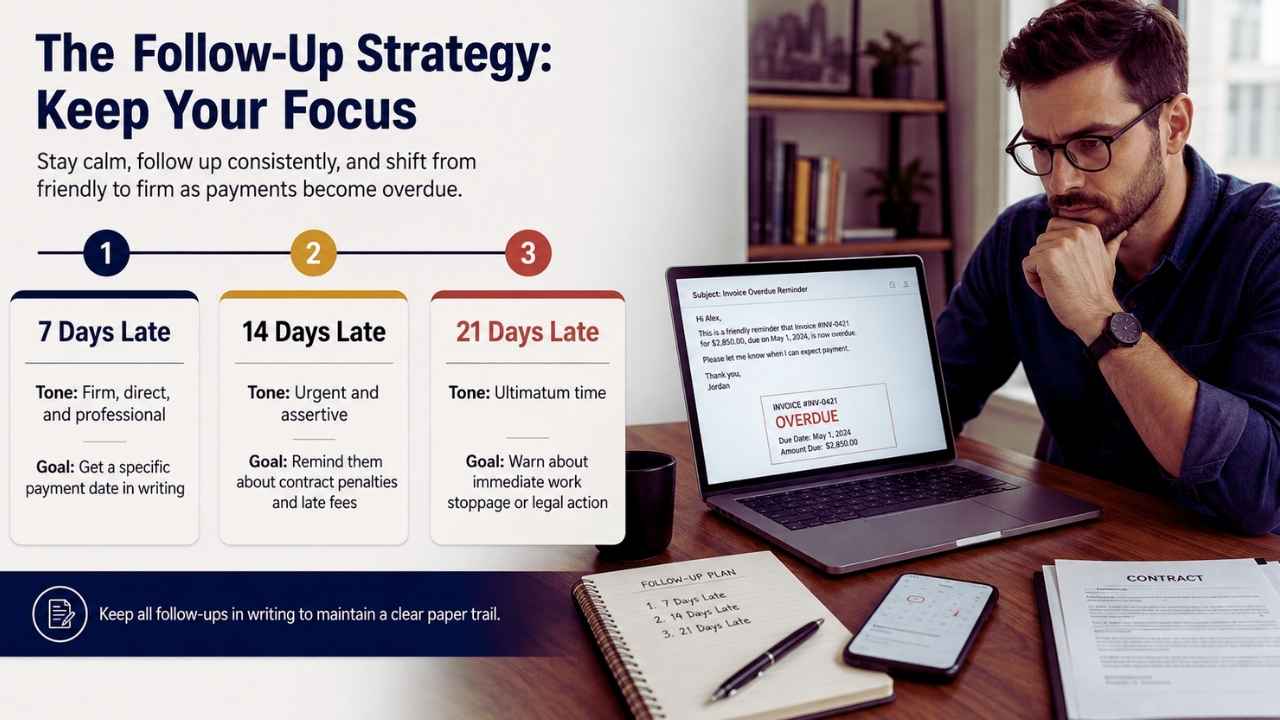
When the deadline passes and your first email gets ignored, it feels deeply personal and incredibly frustrating. It is not personal; it is just business, and you must apply steady, unshakeable pressure without losing your cool. Handling this situation requires serious focus and intense resilience from you. Think about watching a master athlete build momentum during a tough match; they do not panic after a setback, but rather trust their technique and play the long game.
You need to treat your writing business the exact same way. Transition smoothly from a friendly creative partner to a strict business owner demanding their rightfully earned money. At seven days late, change your tone entirely by dropping the casual greetings and directly asking for a specific payment date. By the time fourteen days pass, you must introduce the financial consequences outlined in your contract.
Remind the client that late fees will begin accruing and that their delay is causing a breach of your agreement. Keep all communications strictly in writing so you have a solid paper trail if you need to escalate the matter. A consistent, firm follow-up strategy shows the client that you run a serious operation and will not just fade away.
|
Follow-Up Timeline |
Tone of Voice to Use |
Your Main Goal |
|
7 Days Late |
Firm, direct, and completely professional. |
Get them to commit in writing to a specific payment date. |
|
14 Days Late |
Urgent and highly assertive. |
Remind them about contract penalties and upcoming late fees. |
|
21 Days Late |
Ultimatum time. |
Warn them about immediate work stoppages or formal legal action. |
Escalating Tactics for Stubborn Accounts
By week three or four, if you still have a freelance client not paying, it is time to stop playing nice and use your leverage. You must stop giving them the benefit of the doubt and aggressively protect your valuable time. Never keep working for a client who refuses to pay for the writing or design work you already delivered. Send a firm email stating you are officially pausing all current and future projects until they clear their outstanding balance. If they need your skills badly enough, this work stoppage usually triggers a very fast payment from their accounting team.
Additionally, apply the late fees stipulated in your contract, which are typically around 1.5 to 2 percent per month. Send an updated invoice reflecting the higher total, as seeing the debt actively grow often scares clients into paying the original amount immediately. If your direct editor or manager ignores you, bypass them entirely to get results.
Go on LinkedIn, find the company’s Head of Finance or CEO, and forward the email chain to them directly. Politely explain you cannot reach your normal contact and need immediate assistance settling a past-due bill. Involving senior leadership forces the company to acknowledge the unpaid debt and usually results in a swiftly cut check.
|
Escalation Tactic |
When to Use It |
What Usually Happens |
|
Stop Working |
14 or more days late on an active project. |
They realize they cannot get free labor and finally prioritize your invoice. |
|
Apply Late Fees |
30 days late on the original invoice. |
Creates intense urgency as their final bill gets more expensive every week. |
|
Email the Boss |
When your main contact completely ghosts you. |
Forces someone with actual financial power in the company to cut a check. |
Legal Action and Debt Collection
Sometimes playing nice and sending firm emails fails completely, leaving you with a difficult choice. When a client flat-out refuses to pay, you have to decide if chasing the money is worth your valuable time and mental energy. Before you sue anyone, send a formal demand letter outlining exactly what they owe and the legal steps you will take if they ignore you. You can write one yourself using free templates online, or pay a lawyer a small fee to send one on official law firm letterhead.
Knowing your local legal rights is also crucial, as many regions are passing progressive laws to protect gig workers. For instance, California enacted the Freelance Worker Protection Act taking effect in January 2025, which mandates written contracts for services over 250 dollars and strictly enforces payment within 30 days. If the client owes you less than your state’s maximum limit, take them to small claims court where you do not need an expensive lawyer.
You just pay a small filing fee and show the judge your emails, signed contracts, and unpaid invoices to secure a judgment. Alternatively, you can hire a professional debt collection agency to hunt down the money for you. Keep in mind that a collection agency will take a massive cut of whatever money they recover, but it removes the stress from your plate entirely.
|
Legal Move |
The Good Stuff |
The Catch |
|
Demand Letter |
Cheap to execute and usually scares them into paying quickly. |
Carries no real legal power if the client decides to call your bluff. |
|
Small Claims Court |
Gets you a legally binding judgment without expensive lawyers. |
Takes up your valuable time, requires a filing fee, and limits claim amounts. |
|
Collection Agency |
You do zero work once you hand the bad debt over to them. |
They take a massive cut, sometimes up to 50 percent, of the recovered money. |
Protecting Yourself Against Future Non-Payment
The absolute best way to handle a freelance client not paying is to build a fortress around your business so it never happens again. Treat every single unpaid bill as a harsh, valuable lesson in operational security and tighten up your systems immediately. Never start working on any project without a fully signed agreement protecting your intellectual and financial rights. You do not need a massive legal document; a simple one-page contract showing the project scope, your rate, payment terms, and late fees is highly effective.
Stop funding your clients’ projects out of your own pocket and start asking for money upfront before you begin. Make new clients pay a 50 percent deposit before you type a single word, and bill the rest when you finish the final draft. For massive, long-term content projects, use milestone payments to ensure a steady cash flow and reduce your risk.
Finally, always put a clause in your contract stating that you own the copyright to the work until they pay the invoice in full. If a client publishes your article without paying, you have the legal power to file a digital takedown notice and pull the stolen content off the internet. Setting these strict boundaries ensures you only attract professional clients who respect your time and expertise.
|
Defense Tactic |
How to Implement It |
Why It Actually Works |
|
50 Percent Deposits |
Make it a strict, non-negotiable rule for every single new client. |
Guarantees you get paid for at least half the work if they suddenly vanish. |
|
Digital Contracts |
Use secure digital signing tools like DocuSign or HelloSign. |
Gives you hard, timestamped proof for small claims court or demand letters. |
|
Copyright Clause |
Add a “rights transfer upon full payment” term to your contract. |
Gives you the legal power to pull unpaid work directly off their website. |
Tools to Automate Your Invoicing
Let intelligent software do the heavy lifting for your business so you can focus exclusively on creating great content. When an automated computer system sends the late payment reminders, the client does not feel personally attacked, and you save a massive amount of mental energy. Professional accounting software like FreshBooks, HoneyBook, or QuickBooks allows you to track your invoices in real time.
These digital tools let you see the exact minute a client opens your bill, which completely destroys the common excuse that they never received your email. By 2025, invoice processing has become highly automated, with many platforms offering real-time payment settlement and multi-currency solutions. You can turn on automatic reminders, setting the software to email the client at 3, 7, and 14 days late without you having to draft a single message.
Setting up an integrated payment gateway also reduces friction, allowing the client to pay instantly with a credit card or secure bank transfer. Digital delivery is the standard now, and email-only invoicing without a direct payment link is completely outdated. The easier you make it for a client to hand over their money, the faster you will see those funds hit your bank account. Automating your finances is the smartest move you can make to protect your freelance career.
|
Software Feature |
How It Helps Your Business |
Great Tools to Try Today |
|
Read Receipts |
Tells you exactly what time they looked at your digital invoice. |
FreshBooks, QuickBooks, HoneyBook. |
|
Auto-Reminders |
Sends aggressive follow-up emails while you sleep peacefully. |
Wave, Bonsai, Xero. |
|
Payment Gateways |
Lets clients pay instantly with a credit card or bank transfer. |
Stripe, PayPal, Square. |
Final Thoughts
Dealing with an overdue bill tests exactly how tough and resilient your independent business truly is. Do not let a freelance client not paying ruin your entire week or make you doubt your professional writing skills. Treat the situation as a standard administrative glitch, tighten up your client onboarding process, and strictly enforce your written contracts.
Stick to your boundaries, stay entirely professional, and keep the strategic pressure on the client. You will get your money back, and you will build a much stronger, more secure freelance career in the process. Remember, your time is incredibly valuable, and you deserve to be compensated for every single word you write.
Frequently Asked Questions (FAQs) About Freelance Client Not Paying
You can, but don’t do it. Naming and shaming a bad client on LinkedIn or Twitter feels amazing for about five minutes. Then, future clients look at your profile and see you as a PR risk. Keep your fights private and strictly legal.
Can I delete my work if they refuse to pay?
If you write in Google Docs or build websites, you probably want to hit the delete button. Don’t do it. Unless your contract specifically gives you permission to dismantle a project for non-payment, you could get sued for business damages. Use DMCA takedown notices instead.
What if the client lives overseas?
Chasing international debt is a nightmare. Small claims courts usually only work if the client lives near you. If you work with international clients, demand 100% upfront or use platforms like Upwork or Escrow.com that hold the money safe before you start.