


You found it. The perfect car sits right there on the lot. The test drive felt amazing, and you can already picture it in your driveway. But before they hand over the keys, a massive stack of paperwork waits for your signature. For most buyers, this moment brings a wave of anxiety because they need to figure out how car loans work.
Let us cut through the confusing dealership jargon together. An auto loan is simply a financial agreement where a bank or credit union gives you the money to buy the car today. In return, you agree to pay it back over time, plus a little extra for the privilege. That extra cost is the interest rate. How the lender calculates this rate determines whether you get a good deal or end up paying thousands more than the car is worth. If you plan to finance a vehicle soon, understanding these moving parts gives you the upper hand at the negotiating table.
The Anatomy of an Auto Loan
Every car loan breaks down into four main components, and changing any single one of them directly impacts your wallet. First, you have the principal, which is the actual amount of money you borrow after subtracting your down payment and trade-in value. According to recent market data from 2026, Americans borrow an average of $43,925 for new vehicles and $27,070 for used vehicles. Next comes the interest rate or APR, representing the cost the lender charges you to borrow their cash.
The third piece is the loan term, dictating exactly how many months you have to pay the money back. Finally, these three factors combine to create your monthly payment. In the first quarter of 2026, the average monthly payment hit a record $770 for a new car and $531 for a used one. You want to negotiate the lowest purchase price possible to reduce that principal before you even talk about the other three elements.
|
Loan Component |
What It Actually Means |
How You Can Lower It |
|
Principal |
The total dollar amount you borrow. |
Make a larger down payment or negotiate a lower price. |
|
Interest Rate (APR) |
The premium charged by the lender. |
Boost your credit score and shop multiple lenders. |
|
Loan Term |
The timeline you have to repay the debt. |
Select a shorter repayment window like 36 months. |
|
Monthly Payment |
Your required out-of-pocket cash each month. |
Lower the principal or extend the term cautiously. |
How Car Loans Work: The Amortization Process
When you send in a car payment, the bank does not just split your money evenly between the car’s price and the interest fee. Car loans use a front-loaded mathematical process called amortization. During the first year of your loan, a massive chunk of your monthly payment goes directly toward paying off the interest. Only a small fraction actually chips away at the principal balance of the vehicle. As the months roll by, this ratio slowly flips in your favor.
By the final year of your loan term, almost your entire payment goes straight to the principal. This aggressive front-loading is exactly why paying off an auto loan early saves you a tremendous amount of cash. You bypass all those heavy interest months entirely. Just double-check your lending contract to ensure they do not hit you with a sneaky prepayment penalty for settling the debt ahead of schedule.
Read Also: How to Refinance a Loan: When It Saves Money and When It Doesn’t?
|
Loan Phase |
Where Your Money Goes |
Financial Impact |
|
Early Months |
Heavily weighted toward interest. |
Balance drops slowly. |
|
Middle Months |
Roughly equal split. |
Equity begins to build. |
|
Final Months |
Mostly applied to principal. |
Balance drops rapidly. |
|
Early Payoff |
Skips remaining interest entirely. |
Saves you maximum money. |
Credit Scores and Interest Rates in 2026
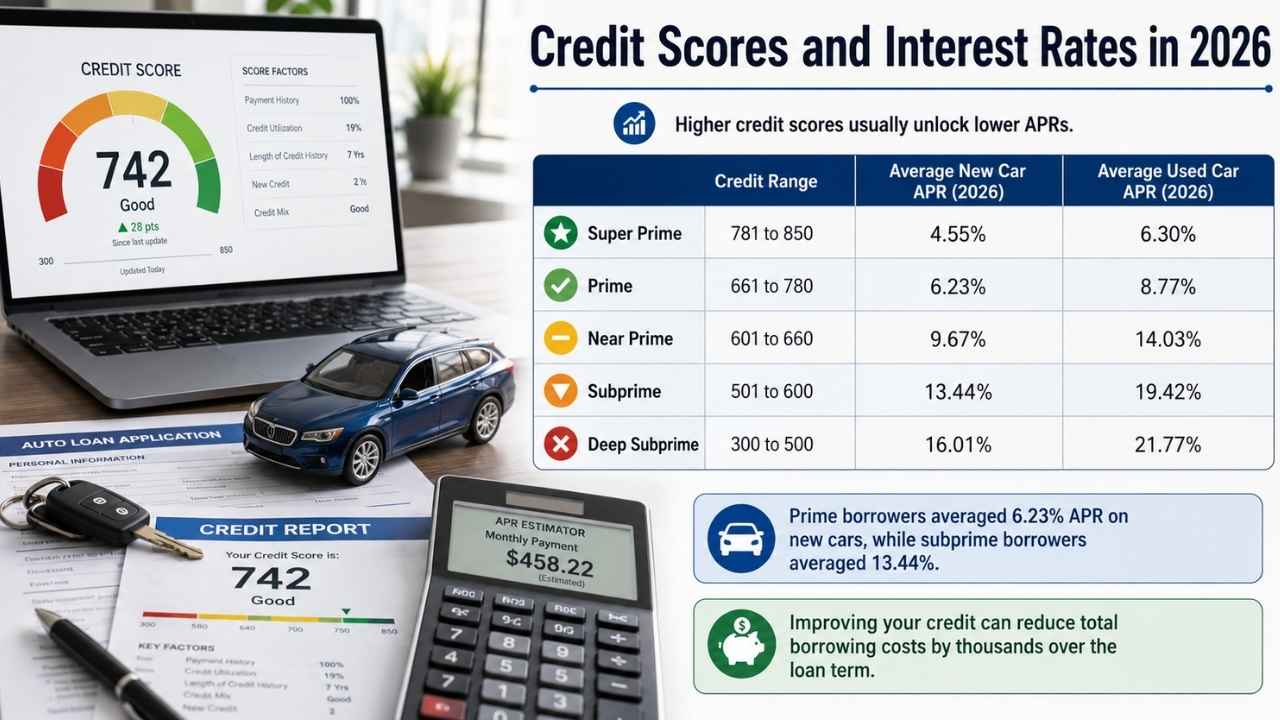
Your credit score acts as the single biggest factor dictating the interest rate you receive. Lenders analyze your credit history to judge exactly how risky it feels to hand you a large check. If you boast a high score, they view you as a safe bet and reward you with a highly competitive rate. If your score sits on the lower end, they hike up the rate to protect themselves against potential default.
Looking at Q1 2026 data, a borrower with prime credit secured an average rate of 6.23 percent on a new car. Meanwhile, someone with subprime credit faced a punishing 13.44 percent for that exact same vehicle. That gap translates into thousands of dollars in extra interest over the life of the loan. Taking just six months to aggressively pay down credit card balances and correct credit report errors can transform your borrowing power entirely.
|
Credit Score Tier |
Credit Range |
Average New Car APR (2026) |
Average Used Car APR (2026) |
|
Super Prime |
781 to 850 |
4.55% |
6.30% |
|
Prime |
661 to 780 |
6.23% |
8.77% |
|
Near Prime |
601 to 660 |
9.67% |
14.03% |
|
Subprime |
501 to 600 |
13.44% |
19.42% |
|
Deep Subprime |
300 to 500 |
16.01% |
21.77% |
The Trap of Long Loan Terms
Vehicles cost a fortune today, so buyers often stretch their loan terms to 72 or even 84 months just to keep the monthly payment looking affordable. In fact, the average term for a new car loan in early 2026 hit 69.48 months, showing just how common this tactic has become. While a long loan makes the monthly bill easier to swallow, it acts as a massive financial trap. You end up paying a small fortune in total interest because the lender charges you for a much longer period.
Worse, you risk going completely upside down on the loan. Cars lose their value quickly through depreciation. If you take out a seven-year loan, the car’s market value drops much faster than you can pay down the principal balance. If you crash the car or decide to sell it three years later, you will actually owe the bank more cash than the vehicle is worth.
|
Loan Term Length |
Monthly Payment Impact |
Total Interest Cost |
Equity Risk Level |
|
36 Months |
Highest monthly payment |
Lowest total interest |
Very low risk |
|
48 Months |
High monthly payment |
Moderate interest |
Low risk |
|
60 Months |
Average monthly payment |
High interest |
Moderate risk |
|
72 to 84 Months |
Lowest monthly payment |
Extremely high interest |
High risk of negative equity |
Beware the Hidden Fees
Securing auto financing involves far more than just agreeing to a basic monthly payment and an APR. Dealerships often slip hidden costs into the paperwork, drastically inflating your total financial burden. One major hazard is the dealer markup, where the dealership secretly bumps up the interest rate the bank offered you and keeps the difference as pure profit. Research shows this hidden markup averages nearly 2.47 percent and costs consumers billions in hidden interest over the life of their loans.
You also need to watch out for inflated origination fees and expensive credit insurance policies that you absolutely do not need. While Guaranteed Asset Protection (GAP) insurance makes sense if you make a tiny down payment, buying it directly from the dealer usually costs triple what your normal auto insurance provider charges. Always demand a fully itemized breakdown of every single fee before you sign a legally binding contract.
|
Fee Type |
What It Covers |
How to Handle It |
|
Dealer Interest Markup |
Secret rate increase added by the dealer. |
Get pre-approved by a bank first to block it. |
|
Origination Fee |
Cost for the lender to process your paperwork. |
Negotiate this fee or find a lender without one. |
|
GAP Insurance |
Covers negative equity if the car is totaled. |
Buy it from your own insurance agent instead. |
|
Credit Insurance |
Pays the loan if you lose your job or pass away. |
Decline it entirely; it is almost never worth the cost. |
Where to Get a Car Loan?
Walking into a dealership without a financing plan hands all the power directly to the salesperson. The absolute smartest financial move you can make involves securing pre-approval from an outside lender before you even look at a car. Traditional banks currently originate over 28 percent of auto loans, offering solid rates if you have an established relationship with them. Credit unions often beat traditional banks by offering the lowest APRs on the market, since they operate as non-profit organizations focused on their members.
Captive lenders, which are the financing arms of the car manufacturers themselves, handle roughly 26 percent of all auto loans. These manufacturer lenders sometimes offer promotional zero percent interest deals to move inventory, though you need pristine credit to qualify for those offers. Having an outside offer in your pocket forces the dealership to beat your rate rather than dictating the terms to you.
|
Lender Type |
2026 Market Share |
Best Suited For |
|
Traditional Banks |
28.42% |
Existing customers seeking convenience. |
|
Captive Lenders (Manufacturer) |
26.83% |
Buyers with perfect credit chasing 0% promotions. |
|
Credit Unions |
20.09% |
Borrowers hunting for the absolute lowest standard rates. |
|
Online Finance Companies |
15.43% |
Buyers who want to compare multiple offers instantly. |
Final Thoughts
Figuring out how car loans work serves as your ultimate defense against overpaying at the dealership. Focus heavily on the total cost of the vehicle rather than getting distracted by a flashy, low monthly payment.
Keep your loan term as short as you can reasonably afford, supply a solid down payment, aggressively watch out for hidden dealership fees, and always secure your financing before you ever set foot on the lot.
Frequently Asked Questions (FAQs) About How Car Loans Work
Can I get a car loan with bad credit?
Yes, but it will be expensive. Borrowers with deep subprime credit (300-500) often face interest rates above 16% for new cars and nearly 22% for used cars. If you must buy a car with bad credit, opt for an inexpensive used vehicle and try to refinance after a year of on-time payments.
Does applying for auto loans hurt my credit score?
Applying for credit results in a “hard inquiry,” which can temporarily drop your score by a few points. However, credit scoring models group multiple auto loan inquiries made within a short window (usually 14 days) as a single inquiry, so you aren’t penalized for shopping around.
Why are car payments so high right now?
Car payments are high because average loan amounts are up—$43,925 for new vehicles and $27,070 for used—and APRs remain elevated.