

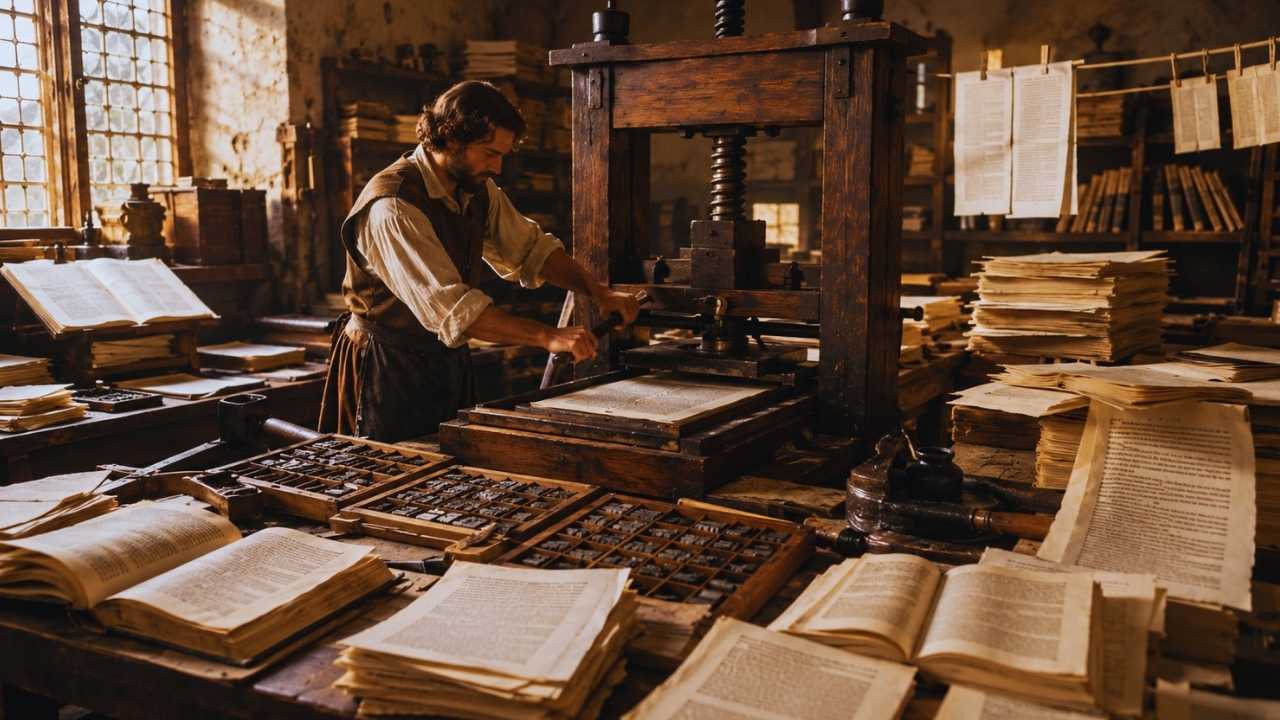
Think about waiting three full years just to read a single book. Sounds absolutely crazy to us today, right? But before 1440, that was completely normal. Books were extreme luxury items, painstakingly copied by hand onto expensive animal skin. If a library caught fire, an entire century of human knowledge could literally go up in smoke in a single afternoon.
Then, a German goldsmith named Johannes Gutenberg changed the rules of the game forever. Gutenberg did not just build a simple machine. He built the entire launchpad for the modern information age. His movable type press completely broke the church and the elite’s absolute stranglehold on knowledge. It made books cheap, fast to make, and easy for everyday people to get their hands on.
When you look closely at the printing press impact history, you pinpoint the exact moment we left the Middle Ages and aggressively entered the modern world. It triggered religious rebellions, launched modern science, and finally taught the masses how to read silently to themselves.
The Dark Age of Information: Life Before the Press
To truly grasp how much this incredible machine changed things, you have to realize how heavily restricted information used to be. For centuries, news traveled mostly by word of mouth. When people did write things down, they did it entirely by hand. Monks sat in dead-quiet rooms called scriptoria, copying out texts one painstaking letter at a time. This setup was a total nightmare for human progress. First off, it was painfully slow. A medieval copyist needed about three years to finish a single copy of the Bible.
Second, humans make constant mistakes. Scribes got tired, skipped words, and misspelled important names. Over decades, crucial historical texts got completely ruined, meaning the idea of a perfectly accurate, definitive book did not exist. Furthermore, books cost an absolute fortune. Makers wrote them on vellum or parchment (treated animal skin), so just buying the blank pages was incredibly expensive. According to historians, a single hand-copied book in the 14th century could cost as much as an entire house.
Because they were so rare, libraries literally chained books to heavy wooden desks so people would not steal them. Only about 12 percent of the European population could even read. Most people lived their entire lives without ever touching a book. The people at the very top decided what got written down and what got forgotten, keeping the masses completely in the dark.
|
Aspect of Daily Life |
The Grim Reality Before the Press |
|
Production Speed |
Painfully slow; it took roughly three full years for a monk to hand-copy one Bible. |
|
Reading Culture |
Highly oral and strictly communal; private, silent reading was virtually unheard of. |
|
Information Access |
Locked completely down by royalty, rich merchants, and the powerful church. |
|
Material Costs |
Outrageously high; a heavily illustrated manuscript cost as much as a small farm. |
Johannes Gutenberg: Building the Machine
Gutenberg did not invent the whole concept out of nowhere. Inventors in East Asia, like Bi Sheng, used porcelain movable type centuries earlier. Korean printers even used metal type to print about 40 pages a day. However, Asian languages have thousands of unique characters, which made mass printing a massive headache. Gutenberg’s brilliant move was taking existing tech and adapting it for the incredibly simple, phonetic Latin alphabet. As a skilled goldsmith, he knew his way around metal perfectly.
He mixed lead, tin, and antimony to create a highly durable alloy that melted easily, cooled fast, and survived the crushing pressure of a printing press. He also completely ditched the watery ink scribes used because it ran right off metal. Instead, he mixed linseed oil and soot to make a thick, sticky ink that adhered flawlessly. Finally, he grabbed a traditional wooden screw press, which was normally used to crush grapes for wine, and repurposed it for paper. While a scribe spent three agonizing years writing one Bible, Gutenberg’s busy shop used that exact same time to print roughly 180 of them.
Here is the heartbreaking part: the guy who completely changed the world died broke. In 1448, Gutenberg took a massive loan from a wealthy investor named Johann Fust. The heavy debt snowballed. When Gutenberg could not pay it back on time, Fust sued him, won the lawsuit, and seized the equipment right as the famous 42-line Bibles were finishing up. Fust got extremely rich, and Gutenberg died almost bankrupt.
|
The Key Invention |
How It Worked to Change Printing |
|
Movable Metal Type |
Individual cast letters built to be rearranged and reused constantly for new pages. |
|
The Matrix Mold |
A highly precise hand mold used for making quick, exact copies of individual letters. |
|
Oil-Based Ink |
A sticky, durable mix of soot and linseed oil that stuck perfectly to metal type. |
|
The Wooden Press |
Adapted directly from heavy screw presses used to crush grapes for winemaking. |
Economic Explosion: Printing Press Impact History on Cities
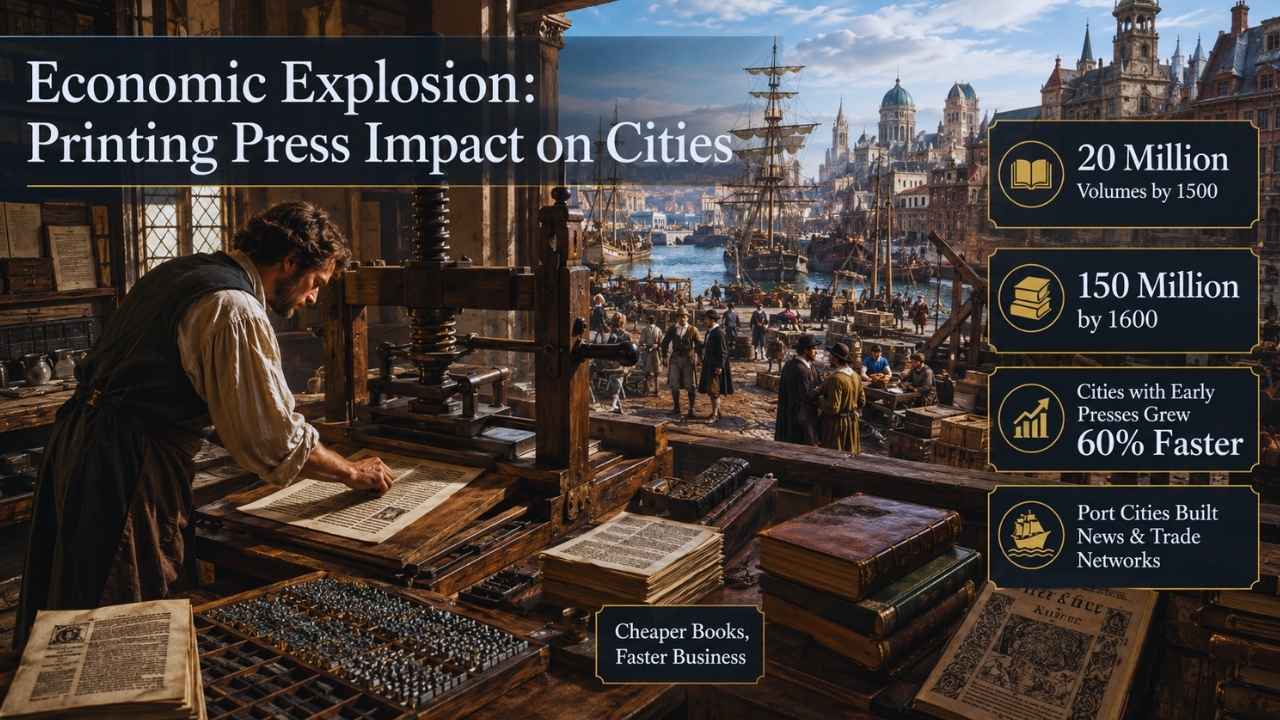
Once the massive secret of the press got out, the technology spread like an absolute wildfire across the continent. Looking back, the printing press impact history reveals a staggering economic boom that completely reshaped Europe. By 1500, just 50 years after Gutenberg’s first Bible, printers running 1,700 presses had pumped out roughly 20 million volumes of 40,000 different books. A century later, that number aggressively skyrocketed to 150 million. This unbelievable flood of books triggered serious urban growth.
Economic researchers pulled the hard data and found something completely wild: European cities that adopted printing presses in the late 1400s actually grew 60 percent faster between 1500 and 1600 than similar cities that did not. The press became the ultimate tool for cutting commercial costs and doing fast business. Printers also built the world’s very first global news network. Port cities like Venice realized they could combine cheap boat transport with cheap printing to make an absolute killing.
Printers quickly sold four-page news pamphlets, travel guides, maps, and accounting manuals to eager merchants and sailors. Ships left port carrying the absolute latest breaking news on foreign wars, local scandals, and new trade routes. For the very first time in human history, checking the daily news became a completely normal part of everyday life.
|
Economic Shift |
The Hard Data and Facts |
|
Massive Book Volume |
Hit roughly 20 million copies by 1500; skyrocketed to an insane 150 million by 1600. |
|
Radical Price Drop |
Books became dramatically cheaper, completely undercutting the expensive manuscript market. |
|
Explosive City Growth |
Cities with early presses grew 60 percent faster in the 1500s than those without them. |
|
Global News Networks |
Port cities actively used cheap printing to build massive international trade and news networks. |
Standardizing Language and Launching Science
Before mass printing hit the scene, spelling was an absolute, chaotic mess. People spelled words strictly based on their heavy local accents. You could easily find the exact same word spelled five entirely different ways on a single page of text. Printers absolutely hated guessing. Setting tiny metal letters by hand is exhausting, backbreaking work, and they needed serious efficiency to make a profit. So, professional print shops created strict in-house style guides. They firmly laid down the law on proper spelling, basic grammar, and standard punctuation.
This quickly wiped out a lot of small regional dialects but heavily helped unify entire countries under one highly standard language. This exact same intense standardization aggressively launched modern science. Before the press, doing any kind of science was deeply frustrating. If a brilliant astronomer drew a perfect map of the stars, a tired monk would inevitably ruin it while copying it.
Hand-drawn data literally got worse with every single generation. The press completely fixed this instantly. A highly detailed woodcut diagram of a human heart printed in Italy looked exactly the same when someone eagerly read it in England. This incredible consistency created actual peer review. Scientists could finally share their findings across borders, relentlessly test each other’s work, and confidently build on highly accurate data instead of starting over from scratch every generation.
|
The Scientific Upgrade |
Why It Mattered to Human Progress |
|
Accurate Diagrams |
Medical and space drawings finally looked exactly the same in every single printed copy. |
|
Global Peer Review |
Scientists shared data instantly, letting others test and verify their exact historical work. |
|
Spelling Rules |
Wild, completely chaotic regional spellings got firmly locked into official national standards. |
|
Data Preservation |
Crucial mathematical and biological discoveries were no longer lost due to lazy copying errors. |
Rewiring the Human Brain: Literacy and Copyright
If books cost as much as a small house, why would anyone ever bother learning to read? At the very end of the Middle Ages, reading was incredibly rare among the working class. The printing press aggressively created a massive, immediate demand for basic literacy. While an early printed book was still a serious purchase, it was a massive bargain compared to a handwritten manuscript. For example, by the 1490s, a printed copy of a great work by Cicero only cost a month’s salary for a local school teacher, making it highly attainable.
Plus, smart printers quickly figured out that cheap, everyday items sold much faster than massive Bibles. They aggressively flooded the eager market with short poems, romance novels, tasty recipes, and fun sheet music. The press actually changed how our human brains process complex information. Before the press, someone usually read a highly expensive book out loud to a gathered crowd. Mass-produced books actively moved society toward silent, intensely private reading. People started thinking much more deeply and forming their own completely independent opinions.
Because every copy of a printed book was exactly the same, the modern concept of “authorship” officially became a real thing. When book sales became big, serious business, governments literally had to invent the very first copyright laws to protect writers from blatant theft. Plus, identical copies meant printers could finally add highly useful things we completely take for granted today: page numbers, accurate tables of contents, and highly detailed indexes.
|
Cultural Shift |
The Wild Post-Press Reality |
|
Reading Habits |
People stopped reading out loud in noisy groups and started reading silently entirely alone. |
|
New Book Features |
Printed books finally gained standard page numbers, indexes, and accurate tables of contents. |
|
Author Rights |
Exact copies meant an author’s specific words finally mattered, birthing intellectual property. |
|
Copyright Laws |
European governments rapidly passed the very first laws to stop people from stealing printed work. |
The Protestant Reformation: The First Viral Campaign
In 1517, a deeply frustrated monk named Martin Luther boldly wrote out a long list of harsh arguments against the Catholic Church’s deeply corrupt practices. A century earlier, this tiny rebellion would have died incredibly fast. The church would have aggressively silenced him, burned his writings, and everyone would have moved on in complete fear. But Luther luckily lived in the fast-paced printing age.
Smart printers grabbed his complex Latin arguments, quickly translated them into everyday, easy-to-read German, and printed thousands of cheap copies. Luther basically became the world’s very first viral author. People read his sharp words and felt incredibly empowered to challenge authority. The press completely stripped the powerful church of its age-old ability to control the daily narrative. Information aggressively crossed national borders instantly, completely bypassing traditional religious gatekeepers.
Ambitious print shops turned into massive, highly efficient translation hubs, actively ditching elite Latin for the common languages regular people actually spoke. The massive shift tore Europe apart and completely reshaped the cultural map. We constantly see the printing press impact history acting as the ultimate weapon to tear down old, deeply entrenched power structures and give loud voices to the completely powerless masses.
Read Also: Leading e-Learning & Content Revolution
|
The Reformation |
What Actually Happened |
|
Martin Luther |
Aggressively used cheap printing to heavily blast the Catholic Church’s corrupt practices. |
|
Going Viral |
Printers quickly churned out hundreds of thousands of copies of Luther’s highly controversial work. |
|
Local Languages |
Printers boldly stopped relying on Latin and translated religious texts into local, everyday languages. |
|
Power Shift |
Bypassed priests entirely by allowing everyday people to directly read the Bible for themselves. |
Final Thoughts
You simply cannot separate modern, everyday life from the brilliant invention of movable type. Every massive, history-altering leap forward over the last 500 years—the Italian Renaissance, the intense Scientific Revolution, the bold Enlightenment—relied heavily on the cheap, incredibly fast spread of radical ideas. Gutenberg bravely gave us the incredible power to strictly record everything we know and eagerly hand it to anyone completely willing to read.
Looking back, the printing press impact history isn’t just a simple story about how we used to make heavy books. It is the absolute definitive story of how we aggressively broke down massive walls of dark ignorance and rapidly built the fast-paced, highly connected, data-driven world we live in today. Without this single, powerful invention, we would likely still be entirely stuck in the dark, waiting years for a single piece of basic information.
Frequently Asked Questions (FAQs) About Printing Press Impact History
Did Gutenberg get rich from his invention?
No. He took on heavy debt from financier Johann Fust to build his presses. After a financial dispute in 1455 over 1,550 borrowed guilders, Fust sued Gutenberg, won the lawsuit, and took control of the printing equipment right as the Gutenberg Bibles were completed. Gutenberg died nearly bankrupt around 1468.
How much did a Gutenberg Bible cost originally?
Customers paid about 20 to 30 guilders (or florins) for a paper copy, and roughly 50 guilders for a copy printed on vellum. For context, a master craftsman earned between 20-30 guilders a year. While expensive, it was a massive price drop compared to a hand-written book.
What was the first book printed in English?
“The Recuyell of the Historyes of Troye,” translated and printed by William Caxton in 1473. He actually printed it in Bruges, Belgium, before bringing the press over to England.
Did the printing press invent the idea of page numbers?
While rudimentary page numbers existed in some rare hand-copied manuscripts, the printing press made page numbers, indexes, and tables of contents a standard, expected feature. Because every copy in a print run was finally identical, these reference tools actually functioned properly.
How did the printing press affect the economy of cities?
Cities that adopted the printing press in the late 1400s saw a massive economic boom. According to economic research, between 1500 and 1600, European cities where printing presses were established grew 60% faster than otherwise similar cities.
What ink did Gutenberg use?
He couldn’t use standard water-based scribe ink, as it ran off the metal type. He invented a thick, viscous oil-based ink using a mixture of linseed oil and lampblack (soot) that adhered perfectly to the metal.