
Think about the last time you learned a completely new skill, like riding a bike, typing on a keyboard, or playing a video game. You probably did not get it perfectly right on the very first try. You needed a bit of practice to recognize the balance, remember the key placements, or master the controls. Your body does something remarkably similar when it comes into contact with a new germ.
Usually, the first time a dangerous virus or bacteria enters your system, your body is caught completely off guard. It has to figure out exactly what the threat is, map out its shape, and learn how to fight it, all while the virus is actively multiplying and making you feel terrible. Vaccines completely change this timeline by giving your body a chance to practice in a completely safe, controlled environment.
When we talk about how vaccines work, we are really talking about an internal training camp. A vaccine acts just like a “wanted” poster for your immune system. It shows your internal security guards what a specific germ looks like without ever actually making you ill. Because your body has already seen the “mugshot” of the virus, it stays on high alert and ready to react. If that specific virus ever tries to sneak into your body for real, your internal security team recognizes it instantly and kicks it out before it can multiply or cause any damage. This guide will walk you through the fascinating biology of that process in simple, everyday language, breaking down the exact steps your body takes to build a natural, lasting defense against disease.
The Body’s Internal Security System
Before diving into the actual shots themselves, we have to look closely at the incredible defense system already living and working inside you. Your immune system is a highly complex network of cells, tissues, and organs that act together like a 24/7 security detail. It spends every single second of every day scanning your body for anything that does not belong. When it finally finds a stranger—like a harmful bacteria or a rapidly spreading virus—it immediately goes into attack mode to keep you healthy.
The Innate Immune System
Your innate immune system is your body’s automatic first responder, and it jumps into action the moment any foreign invader breaks through your skin or enters your airways. This system does not actually care what kind of germ is attacking; it just knows that something is wrong and needs to be stopped immediately. It includes physical barriers like your skin, the sticky mucus in your lungs that traps dust and bugs, and stomach acid that destroys germs you might swallow.
When a germ gets past these walls, the innate system sends out general-purpose white blood cells known as macrophages. Think of them like a neighborhood watch program that sounds the alarm and starts gobbling up anything that looks suspicious. This early, chaotic battle is exactly what causes things like inflammation, swelling, and fever. While a fever feels awful, it is actually a sign that your innate immune system is actively trying to cook the germs out of your body and signal for heavier backup.
|
Feature of Innate System |
Description of Function |
Role in Vaccine Response |
|
Physical Barriers |
Skin, tears, stomach acid, and respiratory mucus. |
Blocks initial entry; bypassed by a needle injection. |
|
Macrophages |
Scavenger cells that eat foreign particles and debris. |
Swallows the vaccine material to show to other cells. |
|
Inflammation |
Increased blood flow to the site of an infection. |
Causes the sore arm you feel after getting a shot. |
|
Fever Response |
Raising body temperature to make it hard for germs to live. |
A mild, temporary fever shows the vaccine is working. |
The Adaptive Immune System
If the innate system is the neighborhood watch, the adaptive immune system is the highly trained special forces unit. This branch of your immunity is much slower to wake up and get moving, but it is incredibly precise and deadly once it arrives. The adaptive system creates long-term “memory” inside your body. It uses specialized cells to carefully identify the specific protein “fingerprint” of an invading germ.
Once it identifies the exact shape of the enemy, it takes a few days to manufacture custom-built weapons specifically designed to destroy that one exact germ. This highly targeted part of your defense is what vaccines specifically aim to trigger. By interacting with the adaptive system, vaccines ensure you walk away with a long-term, highly specific memory of how to fight off a disease, so your body never has to build those weapons from scratch again.
|
Feature of Adaptive System |
Description of Function |
Role in Vaccine Response |
|
Specificity |
Targets one exact germ shape instead of a general attack. |
Learns the exact shape of the vaccine’s active ingredient. |
|
Response Time |
Takes several days or weeks to fully activate the first time. |
Explains why vaccines take about two weeks to work. |
|
Custom Weaponry |
Creates proteins that specifically bind to the invader. |
Builds the exact tools needed for future protection. |
|
Long-Term Memory |
Remembers the germ’s fingerprint for years or decades. |
Provides lasting immunity long after the shot is gone. |
B-Cells and T-Cells
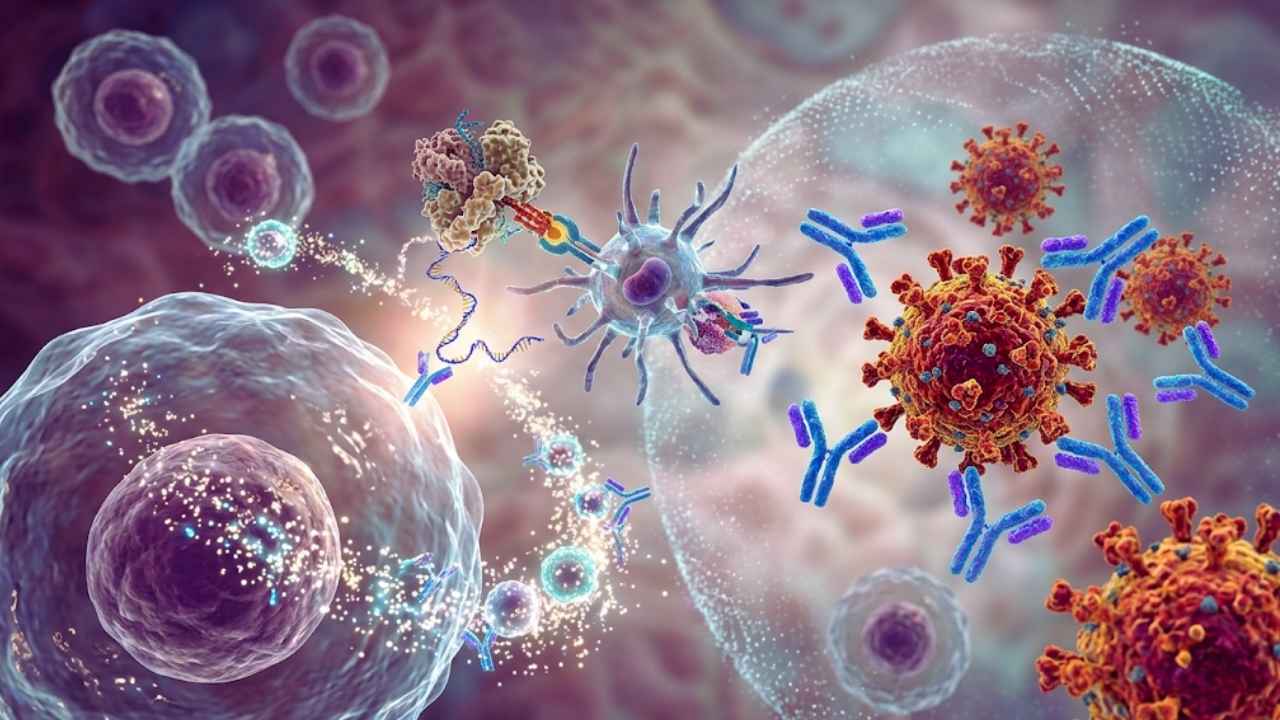
B-cells and T-cells are the absolute heavy hitters of your adaptive immune system, working closely together to wipe out infections. B-cells act exactly like microscopic weapon factories that float through your bloodstream. When they spot a foreign germ, they start pumping out millions of tiny, Y-shaped proteins called antibodies. These antibodies lock onto the outside of viruses like a key sliding into a lock, completely neutralizing them so they cannot break into your healthy cells.
T-cells, on the other hand, act as the frontline soldiers. While B-cells handle the germs floating in the blood, killer T-cells hunt down your own cells that have already been hijacked by a virus and destroy them to stop the virus from multiplying. Meanwhile, helper T-cells act like battlefield generals, shouting chemical orders to keep the B-cells and killer T-cells organized. Together, this coordinated team forms a powerful memory that stands ready to protect you for years to come.
|
Cell Type |
Primary Function |
Vaccine Interaction |
|
B-Cells |
Acts as an antibody manufacturing factory. |
Produces specific antibodies matched to the vaccine. |
|
Helper T-Cells |
Directs the immune response and sounds alarms. |
Validates the vaccine material as a real threat. |
|
Killer T-Cells |
Destroys cells that have already been infected. |
Learns to spot cells showing signs of the specific virus. |
|
Memory Cells |
Stays in the body long after the infection clears. |
Waits quietly for years in case the real virus returns. |
The Science Behind the Training Process
Understanding how vaccines work requires looking closely at how they manage to introduce a “threat” safely without putting your life at risk. Most people simply think a vaccine is just a regular medicine, like a painkiller or an antibiotic, but it is actually much more like a biological simulation.
It closely mimics a real infection so your body is forced to build up its strength and deploy its special forces. Once the simulation is over, the vaccine material naturally breaks down and leaves your body entirely, but the valuable knowledge it gave your immune system stays behind forever.
Antigens: The Identification Badge
The absolute key to understanding any vaccine is understanding the antigen. An antigen is just a tiny, harmless piece of a germ—usually a single protein or sugar found on its outer surface. It is absolutely not the whole, living germ, so it is physically impossible for an antigen to multiply or make you sick. However, it is the exact part that your immune system uses to recognize the germ as a foreign invader.
Think of the antigen like the unique uniform worn by an enemy army. When the vaccine is injected into your arm, your immune system spots these floating uniforms and instantly thinks, “Wait a minute, this definitely should not be here.” It then starts the complex, multi-day process of building the perfect antibodies to attach to that specific shape, essentially learning the enemy’s disguise.
|
Antigen Aspect |
Detailed Explanation |
Importance in Vaccination |
|
Composition |
Usually made of proteins, peptides, or complex sugars. |
Gives the immune system a physical target to grab onto. |
|
Safety Profile |
Cannot replicate or cause the actual disease. |
Allows the body to train without any risk of severe illness. |
|
Recognition |
Acts as the unique “fingerprint” of the virus or bacteria. |
Ensures the immune system learns the correct target. |
|
Antibody Trigger |
Forces B-cells to find a matching antibody shape. |
Starts the exact biological process needed for immunity. |
Creating Immune Memory
The single most important goal of any vaccination is creating those magical memory cells. After your immune system successfully “defeats” the harmless antigens introduced by the vaccine, a small but vital group of B-cells and T-cells actually transform their structure to become memory cells. These veteran cells leave the bloodstream and settle down in your lymph nodes and bone marrow, sometimes staying there for the rest of your life.
They are essentially retired soldiers who have seen the enemy before and kept their weapons sharp. Because they are already trained and hold the exact blueprints for the right antibodies, they can respond to a real infection incredibly fast. If you breathe in the real virus, these memory cells wake up and flood your body with defenses in a matter of hours, rather than the days or weeks it usually takes for a first-time response.
|
Memory Phase |
What Happens Inside the Body |
Why It Matters for Your Health |
|
Clearance |
The vaccine antigens are entirely destroyed and removed. |
Your body returns to normal, but retains the new knowledge. |
|
Transformation |
Select B and T cells morph into long-living memory cells. |
Creates a standing army dedicated to one specific disease. |
|
Storage |
Memory cells hide in bone marrow and lymph nodes. |
Keeps the blueprints safe and ready for rapid deployment. |
|
Secondary Response |
Massive antibody production triggered upon real exposure. |
Stops the real virus before you even realize you are sick. |
The Role of Adjuvants
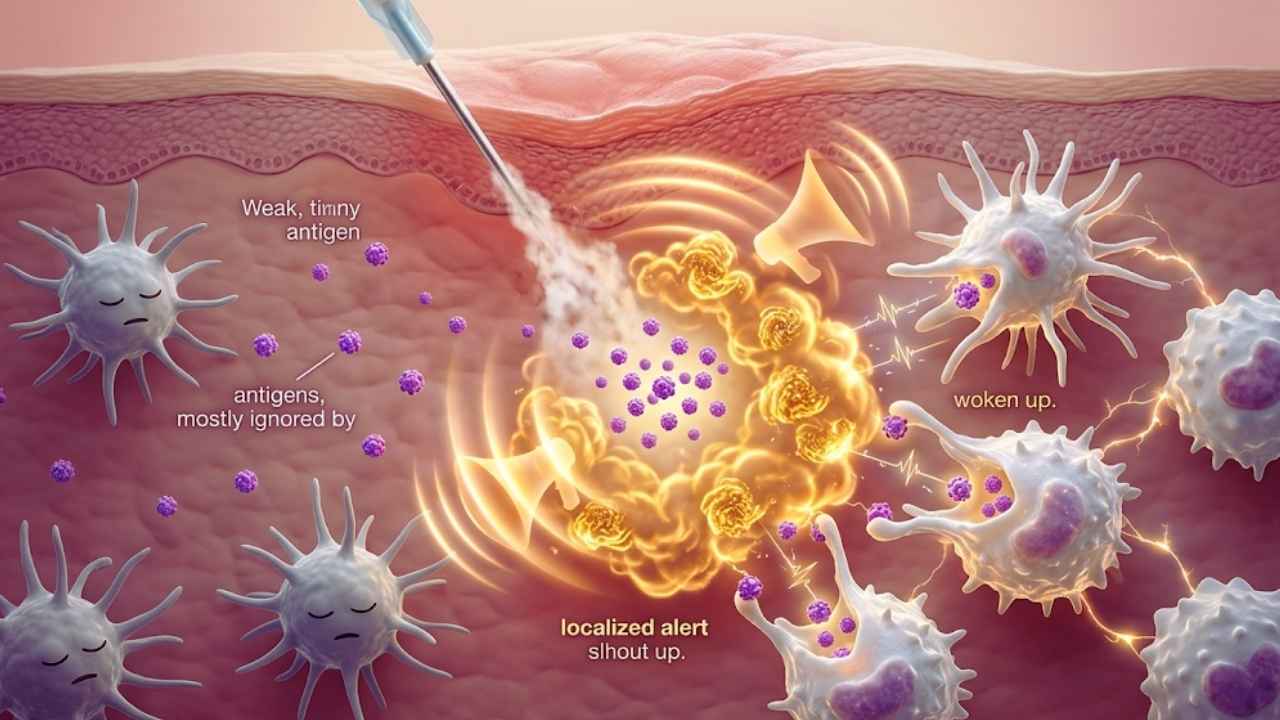
Sometimes, the purified antigen in a modern vaccine is so tiny or so incredibly weak that the immune system might actually just ignore it and go back to sleep. To fix this problem, scientists add a special ingredient called an adjuvant. Think of an adjuvant exactly like a giant megaphone for your immune system. It shouts at your white blood cells to wake up and pay close attention to the antigen floating nearby.
By creating a tiny, localized alert at the injection site, the adjuvant ensures the body takes the threat seriously enough to build a strong, lasting memory. Common, well-tested adjuvants include tiny amounts of aluminum salts, which exist naturally in water and food, and have been used safely in routine vaccines for many decades to guarantee a robust immune response.
|
Adjuvant Fact |
How It Works in the Shot |
Resulting Benefit |
|
Purpose |
Boosts the body’s natural response to an antigen. |
Ensures the vaccine works even with very tiny antigen doses. |
|
Mechanism |
Mimics natural danger signals to attract white blood cells. |
Pulls the immune system’s attention directly to the injection site. |
|
Common Types |
Aluminum salts, squalene oil, or specialized lipids. |
Highly tested ingredients that safely irritate the immune system. |
|
Side Effects |
Responsible for localized swelling or redness. |
Proves that the immune system is actively working and learning. |
The Different Types of Vaccines
Not all vaccines are built the exact same way. Depending on the specific virus or bacteria, how it infects human cells, and who will be receiving the shot, scientists use very different technologies to teach the body. In the past, we mostly relied on weakened or completely dead versions of the entire germ.
Today, we have incredibly precise, cutting-edge tools like mRNA that allow us to be safer and faster than ever before. However, each of these different methods shares the exact same underlying goal: showing the body the germ’s “mugshot” without the danger of facing the real, aggressive disease.
Live-Attenuated and Inactivated Vaccines
Live-attenuated vaccines use a living version of the germ that has been severely weakened in a laboratory setting. It is still just “alive” enough to trigger a massive, full-body immune response, but it is far too weak to cause actual disease in healthy individuals. Because it perfectly mimics a natural infection, it creates incredibly strong, lifelong immunity with just one or two doses.
In contrast, inactivated vaccines use germs that have been completely killed using heat, harsh chemicals, or radiation. Since the germ is entirely dead, it cannot reproduce at all, making it incredibly safe even for people with weaker immune systems. However, because it is dead, the immune response is not quite as loud, meaning you often need multiple booster shots to keep your memory fresh.
|
Vaccine Technology |
How the Germ is Processed |
Real-World Examples |
|
Live-Attenuated |
Germ is weakened by passing it through animal cells in a lab. |
Measles, Mumps, Rubella (MMR), Chickenpox. |
|
Inactivated |
Germ is completely killed using chemicals like formaldehyde. |
Polio shot, Hepatitis A, traditional Flu shot. |
|
Immunity Strength |
Live vaccines offer stronger, longer-lasting initial protection. |
Live vaccines rarely need adult boosters. |
|
Safety Profile |
Inactivated vaccines are safer for compromised immune systems. |
Inactivated vaccines cannot mutate back to a dangerous form. |
Subunit, Recombinant, and Conjugate Vaccines
Instead of using the whole, intact virus or bacteria, subunit vaccines only use a specific, purified piece of the germ—usually just a single protein or sugar from its outer casing. Because these vaccines only contain a tiny fragment, they are extremely well-tolerated by the human body and tend to have far fewer side effects like high fevers. They are absolutely excellent for people with weakened immune systems or chronic health issues.
Recombinant vaccines take this a step further by using simple yeast cells to manufacture the virus protein in massive vats, ensuring no real virus is ever used in the factory. Conjugate vaccines are specifically used for sneaky bacteria that coat themselves in sugars to hide from the immune system; scientists attach these sugars to a strong protein so the immune system is forced to notice and attack the disguise.
|
Vaccine Strategy |
Detailed Mechanism |
Common Examples |
|
Subunit |
Extracts only the essential protein needed to trigger immunity. |
Whooping Cough (Pertussis) component of the DTaP shot. |
|
Recombinant |
Uses yeast to grow the specific virus proteins safely in a lab. |
Hepatitis B, HPV (Human Papillomavirus) vaccines. |
|
Conjugate |
Ties weak bacterial sugars to strong proteins to force a response. |
Hib disease, Pneumococcal bacterial vaccines. |
|
Advantage |
Zero chance of the vaccine causing the actual disease. |
Provides a highly focused, very safe immune response. |
mRNA and Viral Vector Technology
This represents the absolute newest, most exciting frontier of how vaccines work. Instead of putting a piece of the germ directly into your body, mRNA vaccines actually give your own cells a temporary “recipe” written in genetic code. Your cells quickly read this recipe and temporarily manufacture a harmless protein that looks exactly like the spikes on the outside of the virus.
Your immune system then reacts to that protein just like it normally would. Viral vector vaccines do something very similar, but instead of using a fat bubble to deliver the recipe, they use a different, completely harmless virus as a delivery truck. Both of these incredible methods are astonishingly fast to design and produce, making them our best tools for fighting sudden, rapidly spreading global outbreaks.
|
Modern Technology |
How It Delivers the Message |
Key Benefits |
|
mRNA Delivery |
Uses a tiny bubble of fat (lipid nanoparticle) to protect the code. |
Extremely rapid development; easily updated for new variants. |
|
Viral Vector |
Uses an altered, harmless adenovirus to carry the genetic code. |
Highly stable at normal refrigerator temperatures. |
|
Cellular Action |
Forces muscle cells to temporarily build the viral protein. |
Creates a massive, highly specific T-cell and B-cell response. |
|
Breakdown |
The mRNA code is destroyed by the body within a few days. |
Leaves zero permanent genetic traces behind in your cells. |
The Path from Lab to Pharmacy
Safety is understandably the biggest concern for most people when they roll up their sleeve and think about getting a shot. The journey any modern vaccine takes before it ever reaches your local pharmacy is incredibly long, strictly regulated, and filled with difficult checkpoints.
It is absolutely not just a few scientists mixing liquids in a lab; it involves tens of thousands of human volunteers, massive clinical data, and independent experts who heavily scrutinize every single data point. By the time a vaccine is officially approved for the public, we usually know exactly how well it works and exactly what its most common, mild side effects will be.
Exploratory and Pre-clinical Stages
The entire process starts with years of basic, quiet research. Scientists spend countless hours studying a new virus under electron microscopes to find its absolute “weak spot”—usually the specific surface antigen that will trigger the best possible immune response without causing harm. Once they identify it, they build a prototype vaccine and test it heavily in a laboratory using isolated cell cultures and complex computer models.
If it passes those tests, it moves to animal testing, usually involving mice or monkeys. This pre-clinical stage is strictly about toxicology; making absolutely sure the vaccine is not toxic to living tissue and that it successfully causes the animal’s immune system to wake up and produce antibodies. If a prototype fails here, it is thrown out and never makes it to humans.
|
Testing Stage |
Primary Activities |
Goal of the Stage |
|
Exploratory |
Studying the germ’s genetic code and physical structure. |
Identifying the best possible antigen target. |
|
Cell Cultures |
Applying the prototype vaccine to human cells in petri dishes. |
Checking for basic cellular toxicity and cellular reaction. |
|
Animal Testing |
Injecting the prototype into mice or non-human primates. |
Ensuring the whole living body handles the compound safely. |
|
Immunogenicity |
Measuring the animal’s blood for new, specific antibodies. |
Proving that the vaccine actually triggers the immune system. |
Clinical Trials: Phases 1, 2, and 3
Human clinical trials are where the real, intense testing happens, moving very cautiously in three distinct phases. Phase 1 involves a very small group of incredibly healthy volunteers (usually 20 to 100 people) simply to test for absolute basic safety and figure out the correct dosage size. Phase 2 expands the trial to hundreds of diverse people, looking closely at how different groups—like the elderly or young children—react, while closely monitoring for any common side effects like fevers or aches.
Phase 3 is the massive, final test. Tens of thousands of people are randomly split into two distinct groups: one gets the real vaccine, and one gets a saltwater placebo. Scientists then wait months to see how many people in each group catch the disease naturally in their daily lives, proving beyond a doubt whether the vaccine actually works in the real world.
|
Trial Phase |
Number of Participants |
Primary Focus of the Phase |
|
Phase 1 |
20 to 100 healthy adults. |
Checking for severe allergic reactions and finding the safe dose. |
|
Phase 2 |
Several hundred diverse individuals. |
Tracking common side effects and checking antibody levels. |
|
Phase 3 |
Tens of thousands across multiple countries. |
Proving real-world effectiveness against catching the disease. |
|
Placebo Control |
Half of Phase 3 gets a fake shot for direct comparison. |
Eliminates bias and proves the vaccine is the cause of protection. |
Regulatory Approval and Manufacturing
Once all three phases of the clinical trials are finally done, mountains of raw data are sent to strict government agencies, like the FDA in the United States or the EMA in Europe. These agencies are entirely independent, meaning they do not work for the pharmaceutical companies that made the shot. They spend months pouring over every single line of data to ensure the results are honest, safe, and that the factory manufacturing process is perfectly clean and sterile.
Even after a vaccine is finally on the market, the safety checks never stop. Global scientists keep watching through massive reporting systems. They track hundreds of millions of doses to catch even the most incredibly rare side effects that might only happen to one in a million people, ensuring public safety never takes a back seat.
|
Regulatory Step |
Who is Responsible |
What They Do |
|
Data Review |
Independent government agencies (FDA, EMA, WHO). |
Analyzes raw trial data to ensure efficacy outweighs any risks. |
|
Facility Inspection |
Government health inspectors. |
Visits factories to guarantee sterile, consistent manufacturing. |
|
Batch Testing |
Manufacturers and government labs. |
Tests random vials from every batch for exact purity and strength. |
|
Ongoing Monitoring |
Pharmacovigilance systems like VAERS in the US. |
Tracks public reports to spot incredibly rare, long-term issues. |
Why We Need Boosters and Updates
You might frequently wonder why you need to get a new flu shot every single year, or why some childhood vaccines require a second, third, or even fourth dose to work properly. The biological reality is that your immune system is not a permanent, impenetrable brick wall; it is much more like a living memory that can slowly fade over time if it is not reminded of the danger.
Additionally, viruses themselves are not stupid or static—they constantly evolve and change their appearance to survive. As viruses continually change their physical “disguise,” our vaccines have to adapt and change right alongside them. This is a totally normal, expected part of how vaccines work to keep us fully protected over our entire lifespan.
Waning Immunity and Memory
For some diseases, like the measles, the memory cells your body creates after a shot stay highly active and vigilant for decades, offering near-lifelong protection. For other diseases, like tetanus or pertussis, the sheer number of protective antibodies floating in your blood slowly, naturally drops as the years go by. A booster shot acts exactly like a necessary refresher course for your internal security team.
It simply reminds your resting memory cells what the enemy looks like, causing them to suddenly wake up, multiply again, and pump out a massive, fresh batch of strong antibodies. This process keeps your active defense levels high enough in your bloodstream to completely stop a new infection before it ever gets a chance to start multiplying in your cells.
|
Immunity Factor |
Explanation of the Concept |
Real-World Application |
|
Waning Antibodies |
Natural decline of active defense proteins over time. |
Explains why adults need a tetanus booster every ten years. |
|
Memory Cell Activation |
Waking up dormant cells with a fresh antigen exposure. |
A booster shot forces these cells to rapidly multiply again. |
|
Prime-Boost Strategy |
Using multiple shots spaced out over several months. |
Helps babies build a stronger foundation for their immune memory. |
|
Long-Term Protection |
Keeping defense levels above the threshold of infection. |
Ensures you remain immune even if exposed to heavy viral loads. |
Viral Mutation and Evolution
Viruses are incredibly simple machines constantly making millions of copies of themselves inside infected bodies. Sometimes, they make a tiny biological mistake during this copying process, leading to a genetic mutation. If a virus mutates and changes its surface proteins enough, your older antibodies might not be able to physically “grab” onto it anymore, just like an old key failing to open a newly changed lock.
This process is exactly why the seasonal flu shot has to be updated every single year. Global scientists track exactly which mutant versions of the virus are spreading fastest across the globe, and they slightly update the vaccine recipe to perfectly match the newest version of the virus’s “costume,” keeping your immune system one step ahead.
|
Viral Concept |
What it Means Biologically |
Impact on Vaccination |
|
Genetic Mutation |
Errors in copying that change the virus’s physical shape. |
Forces scientists to redesign vaccines to match the new shape. |
|
Antigenic Drift |
Slow, gradual changes to a virus over several years. |
The primary reason we need a slightly different flu shot annually. |
|
Antigenic Shift |
A sudden, massive change combining two different viruses. |
Can cause a pandemic because old immunity is completely useless. |
|
Variant Tracking |
Global surveillance of circulating viral strains. |
Allows doctors to predict which vaccine formulation to use next. |
Community Impact and Herd Immunity
Vaccines absolutely do not just protect the single individual who receives the injection; they act as a powerful shield that protects the entire surrounding community. This incredible mathematical and biological concept is known as herd immunity. When a large enough portion of a town or city is fully vaccinated, a spreading virus literally has nowhere left to go.
It keeps hitting dead ends because vaccinated people stop the virus in its tracks, and it eventually dies out entirely in that area. This communal shield is exactly how humanity has managed to almost completely eliminate horrific diseases that used to kill or paralyze millions of people every single year.
Protecting the Vulnerable
It is a vital fact that not every single person in a community can safely get vaccinated. Some individuals have severe, life-threatening allergies to specific vaccine ingredients. Others are currently going through brutal treatments like chemotherapy, which completely wipes out their immune system, making vaccines totally ineffective for them. Furthermore, newborn babies are often just too young to safely receive certain routine shots.
All of these vulnerable people rely entirely on the healthy people surrounding them. When you make the choice to get vaccinated, you are actively acting as a physical shield for them. By making sure your body cannot catch, carry, or spread the virus, you are actively keeping the most vulnerable members of your family and neighborhood safe from life-threatening illnesses.
|
Community Group |
Why They Cannot Be Vaccinated |
How Herd Immunity Helps |
|
Newborn Babies |
Immune systems are too undeveloped for certain shots. |
Vaccinated parents and siblings prevent bringing the germ home. |
|
Cancer Patients |
Chemotherapy destroys their ability to create antibodies. |
A highly vaccinated town ensures they never encounter the germ. |
|
Organ Transplants |
Take heavy drugs to suppress their immune systems. |
Relies completely on the community to act as a barrier to infection. |
|
Severe Allergy Sufferers |
Might go into anaphylactic shock from vaccine components. |
Saved from illness because the virus cannot spread near them. |
The Eradication of Disease
When a community maintains an incredibly high level of herd immunity for a long enough period of time, we can actually achieve the ultimate goal: wiping a disease completely off the face of the earth. Smallpox is the most famous and triumphant example of this concept. It used to terribly disfigure and kill millions of people every single year across the globe, but thanks to a massive, decades-long global vaccination effort, the virus literally no longer exists outside of highly secure research labs.
We are currently incredibly close to doing the exact same thing with wild polio. This kind of biological miracle only ever happens when we work together as a global “herd” to deny the virus any human hosts, driving it straight into permanent extinction.
|
Disease Status |
Definition |
Real-World Examples |
|
Outbreak Control |
Stopping a sudden spike in local cases. |
Giving emergency measles shots during a localized school outbreak. |
|
Elimination |
Reducing local disease spread to absolute zero in a region. |
Polio is completely eliminated in the United States and Europe. |
|
Global Eradication |
The germ permanently ceases to exist in the wild globally. |
Smallpox (humans) and Rinderpest (cattle) are entirely gone. |
|
Ongoing Campaigns |
Massive efforts targeting the final remaining pockets of virus. |
Global health workers fighting to eradicate polio in Asia and Africa. |
Vaccine Innovation in 2026
As we continue moving rapidly through the year 2026, the underlying technology driving how vaccines work is advancing significantly faster than ever before in medical history. We are rapidly moving away from the simple, old-fashioned “one-size-fits-all” needles and heavily leaning toward much more intelligent, precise delivery systems.
These incredible innovations are specifically designed to make vaccines dramatically easier to store in warm climates, totally painless for patients to take, and vastly more powerful at preventing an infection right at the exact physical spot where it usually starts—deep inside your nose and throat.
Nasal Sprays and Needle-Free Options
One of the most exciting and practical trends dominating this year is the massive rise of mucosal vaccines. Instead of a traditional, sometimes painful needle pushed into the arm muscle, these advanced vaccines are easily given as a simple nasal spray or a sweet drop under the tongue. This is wildly important because most common viruses actually enter our bodies exclusively through our breathing passages.
By actively training the immune system right there in the mucosal lining of the nose, these vaccines can physically block a virus before it ever enters the bloodstream. It is exactly like placing your best security guards right at the front gate of the fortress, instead of waiting for the intruder to successfully break into the main living room.
|
Delivery Method |
How It Is Administered |
Main Advantage Over Needles |
|
Nasal Sprays |
A fine mist is sprayed directly into the nostrils. |
Builds massive localized immunity right where respiratory bugs enter. |
|
Oral Drops |
Liquid placed on the tongue and swallowed. |
Excellent for fighting gut viruses and incredibly easy for babies. |
|
Microneedle Patches |
Looks like a tiny band-aid covered in dissolving sugar needles. |
Totally painless, can be applied at home without a trained nurse. |
|
Mucosal Immunity |
Promotes special IgA antibodies in the nose and throat. |
Better at actively stopping transmission of the virus to other people. |
Self-Amplifying mRNA
The next massive generational leap in mRNA technology is something brilliant called “self-amplifying” mRNA, often just called sa-mRNA. Standard mRNA vaccines give your cells a single set of genetic instructions that fade quickly. Self-amplifying versions, however, give your cells those exact same instructions, but also include a microscopic, harmless “copy machine” built into the code.
This amazing feature allows your own body to temporarily produce much more of the target protein while using a drastically smaller initial dose of the actual vaccine liquid. This directly means vastly fewer side effects like fevers for the patient, and a much cheaper, faster manufacturing process that makes it incredibly easy to ship life-saving vaccines to lower-income nations quickly.
|
mRNA Technology |
Biological Mechanism |
Real-World Benefit |
|
Traditional mRNA |
Delivers a static code that is read once and destroyed. |
Highly effective but requires a relatively large physical dose. |
|
Self-Amplifying mRNA |
Includes an enzyme code that actively copies the instructions. |
Requires a tiny micro-dose, leading to far fewer side effects. |
|
Manufacturing Speed |
Smaller doses mean factories can make millions more vials. |
Solves massive supply chain bottlenecks during sudden pandemics. |
|
Global Accessibility |
Cheaper to produce and often easier to stabilize. |
Allows developing nations faster, cheaper access to top-tier shots. |
Final Thoughts
Truly understanding how vaccines work totally takes the fear and mystery out of one of the single most important, life-saving tools in all of modern medicine. They are absolutely not about pumping you full of harsh chemicals or complex, dangerous drugs; they are entirely about leveraging your own body’s incredible, natural ability to learn, adapt, and protect itself. By providing a remarkably safe “training manual,” vaccines simply ensure that your internal immune system is never caught totally off guard by a deadly invader.
From the highly traditional, weakened germs used successfully in the past to the incredibly high-tech mRNA instructions dominating the clinics of today, the ultimate goal has always remained exactly the same: keeping you, your loved ones, and your wider community perfectly safe from totally preventable diseases. As medical science continues to rapidly evolve in 2026 and well beyond, we can easily expect these vital tools to become even more pain-free, effective, and globally accessible. Getting vaccinated is simply the smartest, easiest way to take total charge of your personal health and actively contribute to a future world where massive, deadly outbreaks are nothing but a thing of the distant past.
Frequently Asked Questions (FAQs) About How Vaccines Work
Medical history and basic biology show us that nearly all true vaccine side effects happen within the first six weeks of getting the shot. This is simply because the physical vaccine ingredients completely break down and leave your body very quickly. What stays behind is nothing but your own immune system’s natural memory. Scientists have studied global vaccines for well over a century, and there is absolutely zero biological mechanism or evidence showing they cause new health problems years down the road.
Is natural immunity better or safer than vaccine immunity?
While surviving a harsh disease can definitely provide your body with natural immunity, it always comes with the massive, very real risk of severe hospitalizations, long-term health complications (like lung scarring or heart issues), or even death. Vaccines carefully provide a safe, scientifically controlled way to build the exact same strong immunity without ever putting your life, lungs, or overall health in any actual danger.
What actually happens to society if we simply stop vaccinating?
We do not have to guess; we have seen it happen. When vaccination rates drop even slightly in a community, incredibly contagious and dangerous diseases like measles or whooping cough immediately come roaring back. Outbreaks happen incredibly fast, hospitalizing children and vulnerable adults. Vaccines act like a heavy dam holding back a river of disease; if we stop maintaining the dam, the water will absolutely flood back in.
Do modern vaccines alter or interact with my human DNA?
Absolutely not. This is a very common but completely false myth, especially regarding modern mRNA technology. The mRNA code never actually enters the deep center of your cells (the nucleus) where your permanent DNA is safely locked away. It acts strictly as a temporary sticky note that your body reads, uses to build a protein, and then completely shreds and throws away within a matter of days.
Can a baby’s tiny immune system get overloaded with too many vaccines?
Not even close. A healthy baby’s immune system successfully fights off thousands of different foreign antigens every single day just by crawling on the floor, putting toys in their mouth, and breathing normal air. The antigens introduced in the entire childhood vaccination schedule represent a tiny, almost microscopic fraction of what their immune system handles naturally every single day without breaking a sweat.