


Let’s be honest right from the start. Borrowing money is stressful enough without drowning in endless banking jargon. You walk into a branch or click through an online lender’s site, and suddenly they want to know exactly how you plan to back your debt.
I always tell people that understanding the difference between secured vs unsecured loans can keep thousands of dollars in your pocket over the lifespan of your borrowing. This one specific choice dictates your interest rate, sets your actual borrowing limit, and lays out exactly what you stand to lose if your financial situation falls apart.
Whether you need to consolidate crushing credit card balances, finance a massive kitchen remodel, or handle a surprise medical bill, the path you choose shapes your finances for years. Let us cut through the fluff and look at how these two borrowing methods actually work. We will explore the hidden costs tied to them in today’s market and figure out how to decide which option makes the most sense for your wallet.
The Core Mechanics: How Do These Borrowing Options Work?
To understand how lenders look at you, you first have to understand how they look at risk. When a bank hands over a pile of cash, their absolute biggest fear is that you will simply stop paying them back. They manage this fear in two totally different ways: by holding your property hostage or by trusting your financial track record. Secured borrowing demands collateral, meaning you pledge a physical or financial asset to the bank. If you miss your monthly payments, the bank has the legal right to seize that asset, sell it off, and recoup their lost cash. Think about a standard car loan. You get the money to buy the vehicle, but the bank essentially holds the title.
If you stop sending them checks, a tow truck shows up in your driveway. Unsecured borrowing, on the other hand, operates entirely on trust and data. You do not pledge your house, your car, or your savings account. Instead, the bank looks closely at your credit score, your income history, and your current debt load. Because the bank has no immediate property to seize if you vanish into thin air, they take on a massive amount of risk and charge you a premium to make up for it. They have to assume a certain percentage of borrowers will default, so they raise the price for everyone to cover those eventual losses.
|
Feature |
Secured Debt |
Unsecured Debt |
|
Collateral Required |
Yes (Real estate, cars, cash) |
No |
|
Risk to Borrower |
High (Asset immediately at stake) |
Moderate (Credit damage, collections) |
|
Risk to Lender |
Low (Backed by tangible value) |
High (Backed only by a promise) |
|
Common Examples |
Mortgages, Auto loans, Title loans |
Personal loans, Credit cards |
Interest Rates in 2026: What Are You Actually Paying?
When you compare secured vs unsecured loans, the most obvious difference slaps you right in the face when you check your monthly payment. Risk dictates price across the entire financial industry. Because unsecured lenders stick their necks out further, they charge you higher interest rates to build a safety buffer. The broader economic climate heavily influences what you pay right now. According to recent Bankrate data from mid-2026, the overall average interest rate for a standard personal loan sits exactly at 12.28 percent for a borrower with a solid 700 FICO score. However, that number shifts wildly depending on who you are and where you shop.
If you have stellar credit, online fintech lenders advertise competitive unsecured rates starting as low as 6.20 percent. On the flip side, if your credit is rough around the edges, unsecured rates skyrocket up to maximum legal caps near 36 percent. Secured financing generally undercuts these numbers across the board because a physical asset backs the cash. The bank feels entirely safe offering much lower interest rates, which hits your wallet in the best way possible. Over a three-year repayment window on a large loan, securing a lower rate saves you thousands in pure interest.
|
Cost Factor |
Secured Financing |
Unsecured Financing |
|
Typical Rate Range (2026) |
6 to 15 percent (Varies by asset) |
6.20 to 36 percent (Averages near 12.28 percent) |
|
Rate Structure |
Often fixed, sometimes variable |
Usually fixed |
|
Upfront Fees |
Appraisal fees, title fees |
Origination fees, or zero-fee |
|
Credit Union Perk |
Great rates for auto and home |
Rates legally capped at 18 percent |
Credit Score Requirements and Approval Odds
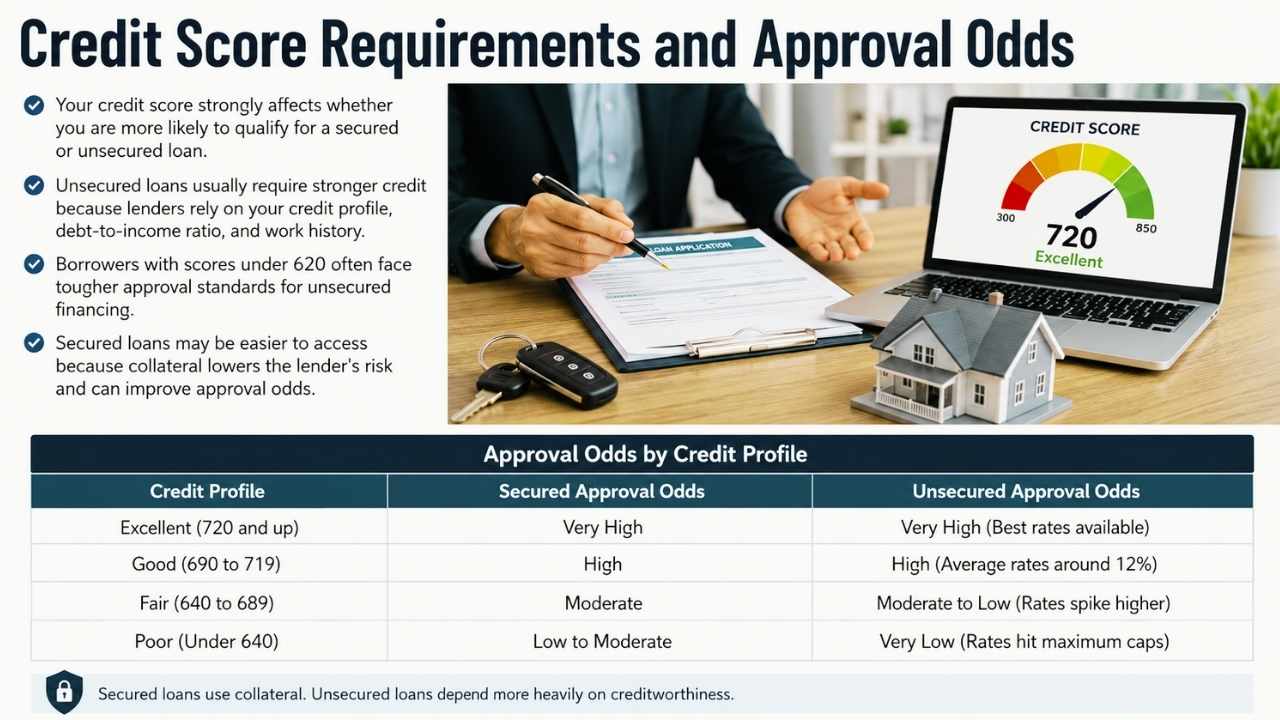 Your credit score plays a heavy hand when deciding between secured vs unsecured loans. If you boast a flawless 800 FICO score, lenders will throw unsecured money at you all day long. But if your score hovers in the low 600s, the conversation changes fast. With unsecured financing, your credit profile acts as your only proof that you actually pay your bills. Lenders look incredibly closely at your debt-to-income ratio to make sure you can afford the new payment. Commercial banks typically demand a high credit score and a solid work history for unsecured loan approval.
Borrowers with scores under 620 face massive hurdles because banks simply tighten their belts when they lack an asset to fall back on. Secured financing opens doors for people with bruised credit histories. The collateral acts as the ultimate equalizer. If you want to buy a car and you only have a 610 credit score, a bank might still approve you in ten minutes. Pledging an asset makes you look much safer on paper, letting borrowers rebuild their credit without getting instantly denied by a computer algorithm.
|
Credit Profile |
Secured Approval Odds |
Unsecured Approval Odds |
|
Excellent (720 and up) |
Very High |
Very High (Best rates available) |
|
Good (690 to 719) |
High |
High (Average rates around 12 percent) |
|
Fair (640 to 689) |
Moderate |
Moderate to Low (Rates spike higher) |
|
Poor (Under 640) |
Low to Moderate |
Very Low (Rates hit maximum caps) |
Borrowing Limits: How Much Cash Can You Access?
How much money do you actually need, and how fast do you need it? Those two questions often make the decision for you right away. The scope and scale of these two borrowing methods look completely different. Unsecured personal loans generally max out between $50,000 and $100,000. Most lenders cap their offers well below that maximum unless you pull down a massive annual salary and carry zero existing debt. Because the bank has no collateral, they limit how much they are willing to lose on a single customer. Timelines for unsecured loans stay aggressive, demanding repayment within one to seven years.
The major perk here is speed, as you can often apply from your phone and see the funds deposited directly into your checking account within 24 to 48 hours. Secured borrowing scales directly with the value of your asset. If you have a home worth half a million dollars and you have paid off most of your mortgage, you can secure hundreds of thousands of dollars against it through a home equity loan. Secured options stretch out much longer, giving your daily household budget breathing room, but the trade-off is that getting the loan often takes weeks due to appraisals and paperwork.
|
Loan Attribute |
Secured Financing |
Unsecured Financing |
|
Maximum Amount |
Up to millions (tied to asset value) |
Capped heavily at $50,000 to $100,000 |
|
Repayment Term |
5 to 30 years |
1 to 7 years |
|
Funding Speed |
Weeks (requires appraisals) |
Fast (Usually 24 to 48 hours) |
The Fallout: What Happens If You Default?
The risk profile of secured vs unsecured loans flips completely depending on whose perspective you look from. For the bank, unsecured debt is incredibly risky. For you, secured debt is the real danger zone. If you hit a financial wall, lose your job, and stop paying a secured debt, the consequences happen fast and hit hard. The lender initiates a repossession or a foreclosure. You literally lose the roof over your head or the car you drive to work. The bank liquidates the asset at an auction to clear your debt.
Here is the worst part: if the auction sale does not cover the full balance of what you owe, you might still owe the remaining difference. Defaulting on unsecured debt hurts your financial reputation, but it does not leave you stranded on the side of the road. The lender cannot instantly send someone to seize your property. Instead, they hit you with late fees and absolutely destroy your credit score. Eventually, the bank gets tired of asking for the money and sells your debt to a third-party collections agency, which could eventually lead to a lawsuit and wage garnishment if you ignore them completely.
|
Consequence |
Secured Loan Default |
Unsecured Loan Default |
|
Immediate Action |
Asset repossession or foreclosure |
Late fees, aggressive credit damage |
|
Long-term Impact |
Asset loss remains on credit report |
Debt sold to collections, possible lawsuit |
|
Direct Asset Loss |
Yes (Tied straight to the contract) |
No (Unless sued and a judge orders it) |
Real-World Scenarios: Which Loan Fits Your Life?
Theory is great, but real life requires practical choices based on your actual needs. Neither option is inherently bad; they just solve very different problems for different types of people. I firmly believe your specific goal should dictate the type of debt you take on. If you need cash fast to cover a genuine emergency, unsecured is the only way to go. You can apply while sitting on your couch and have the cash the next morning. It works perfectly for consolidating high-interest credit cards.
Taking out a 12 percent unsecured personal loan to pay off a pile of 25 percent APR credit cards saves you a fortune. It gives you a single, fixed monthly payment and an actual light at the end of the tunnel. If you plan to buy a large physical asset or start a massive home renovation, secured financing wins easily. Buying a house or a car almost always requires secured debt simply because of the sheer size of the purchase. If you already own a home, using a home equity loan offers massive borrowing power at a fraction of the cost of a personal loan.
|
Your Financial Goal |
Best Loan Type |
Why It Works Best |
|
Buying a primary vehicle |
Secured |
Lower rate, the car acts as automatic collateral |
|
Paying off medical bills |
Unsecured |
Fast funding, protects your personal property |
|
Consolidating credit cards |
Unsecured |
Fixed payment schedule, no asset requirements |
|
Major home renovations |
Secured |
High borrowing limits, extended repayment terms |
Final Thoughts
At the end of the day, picking between secured vs unsecured loans comes down to exactly what you need the money for and how much risk you can comfortably stomach. If you want speed, flexibility, and absolute protection for your physical assets, the unsecured route makes the most sense. You do not have to worry about a tow truck showing up in the middle of the night or a bank foreclosing on your family home. You will pay a premium in interest for that safety net, but for many borrowers, it buys total peace of mind.
If you need to borrow a massive sum of money, want to lock in the absolute lowest monthly payment possible, or need to overcome a bad credit score, bringing collateral to the table is your best move. Just make sure your income is rock solid before you sign the dotted line. Run the numbers, check your credit score, look at the actual costs over the life of the loan, and choose the path that keeps you moving forward without keeping you awake at night. Below is a quick wrap-up comparison to help you finalize your choice before applying.
Frequently Asked Questions (FAQs) About Secured vs Unsecured Loans
Can a lender take my house if I don’t pay an unsecured personal loan?
Not directly, and definitely not quickly. Because the loan is unsecured, they have no initial claim to your property. However, if they take you to court, win a legal judgment, and you still refuse to pay, the court could eventually place a lien on your home. This means you couldn’t sell or refinance the house without paying them out of the proceeds.
Does paying off a secured loan build my credit faster than an unsecured one?
No. The credit bureaus mostly care about your payment history and your overall debt balances. They don’t hand out extra points just because an asset backs the loan. Making on-time, in-full payments on either loan type will reliably boost your credit score over time. Consistency matters way more than the loan category.
Can I convert an unsecured loan into a secured one to lower my interest rate?
Yes, but you have to do it manually through a process called refinancing. You apply for a new secured loan—like a home equity loan or a secured auto loan—use those new funds to entirely pay off the expensive unsecured debt, and then make your new payments at the lower rate.
What happens to a secured loan if the collateral gets destroyed?
If your car gets totaled or your house burns down, you still owe the bank the money. This is exactly why lenders force you to carry comprehensive auto insurance and homeowners insurance. The insurance payout goes directly to the bank to clear the secured debt. If the insurance doesn’t cover the full balance, you are on the hook for the rest out of your own pocket.
Why do lenders legally cap credit union interest rates?
Federal credit unions operate as non-profit financial cooperatives owned by their members. They don’t exist to generate profit for Wall Street shareholders. Because of this structure, federal regulators legally cap their maximum interest rate on most loans at 18%. This makes credit unions a fantastic place to shop for an unsecured personal loan if your credit history isn’t perfect.