Turn on the news during any global crisis, and you will quickly hear politicians threatening to slap crushing penalties on a rogue nation. Tanks and troops usually stay put while treasury officials drop financial blockades instead. But what actually happens when a country launches these economic weapons?
We live in a world where trade and money flow across borders at lightning speed. Because everyone is connected, locking a country out of the global financial system can hurt just as much as a missile strike. But dropping a financial hammer does not automatically mean a regime will fold. Sometimes, dictators dig in.
Other times, everyday citizens end up paying the price while the leaders do not miss a single meal. To understand exactly how economic sanctions work, you have to look past the political speeches. You need to peek under the hood of global banking, international trade routes, and real-world data to see if these policies actually succeed.
What Are Economic Sanctions and Why Do We Use Them?
At their core, economic restrictions act as financial and trade speedbumps designed to force a change in foreign behavior without firing a single shot. One country, or a coalition of nations, hits a targeted state, business, or specific person with severe trade limits. Think of them as the ultimate geopolitical time-out. These tools are far from a modern invention. Back in 432 BC, the ancient Greek city-state of Athens passed the Megarian Decree, banning merchants from Megara from selling goods in Athenian markets.
The basic idea has not changed in over two thousand years, but our modern tools are way more precise. Today, governments can freeze individual bank accounts, block specific tech shipments, or sever an entire country’s banking system in an instant.
Countries launch these penalties for all sorts of reasons, from stopping human rights abuses and freezing nuclear weapons programs to pushing back against unprovoked invasions and cutting off funding for terrorist networks. By choking off cash and essential supplies, the country imposing the rules hopes to make bad behavior far too expensive for the target to continue.
|
Penalty Type |
How It Works in Practice |
Real-World Example |
|
Trade Embargoes |
A full or partial ban on trading goods with a specific nation. |
The long-standing US trade embargo on Cuba. |
|
Financial Restrictions |
Freezing bank accounts, stopping investments, or cutting off wire transfers. |
Blocking a country’s banks from accessing international wire networks. |
|
Sectoral Limits |
Targeting one specific industry to drain revenue without starving the whole economy. |
Banning the export of advanced computer microchips to rival nations. |
|
Targeted (“Smart”) Penalties |
Going straight after specific politicians, corrupt leaders, or oligarchs. |
Seizing superyachts, villas, and private bank accounts belonging to billionaires. |
The Core Mechanics: How Economic Sanctions Work?
You can’t just announce a blockade on television and expect global trade to instantly halt. The real work behind how economic sanctions work relies on an aggressive network of legal enforcement, government agencies, and global banks. Most major restrictions come from three big players: the United Nations Security Council, the European Union, or the United States. When the UN Security Council approves a penalty, all 193 member states are legally bound to enforce it.
But here is the catch: any of the five permanent council members can instantly veto any resolution. Since superpowers rarely agree on major conflicts today, getting the UN to pass broad, sweeping restrictions is almost impossible. That leaves individual nations to do the heavy lifting. The United States acts as the world’s chief financial referee, largely because the US dollar rules global trade. If you want to buy crude oil, grain, or foreign machinery, you almost always pay in dollars.
That money eventually clears through a bank on US soil, giving Washington huge leverage over international deals. The Office of Foreign Assets Control manages these blacklists, and they carry massive weight. The US essentially tells foreign businesses they can trade with the target, or they can trade with America, but never both. Faced with losing access to the world’s largest economy, foreign banks and corporations almost always fall in line.
|
Enforcement Stage |
What Happens on the Ground |
|
1. The Trigger |
A country violates international law, launches an invasion, or abuses its people. |
|
2. The Legal Draft |
Government officials write targeted orders, listing specific banks, companies, and ships. |
|
3. The Implementation |
Banks lock down accounts, and customs officers physically stop cargo containers at ports. |
|
4. The Enforcement |
Investigators track down illegal trade, seize smuggled assets, and fine rule-breakers billions. |
Evaluating the Success Rate: Do They Actually Work?
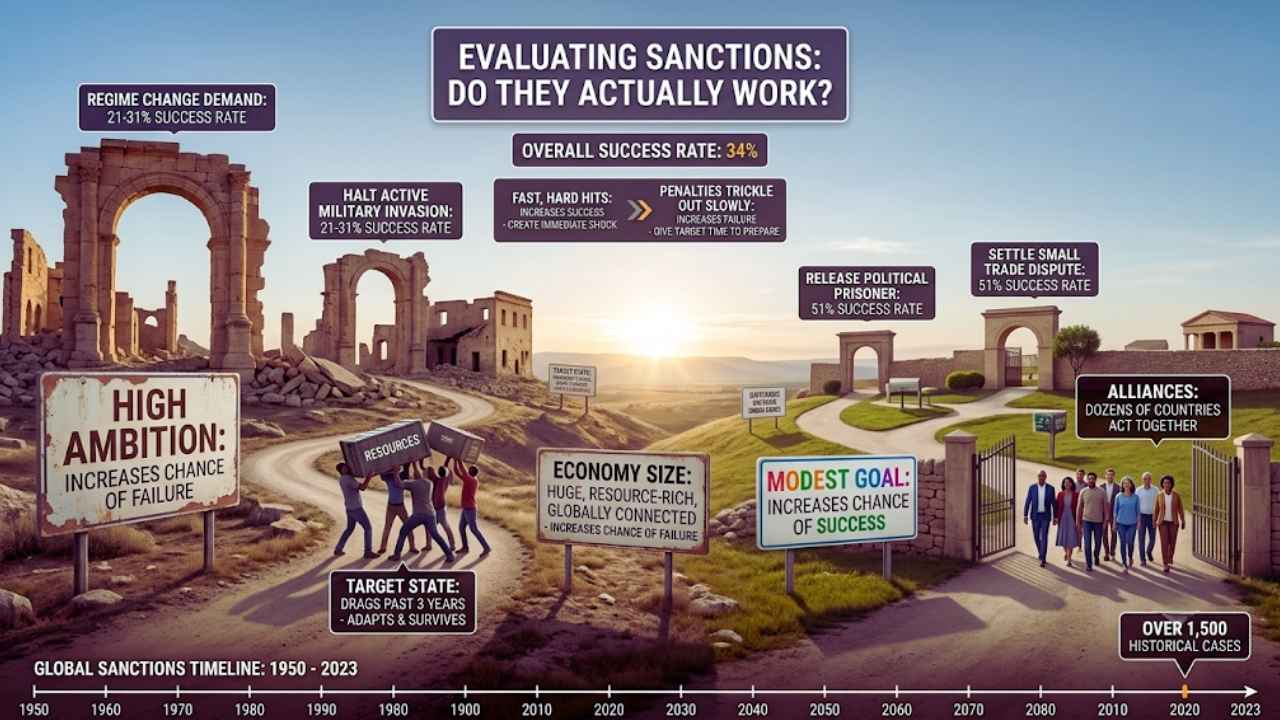
Politicians love using economic penalties because they look decisive without starting a physical war. But do they actually force foreign leaders to back down? The numbers show a surprisingly grim reality. The Global Sanctions Data Base currently tracks exactly 1,547 historical cases spanning from 1950 to the end of 2023. Looking closely at these thousands of events reveals that financial blockades fail far more often than they succeed.
According to leading quantitative studies from the Peterson Institute for International Economics, the overall success rate hovers right around 34 percent. Why is the failure rate so high? It mostly comes down to how ambitious the goal is. If a country is trying to force a massive change, like overthrowing a regime or halting an active military invasion, the success rate plummets to just 21 to 31 percent.
Dictators rarely quit just because their people are hurting. Instead, they hoard resources, blame foreign enemies, and crack down on dissent. However, if the goal is modest—like releasing a specific political prisoner or settling a small trade dispute—the success rate jumps up to 51 percent. Furthermore, if a financial standoff drags past the three-year mark, the target state almost always adapts and survives.
|
Success Factor |
Increases Chance of Success |
Increases Chance of Failure |
|
Scope of Goal |
Small, specific, and realistic policy adjustments. |
Massive demands like overthrowing a regime or ending a war. |
|
Economy Size |
Target economy is small and depends heavily on the sender. |
Target economy is huge, resource-rich, and globally connected. |
|
Timing |
Penalties hit fast and hard, creating immediate shock. |
Penalties trickle out slowly, giving the target time to prepare. |
|
Alliances |
Dozens of countries act together in a unified front. |
One country acts completely alone without international backing. |
High-Profile Case Studies: From South Africa to Russia
To really see these financial weapons in practice, it helps to look at real history and modern data. The track record is full of rare victories, decades-long standoffs, and massive economic adaptations. The global campaign against South Africa’s apartheid government in the 1980s is one of the clearest success stories. Dozens of nations cut off trade, banks pulled investments, and global consumers boycotted products, totally starving the regime of cash and forcing systemic political reform.
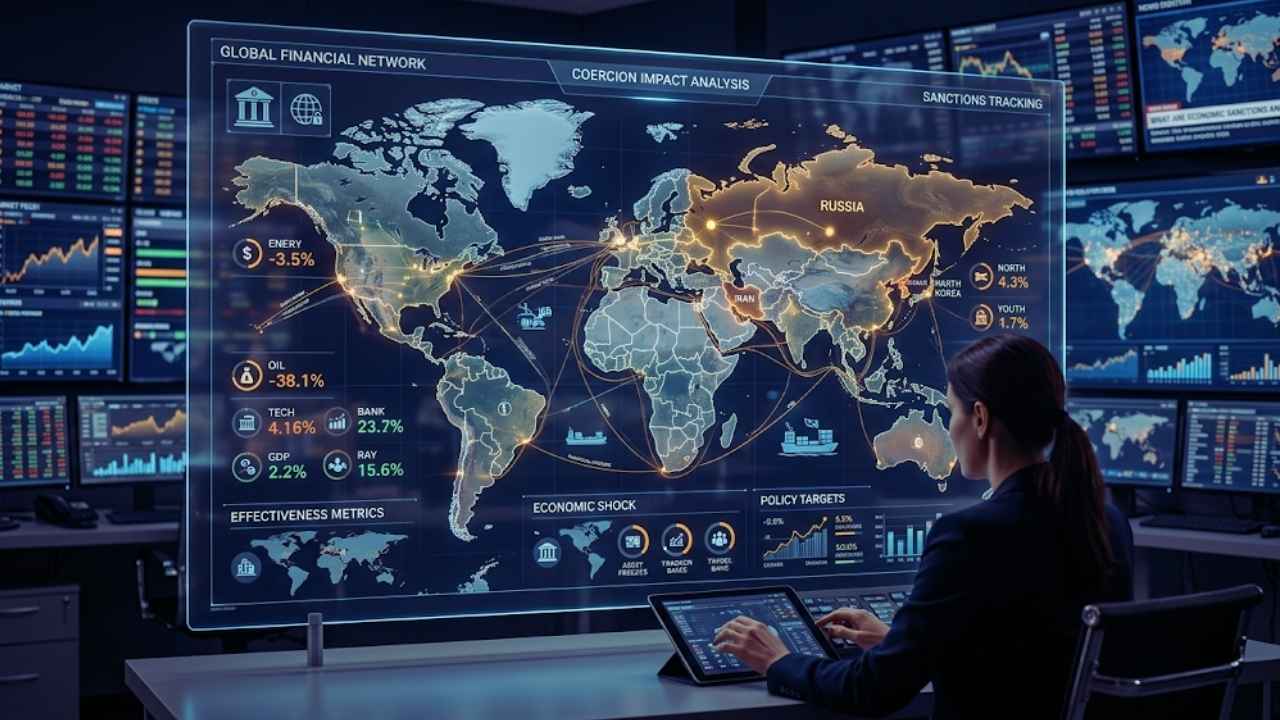
But then you have Cuba, where a 60-year United States embargo impoverished the island but completely failed to oust the communist government. The most extreme modern test is happening right now with Russia. Following the 2022 invasion of Ukraine, Western nations launched the largest financial pressure campaign in modern history. According to recent data from Castellum.AI, Russia is currently buried under 24,387 active penalties, making it the most sanctioned nation on earth by a massive margin.
For comparison, Iran holds the second spot globally with 5,475 penalties, followed by Syria at 2,879, North Korea at 2,223, and Venezuela at 838. Despite facing nearly 25,000 restrictions, Russia’s economy did not immediately collapse because they aggressively rerouted their trade away from Western nations and turned to new buyers in Asia.
|
Top Sanctioned Nations |
Total Active Penalties (Estimated) |
Current Status |
|
Russia |
Over 24,000 |
Heavily restricted but adapted via shadow fleets and Asian markets. |
|
Iran |
Over 5,400 |
Facing severe inflation but maintaining regional military influence. |
|
Syria |
Over 2,800 |
Economy is devastated, but the ruling government remains in power. |
|
North Korea |
Over 2,200 |
Completely isolated, relying on crypto theft and black markets. |
How Countries Bypass Restrictions: The Shadow Fleet & Covert Networks
When a government gets locked out of the official global market, it doesn’t just throw in the towel and surrender. Instead, it builds a parallel economy entirely off the grid. A clear example of this adaptation is the explosive growth of the global shadow fleet. To bypass Western price caps and shipping bans, countries rely on hundreds of aging, unregistered oil tankers. These ships often hide their true ownership behind complex layers of shell companies registered in neutral nations.
They turn off their location transponders, perform risky ship-to-ship oil transfers in open ocean waters, and carry absolutely no Western insurance. By operating entirely outside traditional financial channels, target states keep billions of dollars in cash flowing into their treasuries to fund their governments. Beyond these ghost ships, targeted countries rely heavily on other covert tricks to keep their economies breathing.
They set up front companies in neighboring countries to quietly purchase banned computer chips and military tech. They increasingly use decentralized digital currencies and crypto-mixers to move millions across borders without touching a single monitored bank. When all else fails, they simply revert to raw commodity bartering—trading physical gold or oil directly for weapons to skip the banking grid altogether.
|
Evasion Strategy |
How It Works in Practice |
|
Shadow Fleets |
Moving oil on old, unflagged ships that hide their location data. |
|
Middleman Countries |
Shipping goods through neutral neighbors to hide the final destination. |
|
Digital Currencies |
Using crypto networks to settle international bills off the banking grid. |
|
Raw Goods Bartering |
Exchanging physical gold or oil directly for food, machinery, and arms. |
The Unintended Fallout: Who Really Pays the Price?
When world powers drop financial blockades on an enemy, the damage rarely stays contained to government officials and corrupt politicians. In most cases, the ruling elite stay perfectly comfortable while regular families suffer the absolute worst of the consequences. Take the United Nations restrictions placed on Iraq during the 1990s. The penalties crushed the local economy, triggered sky-high inflation, and led to severe shortages of clean water, food, and basic medicines.
While everyday citizens struggled to survive, Saddam Hussein’s grip on power remained completely firm. In theory, modern laws include humanitarian exemptions so food and medicine can keep flowing into target countries. But in practice, global banks are absolutely terrified of getting hit with massive multi-billion-dollar fines for accidental slip-ups. Because of this intense fear, major financial institutions practice extreme over-compliance.
They flat-out refuse to process any payment involving a banned nation, even when the paperwork proves the order is perfectly legal medicine. As a result, civilian hospitals run out of basic supplies and vaccines. Furthermore, these bans create massive profit margins for black markets, allowing organized crime rings and corrupt government officials to get violently rich off smuggling operations while the local currency collapses.
|
Unintended Fallout |
Real-World Impact |
|
Humanitarian Crises |
Everyday people face steep inflation and severe shortages of food and healthcare. |
|
Bank Over-Compliance |
Fearful banks block legal shipments of medicine and humanitarian aid. |
|
Black Market Booms |
Organized crime and corrupt officials profit massively from underground smuggling. |
|
Financial Fragmentation |
Rival nations build independent trading networks to bypass US dollar dominance. |
The Future of Global Financial Warfare
The playbook for international pressure is changing incredibly fast, moving away from broad trade embargoes that crush entire populations and shifting toward highly precise, high-tech restrictions. One major trend is the aggressive use of technology export controls. Rather than trying to stop a country from selling its natural resources, sender nations completely ban the export of high-end components required to build modern tech. A prime example is the recent coalition effort restricting access to advanced semiconductor chips, artificial intelligence hardware, and chip-making machinery.
The goal here is not to starve a civilian population; it is to intentionally keep a rival’s military technology and computing capabilities stuck in the past. We are also seeing a massive rise in cyber and digital enforcement. Treasury officials now spend considerable time actively tracking crypto wallets, blacklisting digital laundering services, and freezing assets linked to state-sponsored hacking groups.
Since rogue states use ransomware and crypto theft to secretly fund their weapons programs, policing the digital border has become just as crucial as monitoring physical shipping ports. The future of how economic sanctions work relies entirely on outsmarting digital evasion tactics before the targets build completely untraceable financial networks.
|
Future Trend |
Primary Focus |
|
Tech Export Bans |
Choking off access to advanced microchips, AI hardware, and manufacturing gear. |
|
Digital & Crypto Tracking |
Blacklisting dark-web mixers and digital wallets used to launder stolen funds. |
|
Maritime Enforcement |
Cracking down on off-grid shadow tankers, illegal ship transfers, and fake flags. |
Final Thoughts
Economic statecraft is a messy, deeply complicated business. Looking closely at the historical numbers shows that these financial weapons fail to reach their main goals over 60 percent of the time. Target countries find clever workarounds, innocent civilians absorb almost all the pain, and global trade gets more fragmented by the day. Yet despite these obvious flaws, financial blockades remain the absolute tool of choice for world leaders.
When sending in troops is far too dangerous and doing nothing looks weak, economic penalties offer a necessary middle path. Fully understanding how economic sanctions work means recognizing them for what they really are: not quick, magic fixes, but slow, grinding tools of financial pressure whose real results take years to play out on the global stage.
Frequently Asked Questions (FAQs) About How Economic Sanctions Work
Can penalties target specific individuals, or do they always hit entire countries?
Governments target individuals all the time using “targeted” or “smart” penalties. Under laws like the US Magnitsky Act, authorities can freeze personal bank accounts, seize luxury yachts, and block travel visas for specific corrupt politicians, warlords, or oligarchs without cutting off the entire nation’s trade.
What actually happens to money when it gets frozen?
When assets are frozen, the money doesn’t disappear, and the government that froze it doesn’t automatically get to spend it. The funds simply sit locked in a secure bank account, earning interest, but completely off-limits to the owner. While politicians sometimes debate seizing frozen money to pay for war damages, doing so involves major legal hurdles under international law.
Why are these trade bans so hard to lift once put in place?
Lifting a penalty requires serious political capital. Even if a target state makes small improvements, politicians in the sender nation rarely want to look “soft” on foreign rivals by removing restrictions. Because of this political gridlock, many trade bans stay on the books for decades long after their original strategic purpose has passed.