
I watch the news every single day, and I bet you do too. Whenever a massive crisis hits—a sudden border clash, a devastating earthquake, or a global health scare—one organization always grabs the headlines. We see that iconic blue emblem on aid trucks. We hear about late-night emergency votes in New York. But let’s be honest.
Despite seeing the UN constantly on our screens, most of us only have a fuzzy idea of what actually happens behind those closed doors. If you want to make sense of modern geopolitics, understanding exactly how the United Nations works is your absolute first step. Think of the UN as a massive, incredibly messy global town hall. It isn’t a world government. It doesn’t write laws that apply to you and me. It certainly doesn’t have a secret standing army waiting in the wings. Instead, it operates as a sprawling network of diplomats, accountants, and field workers.
Their job? Trying to get 193 sovereign countries to agree on how to handle the planet’s absolute worst problems. They created the organization in 1945 from the ashes of World War II to stop a third global war. Today, the mission covers way more ground. From fighting climate change to dropping food in active war zones and navigating brutal internal budget cuts in 2026, the operation is massive. Let’s cut through the diplomatic jargon and look at the actual gears, budget constraints, and rules that keep this global machine running.
The Core Mission and 80 Years of History
To make sense of the modern UN, we have to look back at its origins and understand the massive shifts happening right now. The UN replaced the League of Nations, an earlier attempt at global teamwork that failed spectacularly to stop World War II. On June 26, 1945, 50 countries signed the UN Charter in San Francisco. Poland signed shortly after, which brought the founding members to 51. The charter laid out simple baseline goals: keep international peace, build friendly relations, and promote human rights. Today, membership has ballooned to 193 countries, representing almost every recognized sovereign state on Earth.
But things are changing fast right now. Leading into its 80th anniversary, the UN launched the UN80 reform initiative. Running a global diplomatic network burns cash rapidly, and member nations demanded a leaner system. To stay afloat, they are forcing severe structural changes and stripping away layers of old bureaucracy. For instance, the transition into 2026 saw the abolition of thousands of staff positions. The organization is desperately trying to balance its historic peacekeeping mission with the harsh financial realities of modern global economics.
|
Historical & Current Milestones |
Key Details & Modern Realities |
|
Founded |
1945. It entirely replaced the failed League of Nations. |
|
Membership Growth |
Started with 51 countries. It now proudly sits at 193 member states. |
|
Founding Goal |
Prevent global war and promote universal human rights and dignity. |
|
Current Era (2026) |
Pushing the aggressive UN80 reform initiative to drastically cut bureaucracy. |
Breaking Down How the United Nations Works in Practice
When breaking down how the United Nations works, you must look at its principal organs. Think of these as the executive branches, legislative houses, and courts of the global system. Each organ operates with distinct rules, authority levels, and internal politics that dictate global diplomacy.
The General Assembly (GA)
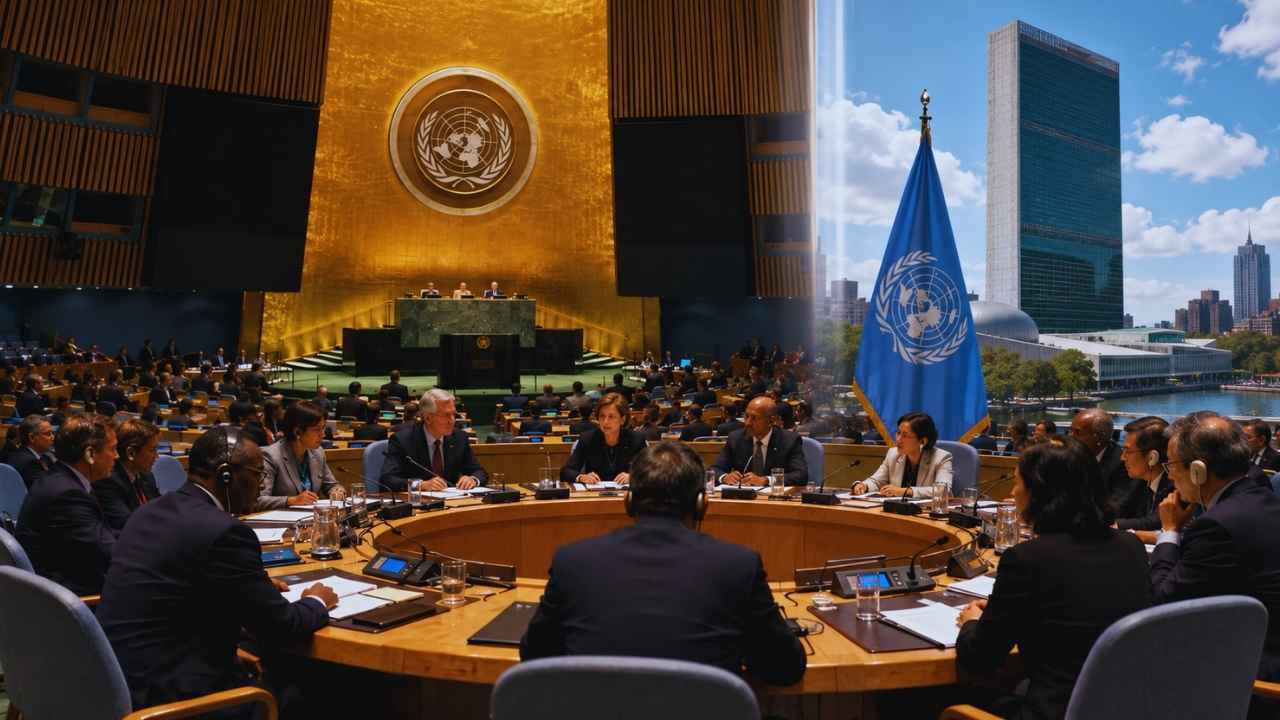
The General Assembly serves as the main debate stage for the entire world. Every September, world leaders fly to New York to deliver highly publicized speeches that often set the tone for global politics. In this room, all 193 member states have equal footing—one country gets one vote, regardless of its size, military power, or wealth. The GA votes on the UN budget, admits new members, and passes resolutions on pressing international issues.
Major decisions need a two-thirds majority, while everyday matters just need a simple majority. However, there is a massive catch that often frustrates observers: GA resolutions are essentially strong recommendations. They carry massive political weight and set international standards, but they are not legally binding. You can think of a GA vote as a global opinion poll with extremely high stakes.
The Security Council (UNSC)
If the General Assembly is the town square, the Security Council operates as the emergency room. This is the only UN body that possesses the authority to issue legally binding orders, impose crippling international sanctions, or authorize direct military force. It holds exactly 15 members. The General Assembly elects ten of these for two-year terms. For the 2026 to 2027 term, the new non-permanent members include Bahrain, Colombia, the Democratic Republic of the Congo, Latvia, and Liberia. Notably, Latvia is taking a seat at this table for the very first time.
However, the real power sits permanently with the five original heavyweights: the United States, the United Kingdom, France, China, and Russia. These P5 members hold an incredible trump card known as the veto. If just one permanent member vetoes a resolution, the entire effort fails completely, no matter how many other nations support it. This singular rule perfectly explains the agonizing political gridlock we witness during major global conflicts.
The Economic and Social Council (ECOSOC)
ECOSOC quietly handles the vital groundwork regarding sustainable development, environmental goals, and global economic policy. It consists of 54 members elected for three-year terms by the General Assembly. This council works hand-in-hand with the UN’s specialized agencies to drive long-term progress.
If an international summit happens regarding clean water access, women’s rights, or poverty eradication, ECOSOC is usually the driving force steering the ship. While it lacks the dramatic late-night veto battles of the Security Council, ECOSOC directly impacts millions of lives by coordinating the funding and strategy for global health and education initiatives.
The Secretariat
The Secretariat forms the administrative backbone of the entire organization. Made up of tens of thousands of international civil servants, this organ does the grueling heavy lifting every single day across the globe. At the top sits the Secretary-General, currently António Guterres, who acts as the world’s chief diplomat.
Leading this massive operation requires relentless focus and resilience, as the secretary-general faces daily, unpredictable pressure from competing nations. Recently, this branch hit heavy turbulence. To meet the incredibly tight 2026 budget requirements, the Secretariat abolished 2,900 staff positions. It proves that even the highest levels of global diplomacy must face corporate-style downsizing when the cash runs low.
The International Court of Justice (ICJ)
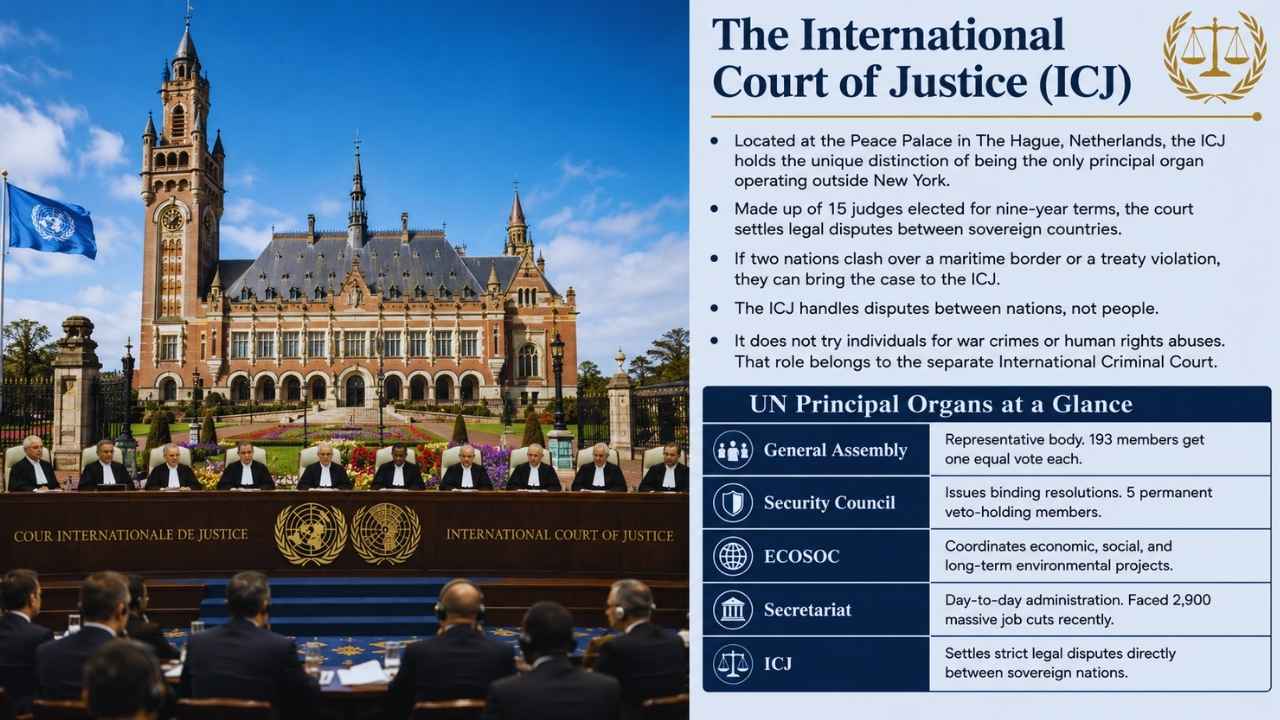 Located at the Peace Palace in The Hague, Netherlands, the ICJ holds the unique distinction of being the only principal organ operating outside New York. Made up of 15 elite judges elected for nine-year terms, the court exists to settle complex legal disputes between sovereign countries. For example, if two nations clash over a maritime border or a treaty violation, they bring the case here.
It is crucial to remember that the ICJ handles disputes between nations, not people. It does not try individuals for war crimes or human rights abuses—that specific duty falls to the entirely separate International Criminal Court.
|
Principal Organ |
Primary Function & 2026 Operational Status |
|
General Assembly |
Representative body. 193 members get one equal vote each. |
|
Security Council |
Issues binding resolutions. 5 permanent veto-holding members. |
|
ECOSOC |
Coordinates economic, social, and long-term environmental projects. |
|
Secretariat |
Day-to-day administration. Faced 2,900 massive job cuts recently. |
|
ICJ |
Settles strict legal disputes directly between sovereign nations. |
Funding the Global Machine: The 3.45 Billion Dollar Question
You simply cannot grasp global politics without talking about the money that keeps the lights on. Running an operation that handles peacekeeping, humanitarian aid, and international law requires a massive, constant cash flow. The UN relies on a notoriously messy mix of mandatory dues and voluntary donations. For 2026, the General Assembly approved a regular budget of exactly 3.45 billion dollars. This figure represents a massive drop—270 million dollars less than the 2025 budget.
The aggressive UN80 reform initiative drove this cut to force the organization into becoming a leaner, more efficient machine. Assessed contributions fund this regular budget. The General Assembly calculates what each country owes using a complex formula based primarily on gross national income, total population, and national debt. Because of its massive economy, the United States pays the highest dues, which are strictly capped at 22 percent of the budget. China follows at 20 percent, while Japan and Germany trail closely behind. However, collecting that cash is an absolute nightmare.
The UN regularly faces severe financial crises because countries pay late or simply withhold their funds entirely. Going into 2026, the organization stared down a staggering 1.586 billion dollars in unpaid dues from member states. Keep in mind, this regular budget only covers administrative costs. They bill the multi-billion dollar peacekeeping operations completely separately, while specialized aid agencies survive almost entirely on unpredictable voluntary donations from governments and private donors.
|
2026 UN Funding Categories |
How It Works & Verified Current Statistics |
|
Regular Budget |
3.45 billion dollars approved for 2026 (a 270 million dollar cut from 2025). |
|
Top Contributors |
US (22%), China (20%), Japan (6.9%), Germany (6.1%). |
|
The Arrears Crisis |
A staggering 1.586 billion dollars in unpaid dues carried into 2026. |
|
Voluntary Funds |
Used for specialized agencies like UNICEF. Highly unpredictable cash flow. |
Specialized Agencies: Boots on the Ground
While the high-stakes political drama happens in New York, the actual physical groundwork happens through the UN’s specialized agencies. This is where you see the tangible, daily results of how the United Nations works out in the field. These agencies operate autonomously. They work within the broader UN ecosystem but manage their own distinct budgets, leaders, and operational rules. The World Health Organization directs international health responses and coordinates massive, cross-border vaccination campaigns.
Meanwhile, UNICEF delivers critical humanitarian aid to children worldwide, focusing heavily on basic education and rapid disaster relief. The World Food Programme stands as the world’s largest humanitarian organization fighting hunger; they are usually the very first trucks rolling into a disaster zone after an earthquake or flood. Finally, financial heavyweights like the International Monetary Fund and the World Bank—though technically part of the UN system—operate completely independently to provide vital loans and stabilize collapsing currencies in developing nations.
Together, these agencies handle the brutal, unforgiving logistics of human survival. Whether they drop metric tons of grain into a famine-struck region or negotiate temporary ceasefires to allow doctors to cross battle lines, they turn diplomatic paper agreements into physical, life-saving action.
|
Specialized Agency |
Primary Real-World Focus and Field Operations |
|
WHO |
Global public health tracking, medical standards, and disease control. |
|
UNICEF |
Emergency child welfare, clean water access, and basic education. |
|
WFP |
Food assistance, famine relief, and logistics in active crisis zones. |
|
IMF / World Bank |
Macroeconomic stability, currency protection, and large-scale loans. |
The Peacekeeping Puzzle: Blue Helmets in Action
When diplomacy totally fails, the UN often sends armed peacekeepers into the fray. But people constantly misunderstand this process: the UN absolutely does not command a massive standing army of its own. It relies entirely on member states to voluntarily provide the troops, police officers, and military gear necessary for its missions. For recent fiscal cycles, the approved peacekeeping budget hovered at approximately 5.6 billion dollars.
These brave forces wear the famous bright blue helmets for visibility but remain official, active-duty members of their home militaries. Interestingly, the wealthy countries that fund the UN the most rarely provide the actual boots on the ground. As of early 2026, the top troop contributors are Nepal, India, Rwanda, and Bangladesh. Nepal alone provides over 4,400 personnel, closely followed by India and Rwanda with over 4,200 troops each.
These nations send thousands of soldiers to physically stand between warring factions and protect vulnerable civilian populations in incredibly dangerous zones. Developing nations often supply these troops because the UN financially reimburses them per soldier, which helps fund and sustain their domestic military infrastructure.
Read Also: Printing Press Impact History: How One Invention Changed Everything
|
Peacekeeping Facts (2026) |
Real-Time Data Points and Current Force Structure |
|
Total Budget |
Approximately 5.6 billion dollars annually. |
|
Top Troop Contributor #1 |
Nepal (over 4,400 personnel actively deployed). |
|
Top Troop Contributor #2 |
India (over 4,200 personnel actively deployed). |
|
Military Structure |
No standing army. All troops come directly from member states. |
Real-World Hurdles and the Call for Reform
No global system operates flawlessly, and the UN takes heavy, entirely justified criticism from all sides. If you want a realistic picture of the organization, you must look at the structural walls it constantly hits. The loudest complaints target the Security Council’s archaic veto power. Allowing just five countries to block any major international action makes the UN incredibly sluggish. We see this constantly when resolutions about major wars get vetoed, leaving the entire international community paralyzed and helpless.
People call for reform every single year, constantly suggesting we add new permanent members like India, Brazil, or Germany to reflect the modern world. But changing these fundamental rules requires the current P5 nations to officially agree to give up their exclusive power, which they flatly refuse to do. Beyond the fierce politics, the bureaucracy itself is famously thick and slow-moving.
The current UN80 reform initiative directly answers angry member states who are demanding a leaner, faster organization. Trimming thousands of jobs hurts the workforce, but many experienced diplomats argue it is the only viable way to stop the UN from collapsing under its own massive administrative weight.
|
Systemic Challenges |
Why It Creates Severe Global Friction |
|
The P5 Veto Power |
Any of the 5 permanent members can entirely block global action. |
|
Financial Instability |
Constant cash flow crises due to 1.58 billion dollars in unpaid dues. |
|
Enforcement Limits |
The GA passes resolutions but cannot legally force strict compliance. |
Final Thoughts
Understanding exactly how the United Nations works means looking far past the polished diplomatic speeches and smiling handshakes. You have to willingly dig into the messy, bureaucratic, and often frustrating reality of global cooperation. It is an incredibly complex machine. It constantly struggles with Security Council gridlock, battles massive billion-dollar funding shortages, and fights relentlessly to enforce its own rules on sovereign nations.
Yet, despite the deep and obvious flaws, it remains the only room in the entire world where 193 sovereign nations can sit down at the same table. From eradicating diseases to deploying thousands of peacekeepers into active war zones, the daily, grueling operations of the UN stop local crises from spiraling into global catastrophes. It isn’t a perfect system by any stretch of the imagination, but right now, it is the only safety net the world truly has.
Frequently Asked Questions (FAQs) About How The United Nations Works
Can a country be kicked out of the UN?
Yes, but it almost never happens. According to Article 6 of the UN Charter, a member state that persistently violates the principles of the charter can be expelled by the General Assembly. However, this requires a recommendation from the Security Council. Because of the veto power, expelling any country that is allied with a P5 member is politically impossible.
What happens if a country ignores a ruling by the International Court of Justice?
ICJ rulings are technically binding, but the court has no police force. If a country ignores a ruling, the aggrieved nation can take the issue to the Security Council, which can authorize sanctions or force. But again, if the offending country has a friend on the Security Council with veto power, the enforcement dies on the floor.
What happens if a country refuses to pay its UN dues?
Under Article 19 of the Charter, if a member state falls two full years behind on its financial contributions, it automatically loses its voting rights in the General Assembly. The Assembly can grant an exception if they decide the non-payment is due to conditions totally beyond the country’s control (like a total economic collapse or natural disaster).
Are people still getting hired at the UN despite the 2026 budget cuts?
Yes, but the landscape has changed. While the Secretariat cut 2,900 core administrative roles to meet the $3.45 billion budget cap, specialized agencies (like WHO or WFP) operate on separate, voluntary budgets and continuously hire field workers, logisticians, and specialists for direct crisis intervention.