
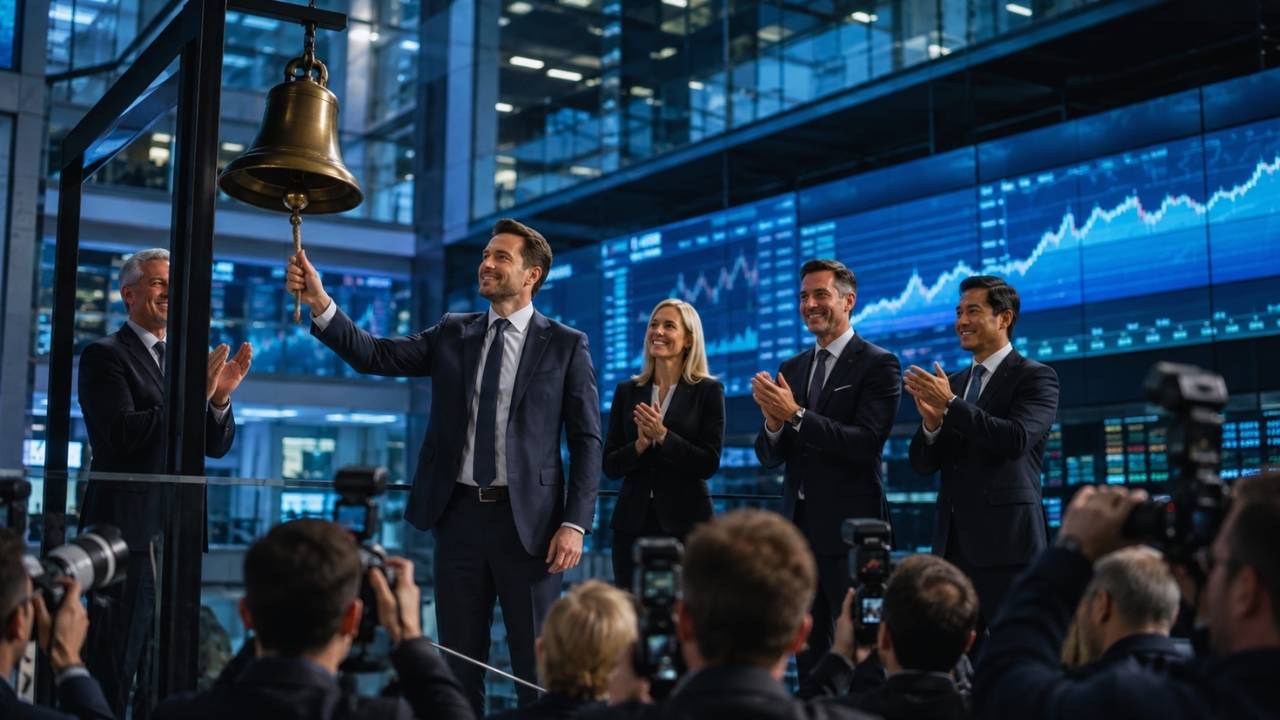
Every few months, Wall Street puts on a big show. Executives in tailored suits stand on a balcony, ring a heavy brass bell, and wave while traders on the floor clap below. That big event usually means a private business just went public.
But when you look past the champagne and television cameras, what is an IPO, and why does it matter to regular people? When a brand you use every day, like a massive tech startup, a fast-food chain, or an electric car maker, debuts on the stock market, it makes headlines worldwide. Yet most people have no idea how a company actually gets there. Going public takes months of grueling legal work, mountains of paperwork, and millions of dollars in fees. Let us strip away the complicated jargon. Here is a straight-talking guide on how private businesses open their doors to the public, what it costs them, the incredible scale of recent market debuts, and what it all means for your money.
What Is an IPO and How Does It Actually Work?
To understand what an IPO is, you have to look at how a company changes its entire financial setup. IPO stands for Initial Public Offering. It is the exact moment a private company creates new stock shares and sells them to the general public for the very first time. Before this happens, the business stays strictly private. A small, exclusive group owns everything, including the original founders, employees who got equity, family members, and early venture capitalists. You cannot simply log into an app on your phone and buy shares in a private company because the doors are locked to the public. The business operates quietly without having to share its financial secrets with the rest of the world.
Once the company completes its initial offering, its stock lists on a major open exchange like the Nasdaq or the New York Stock Exchange. From that second on, anyone with a broker account can buy, sell, or trade those shares. This event permanently changes how the business runs. The company goes from answering only to a small board of directors to answering to thousands, or even millions, of public shareholders. Federal regulators step in and demand total transparency. The business must publish quarterly earnings reports, declare its debts, and admit its biggest risk factors to the public. It is a total transformation from a private venture into a publicly accountable financial entity.
|
Term |
Simple Meaning |
Why It Matters For You |
|
Private Company |
Owned strictly by founders and private investors. |
Keeps its financials a total secret; regular folks cannot buy in or see the books. |
|
Public Company |
Owned collectively by public shareholders. |
Anyone can buy shares, but the company must post quarterly earnings publicly. |
|
Stock Share |
A tiny piece of ownership in a corporate business. |
Gives you a slice of the company profits, potential losses, and voting rights. |
|
Stock Exchange |
A marketplace exactly like the NYSE or Nasdaq. |
Connects stock buyers and sellers around the clock in a heavily regulated space. |
Why Do Private Companies Choose to Go Public?
Going public forces a business to pull back the curtain and show its cash flow, executive salaries, and structural risks to everyone. So why do successful founders willingly take on that extra headache and intense public scrutiny? It usually comes down to three massive benefits: access to cash, payouts for early risk-takers, and corporate status. First off, businesses need serious money to grow. A company might hit a point where it needs billions to build new factories, hire massive engineering teams, or expand overseas. Private venture capital funds can only write so many checks. Selling shares to the public opens a massive firehose of fresh funding.
Early founders and angel investors took a huge gamble when the company was just an idea in a garage. They want to turn those early paper gains into actual cash. Going public creates an open market where those early backers can finally sell their stock and secure their wealth. Furthermore, a public stock ticker gives a company serious clout. Big suppliers trust public firms more, and top executives prefer working for them. Plus, public shares act exactly like cash. If a company wants to buy out a smaller rival, it can simply hand over its own company stock instead of draining its bank account.
|
Pros of Going Public |
Cons of Going Public |
Key Details |
|
Raises huge amounts of cash fast. |
Forces company to publish financial reports. |
Unlocks billions in capital but destroys corporate privacy. |
|
Helps founders sell their shares. |
Founders can lose majority voting control. |
Creates wealth for early backers but dilutes their overall power. |
|
Boosts brand reputation and media coverage. |
Costs millions in bank fees and legal retainers. |
Attracts better talent but requires a massive upfront investment. |
|
Uses stock to buy out rival companies. |
Creates huge pressure for quarterly profits. |
Makes acquisitions easier but forces a short-term business mindset. |
The Massive Financial Costs of Going Public
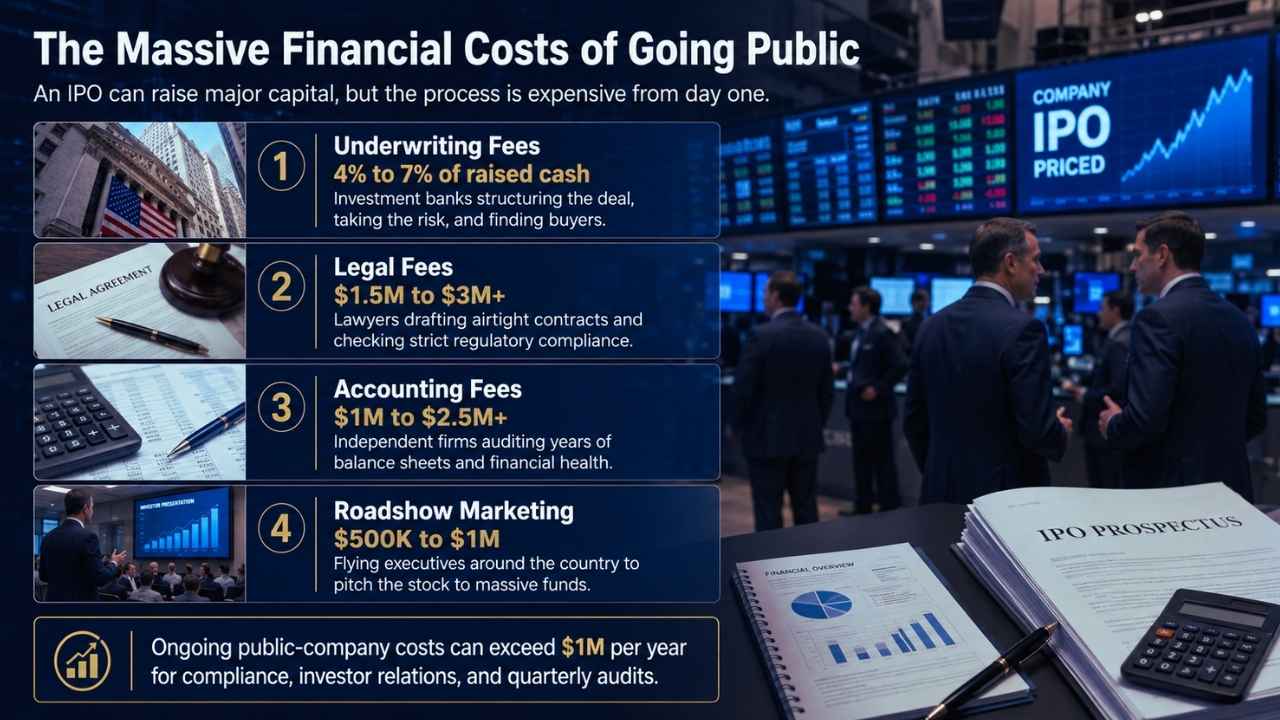
Raising money on Wall Street is definitely not free. In fact, taking a business public is wildly expensive and takes a massive bite out of the capital raised. The investment banks running the deal charge a steep underwriting fee, often called the gross spread. That fee typically takes 4% to 7% right off the top of the money raised. If a firm raises one hundred million dollars, investment bankers can easily walk away with up to seven million dollars before the company sees a single dime. For giant tech companies raising billions, that percentage might drop slightly, but the actual dollar amount handed over to bankers is staggering.
On top of the hefty banker fees, you have to account for towering legal and accounting bills. Companies must hire high-powered corporate law firms and top accounting groups to audit every ledger line and draft documents for federal regulators. That highly specialized work routinely costs between one and a half million to over three million dollars. Even after the launch, staying public drains the bank account. Maintaining legal compliance, funding an investor relations department, and paying for mandatory quarterly audits easily costs over one million dollars every single year. Going public is a massive financial commitment that requires deep pockets from day one.
|
Expense Category |
Average Cost |
What You Are Actually Paying For |
|
Underwriting Fees |
4% to 7% of raised cash |
Investment banks structuring the deal, taking the risk, and finding buyers. |
|
Legal Fees |
$1.5M to $3M+ |
Lawyers drafting airtight contracts and checking strict regulatory compliance. |
|
Accounting Fees |
$1M to $2.5M+ |
Independent firms auditing years of balance sheets and financial health. |
|
Roadshow Marketing |
$500K to $1M |
Flying executives around the country to pitch the stock to massive funds. |
The Step-by-Step IPO Process Every Company Must Follow
Going public absolutely does not happen overnight. It is a long, rigid, and heavily regulated process that takes anywhere from six months to a full year. The first step involves picking the bankers. The company hires major investment banks, like Morgan Stanley or Goldman Sachs, to act as lead underwriters. These banks figure out how much money to raise, set up the deal structure, and legally promise to buy the shares if the market falls flat. Following this, the company enters the due diligence phase. Lawyers and accountants assemble a massive document called the Form S-1 and submit it to the Securities and Exchange Commission (SEC). This document lays out everything from financial records to an honest list of business risks.
Once the SEC clears the paperwork, top executives start pitching. They go on a promotional tour called the roadshow, traveling from city to city to pitch hedge funds, mutual funds, and rich investors to get them excited about buying the stock. The night before the stock starts trading, bankers and executives meet to pick a final initial price per share. If demand during the roadshow was sky-high, they push the price up. If investors seemed lukewarm, they drop the price. The next morning, executives ring the bell on the exchange floor. Trading opens, stock charts start ticking, and anyone with a brokerage account can finally place an order.
|
Phase Name |
Timeline |
Main Goal and Action Required |
|
Prep Work |
6 to 12 months out |
Hire bankers, run internal audits, fix corporate governance, and build a team. |
|
SEC Filing |
3 to 6 months out |
Draft and file Form S-1 with regulators, and answer their strict questions. |
|
The Roadshow |
3 to 4 weeks out |
Pitch massive funds, build buyer interest, and secure big buying commitments. |
|
Pricing & Launch |
1 to 2 days out |
Lock in initial price per share, ring the market bell, and start open trading. |
Real-World Data and Historic IPO Trends in 2025 and 2026
The stock market constantly shifts, and the appetite for new public companies changes every year. For instance, the market saw a massive comeback in 2025. Data shows there were 347 public debuts in 2025, easily beating the sluggish 225 offerings we saw back in 2024. The medical supply giant Medline Inc. led the pack in 2025, shocking the financial world with a massive deal that raised over six billion dollars. It proved that investors were hungry again for solid, profitable companies.
However, market forecasts show that 2026 might completely rewrite the financial record books. Wall Street expects massive tech giants to finally hit the public markets. SpaceX is projected to launch an offering in June 2026 that could raise an unbelievable 75 billion dollars. If this happens, it will easily triple the current all-time record set by Saudi Aramco in 2019, which raised just under thirty billion dollars. Furthermore, leaders in the artificial intelligence space, like OpenAI and Anthropic, are also heavily rumored to file their paperwork by the end of 2026. The sheer scale of capital moving through the markets right now proves that going public remains the ultimate endgame for massive private corporations.
|
Rank |
Company Name |
Year of Debut |
Cash Raised |
Industry Sector |
|
Projected 1 |
SpaceX |
2026 (Expected) |
$75.0 Billion |
Aerospace / Tech |
|
Current 1 |
Saudi Aramco |
2019 |
$29.4 Billion |
Energy / Oil & Gas |
|
Current 2 |
Alibaba Group |
2014 |
$25.0 Billion |
E-Commerce / Tech |
|
Current 3 |
SoftBank Corp. |
2018 |
$23.5 Billion |
Telecommunications |
|
Current 4 |
Ag. Bank of China |
2010 |
$22.1 Billion |
Banking / Finance |
Exploring Alternatives: Direct Listings and SPAC Mergers
Traditional offerings are not the only route to Wall Street anymore. Companies frequently use two alternative methods to bypass standard bankers and save millions in fees. In a direct listing, a firm does not create new shares or raise new money. It simply lets current employees and early investors sell their existing stock directly to buyers on the open market. Brands like Spotify and Slack successfully used this exact trick. It skips expensive underwriting fees, but it will not bring in fresh corporate cash for the company to spend.
Another highly discussed route is the SPAC merger. A special purpose acquisition company is basically an empty shell firm. It lists on the stock market first to raise a large pool of cash without actually selling a product. Then, it actively hunts for a private company to buy. Once it finds a target, the two merge, and the private firm instantly becomes a public entity. This route cuts down on SEC review times and allows companies to make bold future financial predictions. While SPACs exploded in popularity a few years ago, strict new regulations have slowed them down recently, pushing many companies back toward the traditional process.
|
Route Taken |
Best Suited For |
Core Difference and Reality |
|
Traditional IPO |
Companies needing big cash injections. |
Uses bankers to market and create brand-new shares; heavy SEC oversight. |
|
Direct Listing |
Famous brands with plenty of cash. |
Sells existing shares without hiring underwriter banks; raises no new money. |
|
SPAC Merger |
Firms looking for a faster shortcut. |
Merges into an empty, already-traded shell company to bypass normal rules. |
If you want to buy into a hot new tech stock on day one, you absolutely need to temper your expectations. Small-time retail traders rarely get access to stock at the initial offering price set the night before. Investment bankers save almost all those early, discounted shares for their biggest and most lucrative clients. We are talking about massive pension funds, hedge funds, and ultra-wealthy individuals. Unless you have millions sitting in a premium brokerage account, you will likely get completely shut out of the initial allocation.
Main street investors usually have to wait for open trading to start on launch day. By the time you hit the buy button on your phone, the stock price may have already jumped forty or fifty percent above its initial price. Plus, brand-new stocks are notoriously swingy and unpredictable. They can pop wildly in the first two hours and tumble well below their launch price a week later as the hype dies down. Buying on launch day is extremely risky, and smart investors often wait a few weeks for the dust to settle before putting their hard-earned money into a newly public business.
|
Investor Class |
Share Access Level |
How They Actually Buy Stock |
|
Big Institutions |
Excellent |
Buy bulk blocks directly from banks at the set price before public trading. |
|
Wealthy Individuals |
Moderate |
Get small allocations through their elite private wealth brokers. |
|
Retail Investors |
Low |
Must buy on open stock exchanges after public trading officially begins. |
Final Thoughts
Understanding what is an IPO gives you a much clearer view of how huge businesses raise cash and expand their global footprint. Going public is not just a party with falling confetti on a trading floor. It is a high-stakes, stressful transaction where founders swap their total company control for a mountain of liquid capital. The process forces private companies under a federal microscope, compelling them to open their private books to Wall Street’s toughest, most unforgiving critics.
While jumping into a brand-new stock brings heavy volatility and serious financial risk, these launches give everyday investors a rare chance to buy into rapidly growing companies. The landscape is constantly changing, with record-breaking deals hitting the market and new funding methods challenging the old banking systems. Armed with the factual data on banker fees, SEC rules, and historical market timelines, you can watch the opening market bell ring with a much clearer picture of where the money is actually going.
Frequently Asked Questions (FAQs) About what is an IPO
What is the Quiet Period?
Once a company files its S-1 paperwork with the SEC, it enters a federally mandated quiet period. Executives cannot make public forecasts, give hype-filled interviews, or share details not explicitly written in the SEC filing. If a CEO goes on TV and promises massive future profits, the SEC can delay or outright cancel the public debut.
Can insiders dump all their stock on day one?
No. Almost all deals include a “lock-up period” that lasts between 90 and 180 days. Founders, employees, and early venture capitalists are legally blocked from selling their shares during this window. This prevents the market from being flooded with sell orders, which would crash the stock price immediately. Once the lock-up expires, it is common to see a temporary dip in the stock’s price as insiders finally cash out.
What is the Greenshoe Option?
Underwriters have a special tool called the “Greenshoe option” (officially known as an over-allotment option). If demand is incredibly high and the stock price surges, underwriters can legally sell up to 15% more shares than originally planned. Conversely, if the stock price starts falling on its first day, underwriters can buy back shares on the open market to artificially stabilize the price and stop the bleeding.
What is a Dutch Auction?
Instead of bankers setting the price, some companies use a Dutch Auction. Investors submit bids for how many shares they want and how much they are willing to pay. The shares are then sold to the highest bidders until all shares are allocated. Google famously used this method for its 2004 debut to bypass Wall Street’s traditional gatekeepers.