


You just got the keys. The mortgage ink is dry. Moving boxes are stacked everywhere in the living room, and you are officially a homeowner. But tucked inside that massive stack of closing paperwork is a policy you probably barely glanced at: your homeowners insurance. Let us be honest.
We treat home insurance like a chore. We buy it to keep the bank happy, set it on auto-pay, and completely forget it exists. But if a pipe bursts at two in the morning or a freak windstorm tears off your roof, you will suddenly care a whole lot about the fine print. I have seen too many panicked homeowners realize way too late that their policy does not cover what they thought it did.
That is exactly why understanding how homeowners insurance works before disaster strikes is the smartest financial move you can make. It is not just lender red tape. It is the only thing standing between a manageable repair bill and total bankruptcy. Let us cut the jargon and break down the nuts and bolts of standard policies, what insurers actually pay for in 2026, the sneaky exclusions that trap people, and what really happens when you file a claim.
The Basics: Understanding How Homeowners Insurance Works
At its core, a policy is a simple legal contract between you and an insurance carrier. You pay a set amount of money, known as your premium, on a monthly or annual basis to keep the agreement active. In exchange, the insurance company agrees to pay for sudden, accidental damage to your property up to a specific financial limit. However, you do not just get a blank check when something breaks.
You share the financial risk through a deductible, which is the out-of-pocket cash you pay before your insurance coverage kicks in. Say a brutal hail storm wrecks your siding and causes ten thousand dollars in damage. If your policy has a one thousand dollar deductible, you pay the first grand out of your own bank account, and the insurer cuts a check for the remaining nine thousand dollars.
Want a cheaper monthly bill? You can raise your deductible. Just make sure you actually have that cash sitting in the bank if a storm hits. If you have a mortgage, your house acts as the bank’s collateral, meaning they need to know you can rebuild it if it burns to the ground. That is why lenders mandate an active policy and often roll the premium right into your monthly mortgage payment to ensure it never lapses.
|
Term |
What It Actually Means |
Why You Should Care |
|
Premium |
The exact price you pay to keep the policy active. |
If you miss a payment, you lose your coverage entirely. |
|
Deductible |
Your upfront, out-of-pocket share of any filed claim. |
Higher deductibles lower your monthly bills but increase your financial risk. |
|
Coverage Limit |
The absolute maximum cash the insurer will pay out. |
If rebuilding costs more than your limit, you owe the difference. |
|
Peril |
The specific event causing the damage, like fire or wind. |
Policies only pay if a covered peril directly caused the destruction. |
Decoding the 6 Core Coverages
To truly grasp the mechanics of your policy, you need to look at the six standard coverage buckets labeled A through F. Dwelling coverage is the heavy lifter, paying to repair or rebuild the physical structure of your home, including the foundation, walls, roof, and permanently attached fixtures like plumbing. You must set this limit to match local rebuilding costs, not your home’s current real estate market value.
Next, you have Other Structures coverage, which protects detached items on your property like a tool shed, custom gazebo, or in-ground pool, usually capped at ten percent of your dwelling limit. Personal Property coverage handles your actual belongings. Imagine picking up your house, turning it upside down, and shaking it; everything that falls out is covered here. Loss of Use coverage pays your hotel bills and extra food costs if a disaster makes your home uninhabitable during repairs.
Personal Liability coverage acts as your legal shield. If the delivery driver slips on your icy steps and sues you, this coverage pays for their bodily injury and your legal defense. Finally, Medical Payments coverage handles minor injuries fast, paying urgent care bills for injured guests regardless of who was at fault, which helps you avoid nasty lawsuits.
|
Coverage Type |
What It Protects in Your Everyday Life |
Standard Policy Limits |
|
A: Dwelling |
The physical house and attached fixtures. |
Based entirely on local construction and labor costs. |
|
B: Other Structures |
Fences, detached garages, and backyard sheds. |
Ten percent of your Coverage A limit. |
|
C: Personal Property |
Furniture, clothes, electronics, and valuables. |
Fifty to seventy percent of your Coverage A limit. |
|
D: Loss of Use |
Hotel and food costs if you are displaced. |
Twenty percent of your Coverage A limit. |
|
E: Liability |
Lawsuits if you accidentally injure someone else. |
One hundred thousand to five hundred thousand dollars. |
|
F: Medical Payments |
Minor medical bills for injured house guests. |
One thousand to five thousand dollars. |
The Claims Reality: What Actually Breaks?
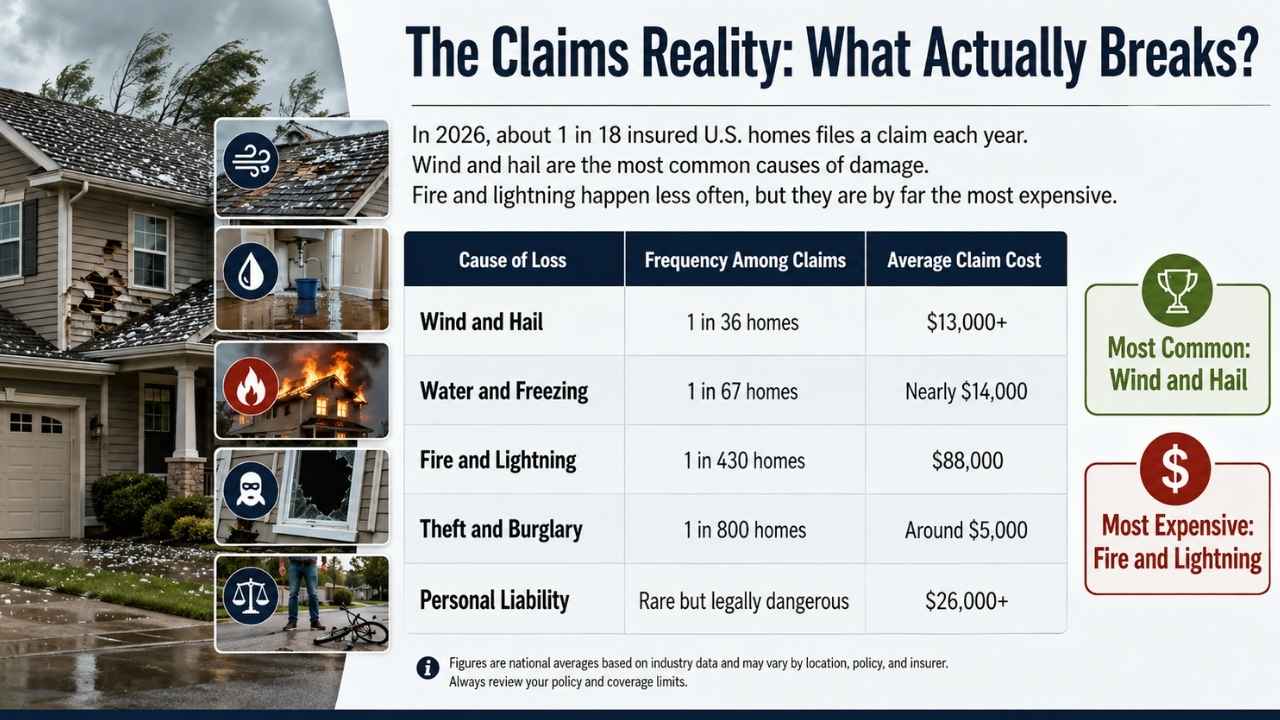
We all worry about a burglar breaking down the back door, but the hard data paints a completely different picture of what actually threatens your home. In 2026, roughly one in every eighteen insured homes in the United States files a claim each year. Wind and hail cause the most frequent damage by a massive margin, making up over forty percent of all claims as severe storms shred roofs and shatter windows.
Water damage from frozen pipes bursting or failed washing machines sits in second place, causing massive headaches for homeowners. But fire is the peril that truly terrifies insurance companies. Fire and lightning claims happen much less frequently, affecting only one in four hundred and thirty homes, but they are devastatingly expensive.
The average fire claim costs an astounding eighty-eight thousand dollars because it completely destroys structures, ruins all your personal belongings, and triggers incredibly expensive, long-term hotel stays. Across the board, the average payout for all property damage claims has climbed past seventeen thousand dollars, driven largely by inflation, labor shortages, and the soaring cost of construction materials.
|
Cause of Loss |
Frequency Among Claims |
Average Claim Cost |
|
Wind and Hail |
Happens to one in thirty-six homes. |
Over thirteen thousand dollars. |
|
Water and Freezing |
Happens to one in sixty-seven homes. |
Nearly fourteen thousand dollars. |
|
Fire and Lightning |
Happens to one in four hundred and thirty homes. |
Eighty-eight thousand dollars. |
|
Theft and Burglary |
Extremely rare, happening to one in eight hundred homes. |
Around five thousand dollars. |
|
Personal Liability |
Rare but legally dangerous. |
Over twenty-six thousand dollars. |
The Fine Print: What Insurers Won’t Cover?
People often assume their insurance policy covers absolutely everything that could possibly go wrong. It does not. Insurers specifically exclude certain risks because they are either too globally catastrophic for one company to handle or entirely preventable with basic routine maintenance. Let us be crystal clear right now: standard home insurance never covers natural flooding.
Storm surges, overflowing rivers, or heavy spring rains backing up into your living room are entirely your financial burden unless you buy a separate policy from the National Flood Insurance Program. The exact same rule applies to earthquakes, mudslides, and sinkholes. Furthermore, insurance is not a home maintenance plan. If your twenty-five-year-old roof leaks during a minor rainstorm, the insurance adjuster will completely deny the claim because you failed to replace a roof that was past its expiration date.
The notorious slow leak rule catches people constantly. If a pipe violently bursts, insurance pays for the cleanup. But if a pipe under your sink drips slowly for six months, rotting the floorboards and breeding dangerous mold, your claim gets thrown out immediately. Pests like termites, rats, and bedbugs are also your problem. You just have to hire an exterminator.
|
Excluded Event |
Why the Insurer Denies It |
The Actionable Fix |
|
Flooding |
Viewed as a widespread, catastrophic regional risk. |
Buy a separate Flood Insurance policy immediately. |
|
Earthquakes |
Too catastrophic for standard shared-risk pools. |
Purchase a specific Earthquake endorsement. |
|
Wear and Tear |
Insurance is not a warranty for old appliances. |
Keep up with regular home maintenance. |
|
Sewer Backup |
Often considered a municipal infrastructure issue. |
Add a Water Backup Endorsement for fifty dollars. |
|
Pest Damage |
Entirely preventable with proactive upkeep. |
Call an exterminator at the first sign of bugs. |
Actual Cash Value vs. Replacement Cost
This is arguably the most critical choice you will make when setting up your coverage. You get to choose exactly how the insurer values your ruined property: Actual Cash Value or Replacement Cost Value. Pick the wrong one, and a bad house fire could ruin you financially for decades. Actual Cash Value is cheaper on a monthly basis, but it violently factors in depreciation. Let us say you bought a beautiful leather sofa five years ago for two thousand dollars, and it burns up.
The adjuster says a five-year-old used sofa is only worth five hundred dollars today. They hand you a tiny check, and when you go to the store to buy a new sofa, you have to pay the fifteen-hundred-dollar difference out of your own pocket. Replacement Cost Value ignores depreciation completely. If that same sofa burns, the insurer checks what a brand-new, similar sofa costs today and hands you the full two thousand dollars.
It costs slightly more per month, but it actually makes you whole. If you live in an area prone to massive hurricanes or wildfires, you also need Extended Replacement Cost. After a regional disaster, local construction costs skyrocket because lumber and contractors become incredibly scarce. This endorsement adds a twenty to fifty percent buffer above your policy limit to cover those sudden price spikes.
|
Valuation Method |
The Payout Math Explained |
Who Actually Needs It |
|
Actual Cash Value |
Pays current value minus years of depreciation. |
Budget-strapped landlords. Avoid for primary homes. |
|
Replacement Cost |
Pays the cost to buy the item brand new today. |
Every single homeowner. This is the minimum standard. |
|
Extended Replacement |
Covers rebuilding costs up to one hundred and fifty percent of the limit. |
Homes located in disaster-prone regions. |
|
Guaranteed Replacement |
Pays whatever it takes to rebuild, regardless of limits. |
Owners of custom, historic, or high-value homes. |
Premium Costs in 2026: What You Pay
Let us talk about money. The 2026 home insurance market is rough. Extreme weather, billion-dollar climate disasters, and crushing inflation have driven rates up nationwide. The national average cost for homeowners insurance now sits around two thousand five hundred and forty-three dollars a year for a home with three hundred thousand dollars in coverage. Between 2020 and 2025 alone, rates climbed a cumulative forty-six percent nationally. But your zip code dictates your reality.
High-risk coastal states are seeing staggering, budget-breaking premiums. Florida currently holds the top spot as the most expensive state, averaging over seven thousand one hundred dollars a year. Louisiana is right behind them at nearly six thousand dollars. Meanwhile, safer inland states enjoy massive breaks. Hawaii boasts the cheapest home insurance in the nation at six hundred and fifty-nine dollars annually, followed by Vermont and New Hampshire.
Beyond location, insurers look incredibly hard at your roof and your personal claims history. If you have a fifteen-year-old asphalt roof, expect severe rate hikes or a canceled policy. If you filed three water claims in the last five years, insurers will flag you as high-risk and jack up your premium without hesitation.
|
The Market Extremes |
Average Annual Cost in 2026 |
Why the Price is So Extreme |
|
Florida (Most Expensive) |
Seven thousand one hundred and thirty-six dollars. |
Massive hurricane exposure and litigation risks. |
|
Louisiana |
Five thousand nine hundred and eighty-six dollars. |
Severe storm surges and coastal flooding threats. |
|
Kansas |
Five thousand two hundred and sixty dollars. |
Relentless tornado and hail damage frequency. |
|
Vermont |
One thousand and sixty-three dollars. |
Mild weather and low overall catastrophe risk. |
|
Hawaii (Cheapest) |
Six hundred and fifty-nine dollars. |
Highly regulated local market and specific building codes. |
Final Thoughts
Protecting your biggest financial asset does not have to be a complicated, stress-inducing nightmare. Fully understanding how homeowners insurance works comes down to three basic principles: knowing your exact financial limits, insisting on replacement cost over actual cash value, and accepting that massive floods and simple wear-and-tear are entirely your responsibility.
Do not leave your home’s protection up to the bare-minimum policy your mortgage broker blindly picked out for you. Grab a cup of coffee this weekend, pull up your declarations page, double-check your deductibles, and make absolutely sure your financial safety net will actually catch you when life inevitably throws a curveball your way.
Frequently Asked Questions (FAQs) About How Homeowners Insurance Works
Does home insurance cover dog bites?
Yes, under Coverage E (Liability). If your dog bites a neighbor, your insurance pays their medical bills and legal settlements. However, many insurers maintain a “restricted breed” list (like Pit Bulls or Rottweilers). If you own one, they may exclude animal liability entirely.
Does my policy cover a backyard trampoline?
Insurers view trampolines and swimming pools as “attractive nuisances.” Some cover trampolines if you install a safety net; others outright refuse to cover any related injuries. Expect to pay a higher liability premium just for owning one.
Will insurance pay if a tree falls on my property?
If a storm blows a tree onto your roof, your dwelling coverage pays to remove it and fix the house. If the tree falls harmlessly onto your empty lawn, the insurer won’t pay a dime for you to chop it up and haul it away.
Are my child’s belongings covered while they are at college?
Usually, yes. If your kid lives in an on-campus dorm, their belongings are protected under your Coverage C, typically capped at 10% of your total personal property limit. If they rent an off-campus apartment, they need a separate renter’s insurance policy.
Is mold damage covered?
Standard policies strictly limit or exclude mold damage. Mold is typically covered only if it directly results from a sudden, covered peril—like a burst pipe. If the mold grew slowly over months due to a neglected leak, your claim is denied.