


Most of us leave our extra cash sitting in a checking or standard savings account at the local bank down the street. It feels familiar and safe, mostly because it is what our parents did. But if you are doing that right now, you are basically handing your money over for free. Standard accounts pay practically nothing.
With inflation continually eating away at your purchasing power, your stagnant cash actually loses real-world value every single day it sits in a checking account. That is exactly why you need a high yield savings account explained without the confusing, dense bank jargon. It is quite literally the easiest financial move you can make this year to protect your hard-earned cash.
Right now, in mid-2026, the market gives savers a massive advantage. The Federal Reserve has held rates steady, which directly impacts how much banks pay you for your deposits. Massive national banks still hand out a measly average of 0.45% to 0.61%. Meanwhile, competitive online banks are fighting tooth and nail for your business by offering yields up to 4.50%. Let us break down exactly what these accounts do, how they outpace inflation, and whether making the switch is a smart move for you today.
What Is a High-Yield Savings Account?
A high-yield savings account (HYSA) is just a regular deposit account with a much faster, far more aggressive engine. You deposit your money, and the bank pays you a significantly higher interest rate on your balance than a traditional brick-and-mortar bank would ever consider offering. We aren’t talking about a tiny, negligible difference. Today’s top accounts pay roughly six times the national average. Big-name banks with massive skyscrapers, marble floors, and ATMs on every street corner spend millions on physical branches and heavy corporate overhead. To cover those massive operational costs, they pay you an incredibly low annual percentage yield (APY). They rely entirely on your laziness, betting that you will not bother to move your money somewhere else.
Online-only banks, fintech companies, and modern credit unions completely flip this outdated model. They do not pay rent for thousands of physical branches or employ an absolute army of tellers. They take those massive savings and pass them directly to you through dramatically higher interest rates. You get the exact same core banking functions you are used to. You can deposit money, transfer funds to your checking account, and watch your balance grow. The only real difference is that your cash actually works for you instead of collecting digital dust.
|
Feature |
Traditional Bank Account |
High-Yield Bank Account |
|
Average APY (July 2026) |
0.45% to 0.61% |
3.80% to 4.50% |
|
Physical Branches |
Yes, highly accessible locally |
Rarely, entirely online access |
|
Maintenance Fees |
Usually charge monthly service fees |
Almost always entirely free |
|
Best Used For |
Immediate, in-person cash access |
Emergency funds and safe growth |
High Yield Savings Account Explained: The Mechanics
To truly get a high yield savings account explained, we have to pull back the curtain on the banking industry. When you deposit cash, the bank does not just lock it in a vault with your name scribbled on a sticky note. They take your money and instantly lend it out, funding mortgages, auto loans, and small business financing for other people. The bank charges those borrowers a high rate and makes a massive profit. In exchange for using your money, the bank pays you a cut of the action. That cut is your APY. Online banks just decide to give you a much larger slice of the pie because they can afford to do so.
The APY you see advertised on the homepage is not locked in forever. High-yield savings accounts feature variable rates. The bank can change your interest rate on a random Tuesday based on the broader economy. This movement is tied directly to the federal funds rate set by the Federal Reserve. When the Fed raises its benchmark rate to fight inflation, borrowing gets incredibly expensive. Banks then aggressively raise the APY on savings accounts to attract your cash. In July 2026, the Federal funds effective rate is sitting right at 3.62%. Because the Fed decided to hold rates steady, HYSAs are still paying out excellent returns right now.
The real wealth-building power here comes directly from compound interest. You earn interest on your initial deposit, and the very next month, you earn interest on the interest you just made. If you put $10,000 into a traditional account earning 0.61%, you walk away with roughly $61 after a whole year. Put that exact same $10,000 in a high-yield account earning 4.15%, and you earn $415. That is hundreds of dollars of free money just for taking ten minutes to download a different banking app.
|
Core Banking Mechanism |
How It Actually Works for You |
|
Variable APY |
Rates fluctuate continuously based on Federal Reserve benchmark decisions. |
|
Compound Interest |
You earn interest on your original deposit plus all previously earned interest. |
|
Fund Lending |
The bank lends your deposits to borrowers and shares the profit yield with you. |
|
Digital Access |
You manage your funds entirely via mobile apps and electronic web transfers. |
Why You Need to Move Your Cash Now in 2026?
The economy is unpredictable, and sticking with a solid cash strategy is more relevant than ever. Following years of wild post-pandemic inflation and aggressive rate hikes, 2026 has shown signs of stabilization, but inflation is still very much a factor. The US Consumer Price Index showed annual inflation running at 3.81% recently. If your money sits in a checking account earning absolutely zero, inflation is actively destroying your wealth, eroding your purchasing power month over month. By locking in a rate over 4.00%, you actually beat inflation and protect your buying power.
If you lock your entire safety net in the stock market, you run the massive risk of having to sell off your investments during a market crash just to pay for an emergency car repair or a medical bill. An HYSA keeps your safety net perfectly liquid and completely secure from terrifying market dips. If you plan to buy a house in a year, pay for a wedding, or take a massive vacation, the stock market is simply too volatile for that tight of a timeline. You need your principal completely protected, and a high-yield account guarantees that protection while still offering growth.
Plus, there is absolutely zero physical effort required. We all want passive income, but real estate and dividend investing require capital, intense research, and active management. With a savings account, you deposit the cash, go to sleep, and wake up slightly richer every single day without lifting a finger.
|
Reason to Open an Account |
The Real-World Financial Benefit |
|
Emergency Fund Storage |
High liquidity lets you grab your cash quickly without facing any penalties. |
|
Short-Term Savings Goals |
Zero risk of losing your original principal balance to wild market swings. |
|
Inflation Hedging |
High yields actively help preserve your actual buying power against rising costs. |
|
Passive Income Generation |
Earn money completely automatically with absolutely no active management. |
Top High-Yield Savings Accounts in July 2026
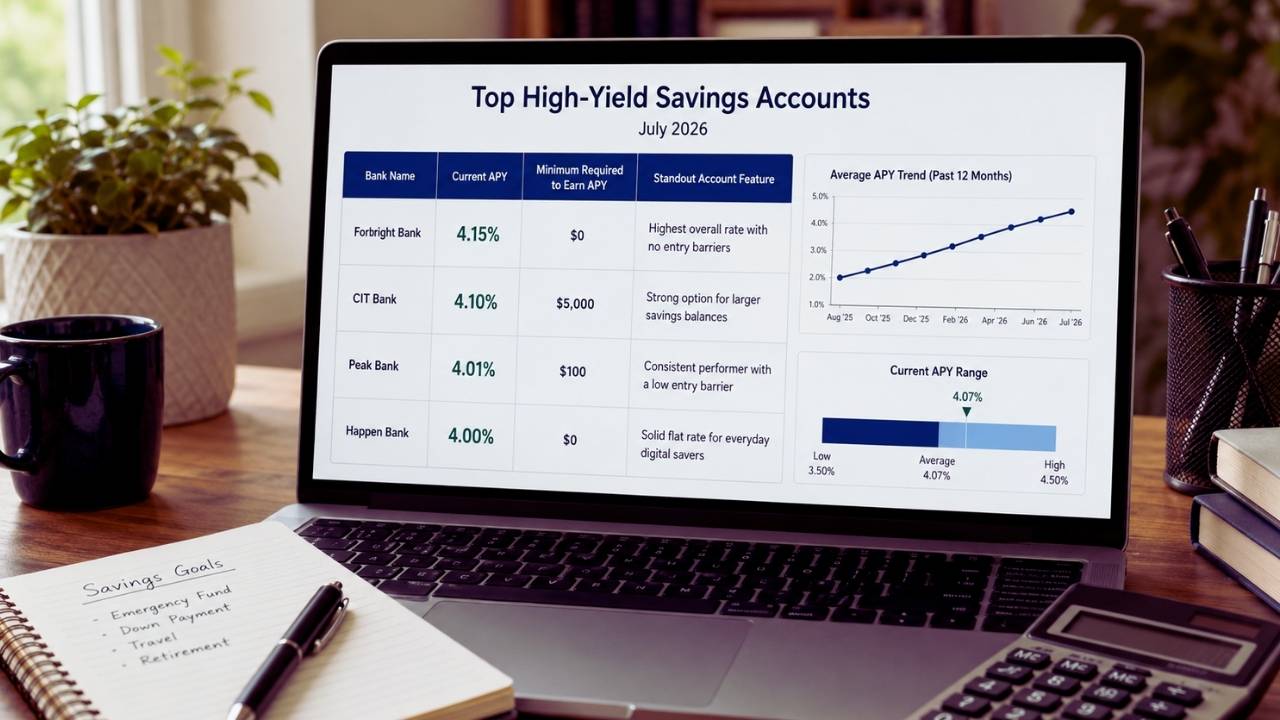
When browsing for the best place to park your cash, you have to look past the flashy numbers and marketing banners. You need to check for hidden minimum balance requirements and sneaky maintenance fees. Some banks use bait-and-switch tactics, offering an incredibly high rate for the first few months before dropping it down to awful levels. Based on July 2026 search data, a few banks stand out as absolute top performers in the space. I have reviewed the current landscape to find accounts that actually deliver on their promises without trapping you in fees.
Forbright Bank is currently leading the pack with an impressive 4.15% APY and absolutely no minimum deposit required to open. This makes it incredibly accessible whether you are depositing $50 or $50,000. CIT Bank offers a very competitive 4.10% APY on their Platinum Savings, but there is a catch. You must maintain a minimum balance of at least $5,000 to earn that top tier, making it better for established savers.
If you are just starting out, Peak Bank is a solid and consistent option offering 4.01% APY with just a $100 minimum deposit. Happen Bank is sitting at an even 4.00% APY, with no minimum deposit required. You just want to make sure the bank you choose has a highly rated mobile app, because you will not be visiting a physical branch to sort out your transfers. Having a high yield savings account explained is great, but picking the wrong app can make the experience incredibly frustrating.
|
Bank Name (July 2026) |
Current APY |
Minimum Required to Earn APY |
Standout Account Feature |
|
Forbright Bank |
4.15% |
$0 |
Highest overall rate with absolutely no entry barriers. |
|
CIT Bank |
4.10% |
$5,000 |
Fantastic option for large, established emergency funds. |
|
Peak Bank |
4.01% |
$100 |
Very consistent performer with a low entry barrier. |
|
Happen Bank |
4.00% |
$0 |
Excellent flat rate for everyday, casual digital savers. |
The Catch: Drawbacks You Cannot Ignore
I like to keep things grounded in reality, and I refuse to pretend these accounts are completely flawless. While these digital accounts are fantastic wealth-building tools, you need to understand their structural limitations before moving your entire life savings over to a mobile app. The biggest issue is transfer delays. Moving money simply takes time. If you keep your checking account at a local credit union but your savings online, transferring funds takes one to three business days. If you face a massive emergency on a Friday night, you might not get that cash until Tuesday morning.
Depositing physical cash is another massive headache. Because online banks do not have physical branches, you cannot just hand a stack of cash to a teller. You usually have to deposit cash into a traditional local bank first, wait for it to clear, and then transfer it electronically to your high-yield account. If you work in a cash-heavy industry like tips-based hospitality, this extra step is incredibly annoying.
Finally, you have to deal with digital-only support. If a transfer gets lost or your account is frozen for a security check, you cannot sit down in a branch manager’s office and demand they fix it. You are entirely reliant on call centers, chatbots, and hold music. If the bank’s customer service team is understaffed, resolving a simple issue can easily ruin your entire afternoon.
|
Drawback Category |
How it Impacts Your Daily Life |
|
Transfer Delays |
Moving cash to a different bank usually takes 1 to 3 business days. |
|
Cash Deposit Friction |
Requires a traditional bank middleman to deposit paper bills. |
|
Variable Interest Rates |
Your interest rate can drop anytime based on Federal Reserve decisions. |
|
No In-Person Help |
Complex issues must be completely resolved over the phone or live chat. |
Are These Accounts Truly Safe?
It feels incredibly risky to send thousands of dollars to an online tech company that you cannot physically walk into. We are conditioned to trust giant stone buildings with security guards. But here is the absolute bottom line: as long as the bank is federally insured, your money is completely safe. This is the most critical thing to check before you ever type in your Social Security number to open an account.
Look for FDIC (Federal Deposit Insurance Corporation) insurance for banks, or NCUA (National Credit Union Administration) insurance for credit unions. This acts as an absolute federal guarantee. Even if the tech startup behind the app goes bankrupt tomorrow, the government backs your deposits up to $250,000 per depositor.
You will not lose a single penny of your cash if the institution fails. Always scroll down to the bottom footer of the bank’s website and look for the “Member FDIC” logo before signing up. If they do not have it, run far away and take your money elsewhere.
|
Insurance Type |
Who It Covers |
Maximum Protection Limit |
|
FDIC Insurance |
Traditional Banks and Online Banks |
$250,000 per individual depositor |
|
NCUA Insurance |
Federal and State Credit Unions |
$250,000 per individual depositor |
|
Joint Accounts |
Married Couples or dual-owners |
Up to $500,000 total ($250k per person) |
Alternatives to Consider
Depending on your specific financial goals, you might want to look at a couple of other highly safe vehicles for your cash. While getting a high yield savings account explained makes it sound like the ultimate financial cure-all, it is not the only game in town.
If you know for a fact you will not touch your money for 12 or 24 months, a Certificate of Deposit (CD) is an incredible option. A CD locks in your APY for the entire term. If the Federal Reserve cuts rates next month, your CD rate stays exactly the same, protecting your high yield. The catch is that if you withdraw early, you pay a harsh financial penalty.
Money Market Accounts (MMAs) act like a hybrid between a checking and a savings account. They offer competitive yields, but they often come with physical debit cards and check-writing privileges. If you want high interest but need easier access to the cash for paying large bills directly, an MMA is a solid compromise. The downside is they usually demand significantly higher minimum balances to avoid punishing monthly fees.
|
Account Type |
Best Feature |
Biggest Drawback |
|
High-Yield Savings |
Easy liquid access to your cash. |
The APY is variable and can drop suddenly. |
|
Certificates of Deposit |
Locked-in, guaranteed interest rate. |
Financial penalties for accessing money early. |
|
Money Market Accounts |
Check-writing and physical debit cards. |
High minimum deposit requirements to avoid fees. |
Final Thoughts
We have covered a massive amount of ground, but I hope you now have the high yield savings account explained in a way that actually helps your wallet. Leaving substantial amounts of cash in a basic bank account earning a fraction of a percent is a massive missed opportunity. You are quite literally letting inflation rob you blind every single day.
With top accounts yielding over 4.00% right now in mid-2026, moving your money lets your savings aggressively outpace inflation. Whether you are building an emergency fund, saving for a down payment, or just trying to maximize your hard-earned cash without taking on stock market risk, an HYSA is an absolute no-brainer. Find a bank with a strong APY, zero monthly fees, and strict FDIC insurance, and let your money finally pull its own weight.
Frequently Asked Questions (FAQs) About High Yield Savings Account Explained
Do I have to pay taxes on the interest I earn?
Yes, absolutely. The IRS treats the interest you earn as taxable income. At the end of the year, your bank sends you a 1099-INT tax form if you earned more than $10 in interest. You report this on your tax return, and it gets taxed at your standard income rate.
Why doesn’t my massive traditional bank match these rates?
They don’t have to. Big banks rely entirely on brand loyalty and physical convenience. They know most customers are too busy to move their direct deposits. Because they have a captive audience, they keep their rates near zero and pocket the profit.
Will applying for an HYSA hurt my credit score?
No. Opening a savings account requires a “soft pull” on your consumer report just to verify your identity. It is not a “hard inquiry” on your credit report and does not drop your FICO score at all.