


You manage thirty loud personalities before most people even finish their first cup of coffee. You stretch non-existent budgets into massive, data-driven projects that keep everyone engaged. You adapt to crazy policy changes overnight, and you constantly analyze performance metrics to adjust your daily approach.
You are a teacher. But if the thought of another school year makes your stomach drop, you aren’t alone. Making a transition from teaching to a corporate career in 2026 is entirely possible, and frankly, it pays incredibly well. Leaving the classroom feels terrifying at first.
You might think you only know how to teach, which is a complete lie. Your daily grind translates perfectly into high-paying business jobs. Companies desperately need people who can break down complex ideas, manage tight deadlines, and lead diverse teams through massive organizational changes. Let’s map out exactly how you can leave the school bells behind, reframe your elite skills, and step into a flexible, lucrative role this year.
Why a Teaching-to-Corporate Career Makes Sense in 2026
The job market heavily favors educators right now, especially as companies scramble to improve employee retention and continuous learning. Recent data from the National Education Association reveals that while the national average public school teacher salary reached $74,495, educators continue to face stagnant wage growth against inflation. Meanwhile, the private sector pays top dollar for the exact skills you use every single day.
The Bureau of Labor Statistics projects an 11 percent job growth for training and development specialists from 2024 to 2034, which is much faster than the national average. A teaching-to-corporate career pivot makes total sense because businesses actively hunt for your ability to manage projects and guide adult learning. You get performance bonuses, fast promotions, and genuine work-life balance. Add in the massive perk of working remotely, and the lifestyle upgrade speaks for itself. You no longer have to ask for permission to use the restroom or spend your entire weekend grading papers for free.
|
Factor |
Classroom Reality (2026 Data) |
Corporate Reality (2026 Data) |
|
Salary Growth |
National average is $74,495 with rigid step scales. |
Performance-based; mid-level roles easily exceed $90k. |
|
Work-Life Balance |
Grading and planning consume nights and weekends. |
Over 90% of instructional designers report healthy balance. |
|
Flexibility |
Strict bell schedules; physical presence mandatory. |
High availability of remote and hybrid work environments. |
|
Job Outlook |
Stagnant real-wage growth due to rising inflation. |
11% projected growth for corporate training roles. |
Top High-Paying Corporate Roles for Former Educators
When you start exploring your options, some corporate roles feel completely tailor-made for educators. You just need to know what job titles to type into the search bar. Instructional design stands out as the ultimate path for former teachers. According to recent market data, the average salary for an instructional designer hit $93,291 per year in early 2026, with senior earners pulling in well over $118,000. If you love building curriculum and creating digital learning materials, you will thrive here using tools like Articulate Storyline.
Alternatively, if you miss the energy of a live room, corporate training allows you to deliver virtual or live sessions to employees, with salaries ranging from $71,000 to over $86,000. Educational technology companies also desperately need customer success managers and product managers to help schools adopt new software. You understand the target audience better than anyone else, making your insider knowledge incredibly valuable.
|
Corporate Role |
Average 2026 Salary |
Best Fit For Teachers Who… |
|
Instructional Designer |
$74,000 – $118,000 |
Love building curriculum, slide decks, and digital modules. |
|
Corporate Trainer |
$71,000 – $86,000 |
Thrive on presenting, public speaking, and running live workshops. |
|
Project Manager |
$80,000 – $120,000 |
Enjoy defining scopes, tracking metrics, and guiding lifecycles. |
|
Customer Success |
$75,000 – $110,000 |
Excel at relationship building, coaching, and client onboarding. |
How to Translate Your Teaching Skills for the Business World
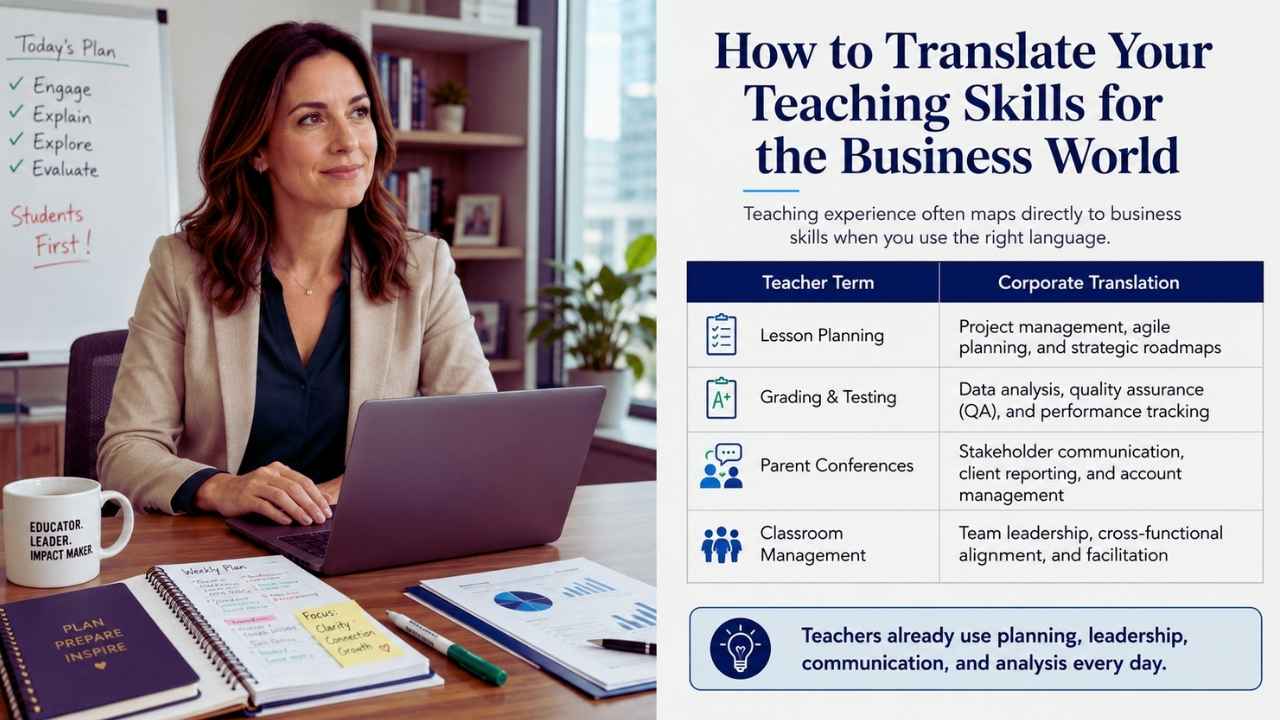 A major hurdle in landing your first business job is the vocabulary barrier. If your resume says you managed an IEP for a fifth grader, a tech recruiter will skip right past your application. You have to speak their language to prove your competence. You don’t just write lesson plans; you define long-term goals, break them down into daily actionable steps, and hit tight deadlines. Businesses call that strategic project management.
Managing thirty teenagers requires negotiation, conflict resolution, and team alignment, which translates directly to team leadership and cross-functional facilitation in a corporate office. When you look at test scores to find learning gaps, you are actively tracking metrics and executing data analysis. You know how to read a room, deliver bad news to stakeholders during parent-teacher conferences, and adjust your strategy when you lose the audience. Companies pay a premium for these exact soft skills.
|
Teacher Term |
Corporate Translation |
|
Lesson Planning |
Project management, agile planning, and strategic roadmaps |
|
Grading & Testing |
Data analysis, quality assurance (QA), and performance tracking |
|
Parent Conferences |
Stakeholder communication, client reporting, and account management |
|
Classroom Management |
Team leadership, cross-functional alignment, and facilitation |
Step-by-Step Guide for Your Transition
Treat this career pivot like a professional repositioning, not just a casual job hunt. You can’t just blast out your teaching resume on job boards and hope for the best. First, you must reskill by learning standard business tools. If you want to be an instructional designer, 86.1 percent of hiring managers expect you to know Articulate Storyline. Next, overhaul your resume by killing every piece of education jargon. Swap words like “students” and “pedagogy” for “users” and “methodology.”
After that, build a digital portfolio showcasing three to four sample projects to prove you can actually solve business problems before they even interview you. Finally, stop sending cold applications and start networking relentlessly on LinkedIn. Reach out to former teachers who successfully made the jump and ask them for a quick virtual coffee. Those casual conversations often lead directly to internal referrals and unlisted job opportunities.
|
Step |
Action Item |
Goal |
|
1. Reskill |
Learn business tools (e.g., Jira, Articulate Storyline, LMS). |
Close the technical gap so you can hit the ground running. |
|
2. Rebrand |
Cut the education jargon from your resume entirely. |
Bypass corporate applicant tracking systems effectively. |
|
3. Build |
Create a digital portfolio with 3-4 sample business projects. |
Prove you can do the work before they even interview you. |
|
4. Network |
Message former teachers on LinkedIn for quick chats. |
Secure internal referrals instead of blind cold applications. |
Overcoming Common Roadblocks During the Transition
Any major life change brings serious friction, and knowing the roadblocks ahead of time keeps you calm when they inevitably pop up. The second you sit down for an interview, imposter syndrome will whisper that you don’t belong in a corporate office. Shut it down immediately. Corporate professionals routinely panic over public speaking and chaotic environments, but you handle that effortlessly before your morning coffee. Many educators also worry they must take a massive pay cut to start at the bottom.
While you might take a lateral move for your very first entry-level corporate job, your earning trajectory skyrockets quickly. A teacher waits ten years for a tiny step increase, but a corporate worker can jump to a new company after two years and secure a massive raise. Finally, prepare for culture shock. Corporate offices give you large blocks of unstructured time, which feels weird at first. Lean into it and focus on hitting your deadlines.
|
Challenge |
The Reality |
The Quick Fix |
|
Imposter Syndrome |
You feel unqualified because your title was “teacher.” |
Track your daily wins. Corporate workers fear public speaking. |
|
Corporate Jargon |
Business acronyms sound like an alien language. |
Read industry blogs. Learn terms like KPI, ROI, B2B, and SaaS. |
|
The Resume Black Hole |
Cold applying yields zero callbacks or interviews. |
Stop blindly applying. Spend 80% of your time networking online. |
|
Culture Shock |
The slower, flexible corporate pace feels totally wrong. |
Enjoy the downtime. Hit your deadlines instead of looking busy. |
Final Thoughts
Building a teaching-to-corporate career takes serious guts and resilience. You leave behind a familiar identity to step into the complete unknown. But the intense stress, the endless weekend grading, and the rigid salary caps don’t have to dictate the rest of your life. Translate your elite communication skills, learn a few new tech tools, and start networking aggressively.
You can absolutely secure a role that respects your personal time and pays you what you are actually worth in the current market. Fix your resume today, build that portfolio, and take the first real step toward a healthier, much wealthier professional life
Frequently Asked Questions (FAQs) About Teaching to Corporate Career
Will I have to work in an office, or can I stay remote?
You have great odds of staying remote. Roles in content strategy, instructional design, and customer success lean heavily toward remote setups. The private sector embraces working from home.
Do I need an MBA to get hired?
Absolutely not. Hiring managers care about execution. A targeted certificate and a killer portfolio easily beat an expensive MBA with zero practical skills.
How do I answer “Why are you leaving teaching?” in an interview?
Play the corporate game. Never complain about the kids, the admin, or the low pay. Keep it professional. Say something like, “I loved my time in education, but I want to focus entirely on adult learning and strategic project execution.”
Are companies actually hiring former teachers right now?
Yes. EdTech companies specifically hunt for former educators to fill sales, product management, and content roles. You understand their target audience better than anyone else. You know the exact pain points of the classroom, making you incredibly valuable.