


Buying a house feels impossible right now. Prices remain high, and inflation eats away at your paycheck every week. You might look at your bank account and think figuring out how to save for down payment funds in two years is a joke. But a 24-month timeline absolutely works if you stop hoping and start executing.
You don’t need a lottery win to get the keys to your new place. You just need a solid blueprint. Think of it like mapping out the layout and keyword strategy for a massive digital publication—you break the big goal down into actionable monthly, weekly, and daily steps. Let’s break down exactly how you can hit your target amount and move into your own home in the next two years.
Calculate Your Exact Target Number
Before you try to save for a down payment, you need a hard number. Vague goals get vague results. You have to know what kind of house you want and what it actually costs in your local market today. In mid-2026, the median U.S. home price reached $440,660. Trying to save 20 percent of that—around $88,000—in two years means stashing over $3,600 every single month. That is not happening for most of us. Here is the real data: the median down payment for first-time buyers is actually just 9 percent.
If you get a conventional loan, you might only need 3 percent. An FHA loan takes just 3.5 percent. Suddenly, a $400,000 house only needs a $14,000 down payment. Spread over two years, you need about $583 a month. You can actually hit that target. Just remember to factor in your closing costs, which generally run another 2 to 6 percent of the loan amount. Bundle those costs into your total goal so you do not get a nasty surprise at the closing table.
Play with the numbers using this calculator to see exactly how different percentages change your monthly savings goal over a 2-year timeline:
|
Loan Type |
Minimum Down Payment |
Estimated Down Payment |
Estimated Closing Costs (3%) |
|
Conventional |
3% |
$12,000 |
$11,640 |
|
FHA |
3.5% |
$14,000 |
$11,580 |
|
First-Time Median |
9% |
$36,000 |
$10,800 |
|
Traditional |
20% |
$80,000 |
$9,600 |
Tap Into 2026 Homebuyer Assistance Programs
You do not have to save every single penny yourself. A really smart way to save for down payment funds is letting a bank or state agency cover a chunk of it. In 2026, tons of programs exist across the country to hand eligible buyers free money. For example, Bank of America offers a down payment grant up to 3 percent of the purchase price, maxing out at $10,000 in select markets.
They also run an America’s Home Grant that gives you up to $7,500 specifically to cover your non-recurring closing costs. You do not have to pay these grants back. Layering these grants with local state housing finance agency programs can wipe out a huge portion of your out-of-pocket cash requirements if you meet the income limits. Start calling local lenders today to see exactly what you qualify for before you start saving aggressively.
|
Program Name |
Maximum Assistance |
Best For |
|
BofA Down Payment Grant |
Up to $10,000 (3% of price) |
Free down payment cash |
|
BofA America’s Home Grant |
Up to $7,500 |
Covering non-recurring closing costs |
|
State Housing Agencies |
Varies widely by state |
Local, targeted assistance |
|
Employer Programs |
Varies by company |
Utilizing corporate benefits |
Restructure Your Budget for Aggressive Savings
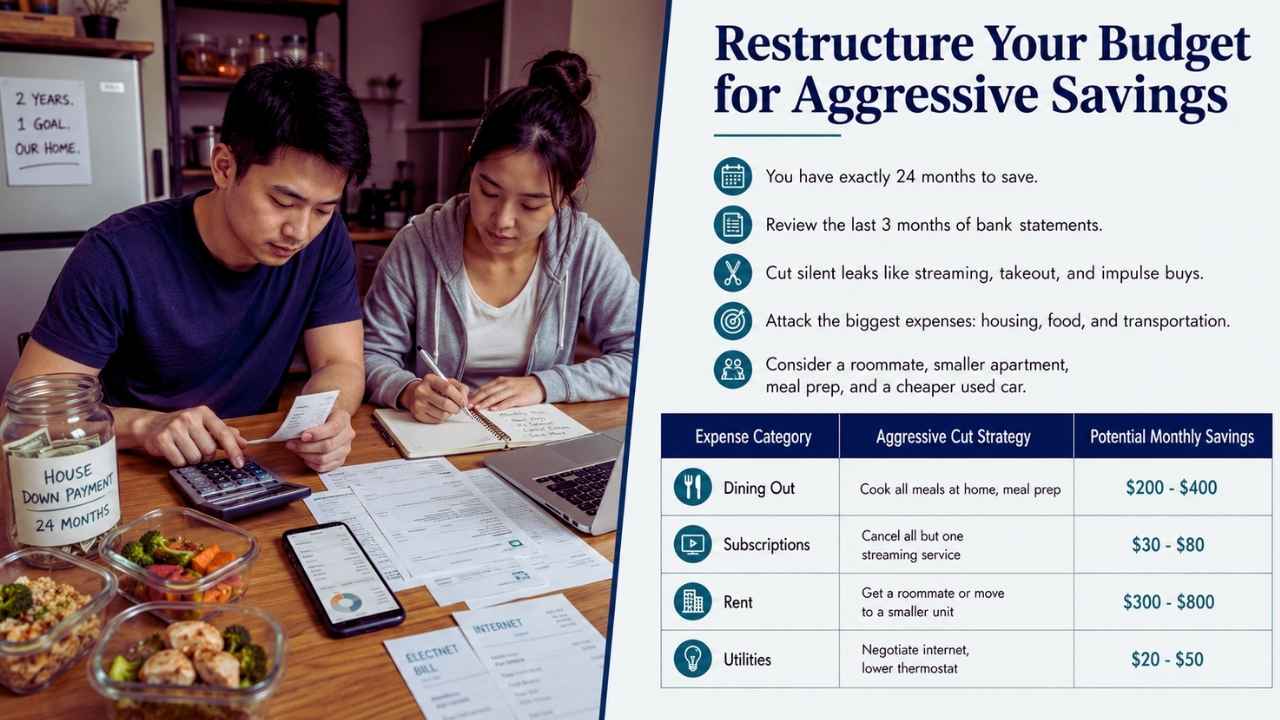 You have exactly 24 months. That means you are entering a temporary season of intense financial focus. Every dollar you do not spend on junk is another dollar you save for down payment. Look hard at your bank statements from the last three months to find the silent leaks. We all have them—forgotten streaming subscriptions, too much takeout, and random online purchases. Cut them all right now.
To make massive progress fast, attack your biggest expenses: housing, food, and transportation. Downsizing your apartment or getting a roommate can free up $500 a month instantly. Stop eating out, meal prep every Sunday, and sell your expensive car for a reliable used one. Remind yourself this austerity is not forever. It is just a two-year sprint to change your living situation permanently.
|
Expense Category |
Aggressive Cut Strategy |
Potential Monthly Savings |
|
Dining Out |
Cook all meals at home, meal prep |
$200 – $400 |
|
Subscriptions |
Cancel all but one streaming service |
$30 – $80 |
|
Rent |
Get a roommate or move to a smaller unit |
$300 – $800 |
|
Utilities |
Negotiate internet, lower thermostat |
$20 – $50 |
Smart Strategies to Save for Down Payment Faster
Where you stash your cash matters almost as much as how much you save. A standard checking account pays practically zero interest, and the national average savings rate sits at a dismal 0.61 percent. Do not leave free money on the table. However, do not put your house fund in the stock market right now. A sudden market drop right before you want to buy a house could ruin your plans completely.
Instead, park your funds in a high-yield savings account. As of mid-2026, top accounts like Forbright Bank offer up to 4.15 percent APY, and others like CIT Bank offer 4.10 percent. Your money grows safely, and the FDIC insures it. If you know exactly when you plan to buy, Certificates of Deposit lock in a great interest rate and stop impulsive spending dead in its tracks.
Read Also: Best Personal Finance Apps in 2026: Honest Comparison
|
Savings Vehicle |
Liquidity (Access to Cash) |
Risk Level |
Best Used For |
|
HYSA |
Very High |
Zero (FDIC Insured) |
Ongoing savings you might need |
|
CD |
Low (Until maturity) |
Zero (FDIC Insured) |
Locking away cash for 12-24 months |
|
S&P 500 Index Fund |
High |
High (Short-term) |
Retirement, goals 5+ years away |
|
Money Market Account |
High |
Zero (FDIC Insured) |
Hybrid checking and savings features |
Increase Your Income Streams
Budgeting only takes you so far. You can only cut your expenses so much before you hit a wall. If you still cannot hit your monthly savings target, you simply have to make more money. Start with your day job. Ask for a performance review and negotiate a raise, or pick up every overtime shift your boss offers. Send every single extra dollar straight to your house fund.
Got a bonus or a tax refund? Send it straight to the bank. The gig economy is perfect for short-term savings sprints. Freelance on the weekends, drive for a rideshare app, or walk dogs. Making an extra $500 a month changes the math completely and gets you to the closing table much faster. If you know digital publishing and SEO, take on freelance writing or consulting gigs on the side.
|
Income Stream |
Effort Required |
Earning Potential |
|
Overtime at current job |
Medium |
Steady hourly rate |
|
Freelance writing/consulting |
High |
$500 – $2,000+ monthly |
|
Rideshare / Delivery |
Low to Medium |
$200 – $800 monthly |
|
Selling unused items |
Low |
Quick, one-time cash |
Track Progress and Maintain Resilience
Saving this much money messes with your head. Around month eight, the excitement wears off, and you get tired of skipping vacations and dinners out. You have to protect your mindset to make it to the finish line. Saving cash is a test of resilience. You do not need a single massive windfall; you just need to keep hitting those daily and weekly targets without losing your focus.
Do not wait until you hit 100 percent of your goal to celebrate. Break your massive number into 10 percent chunks. Acknowledge your hard work every time you cross a new milestone. Treat yourself to a great coffee or a movie night at home to keep your morale up. Watch your account balance grow, trust the math, and keep your eyes entirely on the prize.
|
Milestone |
Action / Reward |
Psychological Benefit |
|
25% Saved |
Review progress, adjust budget |
Proves the plan works |
|
50% Saved |
Start researching neighborhoods |
Builds excitement |
|
75% Saved |
Call a lender for pre-approval |
Makes the goal feel real |
|
100% Saved |
Start touring open houses |
The finish line |
Final Thoughts
You now have the exact roadmap to save for a down payment in 24 months. It takes real work and intense focus. You have to strip your budget down, automate your savings so you cannot touch them, hunt down hidden grants, and hustle on the side. But this sacrifice is completely temporary.
Stick to the math, stay focused at the crease, and two years from now, you will hold the keys to your own front door. Taking the leap into homeownership feels terrifying, but mapping out the journey breaks that fear down into manageable daily actions. Execute the plan, block out the noise, and watch your housing fund grow month over month.
Frequently Asked Questions (FAQs) About Save For Down Payment
If I put down less than 20 percent, can I ever remove Private Mortgage Insurance (PMI)?
Yes. For conventional loans, PMI automatically drops off when you reach 22 percent equity in the home. You can also request to remove it once you hit 20 percent equity. But beware: if you get an FHA loan with less than a 10 percent down payment, the Mortgage Insurance Premium (MIP) stays on for the life of the loan. You have to refinance to a conventional loan later to ditch it.
Does a “piggyback loan” actually help me avoid PMI?
Yes. A piggyback mortgage lets you finance 80 percent of the home with a primary mortgage, take out a second mortgage for 10 percent, and put down 10 percent in cash. Since the primary mortgage sits at 80 percent, you dodge PMI completely. Just remember you will make two separate loan payments every month.
Do I have to pay taxes on cash gifts from family used for a house?
The person giving the gift pays any potential gift tax, not you. For 2026, an individual can gift up to $19,000 per person per year without even reporting it to the IRS. Just know your mortgage lender will demand a signed “gift letter” proving the money isn’t a secret loan.