You hear about the EU all the time. News anchors talk about “Brussels” like it is a single, powerful person making rules about your phone charger or border control. But getting a grip on exactly how the European Union works usually feels like untangling headphones in the dark. It has its own parliament, courts, and cash, yet it isn’t a single country. So, what is it?
We are skipping the heavy political jargon today. Let’s look under the hood of Europe. You will see who actually makes the decisions, how an idea turns into a law that impacts hundreds of millions of people, and what the famous “single market” actually does in real life. If you want to know who holds the real power and why these 27 countries teamed up in the first place, keep reading.
What Exactly Is the European Union?
The European Union is not a super-country trying to swallow up national governments. It operates as a unique supranational club of 27 democratic nations. This means these countries willingly hand over some of their independent power so they can act as a team on the global stage. By teaming up, they get massive economic and political muscle that none of them could build alone.
As of January 1, 2026, the EU holds exactly 452.0 million people. The population spread is wildly uneven across the continent. Germany is the heavyweight with over 83 million citizens. Malta is the smallest, with just over half a million residents. Why start this club in the first place? Look back at the rubble of World War II. European leaders figured out a brilliant hack: if countries tangled up their coal and steel industries, going to war with each other became practically impossible. That simple idea grew rapidly. Today, the modern EU tackles everything from climate change to labor rights.
|
Fact Category |
Current European Union Data |
|
Member States |
27 independent countries |
|
Total Population |
452.0 million citizens |
|
Largest Population |
Germany |
|
Currency |
Euro (used by 21 member states) |
|
Passport-Free Travel |
Schengen Area (29 European countries) |
The Core Institutions: How the European Union Works at the Top?
Meet the main players running the continent. The EU runs on a web of institutions built to balance power carefully. No single country gets to boss the others around. If you want to know how the European Union works behind closed doors, you need to know these four bodies. First, you have the European Council, which acts like a board of directors. The presidents and prime ministers from all 27 countries meet at summits to set the big-picture agenda.
Next, the European Commission serves as the engine room. Based in Brussels, they are the only group allowed to propose new EU laws. Then you have the European Parliament, which acts as your voice. European citizens elect Members of the European Parliament every five years to argue and vote on laws. Finally, the Council of the EU represents the national ministers. If the topic is farming, 27 agriculture ministers show up to review drafts and vote.
|
EU Institution |
Primary Role |
Location |
|
European Council |
Sets broad political direction and priorities |
Brussels, Belgium |
|
European Commission |
Proposes laws and acts as the executive branch |
Brussels, Belgium |
|
European Parliament |
Votes on laws and budgets; represents citizens |
Strasbourg, France |
|
Council of the EU |
National ministers who vote on laws alongside Parliament |
Brussels, Belgium |
Making the Rules: The Law-Making Process Unpacked
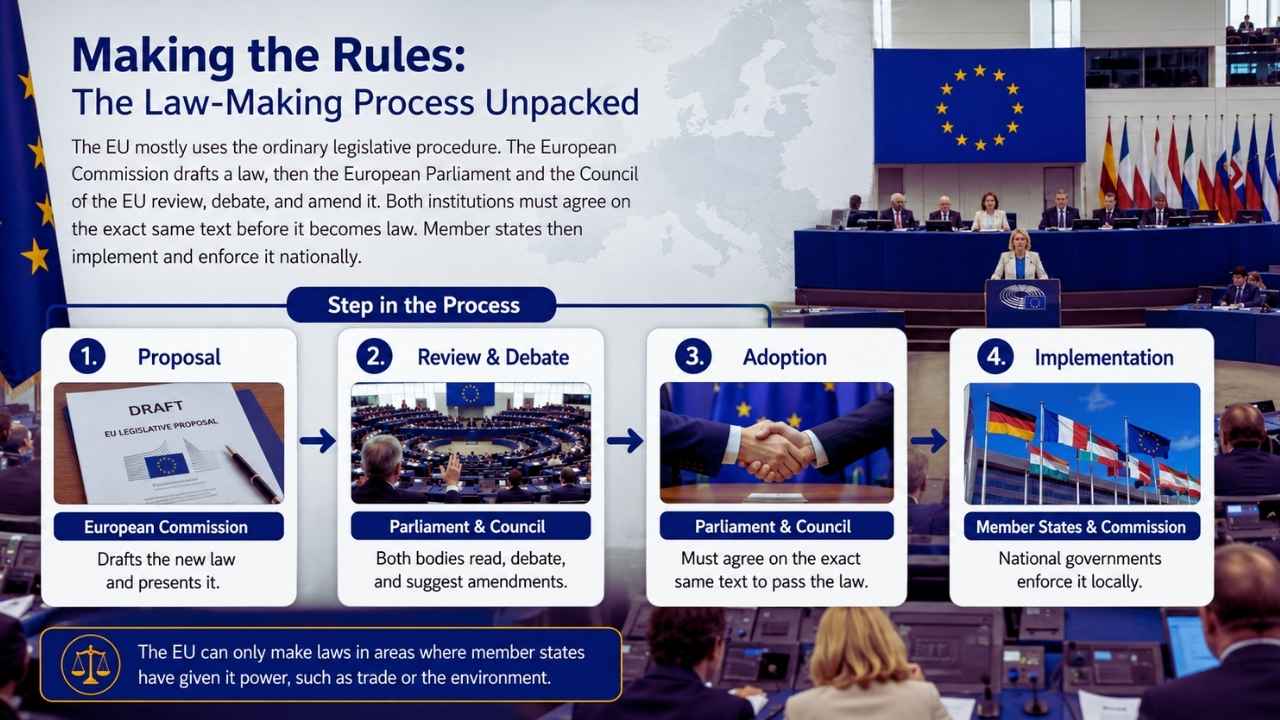 Figuring out how laws get passed is the best way to see how the European Union works in real time. They mostly use something called the “ordinary legislative procedure.” First, the European Commission spots a problem and drafts a solution. Next, that draft goes to the European Parliament and the Council of the EU. Think of them as a two-house legislature.
The Parliament looks out for citizens, while the Council looks out for national governments. They bounce the draft back and forth, slashing and rewriting the text. To pass the law, both sides must agree on the exact wording. If they bump heads, a special committee steps in to hammer out a compromise. Once it passes, member states write the rule into their own national laws. Remember, the EU cannot just make laws about whatever it wants. Countries only give it power in specific areas, like trade or the environment. For local issues like healthcare, national governments keep total control.
|
Step in the Process |
Who is Responsible? |
What Happens? |
|
1. Proposal |
European Commission |
Drafts the new law and presents it. |
|
2. Review & Debate |
Parliament & Council |
Both bodies read, debate, and suggest amendments. |
|
3. Adoption |
Parliament & Council |
Must agree on the exact same text to pass the law. |
|
4. Implementation |
Member States & Commission |
National governments enforce it locally. |
The Single Market, Schengen, and the Eurozone
To really grasp the economic engine of Europe, you need to look at the single market. Before the EU, selling a French shirt in Germany meant dealing with border checks and heavy taxes. The single market killed all that red tape. It treats 27 nations as one massive domestic market running on four freedoms: free movement of goods, services, capital, and people.
Then you have the Eurozone. Out of 27 EU members, 21 use the euro currency. Bulgaria officially adopted the euro on January 1, 2026, dropping the lev and linking its financial system directly to the European Central Bank. We also have the Schengen Area, which abolished physical border checks. The Schengen zone expanded massively when Bulgaria and Romania fully joined on January 1, 2025, officially lifting all internal land border controls. Because of this change, you can literally drive from Portugal to Romania without ever stopping to show a passport.
|
Pillar of the Single Market |
What It Allows |
Real-World Example |
|
Free Movement of Goods |
Products cross borders without tariffs. |
German cars sold easily in Italy. |
|
Free Movement of Services |
Businesses can operate anywhere. |
A Spanish architect designing a house in Sweden. |
|
Free Movement of Capital |
Money can be invested or moved freely. |
Buying property in Greece with French funds. |
|
Free Movement of People |
Citizens can live, work, and study anywhere. |
A Polish student moving to the Netherlands. |
EU Enlargement: The 2026 Waiting List
The EU is an exclusive club, but the doors are definitely not locked. Countries constantly knock on the door trying to get in. Aspiring members have to align their laws, economies, and democracies with strict European standards before getting the keys. The push to expand hit overdrive recently, with several countries racing to close negotiations.
Montenegro leads the pack right now, pushing hard to wrap up their accession talks by the end of 2026. Albania is right on their heels, aggressively closing key negotiation chapters. Meanwhile, Ukraine and Moldova are pushing through their own intense security and foreign policy chapters after opening fresh negotiations. Joining takes years of grueling anti-corruption work and massive structural reforms. However, the massive economic payoff of joining the single market keeps these nations highly motivated to cross the finish line.
|
Candidate Country |
Current Status in 2026 |
Next Major Step |
|
Montenegro |
Leading candidate |
Aims to finish negotiations by the end of 2026 |
|
Albania |
Advanced candidate |
Provisionally closing key negotiation chapters |
|
Ukraine & Moldova |
Opened fresh negotiations |
Tackling external relations and security chapters |
|
Serbia |
Candidate navigating hurdles |
Needs sustained rule of law and reform progress |
Final Thoughts
Seeing exactly how the European Union works reveals a messy, slow, but wildly effective political machine. Getting 27 sovereign nations to agree on anything takes massive compromise and endless debate. Yes, the bureaucracy can feel frustrating and slow-moving at times. But you cannot argue with the results.
The system successfully runs the largest integrated single market on the planet. It keeps the peace on a continent with a deeply violent history, and it gives Europe serious global muscle against other superpowers. Whether you are traveling without a passport across open borders, trusting the strict safety standards on your groceries, or watching global trade negotiations, the EU operates right in the background of your daily life. It is an imperfect system, but it undeniably shapes the modern world.
Frequently Asked Questions (FAQs) About How The European Union Works
What happens if an EU law and a national law clash?
EU law wins. Countries agree to this when they join. If a country ignores a rule, the EU takes them to court and slaps them with massive daily fines until they fix it.
Can a country be in the single market but not in the EU?
Yes. Norway, Iceland, and Liechtenstein do this. They trade freely and accept most EU laws, but they don’t get a vote or a seat at the decision-making table.
Why did the UK leave the EU?
In a 2016 vote (Brexit), the UK chose to leave to take back control of immigration, trade, and local laws. They officially walked away in 2020.
How does the EU spend its money?
The EU has a massive annual budget, but most of it flows right back to the member states. The two biggest expenses are farming subsidies (to keep food secure and cheap) and regional development funds. That second fund goes to poorer regions to build roads and boost economies so they can catch up to wealthier nations.