


It is late at night. You feel a sudden burst of ambition, so you pull out your credit card. You buy a highly rated coding bootcamp or a digital marketing masterclass. You sit through the first three modules, set up fresh digital notes, and feel like you have cracked the code to leveling up your career.
Then, reality hits. You work late on Wednesday. You skip a session. You tell yourself you will catch up over the weekend. The weekend comes and goes. Next thing you know, six months have passed, and that class is just sitting in your bookmarks bar gathering digital dust. If you have done this, do not feel bad at all. You are in very good company. Self-paced digital learning has a notoriously awful completion rate across the board.
Most of us drop out not because we lack talent, but because life gets busy and the initial excitement wears off incredibly fast. Hoarding classes is simply not the same as building real skills. If you want to break the cycle, stop throwing money away, and actually finish online courses, you need a solid system. You need a system that works on your worst, most exhausted days, not just when you ride a wave of motivation.
The Brutal Reality of Digital Learning
The online education industry has completely exploded into a massive, unstoppable beast over the last few years. The global online education market officially reached a staggering valuation of $199 billion in 2026. Millions of people around the world are eagerly buying into the dream of upgrading their skills directly from their living room couches. In fact, over half of US college students took at least one digital class recently, and over a quarter studied exclusively online.
The accessibility of education has never been better in human history. However, there is a very dark side to this booming industry that platforms rarely advertise. The completion rates for self-paced courses remain incredibly low, generally hovering strictly between 12% and 15%. You are fighting a massive uphill battle from the moment you hit the purchase button.
Traditional school systems force you to show up physically and mentally. A professor takes daily attendance, you sit in a physical room completely surrounded by your peers, and there is a real, terrifying deadline with public consequences. Digital courses completely strip away almost all of that necessary social friction. Nobody is checking if you logged in today, tomorrow, or next month. Furthermore, when you pay a small, discounted fee for a masterclass, your brain simply does not feel the painful sting of quitting.
It is entirely different from dropping out of a university where you owe thousands of dollars. You have to actively and artificially create the severe stakes that traditional classrooms provide for free. If you do not build these stakes yourself, you will just keep adding expensive items to your digital graveyard of entirely abandoned projects.
|
Metric |
Traditional Classroom |
Self-Paced Online Course |
The Underlying Reason |
|
Completion Rate |
70% to 85% |
12% to 15% |
Low financial stakes make it extremely easy to walk away without any lingering guilt. |
|
Daily Schedule |
Fixed days and strict times |
Completely open and flexible |
Saying “Whenever I have free time” almost always turns directly into “I will do it never.” |
|
Social Pressure |
High pressure from peers and teachers |
Zero pressure from anyone |
Nobody knows or cares if you decide to quit in the middle of module two. |
|
Immediate Feedback |
Fast responses via office hours |
Rare or fully automated |
Getting stuck on one single bug can stall your progress for several weeks. |
The Mental Traps That Make Us Quit
Quitting a new class rarely happens in a dramatic, intentional moment. It is usually a very slow, quiet fade. You run into some mental friction, you get deeply frustrated, you put the lesson off for a day, and you simply never return. Psychologists call one of the biggest culprits behind this behavior the planning fallacy. We naturally and consistently underestimate exactly how long hard tasks will take to complete.
You might read a syllabus line like “Introduction to Data Structures” and think you can knock that out in exactly 45 minutes. Two hours later, you are still wrestling with the very first setup step, feeling completely defeated. That massive gap between what you expected and the harsh reality immediately kills your drive. You start to feel like you are just not smart enough, even though the initial time estimate was the only thing that was wrong.
Another massive trap you will fall into is severe cognitive overload. When an instructor talks continuously for 45 minutes in a single video, your brain naturally tunes out after the first ten minutes. Educational research shows that we forget a massive chunk of newly presented information within a single hour if we do not immediately apply it to a problem. Sitting back on your sofa and watching video after video gives you a false, comforting illusion of learning.
But without engaging in real, difficult practice, absolutely nothing actually sticks in your long-term memory. You end up feeling overwhelmed by the sheer volume of notes you took, but you possess zero practical skills. You have to stop treating digital education like a streaming binge and start treating it like a physical workout.
|
The Mental Trap |
How It Shows Up in Real Life |
The No-Nonsense Fix You Need |
|
Planning Fallacy |
You assume a hard coding module takes 30 minutes; it actually takes over two hours. |
Multiply your initially estimated study time by at least 2.5 right from the start. |
|
Binge Watching |
Watching three straight hours of video lectures without ever opening a project file. |
Pause the video every 10 minutes to physically test or write down what was just covered. |
|
Shiny Object Syndrome |
Buying a brand new, exciting class before finishing even half of your first one. |
Put a strict, unbreakable ban on new purchases until you submit a final project. |
|
The Midpoint Slump |
Hitting week three when the novel excitement completely dies and boredom sets in. |
Drop down to 5-minute daily micro-sessions just to keep your habit streak alive. |
How to Actually Finish Online Courses with a Friction-Proof Routine
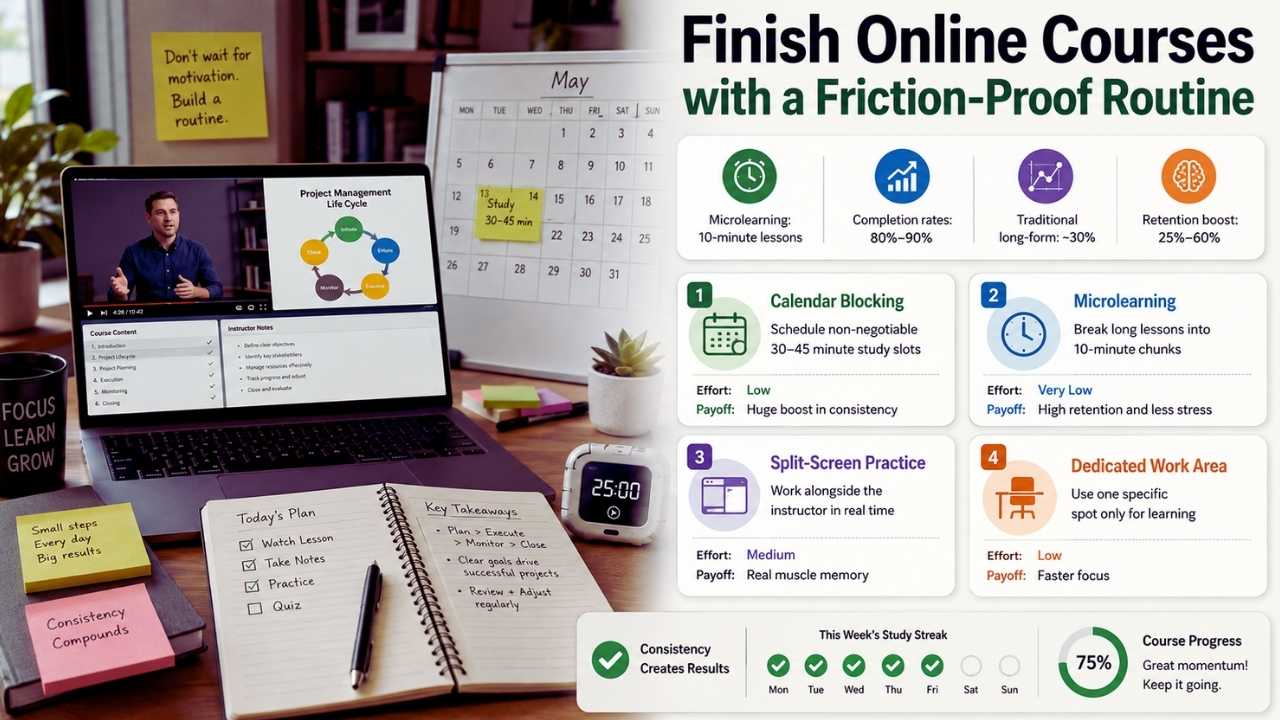
Hoping you will eventually “find free time” to study is a completely losing strategy. You do not magically find free time during a busy work week; you have to aggressively carve it out. If you want to finally finish online courses, you desperately need a daily setup that relies on simple, repeatable habits instead of your raw willpower. Willpower completely runs out by 6 PM after a long day of dealing with emails and meetings. Habits, on the other hand, keep going on autopilot.
First, treat your dedicated study slot exactly like an unmovable meeting with your absolute boss. If it is not placed securely on your digital calendar with a set, specific time, it simply will not happen. Pick two or three 45-minute blocks during your week, set a loud alarm, and treat that block of time as completely non-negotiable.
Stop waiting for a perfectly clear four-hour block on a Saturday afternoon. Life will always get in the way and ruin those plans. Instead, use the small, hidden pockets of time sprinkled throughout your day. Data shows that microlearning programs—breaking material into bite-sized chunks—massively boost course completion rates to between 80% and 90%, compared to roughly 30% for traditional, long-form lectures. Furthermore, microlearning actively improves your knowledge retention by 25% to 60% because your exhausted brain actually has time to digest the material properly.
The average microlearning lesson takes just 10 minutes to complete. Watch one quick lesson on your lunch break or review some flashcards on your morning commute. Small, steady progress runs circles around exhausting weekend binge sessions. Make sure you use an action-first setup, too. Split your computer screen: put the tutorial video on one side and your active workspace on the other, pausing constantly to copy the steps yourself.
|
Study Tactic |
What It Actually Means |
Required Effort Level |
The Ultimate Payoff |
|
Calendar Blocking |
Scheduling entirely non-negotiable 30 to 45 minute study slots on your phone. |
Low |
Huge boost in consistency |
|
Microlearning |
Breaking 1-hour lectures into 10-minute chunks to improve retention by up to 60%. |
Very Low |
High retention and less stress |
|
Split-Screen Practice |
Working directly alongside the instructor’s video lesson in real time. |
Medium |
Real muscle memory is built |
|
Dedicated Work Area |
Keeping one specific physical spot in your home only for focused learning. |
Low |
Your brain focuses faster |
Social Accountability: The Secret Weapon to Finish Online Courses
Studying completely alone in a quiet, dark room gets incredibly lonely very fast. When you hit a massive roadblock or a confusing concept, the easiest path in the world is simply closing your laptop and turning on a movie. You desperately need an external, social reason to keep going when things get tough. This is exactly why the e-learning world is shifting heavily toward active community learning. A traditional self-paced course leaves you entirely on your own to sink or swim.
An engaged community sets hard weekly deadlines, includes lively discussion sessions, and provides immediate answers. We know that 70% of learning and development teams plan to leverage social learning platforms in 2025 because peer pressure absolutely works. In fact, 50% of university students who actively engaged in social interactions completed their course, compared to a much lower rate for isolated learners.
You do not have to spend thousands of dollars on an expensive live boot camp to get these massive benefits. You can easily build your own accountability network for absolutely free. Almost every single major digital class has an active Discord server, Slack workspace, or Reddit forum attached to it. You need to join it on day one. When you inevitably get stuck on a confusing assignment, ask for help immediately.
Seeing dozens of other people hit the exact same problems reminds you that feeling stuck is just a normal part of the learning curve, not a sign you should quit. If that is not enough, put some real financial stakes on the table. Tell a trusted friend that you are finishing module four by Sunday at 6 PM. If you do not send them your completed project files, you owe them $50. Having real skin in the game changes your lazy mindset overnight.
Read Also: How to Get Into AI and Machine Learning Careers in 2026
|
Learning Format |
The Core Structure |
Average Completion |
Who It Is Best Suited For |
|
Self-Paced Learning |
Pre-recorded videos, absolutely no hard deadlines, solo work. |
12% to 15% |
Highly self-disciplined learners on a very tight budget. |
|
Microlearning Focused |
Bite-sized lessons taking only 10 minutes each. |
80% to 90% |
Busy professionals wanting up to 31% higher ROI on their time. |
|
Social / Cohort Based |
Group projects, strict deadlines, peer pressure. |
Significantly Higher |
Learners who absolutely thrive on peer interaction and structure. |
|
Self-Built Study Group |
Self-paced material strictly paired with a friend or forum. |
Moderate to High |
Anyone wanting high completion rates without paying high costs. |
Pre-Flight Checklist: Before You Hit “Buy”
Most digital courses completely fail before the very first welcome video even plays. We tend to buy things for our idealized, perfect future self rather than who we actually are right now. If you are already working 50 hours a week and feeling constantly exhausted, buying an intensive 80-hour machine learning boot camp is setting yourself up for guaranteed burnout.
Before you spend a single dollar, run the curriculum through an honest, brutal filter. Start with a tiny micro-win. If you have a massive trail of half-finished classes behind you, do not jump into a massive 50-hour specialization immediately. Grab a completely free 2-hour mini-course on YouTube first. Build something small, finish it completely, and get that confident win under your belt. Rebuilding your own self-trust as a capable student is literally half the battle.
Write down exactly what finishing this specific course lets you do in the real world. Avoid vague, terrible goals like wanting to learn web design. Instead, write down that you will build and successfully launch a three-page freelance portfolio site by the end of the month. Write that specific target on a brightly colored sticky note and stick it right to the edge of your computer monitor. When module four gets dry, boring, and highly theoretical, you will have a clear, visual reminder of exactly why you started this journey.
Do not forget to leverage modern tools, either. A massive 86% of students used AI tools in 2024 to 2025 for their learning. You can use AI to break down complex concepts from the course that the instructor failed to explain clearly. Having a concrete finish line and the right tools is how you genuinely finish online courses instead of endlessly collecting digital certificates you never actually use.
|
Pre-Purchase Filter Item |
What You Must Ask Yourself |
The Red Flag Warning Sign to Watch For |
|
Prerequisites check |
Do I actually know the required foundational tools? |
Thinking to yourself, “I will just quickly figure out basic JavaScript as I go.” |
|
Time Audit check |
Do I honestly have three open hours a week for a month? |
You are already skipping sleep, meals, or the gym just to keep up with life. |
|
Instructor Teaching Style |
Did I watch at least 10 minutes of a free preview video? |
Their pacing, dry tone, or terrible audio setup annoys you within two minutes. |
|
Portfolio Output value |
Does the final assignment produce a real, usable project? |
The assignments are just pointless multiple-choice quizzes that prove nothing. |
Final Thoughts
The booming digital learning industry heavily thrives on enthusiastically selling the beautiful fantasy of an instant career transformation, while completely ignoring exactly how hard it is to study alone after a long workday. But you absolutely do not have to stay stuck in the endless, expensive cycle of buying classes and abandoning them a week later. The next time you desperately want to finish online courses, leave fleeting motivation entirely out of the equation.
Motivation is incredibly unreliable on a rainy, busy weeknight when your couch looks comfortable. Instead, take complete control by building a simple, unbreakable schedule. Find a peer or a digital community to keep you incredibly honest. Make daily, stubborn progress in small, bite-sized ten-minute steps that do not overwhelm your brain.
The valuable skills and massive career growth you are chasing are waiting right at the end of the course. You just need to show up consistently for 15 minutes at a time, push through the boring parts, and actually build the projects. Stop buying new classes today, open up the one you abandoned last month, and get back to work.
Frequently Asked Questions (FAQs) About Finish Online Courses
Is it fine to skip lessons I already understand?
Yes. It’s your education, not a legal deposition. If module two spends an hour explaining basic spreadsheet formulas you’ve used for five years, skip straight to module three. Forcing yourself to sit through material you already know leads straight to boredom, and boredom leads to closing the tab.
What should I do when software in the video is outdated?
This happens all the time with web development, design tools, and data packages. Don’t panic and don’t quit. Treat it like a real-world job challenge. When a button or command from the lecture doesn’t work in your updated version, spend five minutes searching the current documentation or forums. Figuring out those minor version discrepancies is exactly how professionals work every day.
If I fell behind by three weeks, should I restart from lesson one?
No. Starting over from scratch is a perfectionist trap that almost guarantees you’ll quit again at the exact same spot. Pick up right where you left off. If you feel rusty, watch the last five minutes of the previous video at 1.5x speed to refresh your memory, then dive straight into the next exercise.
Do employers care about completion certificates?
In modern fields like tech, copywriting, UI/UX design, and digital marketing, hiring managers rarely care about a generic PDF certificate. What they care about is what you built. Focus your energy on completing the course’s capstone project so you have a tangible, working example to share in your portfolio or interview.